Omega Aqua Terra Buying Guide: A Quiet Datejust Alternative
Sizes, movements, real 2026 pricing, and an honest look at how the Omega Seamaster Aqua Terra stacks up against a Rolex Datejust for everyday wear.
Price context: this guide includes indicative prices from its original publication period. They have not all been refreshed to current quotes. Use the linked primary sources for specifications and policies, and verify prices independently.

- The Aqua Terra 150M runs from about $5,600 (38mm) to $7,600 (43mm GMT Worldtimer), with a two-tone gold-and-steel model near $10,200
- Every current Aqua Terra is a METAS-certified Master Chronometer, resistant to magnetic fields up to 15,000 gauss
- Versus a Rolex Datejust 41 ($9,650), the Aqua Terra 41 saves roughly $4,000 and offers more water resistance and stronger anti-magnetism, but resale is materially weaker
- Pre-owned steel Aqua Terras typically trade at 65-78% of retail, roughly $3,800-4,600
- The symmetrical case, teak-pattern dial, and 150m water resistance make it a true one-watch-for-everything option
What Is the Omega Seamaster Aqua Terra?
The Omega Seamaster Aqua Terra occupies a strange and useful space in Omega’s catalogue. It carries the Seamaster name, which most people associate with dive watches and James Bond, yet it has no rotating bezel, no dive extension, and no oversized crown guards. Omega introduced the Aqua Terra in 2002 specifically to answer a question divers’ watches don’t: what do you wear to the office on Monday and to a boat on Saturday without changing watches?
The current generation, launched in 2017, refined the formula without abandoning it. The case is symmetrical — no crown guards, straight lugs, a slim bezel — which gives the Aqua Terra a dressier silhouette than the Seamaster Diver 300M despite sharing the same 150m water resistance rating on most references. It sits in the space between a true diver and a formal dress watch, and that middle ground is exactly why so many buyers land on it as a one-watch solution.
For readers weighing an Aqua Terra against the rest of the Seamaster family, the short version is this: the Diver 300M and Planet Ocean are built around water sports, and the Aqua Terra is built around versatility. If you want one watch you can wear with a suit, a t-shirt, or a wetsuit, this is the model in Omega’s lineup designed for exactly that brief.
The Complete Aqua Terra Lineup
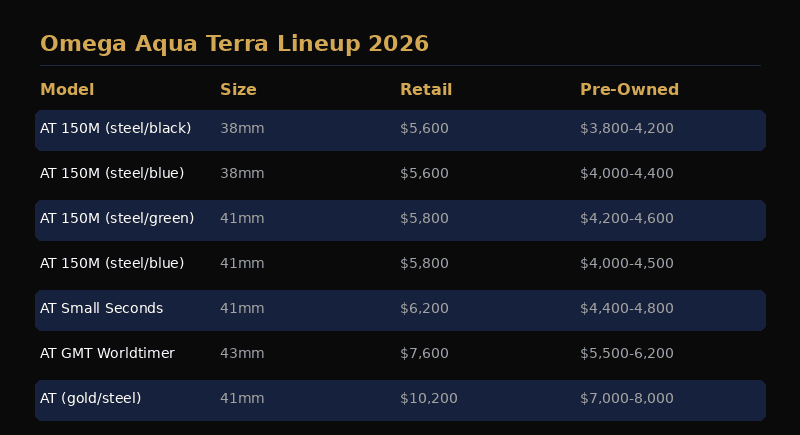
The Aqua Terra 150M line has grown into several distinct configurations since the 2017 redesign. Here is every current variant with its size, movement, and 2026 retail pricing.
| Model | Size | Movement | Retail | Pre-Owned |
|---|---|---|---|---|
| AT 150M 38mm | 38mm | Cal. 8800 / 8900 | ~$5,600 | $3,800-4,200 |
| AT 150M 41mm | 41mm | Cal. 8900 | ~$5,800 | $4,000-4,500 |
| AT Small Seconds | 41mm | Cal. 8913 | ~$6,200 | $4,400-4,800 |
| AT GMT Worldtimer | 43mm | Cal. 8916 / 8938 | ~$7,600 | $5,500-6,200 |
| AT Gold/Steel | 41mm | Cal. 8900 | ~$10,200 | $7,000-8,000 |
The 38mm is the entry point, and it runs either the Calibre 8800 (55-hour power reserve) or the Calibre 8900 (60-hour power reserve) depending on the specific reference and dial. Both list around $5,600 at retail. It wears smaller and slightly dressier than the 41mm, and it’s the size Omega markets toward buyers who want a genuinely compact everyday watch rather than a sports-diver silhouette shrunk down.
The 41mm on a steel bracelet is the volume seller in the range, priced at roughly $5,800. It runs the Calibre 8900 exclusively, giving it the full 60-hour power reserve and the complete METAS Master Chronometer certification. This is the reference most people picture when they say “Aqua Terra.”
The 41mm Small Seconds swaps the standard three-hand layout for a sub-dial at six o’clock, running the dedicated Calibre 8913. At around $6,200, it’s a modest premium over the standard 41mm for a genuinely different dial layout rather than just a cosmetic variant.
The 43mm GMT Worldtimer is the complicated end of the range, built around the Calibre 8916 or 8938 depending on the specific reference, both offering a second time zone display and a rotating 24-hour city ring. At roughly $7,600, it’s aimed at frequent travelers who want the Aqua Terra’s everyday versatility with an actual GMT function rather than a dedicated dive or dress complication.
At the top of the range sits the two-tone gold-and-steel 41mm, priced near $10,200. It uses the same Calibre 8900 movement as the standard steel 41mm, so the added cost is entirely in the 18K Sedna gold case and bracelet components rather than any mechanical upgrade.
Movements and Master Chronometer Certification
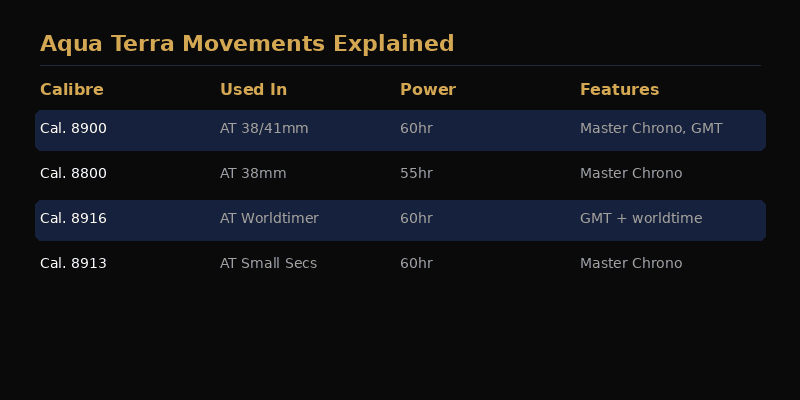
Every current Aqua Terra, regardless of size or configuration, carries Omega’s Co-Axial Master Chronometer designation. That means each watch is tested not just to COSC chronometer standards, but also by METAS — the Swiss Federal Institute of Metrology — for accuracy, power reserve, and resistance to magnetic fields up to 15,000 gauss. For context, most mechanical watches, including the majority of Rolex references, are not rated anywhere near that level of magnetic resistance.
In practical terms, that anti-magnetic rating matters more than it sounds. Everyday exposure to laptops, phone cases with magnetic clasps, induction chargers, and speaker magnets is one of the most common causes of a mechanical watch running fast or stopping intermittently. An Aqua Terra shrugs off all of that without a second thought, which is one reason it has quietly built a reputation among watch enthusiasts as one of the most trouble-free mechanical watches you can buy at this price point.
The movement lineup breaks down by model: the 38mm uses either the Calibre 8800 (55-hour reserve, no display back) or Calibre 8900 (60-hour reserve, exhibition case back) depending on the reference; the 41mm standard model uses the Calibre 8900 exclusively; the 41mm Small Seconds uses the dedicated Calibre 8913; and the 43mm GMT Worldtimer uses either the Calibre 8916 or the newer 8938. All are automatic, all are chronometer- and METAS-certified, and all use Omega’s silicon Si14 balance spring, which is unaffected by magnetism at the component level.
Dial Colors and the Teak Pattern
The single most recognizable design element of the Aqua Terra is its horizontal “teak” stripe pattern, a dial finish inspired by the teak decking used on classic sailing yachts. It has appeared on every generation of the Aqua Terra since 2002 and remains the line’s visual signature — the detail that lets someone identify an Aqua Terra across a room even without seeing the case shape.
Current dial colors include blue, green, black, silver, and white, with the exact palette varying slightly by size and reference. The blue and green dials have proven especially popular and tend to command a small premium over black or silver on the pre-owned market, a pattern that echoes what happens with colored-dial Rolex references as well.
Beyond dial color, the Aqua Terra is available on a steel bracelet, leather strap, or rubber strap, which adds another layer of customization most buyers don’t get with an equivalent Rolex reference. A leather-strap Aqua Terra reads noticeably more formal than the same watch on a bracelet, which reinforces just how much range this one model covers.
Aqua Terra vs Rolex Datejust: The Real Comparison
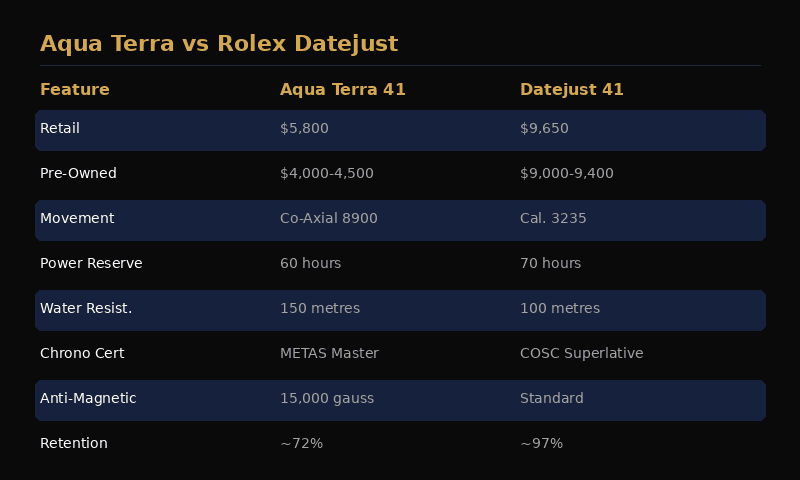
The Aqua Terra’s closest rival isn’t another Seamaster — it’s the Rolex Datejust. Both are steel, everyday, three-hand watches with broad appeal and no single obvious use case. Here’s how the two actually compare, spec for spec.
| Feature | Aqua Terra 41 | Datejust 41 |
|---|---|---|
| Retail | $5,800 | $9,650 |
| Pre-Owned | $4,000-4,500 | $9,000-9,400 |
| Movement | Co-Axial Cal. 8900 | Cal. 3235 |
| Power Reserve | 60 hours | 70 hours |
| Water Resistance | 150 metres | 100 metres |
| Chronometer Cert | METAS Master | COSC Superlative |
| Anti-Magnetic | 15,000 gauss | Standard |
| Value Retention | ~72% | ~97% |
On paper, the Aqua Terra wins several categories outright. It costs about $4,000 less at retail, carries a materially higher anti-magnetic rating, and offers 50 more metres of water resistance. The Datejust answers back with a slightly longer power reserve, a fluted-bezel-and-Jubilee-bracelet silhouette that is arguably the most recognized watch shape in the world, and dramatically better resale.
That resale gap is the real story. A Datejust 41 purchased today and sold in two years will typically return close to what you paid for it. An Aqua Terra 41 in the same scenario will typically return 65-78% of retail. If you are choosing purely as a store of value, the Datejust is the stronger financial decision by a wide margin, and no amount of spec-sheet superiority on the Omega side changes that math — brand demand, not technical merit, drives resale value in this segment.
But most people aren’t buying a $6,000-10,000 watch purely as an investment vehicle. If the goal is a watch you’ll actually wear every day — to work, to dinner, on a boat, in the water — the Aqua Terra gives you a more water-resistant, more magnetically robust watch for meaningfully less money, with the savings available to put toward a second watch, a strap collection, or simply staying in your budget. For a deeper look at how these two brands compare across their full ranges, see our Rolex vs Omega resale value breakdown.
Check Any Watch Price in Seconds
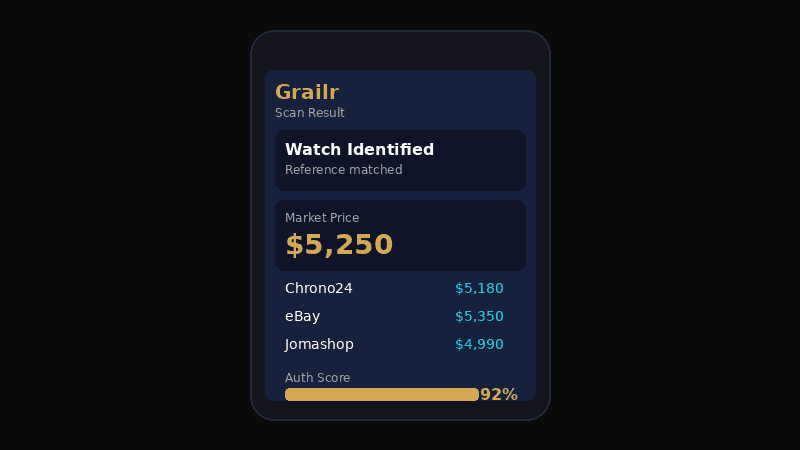
Grailr scans your watch photo and pulls live pricing from Chrono24, eBay, and Jomashop.
- AI identifies brand, model & reference number
- Live market prices from 3+ sources
- Authentication confidence score
Retail Pricing by Configuration
Because the Aqua Terra spans five distinct configurations, price scales more steeply across the range than it does for most single-model watches. Indexed against the 41mm Small Seconds as a baseline, here’s how each configuration compares.
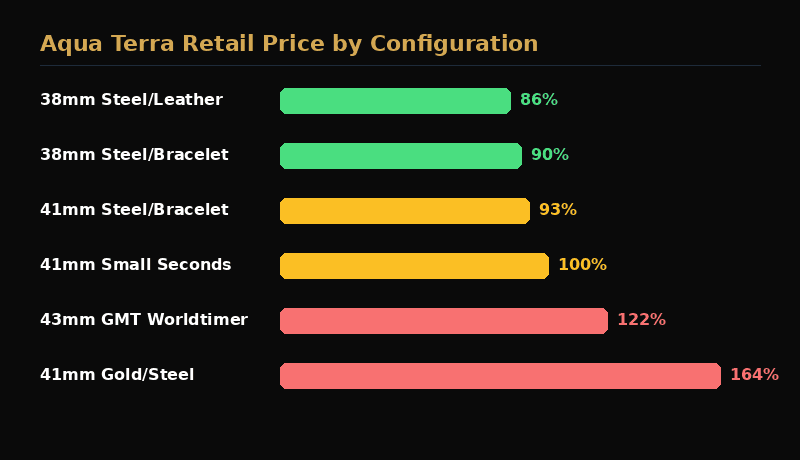
The jump from the standard 41mm bracelet model to the GMT Worldtimer is proportionally larger than the jump from 38mm to 41mm, reflecting the added cost of the GMT complication and worldtimer city ring rather than case size alone. The two-tone gold-and-steel model sits well above everything else in the range — at roughly 164% of the Small Seconds baseline — because it’s pricing precious metal content rather than any additional mechanical function.
Pre-Owned Pricing and Value Retention
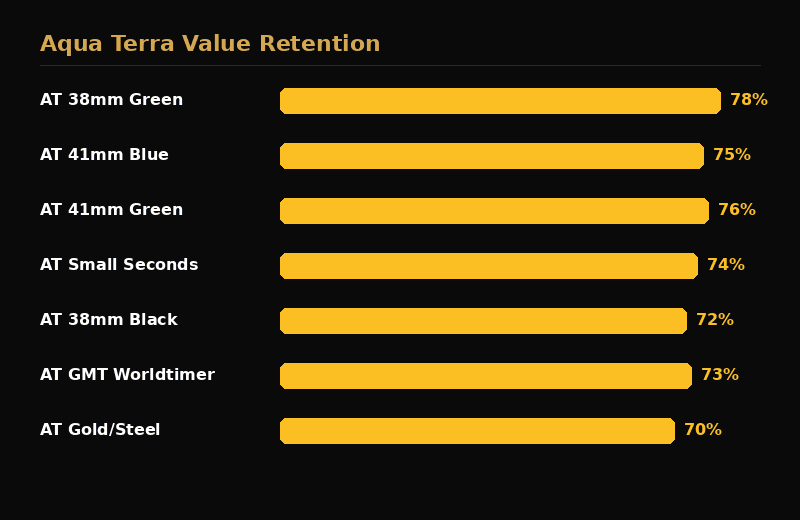
Across the current Aqua Terra range, pre-owned steel models settle at roughly 65-78% of original retail, typically translating to $3,800-4,600 for the most common 38mm and 41mm bracelet references. Retention is fairly consistent across dial colors, with green dials holding a slight edge over black at around 78% versus 72%, mirroring the broader colored-dial premium seen across the watch market.
The two-tone gold-and-steel model retains the smallest share of its retail price at around 70%, which is typical for precious-metal watches generally — the resale market rarely credits the full cost of gold content the way a retail price does. The GMT Worldtimer sits similarly low at around 73%, likely reflecting a smaller pool of buyers for a complicated everyday watch compared to the simpler three-hand models.
If you’re shopping pre-owned, these retention figures are a starting point, not a guarantee — actual resale prices vary with condition, box and papers, service history, and the specific dial reference. Before buying or selling, get an independent, watch-specific estimate rather than relying on a single average figure; Grailr’s appraisal tool can give you an indicative starting point based on the exact reference and condition.
Who Should Buy an Aqua Terra
You want one watch that does everything
The Aqua Terra’s entire design brief is versatility — office, dinner, weekend, boat, all on the same watch. If you don’t want to own three watches for three occasions, this is built specifically for that use case.
You care about anti-magnetic performance
If you work around electronics, MRI-adjacent equipment, or simply want a watch that won’t drift because it sat near a laptop, the 15,000-gauss METAS rating is a genuine practical advantage over most comparable watches, Rolex included.
You’re budget-conscious but still want a real Swiss watch
At $5,600-5,800 for the core sizes, the Aqua Terra undercuts the Datejust by roughly $4,000 while still delivering an in-house, chronometer-certified movement and a genuine luxury build.
Verify before you buy pre-owned
Use Grailr’s free scanner to photograph any listing for a suggested identification and indicative pricing, then confirm the reference and condition through an independent authentication check before you commit. A photo scan suggests a match; it does not certify authenticity.
Resale-first buyers should look elsewhere
If your primary goal is preserving capital, the weaker 65-78% retention means a comparable Rolex or Tudor will likely serve that goal better, even at a higher upfront cost.
Frequently Asked Questions
How much does an Omega Aqua Terra cost?
The 38mm Aqua Terra 150M starts around $5,600, the 41mm on a bracelet is about $5,800, the 41mm Small Seconds is roughly $6,200, the 43mm GMT Worldtimer is about $7,600, and the two-tone gold-and-steel version runs near $10,200. Pre-owned steel models typically trade at 65-78% of retail.
Is the Omega Aqua Terra a good alternative to a Rolex Datejust?
For everyday wear, yes. The Aqua Terra costs roughly $4,000 less than a Datejust 41, carries a higher anti-magnetic rating and more water resistance. Its resale performance is considerably weaker, so buyers focused purely on value retention should still lean toward the Datejust.
What movement does the Aqua Terra use?
Current models use the Co-Axial Master Chronometer Calibre 8800 or 8900 (38mm and 41mm), Calibre 8913 (41mm Small Seconds), or Calibre 8916/8938 (43mm GMT Worldtimer). All are METAS-certified and resist magnetic fields up to 15,000 gauss.
What is the teak pattern on the Aqua Terra dial?
It's a horizontal ridged stripe finish inspired by the teak decking used on classic sailing yachts, and it has been the Aqua Terra's signature dial detail since the line launched in 2002.
Does the Aqua Terra hold its value?
Not as well as comparable Rolex models. Pre-owned Aqua Terra steel watches generally settle at 65-78% of original retail, versus roughly 89-106% for entry-level Rolex references and about 97% for a Datejust 41.
What sizes does the Aqua Terra 150M come in?
The core line is offered in 38mm and 41mm, with a 41mm Small Seconds variant, a 43mm GMT Worldtimer, and a two-tone 41mm gold-and-steel option.
Related Articles
The Bottom Line
The Omega Aqua Terra is one of the few watches in this price range that genuinely earns the label “does everything.” It’s dressy enough for a suit, rugged enough for a pool, and specified well enough — 15,000-gauss anti-magnetism, 150m water resistance, a 60-hour Master Chronometer movement — to outperform a Datejust on paper for roughly $4,000 less. What it won’t do is match the Datejust’s resale performance, so buy it because you want to wear it, not because you expect it to hold its value like a Rolex. For most people shopping in this segment, that trade is an easy one to make.
Found an Aqua Terra You Like?
Grailr uses a photo to suggest a watch identity and an indicative price estimate, with active eBay listings where available. Check the exact reference and condition independently; a photo scan cannot authenticate a watch.
Scan a Watch NowSources and price context
- Omega Seamaster Aqua Terra 150M collection — Lists current references, case sizes, movements, and water resistance for the Aqua Terra family.
- Omega Master Chronometer certification — Explains the METAS testing process and the 15,000-gauss anti-magnetic standard applied to every current Aqua Terra.
- Rolex Datejust collection — Reference specifications used for the Datejust 41 comparison figures in this guide.
These primary sources support the specific specifications and certification claims noted above. Prices and resale percentages elsewhere in this guide are indicative editorial figures, not a verified transaction dataset or guaranteed returns. Confirm the exact reference, region, condition and current quote before buying; asking prices are not completed-sale prices.