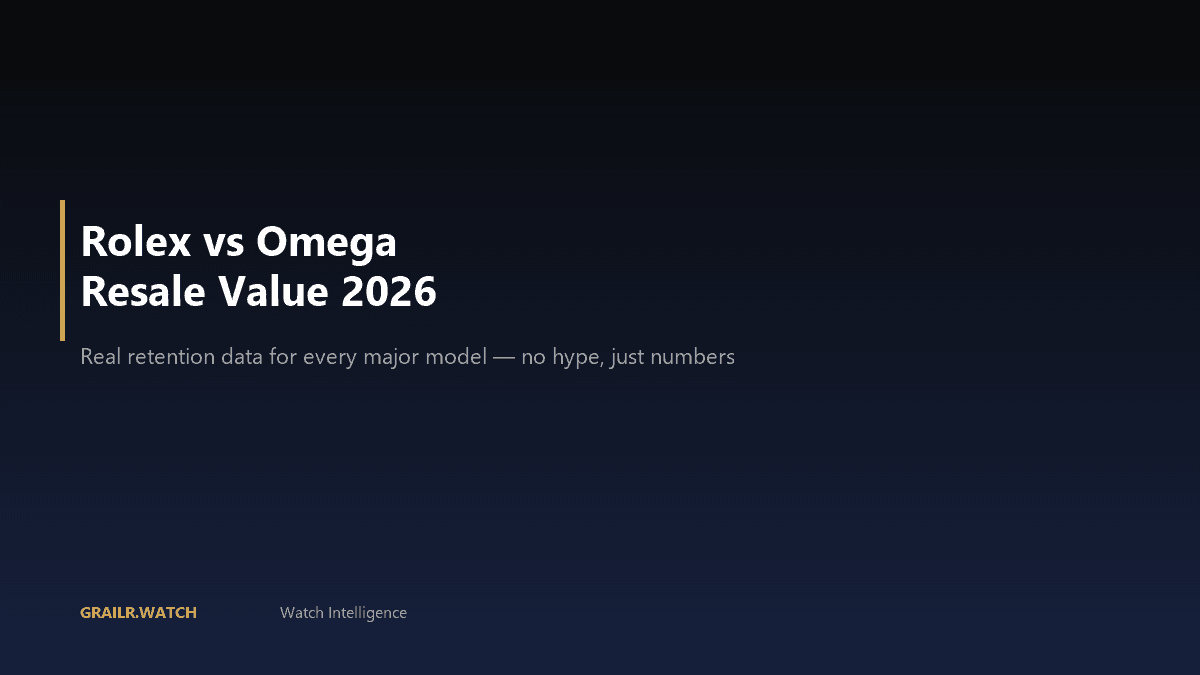
Rolex vs Omega Resale Value: Which Watches Actually Hold Their Value?
Real 2026 retention data for every major Rolex and Omega model — from Daytona to Speedmaster, Submariner to Seamaster. No hype, just the numbers.
- Rolex steel sports models retain 95–180% of retail; Omega averages 70–85% on standard production
- The Daytona leads all models at 150–180% retention; the Speedmaster Moonwatch holds 80–100%
- Omega limited editions (Silver Snoopy, Bond editions) can appreciate 40–60% above retail
- Rolex wins as a financial asset; Omega wins on value per dollar spent on watchmaking
- Gold and two-tone models from both brands depreciate 20–40% — steel is the value play
The Honest Truth About Watch Resale Value
Let’s get the uncomfortable truth out of the way first: most luxury watches lose money. The brands that consistently hold or appreciate in value — Rolex, Patek Philippe, Audemars Piguet — are the exception, not the rule. Even within those brands, it’s specific models in specific materials that drive the numbers.
Rolex dominates the resale conversation because it manufactures scarcity better than any other watch brand. Controlled production, long AD waitlists, and decades of cultural positioning have created a secondary market where steel sports Rolexes trade like commodities. Omega takes a different approach — wider availability, competitive pricing, and a focus on movement technology over artificial scarcity.
Neither strategy is “better.” But they produce very different resale profiles. If you’re buying a watch primarily as a store of value, Rolex wins. If you’re buying a watch to wear and want the most watchmaking per dollar, Omega often wins. This guide gives you the data to make that choice with open eyes.
Rolex Resale Value: Model by Model
Rolex’s resale performance splits into two tiers: steel sports models (Submariner, Daytona, GMT-Master II) that hold or appreciate, and everything else (Datejust, Day-Date, Cellini) that depreciates like most luxury watches. Here’s the complete picture.
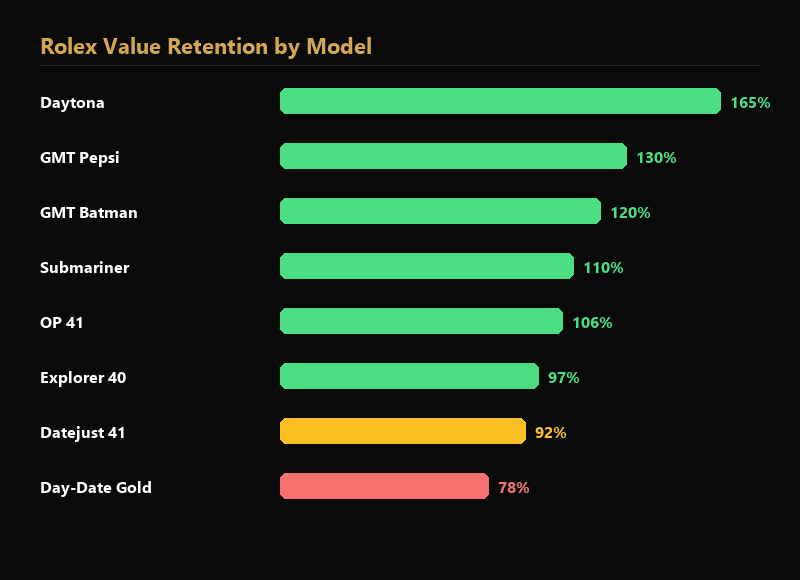
| Model | Retail | Market Price | Retention | Trend |
|---|---|---|---|---|
| Daytona (126500LN) | $15,100 | $23,000–$27,000 | 150–180% | Strong |
| GMT-Master II Pepsi (126710BLRO) | $11,100 | $14,000–$16,000 | 120–140% | Stable |
| GMT-Master II Batman (126710BLNR) | $11,100 | $13,000–$15,000 | 110–130% | Stable |
| Submariner Date (126610LN) | $10,050 | $9,800–$12,500 | 97–124% | Stable |
| Explorer 40 (224270) | $7,350 | $7,100–$7,500 | 97% | Flat |
| Oyster Perpetual 41 | $6,150 | $6,200–$6,800 | 106% | Rising |
| Datejust 41 Steel | $9,650 | $8,500–$9,400 | 88–97% | Flat |
| Day-Date 40 Gold | $39,650 | $28,000–$34,000 | 71–86% | -5%/yr |
The pattern is clear: steel sports models hold value; gold dress watches don’t. A $39,650 Day-Date loses $6,000–$12,000 the moment you walk out of the AD. A $10,050 Submariner keeps its value or gains. The Daytona is in its own category entirely — at 150–180% retention, it’s effectively an appreciating asset.
Omega Resale Value: Model by Model
Omega’s resale story is more nuanced than Rolex’s. Standard production models depreciate 15–30% — normal for a widely-available luxury brand. But specific references, especially limited editions and the Speedmaster Moonwatch, outperform the brand average significantly.
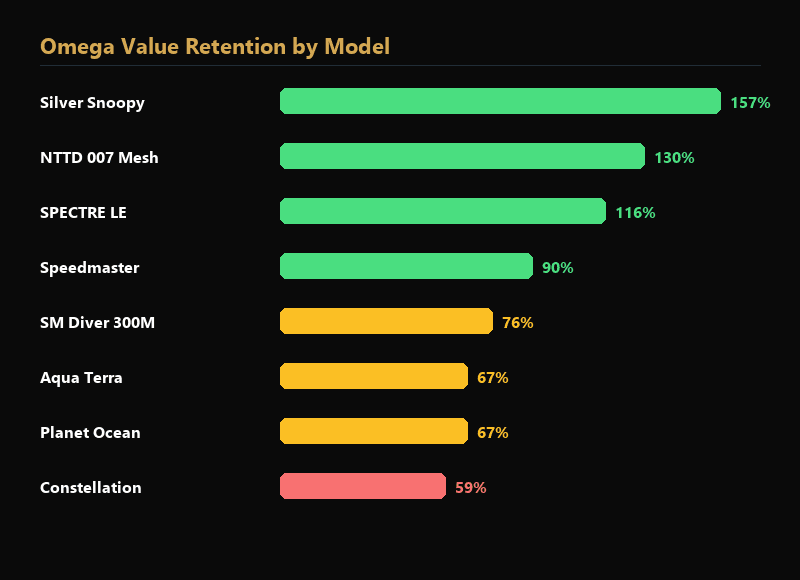
| Model | Retail | Market Price | Retention | Trend |
|---|---|---|---|---|
| Speedmaster Silver Snoopy | $11,100 | $16,000–$19,000 | 144–171% | Strong |
| SM Diver 300M 007 NTTD (Mesh) | $9,200 | $10,000–$14,000 | 109–152% | Rising |
| Speedmaster Moonwatch (3861) | $6,900 | $5,500–$6,900 | 80–100% | Stable |
| SM 300 SPECTRE LE | $7,500 | $7,500–$10,000 | 100–133% | Stable |
| Seamaster Diver 300M | $5,600–$5,900 | $3,800–$5,000 | 68–85% | Flat |
| Seamaster Aqua Terra | $5,900–$6,300 | $3,500–$4,800 | 59–76% | -5% |
| Planet Ocean 600M | $6,900–$7,500 | $4,200–$5,500 | 61–73% | -8% |
| Constellation | $5,800–$7,100 | $3,200–$4,500 | 55–63% | -10% |
The standouts are the Silver Snoopy (144–171% retention — better than most Rolex sports models) and the Bond editions on limited-edition mesh bracelets. The standard Speedmaster Moonwatch holds 80–100% — respectable for any brand. Below that, the Seamaster Diver 300M at 68–85% is the best-performing standard Omega.
Check Any Watch’s Resale Value
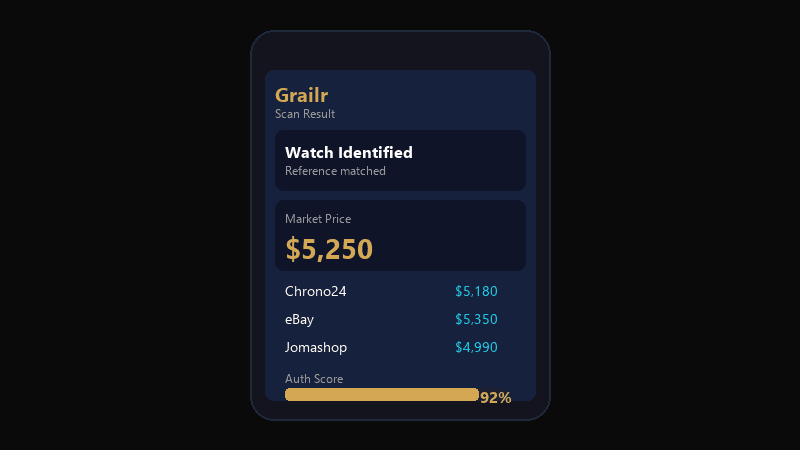
Grailr can suggest a model and reference from a clear photo and provide an indicative AI price estimate. Active eBay listings, when available, show asking prices for comparison. Confirm the reference and condition with the seller; a photo scan does not authenticate a watch.
- AI suggests the model and reference number
- Active eBay asking-price comparisons
- Indicative AI price estimate
Rolex vs Omega: Head-to-Head by Category
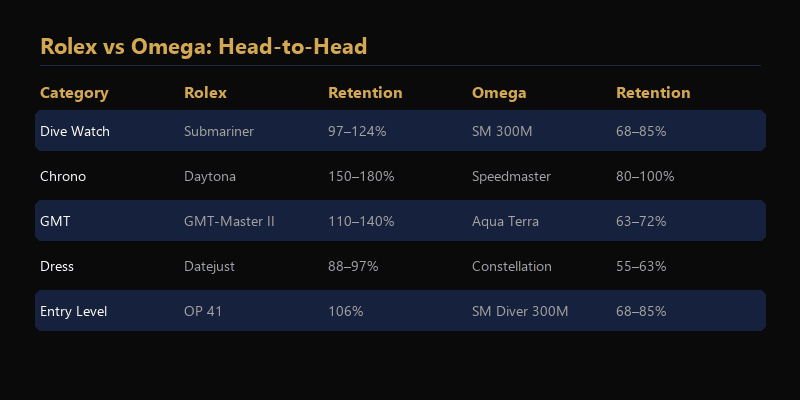
Comparing the two brands fairly means matching equivalent models. Here’s how direct competitors stack up on resale performance.
Dive Watch: Submariner vs Seamaster 300M
Rolex Submariner
Retail: $10,050
Market: $9,800–$12,500
Retention: 97–124%
Omega Seamaster 300M
Retail: $5,600–$5,900
Market: $3,800–$5,000
Retention: 68–85%
Verdict: Rolex wins on retention, but you pay $4,150 more upfront. The Seamaster’s $1,800–$2,100 depreciation is less than the premium you’d pay for the Sub. If you’re buying to wear, the Seamaster is the smarter financial move.
Chronograph: Daytona vs Speedmaster
Rolex Daytona
Retail: $15,100
Market: $23,000–$27,000
Retention: 150–180%
Omega Speedmaster
Retail: $6,900
Market: $5,500–$6,900
Retention: 80–100%
Verdict: The Daytona is in a league of its own — it actually makes money. But good luck buying one at retail. The Speedmaster is widely available and holds its value well for a non-Rolex chronograph. Dollar for dollar, the Speedmaster’s Moonwatch heritage and Co-Axial movement offer more horological substance.
GMT: GMT-Master II vs Seamaster Aqua Terra GMT
Rolex GMT-Master II
Retail: $11,100
Market: $13,000–$16,000
Retention: 110–140%
Omega Aqua Terra GMT
Retail: $7,100–$7,600
Market: $4,500–$5,500
Retention: 63–72%
Verdict: The GMT-Master II dominates on resale. The Aqua Terra GMT’s 63–72% retention is Omega’s weakest performance in this comparison. If GMT function matters and you want value, consider the Tudor Black Bay GMT instead.
Why Rolex Holds Value Better: 5 Factors
1. Controlled Production
Rolex produces approximately 800,000–1,000,000 watches per year across all models. Omega produces a similar volume but distributes across more model families, meaning each specific reference has higher availability. Scarcity drives secondary market premiums.
2. AD Waitlist System
Rolex’s authorized dealer waitlist creates artificial demand that spills into the secondary market. When you can’t buy a Submariner at retail, you buy it pre-owned at a premium. Omega boutiques have no waitlists for standard models — which is great for buyers but bad for resale margins.
3. Brand Recognition
Rolex has the highest brand recognition of any luxury watch maker. Non-watch people know what a Rolex is. This creates a broader buyer pool on the secondary market, which keeps prices stable and liquid.
4. Conservative Design Evolution
Rolex changes designs slowly. A 2020 Submariner looks nearly identical to a 2026 model. This means older references don’t look “outdated” on the secondary market. Omega redesigns more frequently, which can make previous generations feel dated sooner.
5. Grey Market Pricing Discipline
Rolex doesn’t allow discounting at ADs. Omega does — you can find 15–25% off at authorized dealers and grey market sellers. When the “real” price of an Omega is already below MSRP, the pre-owned market prices against the discounted new price, not the list price.
Where Omega Wins: Value You Can’t Resell
Resale value isn’t everything. Omega offers legitimate advantages that don’t show up in retention percentages:
- Superior movement technology: Master Chronometer certification (METAS), 15,000 gauss magnetic resistance, Co-Axial escapement — Omega’s movements are arguably more technically advanced than Rolex’s.
- Immediate availability: Walk into an Omega boutique and buy the watch you want, today. No waitlists, no games, no building a “purchase history.”
- Lower real cost of ownership: A Seamaster Diver 300M bought at 15% off MSRP ($4,760) that depreciates to $4,000 loses $760 over 3 years. A Submariner bought at retail ($10,050) that holds at $10,000 “lost” $50 — but you had $5,290 more tied up in a watch.
- More variety: The Omega catalogue offers more dial colours, materials, and complications than Rolex. If you care about having a watch that expresses your personal style, Omega gives you more options.
Buying Strategy: Maximizing Value Retention
Whether you’re buying Rolex or Omega, these strategies will help you minimize depreciation and maximize long-term value.
Buy Steel
Steel models outperform gold and two-tone on resale for both brands. A steel Submariner retains 97–124%. The same model in gold retains 70–80%. Steel is the value play, period.
Keep the Full Set
Box, papers, warranty card, hang tags — a full set adds 10–20% to resale value for both brands. Never throw away the packaging. For selling strategy, presentation matters.
Buy Iconic Models
Submariner, Daytona, GMT-Master II, Speedmaster Moonwatch — these iconic models hold value better than lesser-known references. Brand recognition drives liquidity.
Buy Pre-Owned Omega
Since Omega depreciates 15–30% from retail, buying a 1–2 year old pre-owned Omega means someone else took the depreciation hit. You get a near-new watch at its “real” market value with minimal further loss.
Frequently Asked Questions
Does Rolex or Omega hold value better?
What is the resale value of a Rolex Submariner?
Do Omega watches hold their value?
Which Rolex has the best resale value?
Is an Omega Speedmaster a good investment?
Should I buy Rolex or Omega for long-term value?
Related Articles
The Bottom Line
Rolex wins the resale battle — there’s no honest way to argue otherwise. Steel sports Rolexes are among the only consumer goods that consistently retain or appreciate in value. But Omega wins on pure watchmaking value: Master Chronometer movements, immediate availability, and a lower cost of ownership when you factor in the real price after discounts. The smartest approach? Buy a Rolex if you want a financial hedge, buy an Omega if you want the best watch for the money, and either way, check the current market price before you pay.
Want to Know What Your Watch Is Worth?
Grailr can suggest a model and reference from a clear photo and provide an indicative AI price estimate. Active eBay listings, when available, show asking prices for comparison. Confirm the reference and condition with the seller; a photo scan does not authenticate a watch.
Scan a Watch NowSources and price context
- Chrono24 ChronoPulse methodology — A transaction-based market index; its movements are not returns for every individual watch.
- eBay Product Research — How to research actual sold prices separately from active asking prices.
The links identify the specific manufacturer information and marketplace guidance used for this guide. Price ranges and resale percentages in this guide are illustrative, not live quotes or guaranteed returns; compare the exact reference, condition and sale date before relying on them.