Credor Watches: Seiko’s Best-Kept Secret
Inside Seiko’s ultra-luxury brand — the Eichi, the Locomotive, the Goldfeather, and what they cost in 2026.
Price context: this guide includes indicative prices from its original publication period. They have not all been refreshed to current quotes. Use the linked primary sources for specifications and policies, and verify prices independently.

- Credor is Seiko’s ultra-luxury brand, founded in 1974, with prices from roughly $2,075 to $104,000
- Three collections — Masterpiece (Eichi), Goldfeather, and Locomotive — each with a distinct character
- The 2026 Watches & Wonders debut marked Credor’s first global push outside Japan
- Finishing quality on Eichi pieces rivals Swiss haute horlogerie at a fraction of the price
- Pre-owned Credor watches trade from $1,200 to $7,000, making them an accessible entry into top-tier Japanese watchmaking
What Is Credor?
The name “Credor” comes from the French crêt d’or — “crest of gold.” Founded in 1974 as Seiko’s answer to the question of how far Japanese watchmaking could go, Credor was built from the start to compete with Swiss haute horlogerie on finishing, materials, and artisanal dial work. For more than fifty years, it succeeded quietly: almost entirely within Japan’s domestic market, known to collectors but invisible on most wrists outside Tokyo.
That changed at Watches & Wonders Geneva 2026, where Credor debuted alongside Patek Philippe, Rolex, and Cartier for the first time. The brand showed three new models — a titanium Locomotive, an Urushi lacquer Goldfeather, and a hand-engraved Goldfeather Tourbillon — and immediately drew comparisons to Breguet and A. Lange & Söhne for the quality of its hand finishing.
Unlike most high-end watch brands, Credor doesn’t chase volume. Annual production is estimated in the low thousands, with the top-tier Masterpiece pieces made in single-digit batches. Each Eichi dial, for instance, is hand-painted on Arita porcelain by a single artisan — a process that takes several months per dial and accounts for a meaningful share of the watch’s price.
Seiko positions Credor above Grand Seiko in its brand hierarchy. Where Grand Seiko focuses on precision, legibility, and everyday wearability, Credor emphasizes decorative arts, traditional Japanese craft techniques like Urushi lacquer and hand engraving, and ultra-thin construction. The two brands share Seiko’s proprietary Spring Drive technology, but Credor uses it as a canvas for artistry rather than a tool for timekeeping accuracy alone.
The Complete Collection
Masterpiece (Including the Eichi Line)
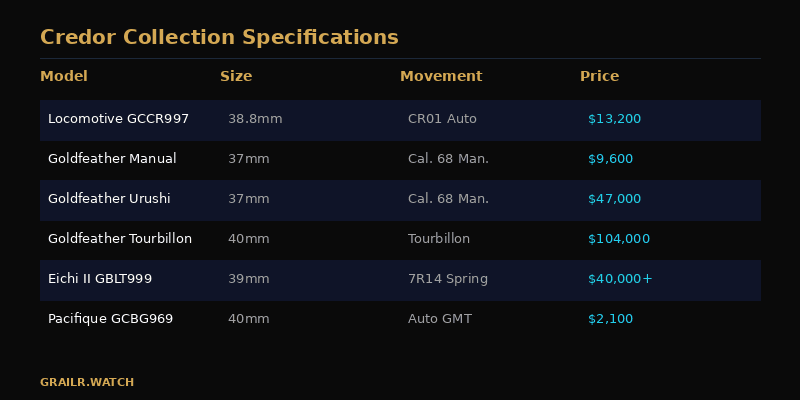
The Masterpiece collection represents Credor’s highest expression. Its centerpiece is the Eichi II — a 39mm platinum-cased watch with a hand-painted Arita porcelain dial and the Spring Drive Caliber 7R14, a manual-wind movement with 41 jewels and a power reserve of approximately 60 hours. The Eichi translates to “eternal wisdom” in Japanese, and the name is earned: each porcelain dial is fired multiple times, hand-painted with a single-hair brush, and finished with a translucent glaze that gives it a depth no printed dial can match.
Production of the Eichi II is limited to roughly 30 pieces per year. At auction, examples regularly sell between $20,000 and $40,000, with pristine examples occasionally exceeding $50,000. The original Eichi (GBLT998), discontinued in 2014, has become a collector’s piece that surfaces perhaps twice a year at Phillips or Christie’s.
Goldfeather
The Goldfeather line is Credor’s ultra-thin dress watch collection. The name references both the gold cases many models use and the featherlight feel of a case that measures under 5mm in thickness. These are manual-wind watches designed for formal occasions — the kind of piece that disappears under a French cuff.
At Watches & Wonders 2026, Credor introduced two Goldfeather models that immediately became talking points. The Goldfeather Urushi pairs a platinum case with a traditional Japanese lacquer dial at $47,000. The Goldfeather Tourbillon GBCF997, priced at approximately $104,000 (16.5 million yen), features hand-engraved bridges visible through the caseback — each one requiring over 100 hours of engraving work.
Locomotive
The Locomotive is Credor’s most accessible collection and the one most likely to attract new buyers following the Geneva debut. Designed by the legendary Gérald Genta — the man behind the Audemars Piguet Royal Oak and Patek Philippe Nautilus — the Locomotive features an integrated bracelet and a distinctive tonneau-influenced case shape.
The current production models are the GCCR995 (limited to 300 pieces) and the GCCR997, both measuring 38.8mm in diameter and 8.9mm in thickness. They run the automatic Caliber CR01 with 26 jewels and a 45-hour power reserve. The titanium version debuted at Geneva for $13,200, while the steel GCCR997 retails at approximately €14,500.
For anyone familiar with the Royal Oak lineage, the Locomotive’s DNA is immediately recognizable — the octagonal bezel softened into a cushion shape, the integrated bracelet flowing from the case, the vertical brushing on the case sides. Genta designed it in the 1970s, and Credor has kept the proportions intact through each revival.
Specifications and Pricing
Credor’s lineup spans from accessible quartz models to six-figure haute horlogerie. The table below covers the key references available in 2026, with indicative retail and pre-owned pricing where data exists.
| Model | Size | Movement | Retail | Pre-Owned |
|---|---|---|---|---|
| GCAZ057 Quartz | 33mm | Quartz | $2,075 | $1,200–$1,800 |
| GSBA057 Quartz | 37mm | Quartz | $2,075 | $1,200–$1,800 |
| Locomotive GCCR997 | 38.8mm | Cal. CR01 Auto | €14,500 | $4,000–$7,000 |
| Locomotive GCCR995 (LE 300) | 38.8mm | Cal. CR01 Auto | $13,200 | $5,000–$8,000 |
| Eichi II GBLT999 | 39mm | Cal. 7R14 Spring Drive | ~$35,000 | $20,000–$40,000 |
| Goldfeather Urushi | 38mm | Manual-wind | $47,000 | N/A (new 2026) |
| Goldfeather Tourbillon GBCF997 | 40mm | Tourbillon Manual | $104,000 | N/A (new 2026) |
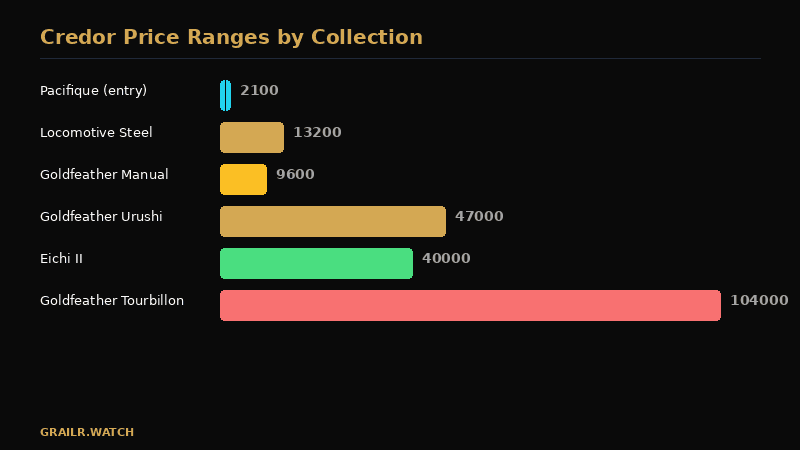
Pre-owned prices are indicative asking prices from Chrono24, WatchPatrol, and auction results. The Goldfeather Urushi and Tourbillon are too new to have secondary market data. Verify current prices independently before buying.
Check Any Watch Price in Seconds
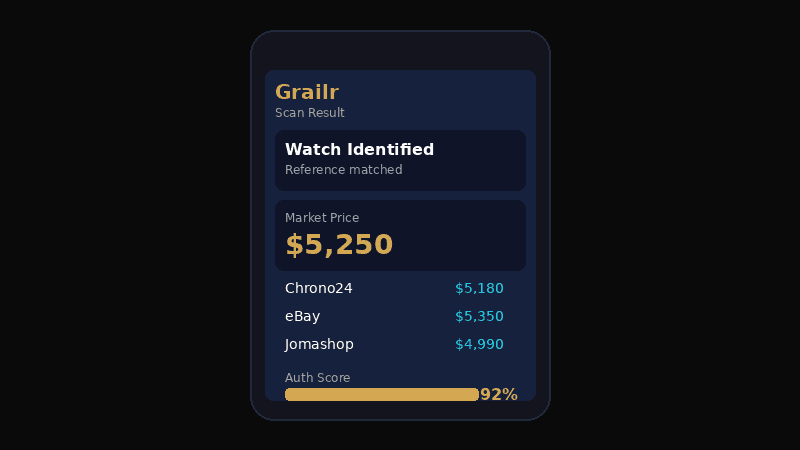
Grailr scans your watch photo and pulls live pricing from Chrono24, eBay, and Jomashop.
- AI identifies brand, model & reference number
- Live market prices from 3+ sources
- Authentication confidence score
What Makes Credor Different
Swiss brands talk about finishing. Credor demonstrates it differently — through craft traditions that have no equivalent in Geneva or Glashütte. Three techniques define the Credor identity and explain why production numbers stay so low.
Spring Drive Technology
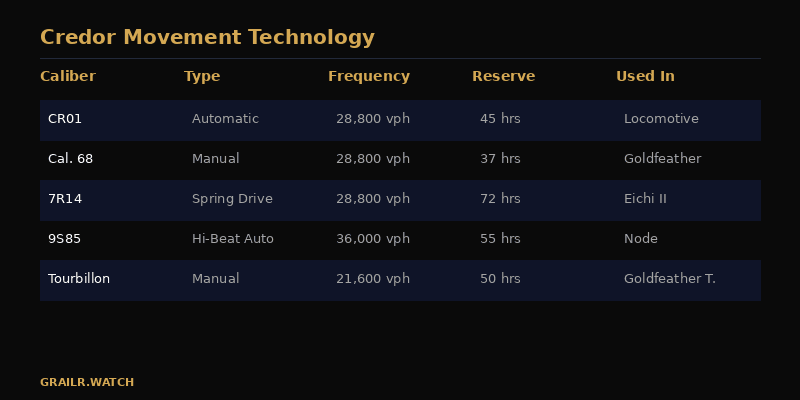
The Eichi line runs on Seiko’s proprietary Spring Drive — a movement that combines a mainspring with a tri-synchro regulator instead of a traditional escapement. The result is a perfectly smooth sweeping seconds hand (no tick, no stutter) and accuracy to ±1 second per day, which is roughly ten times more precise than a COSC-certified mechanical chronometer. No other movement technology produces this combination of mechanical power and quartz-level precision.
Arita Porcelain Dials
The Eichi’s porcelain dial comes from the Arita region of Kyushu, where porcelain has been made since the 1600s. Each dial is shaped from raw clay, fired at over 1,300°C, hand-painted with a brush made from a single human hair, and fired again. The process takes months per dial, and any crack, discoloration, or imperfection during firing means starting over. This is not decoration applied to a finished dial — the dial is the porcelain.
Hand Engraving and Urushi Lacquer
The Goldfeather Tourbillon’s bridges are hand-engraved by a single artisan over more than 100 hours. The patterns draw from Japanese nature motifs — waves, clouds, pine needles — rather than the Geneva stripes or Côtes de Genève that dominate Swiss finishing. Meanwhile, the Goldfeather Urushi’s dial uses traditional Japanese lacquerwork: layers of tree sap, each dried in controlled humidity and hand-polished before the next layer is applied. The depth and lustre of an Urushi dial cannot be photographed accurately — it has to be seen in person.
These aren’t marketing differentiators. They’re the reason Credor can charge $47,000 for a manual-wind dress watch and have collectors call it a bargain compared to a similarly finished Breguet or Voutilainen. The craft hours in a single Eichi dial exceed what most Swiss brands invest in an entire watch.
Credor vs Grand Seiko
The most common question from collectors encountering Credor for the first time: how does it compare to Grand Seiko? Both sit above the mainline Seiko brand, both use Spring Drive technology, and both emphasize finishing. But they occupy different worlds.
| Dimension | Grand Seiko | Credor |
|---|---|---|
| Price range | $3,000–$50,000 | $2,075–$104,000 |
| Annual production | ~36,000 pieces | Low thousands (est.) |
| Movement focus | Hi-Beat, Spring Drive, 9F Quartz | Spring Drive, Manual, Tourbillon |
| Dial techniques | Zaratsu polishing, textured metals | Porcelain, Urushi lacquer, hand engraving |
| Case materials | Steel, titanium, gold | Steel, titanium, gold, platinum |
| Availability | Global AD network | Japan + select global (from 2026) |
| Brand recognition | Growing rapidly | Niche, collector-focused |
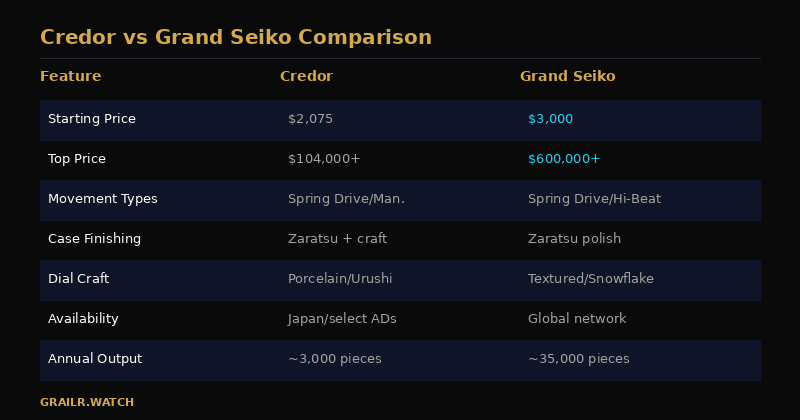
Think of Grand Seiko as the Lexus LS — technically exceptional, refined, built for daily use. Credor is the bespoke interior: hand-stitched, limited, and aimed at buyers who already know what they want. A Grand Seiko Snowflake (SBGA211) at $5,800 is one of the best everyday watches money can buy. An Eichi II at $35,000 is a different conversation entirely — it’s art that tells the time.
For most buyers, Grand Seiko is the right choice. It has a global service network, strong resale value, and holds its value well. Credor is for the collector who has already owned a Grand Seiko, a Rolex, and an Omega, and wants something no one at the office will recognize — but every watchmaker will respect.
Buying Tips
1. Start with the Pre-Owned Market
Pre-owned Credor watches trade between $1,200 and $7,000 for most steel and quartz references. A vintage Pacifique GMT (GCBG969) at $2,100 or a classic dress model at $1,500 lets you experience Credor finishing without a five-figure commitment. Check Chrono24, Yahoo Auctions Japan (use a proxy service), and specialist Japanese watch dealers.
2. Understand the AD Situation
Following the 2026 Geneva debut, select Seiko boutiques outside Japan now carry Locomotive and Goldfeather models. But availability is thin — most global dealers have allocation for single-digit pieces per quarter. If you want a specific reference, contact the Seiko boutique in advance and expect a wait.
3. Check the Movement Service History
Credor’s Spring Drive movements require Seiko-authorized servicing. Unlike a standard mechanical watch that any competent watchmaker can overhaul, the tri-synchro regulator in a Spring Drive caliber needs Seiko-specific parts and training. Factor in $800–$1,500 for a full service when buying pre-owned, and confirm the seller’s service records.
4. Scan Before You Buy
Use Grailr’s free scanner to photograph any listing and check the suggested identification, indicative market pricing, and authentication confidence. This is especially valuable for Credor, where model numbers are unfamiliar to most Western buyers and fakes do circulate on marketplace platforms.
5. Inspect Porcelain and Lacquer Dials Carefully
Arita porcelain and Urushi lacquer dials are fragile compared to metal dials. Hairline cracks in porcelain and lacquer chips are permanent damage that cannot be refinished. When buying pre-owned Eichi or Goldfeather pieces, request macro photographs of the dial under raking light and check for any crazing or chips near the indices.
Is Credor Worth the Investment?
Credor sits in an unusual position for resale. The entry-level quartz models depreciate similarly to any fashion-adjacent watch — expect 40–50% loss from retail within the first few years. But the limited-production pieces tell a different story.
The Eichi line has shown consistent demand at auction. With only ~30 pieces produced annually and a growing international awareness following the Geneva debut, Eichi II examples have held or appreciated from their original retail prices. The Locomotive limited editions (300 pieces for the GCCR995) trade at modest premiums on the secondary market, though data points are sparse.
The 2026 Goldfeather models are too new for resale data, but the combination of platinum cases, hand-engraved or lacquered dials, and production runs likely under 50 pieces suggests they will hold value — assuming demand from the Geneva debut converts into sustained collector interest.
The honest assessment: buy a Credor because you appreciate Japanese craft at its highest level, not because you expect returns. If you want watches that hold value with reliable liquidity, Rolex and Patek Philippe have deeper markets. What Credor offers is something those brands cannot — artisanal techniques that connect centuries of Japanese tradition to modern horology, at prices that undercut comparable Swiss finishing by 30–50%.
Frequently Asked Questions
What is a Credor watch?
Credor is Seiko’s ultra-luxury brand, founded in 1974. The name comes from the French “crêt d’or” meaning crest of gold. Credor watches feature hand-finished movements, artisan dials, and retail from around $2,075 to over $100,000.
How much does a Credor watch cost?
Entry-level quartz models start at about $2,075. The Locomotive automatic collection ranges from $13,200 to €14,500. Masterpiece and Goldfeather pieces reach $47,000 for an Urushi dial and $104,000 for the Goldfeather Tourbillon.
Is Credor better than Grand Seiko?
They serve different purposes. Grand Seiko focuses on precision and wearability. Credor emphasizes decorative arts, hand engraving, and traditional Japanese craftsmanship. The finishing on an Eichi rivals Swiss haute horlogerie at a lower price.
Where can I buy a Credor watch?
Since the 2026 Watches and Wonders debut, select Seiko boutiques globally now carry Locomotive and Goldfeather models. Pre-owned examples appear on Chrono24, Yahoo Auctions Japan, and at specialist dealers.
Do Credor watches hold their value?
Limited-production Eichi and Goldfeather models have held or appreciated at auction. Entry-level quartz models depreciate 40–50% from retail. The Locomotive limited editions trade at modest premiums when they surface.
What movement does Credor use?
Credor uses several Seiko movements: Spring Drive Caliber 7R14 in the Eichi, automatic Caliber CR01 in the Locomotive (45-hour reserve, 26 jewels), manual-wind calibers in the Goldfeather, and high-accuracy quartz in entry-level models.
Related Articles
The Bottom Line
Credor is one of the few brands in the world where the craft genuinely justifies the price. A hand-painted Arita porcelain dial, a 100-hour hand-engraved tourbillon bridge, a Gérald Genta case design that predates the Royal Oak — these are not marketing stories. They’re the product. Whether you start with a $2,000 pre-owned quartz model or go straight to the Locomotive, Credor rewards collectors who value artistry over brand recognition. The Geneva debut may change that calculus over time, but for now, this remains the best-kept secret in luxury watchmaking.
Considering a Credor?
Grailr uses a photo to suggest a watch identity and an indicative price estimate, with active eBay listings where available. Check the exact reference and condition independently; a photo scan cannot authenticate a watch.
Scan a Watch NowSources and price context
- Seiko Credor Locomotive press release — Official specifications for the Caliber CR01 movement, case dimensions, and retail pricing for the Locomotive collection.
- Time+Tide: What is Credor and why should I care about it? — Overview of Credor’s history, collections, and seven recommended models including entry-level references.
These primary sources support the specific specification and pricing points noted above. Pre-owned prices are indicative asking prices from dealer listings and auction results, not verified transaction data. Confirm the exact reference, condition, and current quote before buying.