First Omega in Space: The Speedmaster Collectors Miss
Wally Schirra’s personal CK 2998 reached orbit three years before NASA qualified the Moonwatch. The reissue that honours it is one of the best-value Speedmasters you can buy today — and most collectors walk straight past it.

Price context: All prices in this guide are illustrative ranges drawn from public listings on Chrono24, eBay and retailer sites at the time of writing. They are not live quotes, appraisals or guaranteed sale prices. Always verify the exact reference, condition and sale date before relying on any figure. Get an indicative Grailr estimate for a specific watch.
- On 3 October 1962, Wally Schirra wore his personal Omega CK 2998 aboard Sigma 7 — the first Omega in space, three years before NASA’s official Moonwatch qualification.
- The current 2024 reissue (Ref. 310.32.40.50.06.001) carries the Caliber 3861 Master Chronometer — the most advanced movement ever fitted to a Speedmaster.
- At 39.7 mm, the FOIS wears noticeably smaller than the 42 mm Moonwatch — a size that nods to the 1960s original and suits slimmer wrists.
- MSRP is $8,900, but the FOIS trades at $7,000–$8,500 on the secondary market in 2026 — one of the few Speedmasters available near or below retail.
- Overshadowed by the Silver Snoopy (which trades at $16,000+), the FOIS remains a collector-grade Speedmaster at a mainstream price.
The 1962 Story: Wally Schirra and Mercury-Atlas 8
The popular story of the Omega Speedmaster starts in 1969, when Buzz Aldrin strapped a reference ST 105.012 to his wrist and stepped onto the lunar surface. But the Speedmaster’s space career actually began seven years earlier, under far less fanfare, on the wrist of a Navy test pilot named Walter “Wally” Schirra.
Schirra was one of the original Mercury Seven astronauts. On 3 October 1962, he climbed into the Sigma 7 capsule for Mercury-Atlas 8 — a six-orbit, nine-hour mission designed to test the spacecraft’s engineering systems. On his left wrist was an Omega Speedmaster reference CK 2998, purchased with his own money from a Houston jeweller. It was not government-issued equipment. It was not part of any brand deal. It was simply the chronograph Schirra trusted.
That flight made the CK 2998 the first Omega worn in space. It predated NASA’s formal chronograph qualification programme by three years — the same programme that would subject watches from Rolex, Longines, Hamilton and Omega to extreme temperature cycling, vibration, shock and vacuum testing. Only the Speedmaster survived every test, earning the “Flight Qualified for All Manned Space Missions” designation in 1965.
The distinction matters for collectors: the Moonwatch story is about institutional selection, but the First Omega in Space story is about personal choice. Schirra, a man whose life depended on his instruments, chose a Speedmaster before anyone told him to. That detail — a pilot buying his own chronograph rather than waiting for NASA to issue one — is what the FOIS reissue commemorates. For more on how the Speedmaster family evolved from there, see our complete Speedmaster guide.
How the FOIS Differs from the Standard Moonwatch
At first glance, the First Omega in Space looks like a slightly smaller Moonwatch. It is not. The differences run through the case, dial, bezel, crystal and strap — and they all trace back to the CK 2998 that Schirra actually wore. Here is the spec-by-spec comparison.

| Feature | FOIS (310.32.40.50.06.001) | Moonwatch Hesalite (310.30.42.50.01.001) |
|---|---|---|
| Case diameter | 39.7 mm | 42 mm |
| Case material | Stainless steel | Stainless steel |
| Dial | Grey-blue CVD-coated | Black step dial |
| Crystal | Hesalite-form sapphire | Hesalite (acrylic) |
| Bezel | Black aluminium, “Dot Over Ninety” | Black aluminium, standard scale |
| Movement | Cal. 3861 Master Chronometer | Cal. 3861 Master Chronometer |
| Power reserve | 50 hours | 50 hours |
| Strap / bracelet | Black leather strap | Steel bracelet |
| Water resistance | 50 m | 50 m |
| MSRP | $8,900 | $6,300 |
| 2026 secondary market | $7,000–$8,500 | $4,200–$5,000 |
Three details stand out. First, the “Dot Over Ninety” bezel marking — where the dot at the 90 on the tachymeter scale sits above rather than beside the numerals — is a deliberate callback to an identifying feature of the original CK 2998. Vintage collectors will spot it immediately. Second, the hesalite-form sapphire crystal gives you the domed, warm look of acrylic with the scratch resistance of sapphire. It is a genuine best-of-both-worlds compromise. Third, the grey-blue CVD-coated dial is unique in the current Speedmaster range — no other production model carries this colour.
The 2024 Reference: Deep Dive on 310.32.40.50.06.001
Omega refreshed the First Omega in Space for 2024, and the update is significant. The previous FOIS models ran the Caliber 1861 — a capable, hand-wound movement but one without the Co-Axial escapement, METAS certification or silicon balance spring that define Omega’s modern chronometer standard. The new reference changes that.
Case and Dial
- Reference: 310.32.40.50.06.001
- Diameter: 39.7 mm
- Thickness: ~13.2 mm (incl. crystal dome)
- Case: Stainless steel, polished and brushed
- Dial: Grey-blue CVD coating, 1960s CK 2998 palette
- Crystal: Hesalite-form sapphire, domed
- Caseback: Engraved Seahorse medallion
Movement and Performance
- Caliber: 3861 (manual wind)
- Certification: COSC + METAS Master Chronometer
- Power Reserve: 50 hours
- Accuracy: 0/+5 sec/day
- Magnetic Resistance: 15,000 gauss
- Frequency: 21,600 vph (3 Hz)
- Balance Spring: Silicon (non-magnetic)
The Caliber 3861 is the same movement that powers the standard Moonwatch, the Silver Snoopy Award and Omega’s other premium Speedmaster references. In the context of the FOIS, it represents a generational leap: the 2012 and 2016 models ran the Caliber 1861, which lacked magnetic shielding, used a traditional metallic balance spring susceptible to magnetisation, and could not claim METAS certification. The 3861 addresses every one of those shortcomings.
For daily wearers, the 15,000-gauss magnetic resistance is the most practical upgrade. Phones, laptop lids, tablet covers and wireless chargers all produce magnetic fields that can affect a traditional watch movement. The 3861’s silicon balance spring and Co-Axial escapement are effectively immune to household magnetism. You no longer need to think about where you set your watch down at night.
The leather strap is worth noting as well. Unlike the Moonwatch, which ships on a steel bracelet (adding both weight and a certain toolishness), the FOIS comes on a black leather strap with a pin buckle. The result is a watch that reads more like a refined chronograph than a space instrument — which, for many collectors, is precisely the point. If you value strap versatility, the 20 mm lug width takes any aftermarket strap you care to fit.
Previous FOIS Models
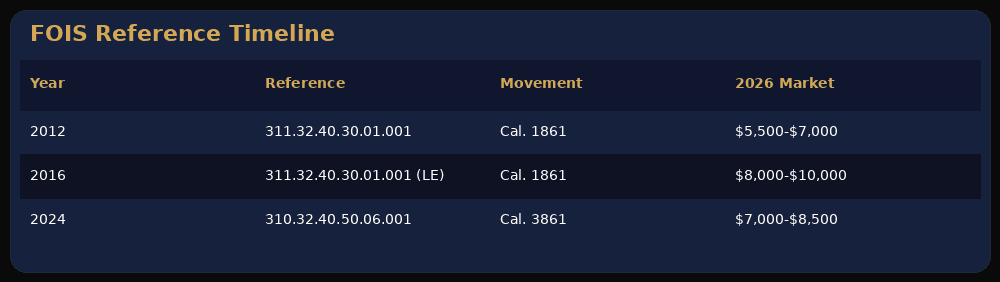
Omega has released three distinct FOIS references since 2012. Each one reinterprets the CK 2998 in a slightly different way, and all three remain available on the secondary market. Here is how they compare.
| Model | Year | Movement | Notes | 2026 Market |
|---|---|---|---|---|
| 311.32.40.30.01.001 | 2012 | Cal. 1861 | Original FOIS reissue, ongoing production | $5,500–$7,000 |
| Numbered Edition | 2016 | Cal. 1861 | Limited to 2,998 pieces, numbered caseback | $8,000–$10,000 |
| 310.32.40.50.06.001 | 2024 | Cal. 3861 | Master Chronometer, grey-blue CVD dial | $7,000–$8,500 |
The 2016 numbered edition is the standout collector’s piece. Limited to 2,998 units (a nod to the CK 2998 reference), it carries a premium over the standard FOIS and is becoming harder to find with complete box and papers. That said, the 2024 reference with the Caliber 3861 is the better watch in every measurable way — better accuracy, better magnetic resistance, longer service intervals. Whether you prioritise scarcity or technology determines which one to chase.
The original 2012 model at $5,500–$7,000 is arguably the best-value entry into the FOIS family. It looks identical to the 2024 version at arm’s length, the Caliber 1861 is proven and inexpensive to service, and the price gap means you could buy it and have money left for an aftermarket strap collection. The trade-off is the lack of magnetic shielding and METAS certification — features that matter if your watch lives next to a phone all day.
Check Any Watch Price in Seconds
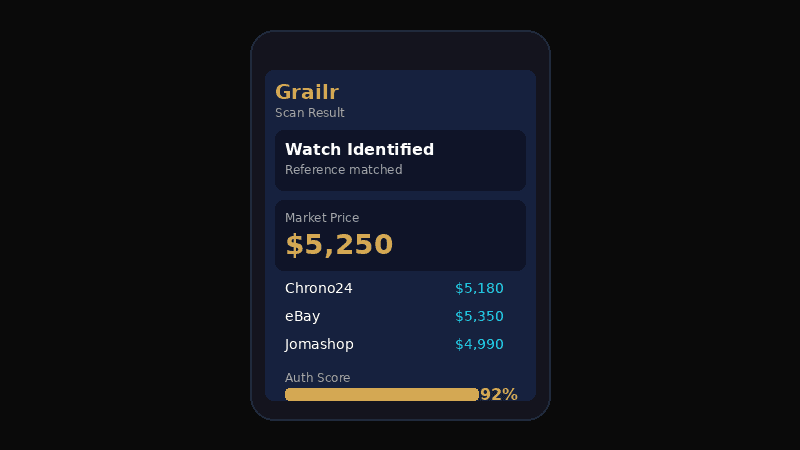
Grailr scans your watch photo and pulls live pricing from Chrono24, eBay, and Jomashop.
- AI identifies brand, model & reference number
- Live market prices from 3+ sources
- Authentication confidence score
Why This Is the Speedmaster to Buy Now
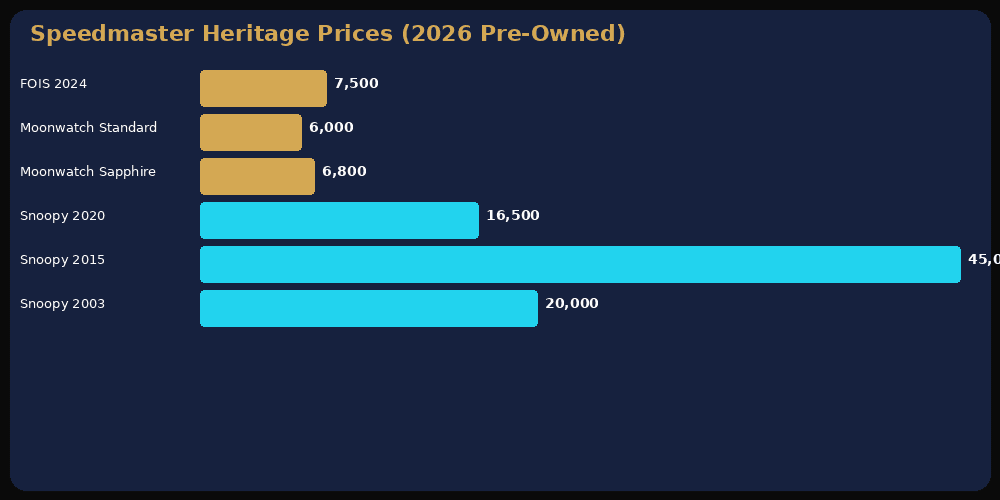
The Speedmaster market in 2026 looks something like this: the Silver Snoopy Award 50th Anniversary (Ref. 310.32.42.50.02.001) trades at $16,000 and above, roughly twice its $11,100 retail price. The standard Moonwatch (Ref. 310.30.42.50.01.001) trades at $4,200–$5,000, which is 67–79% of its $6,300 retail. The FOIS sits at $7,000–$8,500 against an $8,900 MSRP — 79–96% of retail.
That pricing dynamic tells you something. The Snoopy is a hype-driven collectible: its secondary-market premium reflects scarcity, social-media visibility and the fact that Omega cannot produce them fast enough. The standard Moonwatch, conversely, is one of the most widely available luxury chronographs on earth, so supply easily meets demand and the secondary market discounts accordingly.
The FOIS occupies a unique middle ground. It is not hyped enough to carry a premium, but it is niche enough that supply on the secondary market is thin. The result is a watch that trades near or slightly below retail — unusual territory for a current-production Speedmaster with the Master Chronometer 3861 inside. For context, comparable Rolex and Omega models on the resale market rarely sit this close to their retail price without a wait-list or production constraint behind them.
There are five reasons collectors overlook the FOIS, and most of them work in your favour if you are buying rather than speculating:
1. The Snoopy Casts a Long Shadow
Every Speedmaster conversation in 2026 eventually circles back to the Silver Snoopy. It is the most visible, most photographed, most waitlisted Speedmaster in the current range. The FOIS, by contrast, rarely trends on social media. Less visibility means less demand — and that means better prices for you.
2. 39.7 mm Reads as “Small”
The watch market has spent two decades training buyers that 42 mm is the default for a sport chronograph. At 39.7 mm, the FOIS falls below that threshold and some buyers dismiss it as undersized without trying it on. The irony is that the watch community is rapidly swinging back toward smaller cases — and 39.7 mm is exactly where the trend is heading.
3. Manual Wind, No Date
Some buyers want an automatic movement and a date window. The FOIS offers neither. It is a hand-wound chronograph with three registers and nothing else on the dial. That minimalism is a feature for purists, but it can feel limiting to anyone coming from a Seamaster or a Submariner. If you want a daily-wearing Omega with a date, the Seamaster Aqua Terra is the better choice.
4. The Story Requires Explanation
Everyone knows the Moonwatch went to the Moon. The FOIS story — a pilot buying his own chronograph for a Mercury flight three years before the Moon landing — requires a sentence of context. That extra narrative step is enough to reduce impulse purchases and keep demand lower than the Moonwatch or the Snoopy.
5. Leather Strap, Not Bracelet
The FOIS ships on a leather strap, which some buyers perceive as less versatile or less premium than the Moonwatch’s steel bracelet. In practice, the strap keeps the watch lighter on the wrist and opens the door to easy customisation — a NATO, a suede strap, a rubber Velcro for active wear. But first impressions in a boutique still favour steel.
Add it up, and the FOIS is a Speedmaster that gets overlooked for reasons that have little to do with the watch itself. It carries the best movement Omega puts in a Speedmaster, a legitimate space-history pedigree, a case size the market is trending toward, and a price that reflects neglect rather than any actual flaw. That is the textbook definition of an opportunity — and it is the reason we think this is the Speedmaster to buy now.
Sizing and Wearability
The 39.7 mm case of the FOIS is a meaningful departure from the 42 mm standard Moonwatch. On paper, 2.3 mm sounds trivial. On the wrist, it is not. The FOIS wears closer to a vintage Speedmaster or a mid-century dress chronograph than to a modern sport watch.
For wrists in the 6.0″–7.0″ (15–18 cm) range, the FOIS is close to ideal. The shorter lug-to-lug distance means the watch sits flat without overhang, the leather strap follows the wrist curve naturally, and the overall visual weight is balanced. If you have tried a 42 mm Moonwatch and found it slightly too assertive, the FOIS will feel immediately right.
For larger wrists — 7.5″ (19 cm) and above — the FOIS may read as compact, especially under a cuff. This is not inherently a problem (many seasoned collectors deliberately wear smaller watches), but it is worth trying on before committing. The 42 mm Seamaster Diver 300M or the standard Moonwatch may be more proportionate at that wrist size.
One underrated wearability advantage: the FOIS is noticeably lighter than the bracelet-equipped Moonwatch. The leather strap and smaller case combine to produce a watch you can wear all day without fatigue. In summer, when heavier steel bracelets stick to sweaty wrists, the FOIS on leather is a particularly comfortable choice. Use Grailr’s watch identifier to confirm any reference before you purchase, and arrange an independent authentication for pre-owned pieces.
Frequently Asked Questions
What is the First Omega in Space watch?
How much does the First Omega in Space cost?
Is the FOIS smaller than the regular Moonwatch?
What movement is in the First Omega in Space?
Is the First Omega in Space a good investment?
What is the difference between the FOIS and a Moonwatch?
Related Articles
The Bottom Line
The First Omega in Space is one of those watches that rewards you for looking past the hype cycle. It carries the same Caliber 3861 Master Chronometer movement as every other premium Speedmaster in Omega’s range, wrapped in a 39.7 mm case that is historically correct and perfectly sized for the current trend toward smaller watches. The grey-blue CVD dial is unique in the lineup. The space heritage is genuine — not a marketing creation but a documented fact from 3 October 1962.
At $7,000–$8,500 on the secondary market, you are paying less than retail for a Speedmaster that most collectors have not discovered yet. That will not last forever. Whether the FOIS eventually joins the Snoopy in premium territory is anyone’s guess — but it is hard to name another current-production Speedmaster that offers this combination of movement, heritage and value. If you are in the market for a Speedmaster and the 42 mm Moonwatch feels generic, the FOIS deserves serious consideration.
Considering a First Omega in Space?
Grailr can suggest a model and reference from a clear photo and provide an indicative price estimate. Active eBay listings, when available, show asking prices for comparison. Confirm the reference and condition with the seller; a photo scan does not authenticate a watch.
Scan a Watch NowSources and price context
- OMEGA official product page — Ref. 310.32.40.50.06.001 specifications including Caliber 3861, 39.7 mm case diameter and METAS Master Chronometer certification.
- OMEGA museum exhibition notes — Historical context for Wally Schirra’s CK 2998 aboard the Mercury-Atlas 8 mission, October 1962.
- NASA Mercury-Atlas 8 mission profile — The Sigma 7 flight on 3 October 1962 piloted by Walter M. Schirra Jr.
Price ranges and resale percentages in this guide are illustrative, not live quotes or guaranteed returns. Compare the exact reference, condition and sale date before relying on them. Grailr technology provides indicative estimates; it does not establish authenticity, professional appraisal value or completed-sale prices.