Hamilton Electric and Ventura: History and Buying Guide
The shield-shaped watch that launched the electric era — from the fragile caliber 500 to today’s modern Ventura lineup, with real prices and collecting advice.
Price context: this guide includes indicative prices from its original publication period. They have not all been refreshed to current quotes. Use the linked primary sources for specifications and policies, and verify prices independently.

- Hamilton released the world’s first electric watch in 1957, powered by the caliber 500 movement
- The shield-shaped Ventura, designed by Richard Arbib, became iconic after Elvis Presley wore it in Blue Hawaii (1961)
- Modern Venturas range from $1,075 (quartz) to $2,275 (skeleton automatic) with 50m water resistance
- Vintage 14K gold Venturas with original cal. 505 movements sell for $2,000–$4,000 depending on condition
The Birth of the Electric Watch
On January 3, 1957, the Hamilton Watch Company of Lancaster, Pennsylvania, did something no watchmaker had done before: it put a battery inside a wristwatch. The result — the Hamilton Electric — was the world’s first battery-powered wristwatch, and it arrived more than a decade before quartz technology would reshape the industry entirely.
The concept was deceptively simple but mechanically demanding. Instead of a coiled mainspring storing energy from the crown, a tiny 1.5-volt battery delivered electromagnetic impulses to a conventional balance wheel. The watch still ticked like a mechanical — 18,000 vibrations per hour — but it never needed winding. Hamilton’s engineers had spent over a decade developing the technology, and the launch was covered by outlets from Life magazine to the New York Times.
The timing was deliberate. The 1950s were the golden age of American optimism — jet travel, television, the space race. A watch that ran on electricity felt futuristic in a way that resonated with the public. Hamilton priced the debut models between $150 and $2,000 (roughly $1,600 to $21,000 in today’s dollars), positioning them as luxury items for early adopters. The most expensive versions came in solid 14-karat gold cases, a tradition Hamilton would carry into the Ventura line.
What made the Hamilton Electric fundamentally different from the quartz watches that followed was its mechanical heart. Unlike a quartz movement, which uses a vibrating crystal to regulate a stepping motor, the Hamilton Electric used a traditional balance wheel — the same oscillating component found in every mechanical watch since the 17th century. The battery simply replaced the mainspring as the energy source, delivering electromagnetic kicks to keep the balance wheel swinging. This hybrid approach meant the Hamilton Electric sounded like a mechanical watch, ticked like a mechanical watch, and could be regulated like a mechanical watch. It was, in a real sense, the missing link between the mechanical and electronic eras.
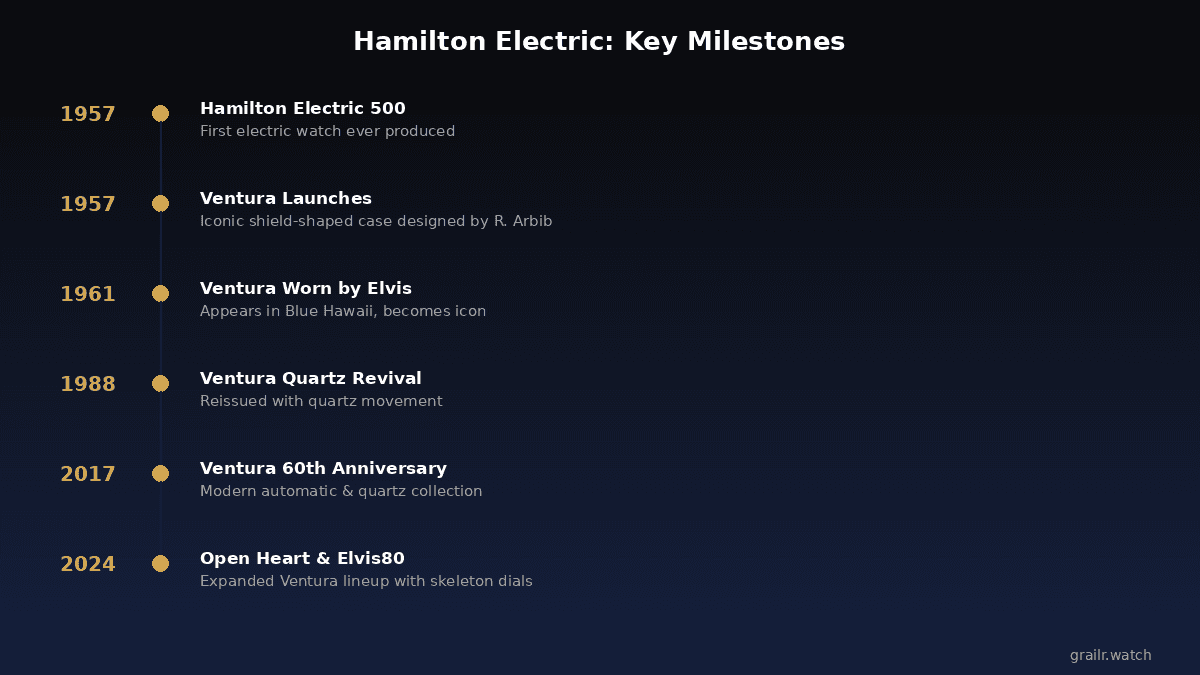
Timeline of Hamilton Electric caliber development, 1957–1969
Caliber Evolution: 500 to 505
The original caliber 500 was an engineering marvel with a critical weakness. Its contact wires — five times finer than a human hair — made and broke an electrical circuit 18,000 times per hour to deliver impulses to the balance wheel. The system worked, but those microscopic wires were fragile. Contamination from skin oils, humidity, or simple wear could cause the contacts to arc, corrode, or break entirely. Early owners reported erratic timekeeping and unexpected stops, and service centres found the wires challenging to replace.
Hamilton responded quickly. The caliber 500A addressed some of the contact-wire issues with improved materials, followed by the 501 and 502 variants that refined the impulse mechanism. But the real breakthrough came in 1959 with the caliber 505, which redesigned the contact system for substantially greater reliability. The 505 kept the same 11-jewel, electromagnetic balance-wheel architecture but used sturdier contact points that tolerated daily wear far better than the originals.
| Specification | Caliber 500 (1957) | Caliber 505 (1959) |
|---|---|---|
| Jewels | 11 | 11 |
| Frequency | 18,000 vph | 18,000 vph |
| Power Source | 1.5V battery | 1.5V battery |
| Contact System | Ultra-fine wire (fragile) | Redesigned contacts (robust) |
| Battery Life | ~1 year | ~1 year |
| Reliability | Problematic in daily wear | Suitable for daily wear |
| Collector Value | Higher (rarity) | Higher (usability) |
Production of Hamilton Electric movements continued through the late 1960s before the arrival of quartz technology rendered the electromagnetic balance-wheel concept obsolete. In total, Hamilton produced electric watches for just over a decade — a short window that makes surviving examples genuinely scarce. Understanding which caliber sits inside a vintage Hamilton Electric is essential for anyone comparing movement technologies, and it directly affects both reliability and value.
The Ventura Design and the Elvis Connection
The Hamilton Electric was a technological breakthrough, but it was the Ventura case that made it unforgettable. Designed by industrial designer Richard Arbib in 1957, the Ventura broke every convention of mid-century watch design. Its asymmetric shield shape — wider at the top, tapering to a point at 6 o’clock — looked like nothing else on any jeweller’s counter. Arbib, who had also designed cars and appliances, brought an automotive sensibility to the case: flowing lines, dramatic angles, and an aggressive stance on the wrist.
The design was polarizing in 1957, and it remains polarizing today. You either love it or you don’t — there is no mistaking it for anything else. That singularity is precisely why the Ventura has endured while dozens of other 1950s watch designs have been forgotten. It was the first watch to prove that a wristwatch could be a design statement, not just an instrument.
The Elvis moment: In 1961, Elvis Presley wore a 14K gold Hamilton Ventura in the film Blue Hawaii. The image of Elvis with the shield-shaped watch on his wrist became one of the most recognizable product placements in cinema history. Hamilton later named its automatic Ventura series “Elvis80” in tribute to what would have been his 80th birthday, a line that continues today.
The Ventura also appeared on the wrists of the Men in Black franchise cast (1997, 2002, 2012, 2019), introducing the design to a new generation. Unlike many vintage watch revivals that soften the original for modern tastes, Hamilton has kept the Ventura’s shield shape essentially unchanged for nearly seven decades. For buyers exploring watches with genuine design heritage in the under-$2,000 range, the Ventura stands in a class of its own.
The design’s longevity is even more remarkable when you consider how many mid-century watch shapes disappeared. Hamilton itself produced dozens of Electric case designs in the late 1950s and 1960s — the Pacer, Nautilus, Regulus, Altair, and Vega, among others. Some were round, some cushion-shaped, some tonneau. None survived as a production model into the 21st century except the Ventura. Arbib’s shield shape turned out to be not just a novelty of its era but a genuinely timeless design — one that looked as fresh on a 2019 movie screen as it did in a 1957 jeweller’s window.
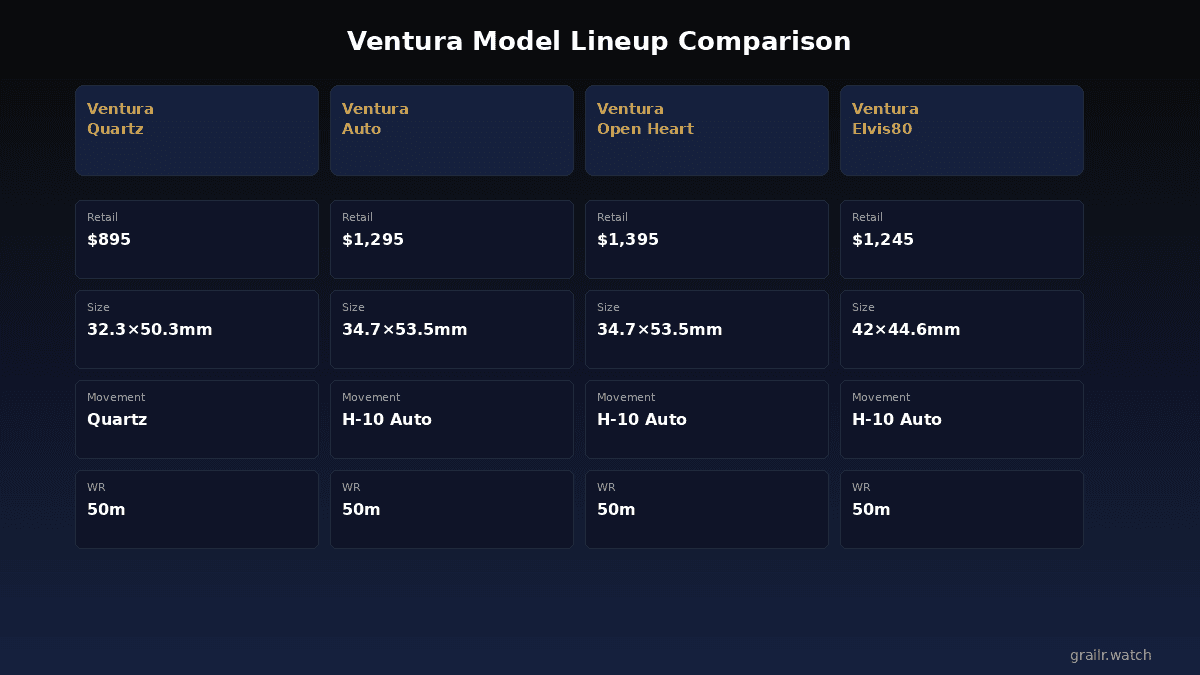
Modern Ventura lineup — from the quartz original to the Elvis80 Skeleton
Modern Ventura Lineup and Pricing
Today’s Hamilton Ventura collection, produced under the Swatch Group umbrella, spans quartz time-only pieces to skeletonized automatics. All models share 50m water resistance, stainless-steel construction, and that unmistakable shield silhouette. Prices range from $1,075 to $2,275 — making the Ventura one of the most distinctive Swiss watches available under $2,500.
| Model | Size | Movement | Price |
|---|---|---|---|
| Ventura Quartz | 32×50mm | F05.111 (quartz) | $1,075 |
| Ventura S Quartz | 24×36mm | Quartz | $1,075 |
| Ventura Chrono Quartz | 32×50mm | Quartz chronograph | $1,245 |
| Ventura Elvis80 Auto | 42×45mm | H-10 (80hr reserve) | $1,945–$1,995 |
| Ventura Elvis80 Skeleton | 42×45mm | H-10S (80hr reserve) | $2,275 |
| Ventura XXL Auto | 46×46mm | H-10 (80hr reserve) | $1,845 |
| Ventura XXL Skeleton | 46×46mm | H-10S (80hr reserve) | $2,175 |
| Ventura Edge Skeleton | 51×47mm | H-10S (80hr reserve) | $1,925–$2,025 |
The quartz models are the most faithful to the original Ventura’s proportions. At 32×50mm, the standard Ventura Quartz wears as a mid-size dress watch with the same visual impact as the 1957 original. The smaller Ventura S at 24×36mm offers a more traditional women’s size, though many male collectors also wear the standard quartz comfortably.
The automatic models — particularly the Elvis80 series — run Hamilton’s excellent H-10 caliber with an 80-hour power reserve. That means you can take the watch off Friday evening and put it back on Monday morning without resetting the time. At $1,945–$1,995 for the closed-dial version, the Elvis80 Auto competes directly with watches from Tissot, Longines, and Certina in the affordable Swiss automatic category — but none of those rivals offer anything close to the Ventura’s design identity.
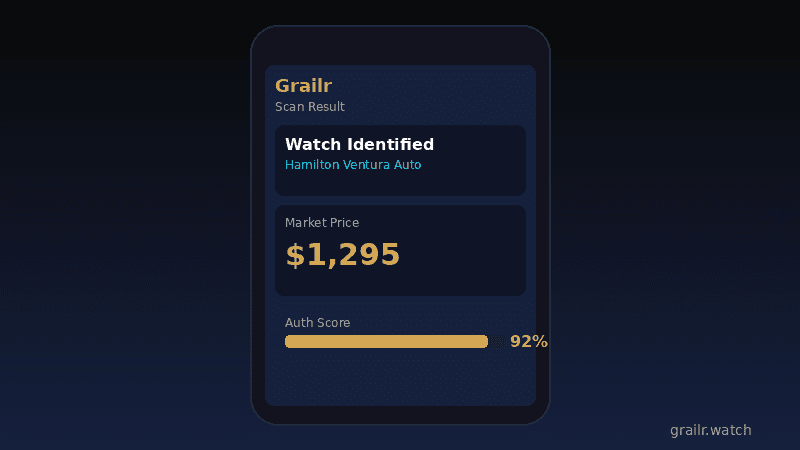
Check Any Watch Price — Instantly
Grailr uses a photo to suggest a watch identity and an indicative price estimate, with active eBay listings where available. Check the exact reference and condition independently; a photo scan cannot authenticate a watch.
- Instant model identification
- Active eBay listings where available
- Authentication confidence scoring
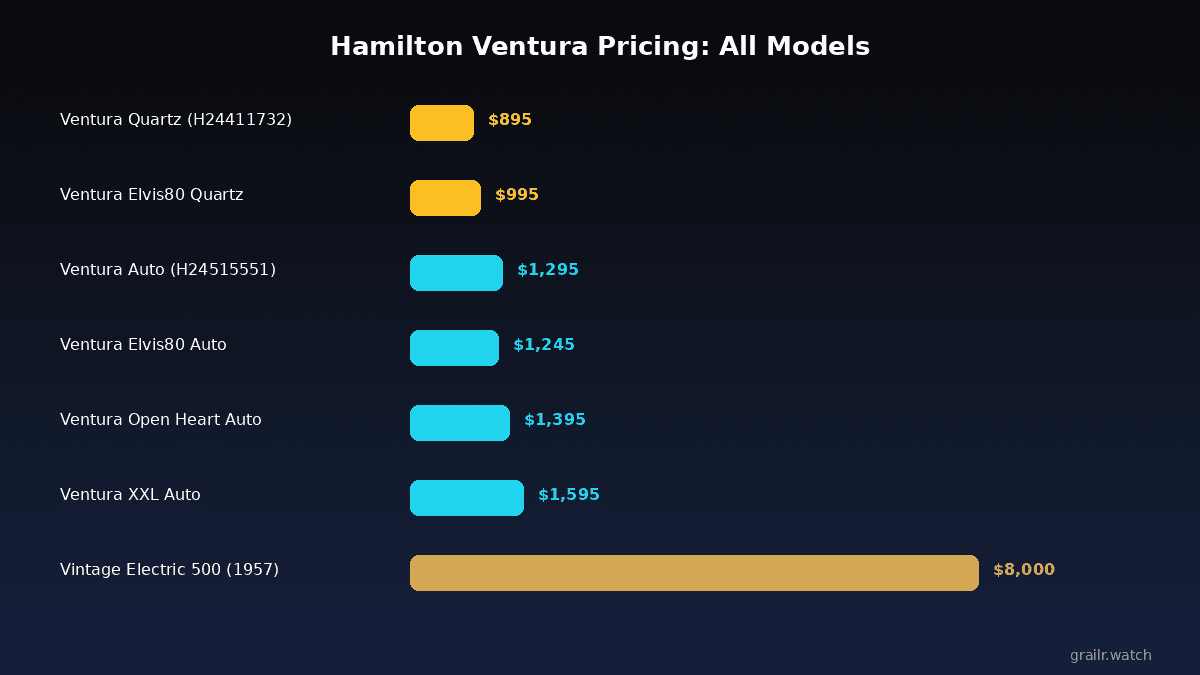
Indicative vintage Ventura pricing by condition and movement type
Vintage Hamilton Electric Collecting
The vintage Hamilton Electric market is small, specialized, and full of traps for the uninformed. Hamilton produced electric watches from 1957 to the late 1960s across dozens of case styles — the Ventura is the most famous, but models like the Pacer, Nautilus, Regulus, and Vega also used electric movements. Understanding what drives value in this niche is essential before spending serious money.
What Drives Value Up
- Original, unconverted electric movement (cal. 500 or 505)
- 14K solid gold case (not gold-filled)
- Original dial without refinishing
- Working condition with original contact wires
What Drives Value Down
- Quartz conversion (common, often undisclosed)
- Aftermarket dial or hands
- Gold-filled case with wear-through
- Non-running movement with corroded contacts
The single most important factor is whether the electric movement is original and unconverted. Many vintage Hamilton Electrics have been converted to quartz by watchmakers who found the original contact-wire mechanism too difficult or expensive to service. A quartz-converted Ventura looks identical on the dial side but lacks the historical significance — and the collector premium — of an original electric movement. Always ask the seller to confirm the movement type, and if possible, request a caseback photograph showing the movement.
Original 14K gold Venturas with working caliber 505 movements typically trade between $2,000 and $4,000, depending on dial condition and case sharpness. Gold-filled versions command less, and quartz-converted examples sell for $500–$1,200 — still attractive watches, but a different proposition entirely. For context on how these fit alongside other Hamilton buying decisions, the vintage Ventura sits in a completely separate market from Hamilton’s modern field watches.
Beyond the Ventura, other Hamilton Electric case designs also attract collectors. The Pacer — a symmetric design with swept-back lugs — is the second most sought-after model. The round-cased Nautilus and cushion-shaped Vega tend to trade for less because their designs, while handsome, don’t carry the same cultural recognition. For any vintage Electric purchase, provenance matters: a watch with documented service history, original box, or period advertising is worth a meaningful premium over a bare watch with unknown background. If the seller cannot confirm whether the movement is original, assume it has been converted until you can inspect it yourself or have a specialist verify it.
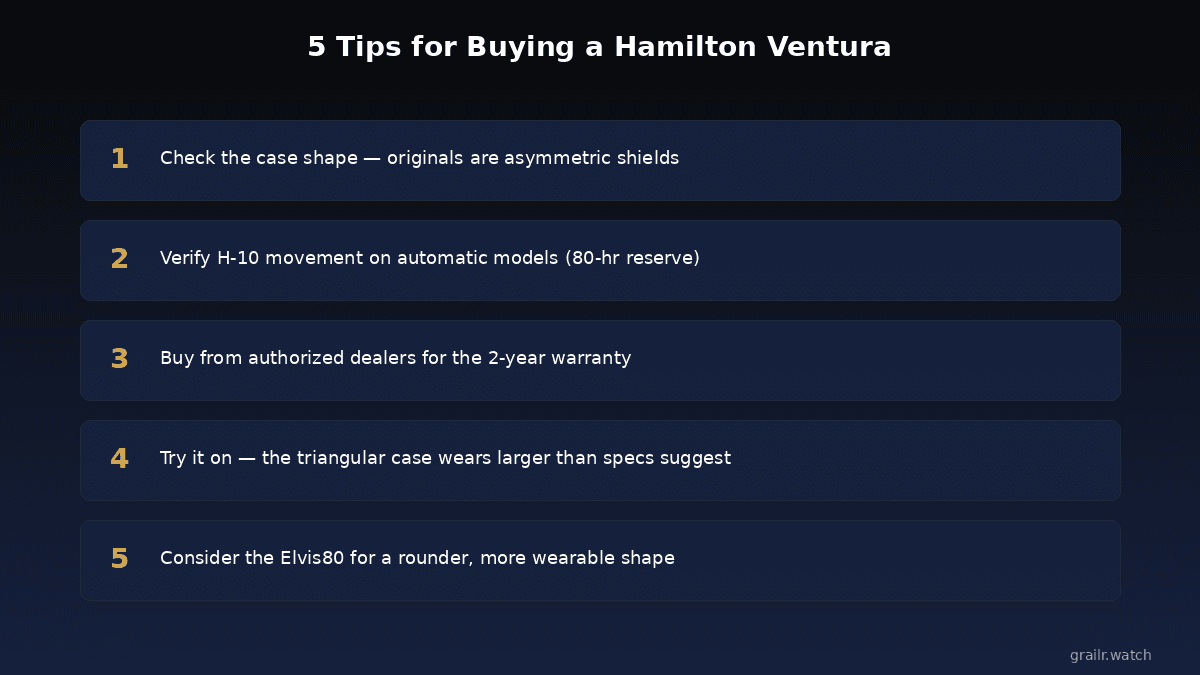
Key considerations when buying a Hamilton Ventura — vintage or modern
Buying Tips for Ventura Collectors
1. Verify the Movement Before Buying Vintage
The most common trap in the vintage Hamilton Electric market is the undisclosed quartz conversion. A converted watch looks identical from the front but is worth a fraction of an original. Ask for a caseback photo, look for the distinctive coil and contact assembly of the electric movement, and be wary of any seller who cannot confirm the movement type. If you’re not confident identifying the movement yourself, have a watchmaker inspect it before purchase.
2. Try the Shield Shape on Your Wrist
The Ventura’s asymmetric case wears differently from any round or rectangular watch. The pointed 6 o’clock extension sits against your wrist bone, and the wider 12 o’clock end can catch on shirt cuffs. Visit a Hamilton boutique or authorized dealer to try one on before committing — this is a shape you either click with immediately or never quite get comfortable wearing.
3. Choose Quartz for the Classic Proportions
The modern quartz Ventura at 32×50mm is the closest to the 1957 original’s dimensions. The automatic Elvis80 at 42×45mm is noticeably larger and thicker to accommodate the H-10 rotor. If you want the sleek, vintage-inspired look, the $1,075 quartz is actually the better choice — and it’s nearly half the price of the automatic.
4. Scan Before You Buy
Use Grailr’s free scanner to photograph any listing and get a suggested identification and indicative price. This is especially useful for vintage Venturas where sellers may misidentify the caliber, case material, or production year. The scan is not proof of authenticity — check the result against the seller documentation and an independent inspection.
5. Budget for Servicing on Vintage Pieces
Finding a watchmaker who can service a Hamilton Electric movement is harder than finding the watch itself. The contact-wire system requires specialized knowledge, and replacement parts are scarce. Budget an additional $300–$600 for a full service from a specialist, and factor that into your purchase price. A non-running vintage Electric is not a bargain if servicing costs more than the watch.
6. Consider the Modern Elvis80 as a Daily Wear
If you love the Ventura design but need a watch you can wear every day without worrying about decades-old contact wires, the Elvis80 Auto is the pragmatic choice. The H-10 movement is proven, parts are available, and the 80-hour power reserve means weekend wear is hassle-free. At under $2,000, it delivers more design personality per dollar than almost any Swiss automatic in its price class.
Frequently Asked Questions
What was the first electric watch ever made?
The Hamilton Electric, powered by caliber 500, debuted on January 3, 1957. It was the world's first battery-powered wristwatch, using a conventional balance wheel driven by electromagnetic impulse rather than a mainspring.
Did Elvis Presley really wear a Hamilton Ventura?
Yes. Elvis wore a 14K gold Hamilton Ventura in the 1961 film Blue Hawaii. The association cemented the Ventura as a cultural icon, and Hamilton later named its automatic Ventura line 'Elvis80' in tribute.
How much is a vintage Hamilton Electric worth?
Original 14K gold Venturas with a working caliber 505 movement typically sell for $2,000-$4,000 depending on condition, dial originality, and whether the movement has been converted to quartz. Unconverted examples with original contact wires command a premium.
What is the difference between caliber 500 and 505?
The caliber 500 (1957) used a contact-wire system five times finer than human hair that proved fragile in daily wear. The caliber 505 (1959) redesigned the contact mechanism for greater reliability while keeping the same electromagnetic balance-wheel principle and 11-jewel count.
Are modern Hamilton Venturas good watches?
Yes. Modern Venturas use proven Swiss quartz or automatic movements (like the H-10 with 80-hour power reserve), offer 50m water resistance, and cost $1,075-$2,275. They deliver the iconic shield shape with modern reliability at a fraction of vintage prices.
Should I buy a vintage or modern Hamilton Ventura?
Buy vintage if you want a genuine piece of horological history and accept the servicing requirements of a 60-year-old movement. Buy modern if you want the iconic design with everyday reliability. Avoid vintage pieces that have been silently converted to quartz -- they lose collector value.
Related Articles
The Bottom Line
The Hamilton Electric holds a unique place in horological history as the watch that bridged the mechanical and electronic eras. The Ventura’s shield-shaped case, designed nearly seven decades ago, remains one of the most distinctive silhouettes in watchmaking. Whether you’re drawn to a vintage 14K gold original with its delicate electromagnetic movement or a modern Elvis80 automatic you can wear every day, the Ventura delivers design identity that no round-cased competitor can match. At $1,075–$2,275 for modern models, it is among the most characterful Swiss watches available at any price.
Spotted a Hamilton You Like?
Grailr uses a photo to suggest a watch identity and an indicative price estimate, with active eBay listings where available. Check the exact reference and condition independently; a photo scan cannot authenticate a watch.
Scan a Watch NowSources and price context
- Hamilton Ventura Collection — Official product page with current specifications, pricing, and the complete Ventura lineup.
- Swatch Group — Hamilton brand profile — Corporate overview of Hamilton within the Swatch Group portfolio, confirming Swiss manufacturing and brand heritage.
These primary sources support the specific history, specification or policy points noted above. Prices and vintage market figures elsewhere in this guide are indicative editorial figures, not a verified transaction dataset or guaranteed returns. Confirm the exact reference, condition and current quote before buying; asking prices are not completed-sale prices.