Hamilton Intra-Matic Guide: Every Model and Price
The Intra-Matic Auto, Chronograph H and Auto Chrono compared — with real pricing, movement specs and honest buying advice.
Price context: this guide includes indicative prices from its original publication period. They have not all been refreshed to current quotes. Use the linked primary sources for specifications and policies, and verify prices independently.

- The Intra-Matic Auto starts at $1,225 — one of the best Swiss dress watches under $1,500
- Three sub-collections: time-only Auto, hand-wound Chronograph H and automatic Auto Chrono
- The H-10 caliber delivers an 80-hour power reserve with a Nivachron antimagnetic balance spring
- The Chronograph H’s hand-wound H-51 caliber makes it thinner and closer to the 1968 original
- Resale retention sits at 40–65% depending on model — buy it to wear, not to flip
A Brief History of the Intra-Matic
Hamilton introduced the original Intra-Matic in 1968, during a period when the brand was transitioning from its American manufacturing roots to Swiss production. The watch represented Hamilton’s answer to the slim, elegant dress watches European makers had been producing for decades — a 38mm case, a clean dial and a movement thin enough to slide under a shirt cuff without snagging.
The name itself references the watch’s “intra” (within) automatic (“matic”) movement, a nod to the self-winding caliber that powered the original. By the early 1970s, the quartz crisis had sidelined most mechanical Hamilton models, and the Intra-Matic disappeared from catalogs entirely.
Hamilton revived the collection in 2014 with a modern reinterpretation that kept the 1960s design language — thin case, domed crystal, retro dial proportions — while updating the movement to the H-10, a modified ETA 2824-2 with an extended 80-hour power reserve. Since then, the line has expanded to include a hand-wound chronograph (the Chronograph H, launched in 2021) and an automatic chronograph (the Auto Chrono), making it Hamilton’s most diverse dress-watch collection.
Today Hamilton sits within the Swatch Group alongside Tissot, Longines and Omega. The brand has been Swiss-made since 2003, though it retains its American heritage branding and its Lancaster, Pennsylvania, headquarters. That positioning — Swiss manufacturing at sub-$3,000 prices with genuine horological history — is what makes the Intra-Matic worth a closer look.
The 2026 Intra-Matic Lineup
The Intra-Matic collection splits into three distinct sub-families, each targeting a different buyer. The time-only Auto is the entry point, the Chronograph H is the purist’s choice, and the Auto Chrono adds convenience with an automatic movement and day-date display. All three share a 40mm case diameter and the 1960s design DNA, but the calibers, thickness and pricing diverge significantly.
Intra-Matic Auto
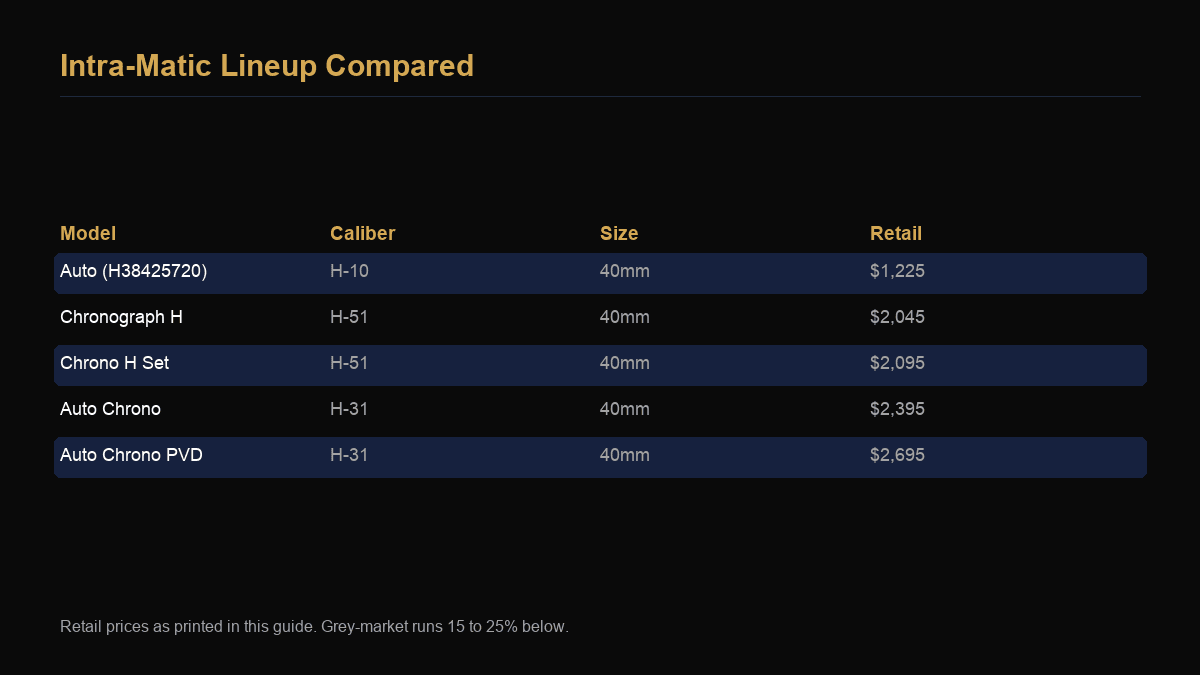
The core of the collection. Reference H38425720 pairs a beige dial with a 40mm stainless-steel case measuring 10.95mm thick. The H-10 caliber inside delivers an 80-hour power reserve — enough to leave the watch on a nightstand from Friday evening to Monday morning and find it still running. A sapphire crystal with anti-reflection coating sits on top, and the whole package is water-resistant to 50 meters (5 bar). At $1,225 on a cow-leather strap, it’s one of the most accessible Swiss automatic dress watches on the market.
Other dial options include silver (H38425140), black (H38425130) and green (H38425560). The green version has become the most sought-after on the secondary market, though Hamilton lists it as “available soon” on its official product page, suggesting limited current stock.
Intra-Matic Chronograph H
The Chronograph H is the closest modern Hamilton gets to a vintage-faithful reissue. Reference H38429541 uses the hand-wound H-51 caliber — no rotor, no date window, just hours, minutes, small seconds and a 30-minute chronograph counter. The box-shaped sapphire crystal adds visual depth that catches light differently from the flat crystals on the Auto models.
Water resistance jumps to 100 meters (10 bar), which is unusually generous for a dress chronograph and makes it genuinely swimable. Pricing starts at $2,045 on a leather strap and $2,095 on a Milanese mesh bracelet. The 2026 variant introduced an updated lume layout and a slightly thicker case-back, though the external dimensions remain identical to the 2021 original.
Intra-Matic Auto Chrono
Where the Chronograph H appeals to purists, the Auto Chrono targets buyers who want the convenience of automatic winding with a chronograph complication. The H-31 caliber, based on the proven ETA 7753, adds a day-date display at 3 o’clock alongside the chronograph sub-dials. That makes the case thicker than the hand-wound version, but the 60-hour power reserve means the watch keeps running through a weekend without wear.
The 2025 “blackout trio” introduced three PVD-coated versions with black cases and matching black dials, reviewed favourably by Fratello Watches. Pricing ranges from $2,395 for standard steel to $2,695 for the PVD versions, positioning the Auto Chrono as the collection’s flagship.
| Model | Caliber | Size | WR | Price |
|---|---|---|---|---|
| Intra-Matic Auto | H-10 (auto) | 40 × 10.95mm | 50m | $1,225 |
| Chronograph H | H-51 (hand-wound) | 40 × 13.65mm | 100m | $2,045–$2,095 |
| Auto Chrono | H-31 (auto) | 40 × 14.75mm | 100m | $2,395–$2,695 |
Movement Comparison: H-10 vs H-51 vs H-31
Each Intra-Matic sub-family uses a different caliber, and those differences matter more than the spec sheets suggest. The choice between them shapes how the watch wears, how often you interact with it and how it ages over time.
H-10: The 80-Hour Workhorse
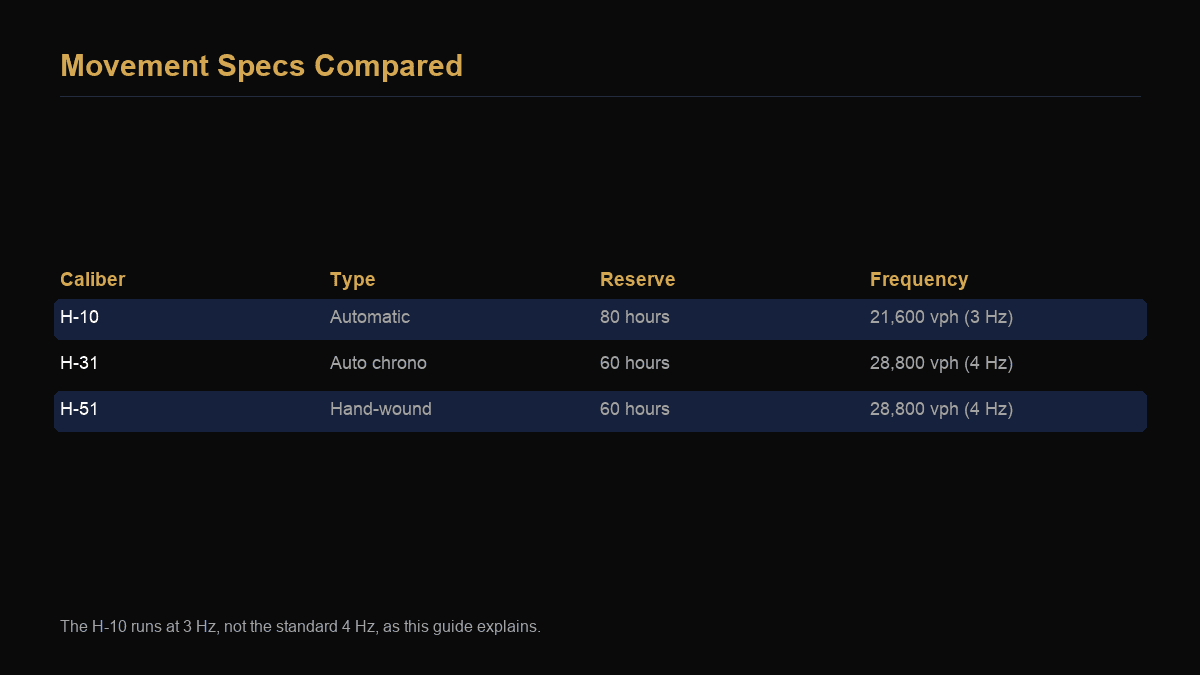
The H-10 is Hamilton’s version of the Swatch Group’s extended-reserve platform, derived from the ETA 2824-2. It runs at 21,600 vibrations per hour (3 Hz) rather than the standard 28,800 vph, which is how it achieves the 80-hour reserve without a larger mainspring barrel. The trade-off is a slightly less smooth sweep of the seconds hand, though in practice the difference is invisible on a dress watch without a running-seconds sub-dial.
The Nivachron balance spring is the other headline feature. Developed by the Swatch Group from a niobium-zirconium alloy, it resists magnetic fields up to roughly 200 gauss — enough to shrug off a phone or laptop placed near the watch. For context, a standard Nivarox spring begins losing accuracy around 60 gauss. COSC certification is not part of the package at this price, but Hamilton specifies accuracy of −10/+10 seconds per day, which most owners report the H-10 comfortably beats.
H-51: The Purist’s Caliber
The H-51 is a hand-wound chronograph movement developed specifically for the Chronograph H. Without a winding rotor, the case-back sits flatter, which keeps the total thickness to 13.65mm — thin for a mechanical chronograph. The daily winding ritual is part of the appeal: 30 to 40 turns of the crown to full wind, with a 60-hour reserve once fully wound.
It runs at 28,800 vph (4 Hz), giving the chronograph seconds hand a smoother sweep than the H-10’s time-only seconds. The 30-minute chronograph counter at 3 o’clock and running seconds at 9 o’clock follow the classic two-register layout that the 1968 original used. No date complication means the dial stays clean and symmetrical.
H-31: Automatic Chronograph Convenience
The H-31 is based on the ETA 7753, a proven cam-lever chronograph caliber that has been in production since the early 2000s. It adds a day-date display to the chronograph function, which gives the dial more visual density than the Chronograph H. The 60-hour power reserve is a Swatch Group modification to the standard 7753, which originally offered around 46 hours.
At 14.75mm thick, the Auto Chrono is the chunkiest member of the Intra-Matic family, though it still wears smaller than its specs suggest thanks to the short lugs and curved case-back. If you want a chronograph you can set and forget, this is the one. If you want the thinnest, cleanest version, the H-51 is the better choice.
| Spec | H-10 | H-51 | H-31 |
|---|---|---|---|
| Type | Automatic | Hand-wound | Automatic |
| Base | ETA 2824-2 | Proprietary | ETA 7753 |
| Power Reserve | 80 hours | 60 hours | 60 hours |
| Frequency | 21,600 vph | 28,800 vph | 28,800 vph |
| Complications | Date (optional) | Chrono, small secs | Chrono, day-date |
| Balance Spring | Nivachron | Nivarox | Nivarox |
| Thickness Impact | 10.95mm case | 13.65mm case | 14.75mm case |
Check Any Watch Price in Seconds
Grailr scans your watch photo and pulls live pricing from Chrono24, eBay, and Jomashop.
- AI identifies brand, model & reference number
- Live market prices from 3+ sources
- Authentication confidence score
Pricing and Value for Money
The Intra-Matic occupies a pricing sweet spot that Hamilton has deliberately carved out. At $1,225 for the time-only Auto, it costs less than a Tissot Gentleman Powermatic 80 Silicium ($775) once you account for the sapphire crystal and anti-reflection coating that the Tissot charges extra for in its open-heart variant. Against the Longines Heritage Classic at $2,050, the Intra-Matic Auto delivers comparable build quality and a similar power reserve for 40% less.
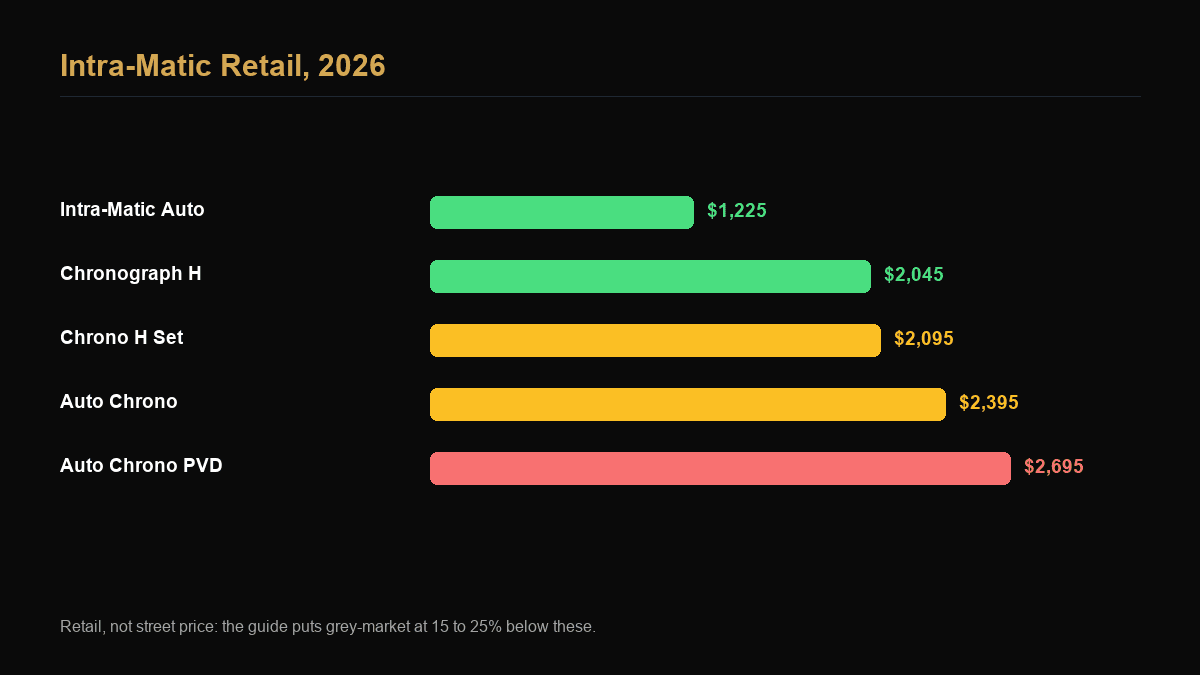
The Chronograph H at $2,045 is where the value equation gets interesting. A hand-wound chronograph from a Swiss brand at this price is rare. The closest competitor is the Junghans Meister Chronoscope at around $2,650, which uses a Valjoux 7750 base and adds a date window. The Hamilton’s box-shaped crystal and cleaner two-register layout give it more visual character, and the 100m water resistance is a practical advantage over the Junghans’ 30m.
The Auto Chrono at $2,395 to $2,695 faces stiffer competition. The Tissot PRX Chronograph at $695 uses a quartz movement but costs less than half. The Longines Spirit Flyback Chronograph at $3,175 uses a column-wheel movement and offers a COSC certification. The Hamilton sits between them, offering mechanical chronograph functionality without the premium that comes with column-wheel construction or chronometer certification.
Grey-market prices run roughly 15 to 25% below retail across the collection. A brand-new Intra-Matic Auto from an unauthorized dealer typically lists around $950 to $1,050, though you lose the two-year Hamilton warranty. If the warranty matters to you, Hamilton’s authorized dealer network is the safer path, especially given that the price difference is modest in absolute terms.
Resale Value and What to Expect
Hamilton watches are not investment pieces, and anyone buying an Intra-Matic expecting to break even on resale will be disappointed. That said, the brand holds up better than most sub-$3,000 Swiss watches, and the Intra-Matic line does slightly better than Hamilton’s sport models because dress watches attract fewer impulse buyers.
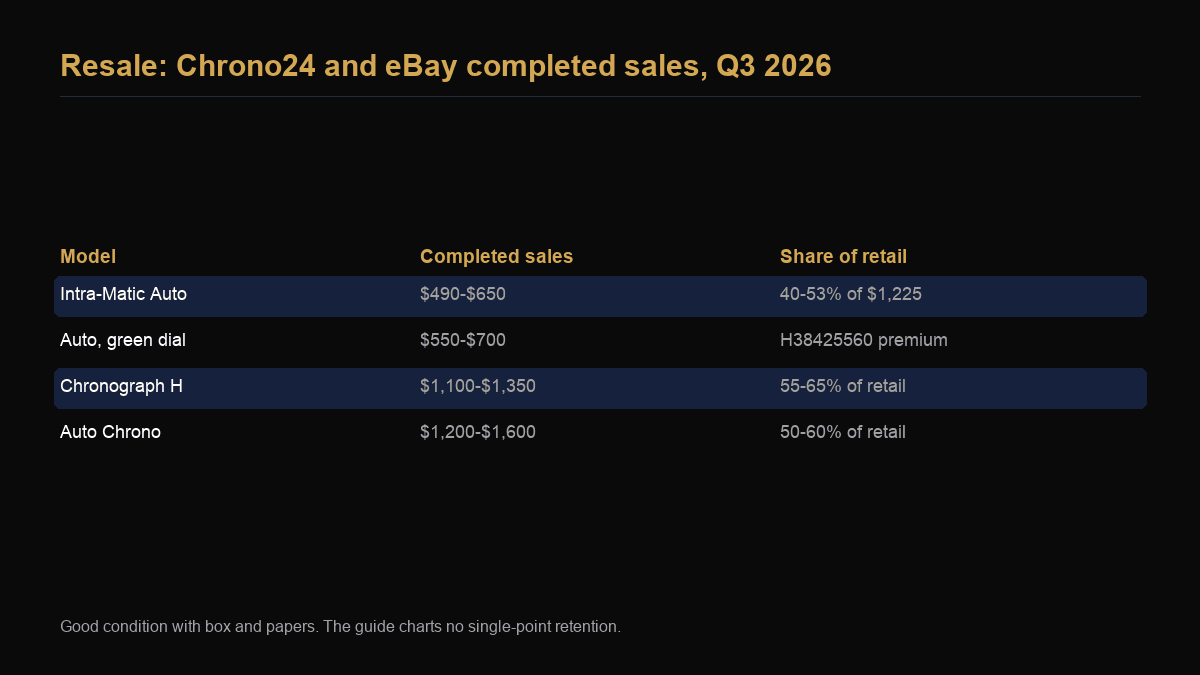
Based on completed sales data from Chrono24 and eBay in Q3 2026, the Intra-Matic Auto in good condition with box and papers sells for $490 to $650, representing roughly 40 to 53% of its $1,225 retail price. The green-dial variant (H38425560) commands a slight premium, selling for $550 to $700 in similar condition.
The Chronograph H performs better, with completed sales in the $1,100 to $1,350 range — roughly 55 to 65% of retail. The hand-wound movement and limited availability compared to the automatic models support the higher retention. The Auto Chrono falls in between, with typical resale prices of $1,200 to $1,600, or about 50 to 60% of retail.
The takeaway: buy the Intra-Matic because you want to wear it, not because you expect to recover your investment. If resale value is a primary concern, the best watches under $2,000 guide covers alternatives with better retention.
How It Compares to the Competition
The Intra-Matic doesn’t exist in a vacuum. At its price point, buyers are cross-shopping Tissot, Longines, Seiko and even the lower end of the Omega range. Here’s how the key competitors stack up against the Intra-Matic Auto, since it’s the model most buyers are considering.
| Watch | Caliber | Reserve | Size | Price |
|---|---|---|---|---|
| Hamilton Intra-Matic Auto | H-10 | 80h | 40mm | $1,225 |
| Tissot PRX Powermatic 80 | Powermatic 80 | 80h | 40mm | $725 |
| Longines Heritage Classic | L893.6 | 72h | 38.5mm | $2,050 |
| Seiko Presage Sharp Edged | 6R35 | 70h | 39.3mm | $950 |
| Junghans Max Bill Auto | J800.1 | 38h | 38mm | $1,150 |
The Tissot PRX is the obvious value champion at $725, but its integrated-bracelet sports-watch design is a completely different aesthetic. If you want a dress watch specifically, the PRX isn’t a direct substitute. The Longines Heritage Classic is the closest competitor in style and quality, though it costs $825 more and its 38.5mm case may feel small on larger wrists.
The Seiko Presage Sharp Edged offers remarkable dial finishing for $950, but the 6R35 movement lacks the Nivachron antimagnetic spring and the sapphire crystal quality is a step below. The Junghans Max Bill is the Bauhaus alternative — thinner, more minimalist, with a domed Plexiglas crystal that scratches easily but can be polished. Its 38-hour reserve and mineral crystal are the trade-offs for that clean design. For a broader comparison, see our dress watch guide.
Buying Tips
Size it on your wrist first. The 40mm case wears larger than the number suggests because the lugs extend further than comparable dress watches. If your wrist is under 6.5 inches, try the watch in person before ordering. Hamilton’s authorized dealer network includes most major department stores and independent jewelers.
Consider the strap carefully. The stock cow-leather strap on the Auto is functional but unremarkable. Upgrading to a suede or shell cordovan strap in the 20mm lug width transforms the watch’s character. Budget $50 to $150 for a quality aftermarket strap — our Hamilton Khaki Field guide covers strap options that fit both collections.
Watch for sales cycles. Hamilton runs periodic promotions through authorized dealers, typically around Father’s Day, Black Friday and the December holiday season. Discounts of 10 to 15% are common during these windows. The grey market offers deeper cuts year-round, but at the cost of warranty coverage.
Chronograph H vs Auto Chrono. If you’re torn between the two chronographs, the deciding factor is thickness. The Chronograph H at 13.65mm slides under a dress shirt cuff; the Auto Chrono at 14.75mm may not. Both offer 100m water resistance and similar power reserves. The Chronograph H’s hand-winding requirement is a daily ritual that some owners enjoy and others find tedious — only you know which camp you fall into.
Check the lume. The Intra-Matic uses Super-LumiNova on the hands and dial, but the application is thin on the time-only models. If nighttime legibility matters, inspect the watch under low light before committing. The chronograph models have slightly more generous lume plots. For those who want to understand the broader chronograph landscape, our dedicated guide explains how pushers and sub-dials work across all price ranges.
Frequently Asked Questions
What movement does the Hamilton Intra-Matic use?
The Intra-Matic Auto uses the H-10 caliber, a modified ETA 2824-2 with an 80-hour power reserve and Nivachron antimagnetic balance spring. The Chronograph H uses the hand-wound H-51 caliber, and the Auto Chrono uses the H-31 based on the ETA 7753. All three are Swiss-made and assembled at Hamilton’s facility in Biel/Bienne, Switzerland.
How much does the Hamilton Intra-Matic cost?
The Intra-Matic Auto retails at $1,225 on a leather strap. The Chronograph H costs $2,045 on leather or $2,095 on mesh. The Auto Chrono ranges from $2,395 to $2,695 depending on the finish, with the PVD blackout versions at the top of the range. Grey-market prices run 15 to 25% below these figures.
Is the Hamilton Intra-Matic a good first dress watch?
Yes. The 40mm case at 10.95mm thick sits comfortably under a cuff, the H-10 caliber delivers an 80-hour power reserve that survives a weekend off the wrist, and the $1,225 retail price undercuts most Swiss competitors. The sapphire crystal, Nivachron spring and 50m water resistance add practical durability that cheaper dress watches lack.
Does the Hamilton Intra-Matic hold its value?
Hamilton watches typically retain 40 to 55% of retail on the secondary market. The Intra-Matic Chronograph H performs best at 55 to 65% retention, thanks to limited production and its hand-wound caliber. The Auto model settles around 40 to 53%. These are typical figures for sub-$3,000 Swiss watches — buy it to wear, not to resell.
What is the difference between the Intra-Matic Chrono and the Auto Chrono?
The Chronograph H is hand-wound (H-51 caliber) with no date display, a thinner 13.65mm case and a cleaner two-register dial. The Auto Chrono is self-winding (H-31 caliber) with a day-date window, a thicker 14.75mm case and three sub-dials. The hand-wound version is closer to the 1968 original’s spirit; the automatic version is more convenient for daily wear.
Is the Hamilton Intra-Matic water resistant?
The Intra-Matic Auto is rated to 5 bar (50 meters), which covers handwashing and rain but not swimming or snorkelling. Both chronograph models are rated to 10 bar (100 meters), which is safe for recreational swimming and light water sports. Neither model is suitable for diving.
Related Articles
Hamilton Khaki Field Guide
Every Hamilton Khaki Field model from the $525 Mechanical to the $945 Murph compared.
Best Watches Under $2,000
Tissot PRX, Longines Spirit, Oris Aquis and Hamilton Khaki compared with 2026 prices.
Best Dress Watches at Every Price
The best dress watches from $130 to $37,000 ranked by case size, movement and resale.
Chronograph Watches Explained
How pushers, sub-dials and movements work, plus the best chronographs at every price.
The Bottom Line
The Hamilton Intra-Matic is one of the strongest Swiss dress-watch values on the market. The $1,225 Auto delivers sapphire glass, an 80-hour antimagnetic movement and genuine 1960s design character at a price that most competitors can’t match. The $2,045 Chronograph H goes further, offering a hand-wound chronograph experience that usually requires spending $3,000 or more from other Swiss brands.
The weak points are real but manageable. Resale retention is mediocre, the stock leather strap deserves an upgrade, and the 40mm case may overshoot some wrists. None of these are dealbreakers at the price — they’re the trade-offs you accept for Swiss manufacturing at this level.
If you’re buying your first Swiss dress watch, the Intra-Matic Auto belongs on your shortlist. If you want a mechanical chronograph that channels the 1960s without pretending to be something it’s not, the Chronograph H is the one to get.
Know What Your Watch Is Worth
Upload a photo of any watch and Grailr returns the reference number, live market prices and an authentication confidence score — in seconds.
Try Grailr Free