Chronograph Watches Explained: How They Work
Everything you need to know about the chronograph complication — from the pushers and sub-dials on your wrist to the column wheels and clutch systems inside the case.
Price context: this guide includes indicative prices from its original publication period. They have not all been refreshed to current quotes. Use the linked primary sources for specifications and policies, and verify prices independently.
- A chronograph is a built-in stopwatch controlled by two pushers that operates independently of the regular timekeeping
- Mechanical chronographs add 50–200+ parts to the movement, which is why they cost and service more than time-only watches
- Column-wheel movements offer a smoother feel than cam-switched ones, but both are reliable at their price tier
- You can buy a competent chronograph for under $300 or spend six figures on a rattrapante — the right choice depends on your use case
- Flyback and split-seconds are the two advanced chronograph types — both developed for aviation and motorsport timing
What Is a Chronograph on a Watch?
A chronograph is a watch complication that adds a stopwatch function to the regular time display. Press the top pusher at two o’clock and an extra seconds hand begins sweeping around the dial, timing an event. Press the same pusher again to stop it. Press the lower pusher at four o’clock to reset the hand to twelve. The entire sequence operates independently of the hour, minute and running-seconds hands — your watch keeps time normally whether the chronograph is engaged or not.
The word itself comes from the Greek chronos (time) and grapho (to write). That etymology points back to the earliest chronographs, which literally marked time on a dial with a drop of ink. Modern chronographs replaced ink with mechanical hands and, eventually, with electronic circuits, but the purpose remains the same: to measure elapsed time on demand.
Chronographs are among the most popular complications in watchmaking. They appear in everything from $50 quartz sport watches to six-figure haute horlogerie pieces. Whether you need one for timing laps, cooking or simply like the look of the extra sub-dials, the function is practical in a way that many complications — tourbillons, minute repeaters — are not.
If you’re comparing this to a chronometer, note that the two words sound alike but mean different things. A chronograph is a stopwatch complication. A chronometer is a precision-certified movement that has passed testing by an official body such as COSC. A watch can be both, one, or neither. The Omega Speedmaster Moonwatch, for example, is a chronograph but not a chronometer in its standard configuration.
Anatomy of a Chronograph Dial
A chronograph dial carries more information than a time-only watch, but once you understand the layout, every chronograph reads the same way. Here are the core components you’ll find on most models.
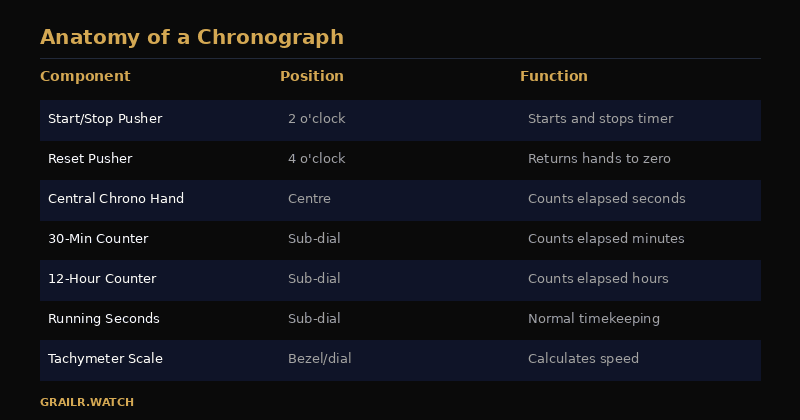
| Component | Position | Function |
|---|---|---|
| Start/stop pusher | 2 o’clock | Engages and pauses the chronograph timing hand |
| Reset pusher | 4 o’clock | Returns all chronograph hands to zero (only works when stopped on most models) |
| Central chrono seconds | Centre of dial | Long hand that sweeps to count elapsed seconds |
| 30-minute counter | Usually 3 o’clock | Sub-dial that counts elapsed minutes up to 30 (or 60 on some calibers) |
| 12-hour counter | Usually 6 o’clock | Sub-dial that counts elapsed hours up to 12 |
| Running seconds | Usually 9 o’clock | Continuous small seconds — confirms the movement is running |
| Tachymeter bezel | Outer ring or chapter ring | Scale for converting elapsed seconds to speed in units per hour |
Not every chronograph uses three registers. The bicompax layout (two sub-dials) drops one counter for a cleaner look — the Tudor Black Bay Chrono and many vintage chronographs use this format. The tricompax layout (three sub-dials) is the most common, while rare models like the Patek Philippe 5970 use a fourth counter for additional complications such as a perpetual calendar.
A tachymeter bezel lets you calculate speed without math. Start the chronograph, observe an event over a known distance (usually one kilometre or one mile), and the number the seconds hand points to on the tachymeter scale is the speed in units per hour. Pulsometer and telemeter scales, once used by doctors and artillery officers, work on the same principle but measure heart rate or distance to a sound source.
How Chronograph Movements Work
The chronograph mechanism adds a layer of engineering on top of the base timekeeping movement. When you press the start pusher, a series of levers engage a clutch that connects the chronograph’s gear train to the movement’s fourth wheel. The seconds hand begins to sweep. Pressing again disengages the clutch. Pressing reset activates a hammer that snaps the hands back to zero.
What varies between calibers is how the switching happens, and the two key distinctions are the clutch type and the switching mechanism.
Clutch Types
The horizontal (lateral) clutch uses two gears that slide alongside each other. It is the traditional design found in calibers like the Valjoux 7750. The engagement can cause a tiny jump of the seconds hand because the gears mesh as the clutch engages.
The vertical clutch uses friction discs stacked on top of each other, similar to an automotive clutch. It allows the seconds hand to start without any jump because the chronograph gear train is always spinning — pressing start simply locks it to the seconds hand. Most modern in-house calibers use vertical clutches, including the Rolex 4130, Omega 9300 and Zenith El Primero. The trade-off is greater thickness and complexity.
Switching Mechanisms
A column wheel is a small, castle-shaped component that rotates in precise increments when you press a pusher. Its pillars act as gates that direct levers controlling the start, stop and reset functions. Column wheels are expensive to manufacture and are considered the hallmark of a high-quality chronograph. Calibers with column wheels include the Hamilton H-51, Zenith El Primero and Seagull ST19.
A cam-switched (sometimes called lever-actuated) mechanism uses a shaped cam and levers instead of a column wheel. It requires fewer parts and less finishing, which is why most affordable chronographs use it. The Valjoux 7750 is the most famous cam-switched caliber. The feel of the pushers tends to be slightly less precise than a column wheel, but functionally both systems are reliable.
Power Source: Mechanical, Quartz and Hybrid
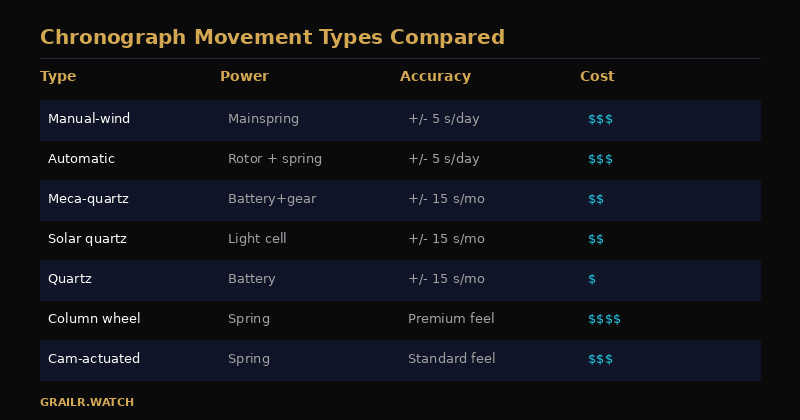
Manual-wind chronographs require you to wind the crown daily. They tend to be thinner because they skip the automatic rotor. The Omega Speedmaster Moonwatch Professional is the most famous example.
Automatic chronographs wind themselves through a rotor as you wear them. They are thicker but more convenient. Most modern chronographs above $1,000 are automatic.
Quartz chronographs use a battery-powered circuit. They measure to 1/10 or even 1/100 of a second — far more precisely than any mechanical chronograph, which typically resolves to 1/5 or 1/8 of a second. Solar-powered variants like the Seiko Speedtimer SSC813 can run for six months on a full charge.
Meca-quartz is a hybrid that pairs a quartz timekeeping module with a mechanical chronograph module. The Seiko VK63 and VK64 are the most common examples. They give a sweeping chronograph seconds hand (like a mechanical) with quartz accuracy and a sub-$500 price point. The Yema Rallygraf at $369 uses this approach.
Notable Chronograph Calibers Compared
The caliber inside a chronograph determines its accuracy, power reserve, thickness and serviceability. Here are the movements you’ll encounter most often, from workhorse to exotic.
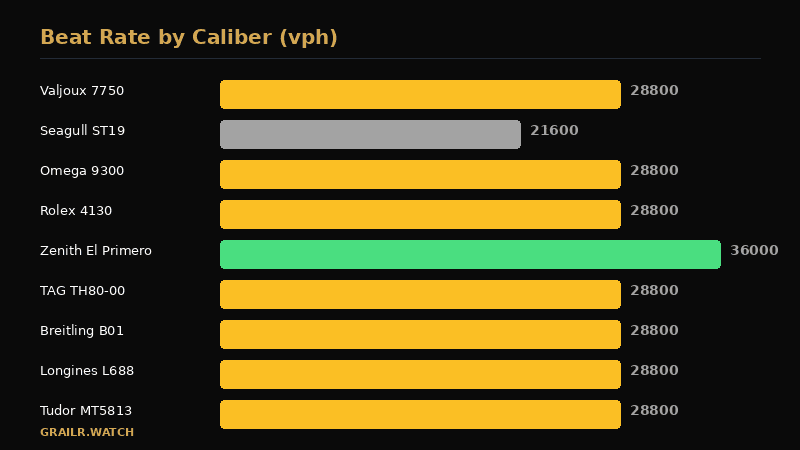
| Caliber | Brand | Type | Frequency | Power Reserve | Switching |
|---|---|---|---|---|---|
| Valjoux 7750 | ETA / Sellita | Auto | 28,800 vph | 48 h | Cam, horizontal clutch |
| ST19 | Seagull (Tianjin) | Manual | 21,600 vph | 45 h | Column wheel, horizontal |
| El Primero 400 | Zenith | Auto | 36,000 vph | 50 h | Column wheel, horizontal |
| Caliber 4130 | Rolex | Auto | 28,800 vph | 72 h | Column wheel, vertical clutch |
| Co-Axial 9300 | Omega | Auto | 28,800 vph | 60 h | Column wheel, vertical clutch |
| B01 | Breitling | Auto | 28,800 vph | 70 h | Column wheel, vertical clutch |
| H-51 | Hamilton | Manual | 28,800 vph | 60 h | Column wheel, horizontal |
| L688 | Longines | Auto | 28,800 vph | 66 h | Column wheel, vertical clutch |
| TH80-00 | TAG Heuer | Auto | 28,800 vph | 70 h | Isograph (flexure-based) |
The Valjoux 7750 (and its Sellita clone, the SW500) is the workhorse. It powers chronographs from Sinn, Fortis, Oris and dozens of other brands. Its cam-switched mechanism is proven and affordable to service, though the off-centre micro-rotor can make it wobble noticeably. The movement has been in production since 1974.
The Zenith El Primero, launched in 1969, was the first automatic chronograph movement. Its 36,000 vph frequency allows 1/10-second resolution on models with the right dial markings. The 2026 Defy El Primero 21 pushes that to 1/100th of a second with a separate 360,000 vph escapement for the chronograph.
TAG Heuer’s new TH80-00, debuted in the 2026 Monaco Evergraph, replaces traditional levers and springs with a flexure-based “Isograph” switching system. It claims to reduce friction and improve longevity, though long-term reliability data is not yet available.
Flyback, Rattrapante and Monopusher
Beyond the standard start-stop-reset sequence, three advanced chronograph types exist. Each was developed for a specific professional need.
A flyback chronograph lets you reset and restart with a single press of the lower pusher while the chronograph is running. On a standard chronograph you must stop, reset, then start again — three presses. The flyback was developed for pilots who needed to time successive legs of a flight without losing a beat. The Omega Speedmaster ’57, the Longines Avigation BigEye and the Frederique Constant FC-760 all offer flyback.
A rattrapante (split-seconds) chronograph has two chronograph seconds hands stacked on top of each other. Both start together, but pressing a third pusher stops one hand while the other continues — allowing you to time two events with a common start. The stopped hand “catches up” to the running hand when you press the split pusher again. The A. Lange & Söhne Triple Split is the only watch that extends this to minutes and hours.
A monopusher chronograph uses a single button — usually integrated into the crown — to control start, stop and reset in sequence. It is the oldest chronograph design and appears in pieces like the Montblanc 1858 Monopusher and Longines Master Collection Chrono Monopusher. The simplicity appeals to purists, though you cannot hold a split time.
Check Any Watch Price in Seconds
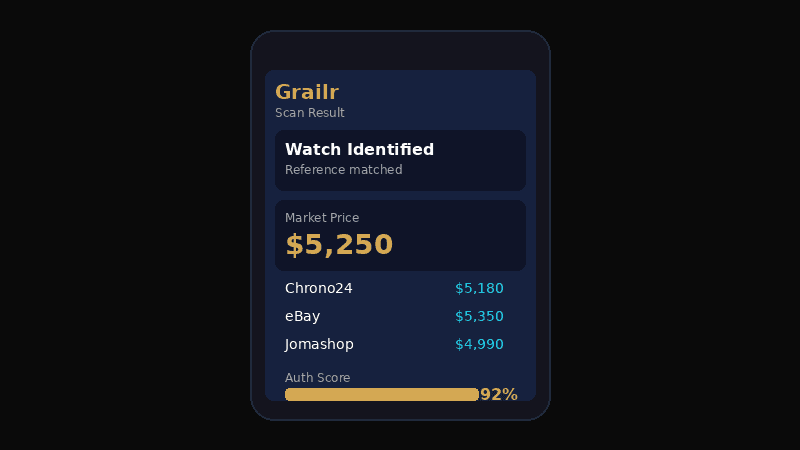
Grailr scans your watch photo and pulls live pricing from Chrono24, eBay, and Jomashop.
- AI identifies brand, model & reference number
- Live market prices from 3+ sources
- Authentication confidence score
Best Chronograph Watches at Every Price
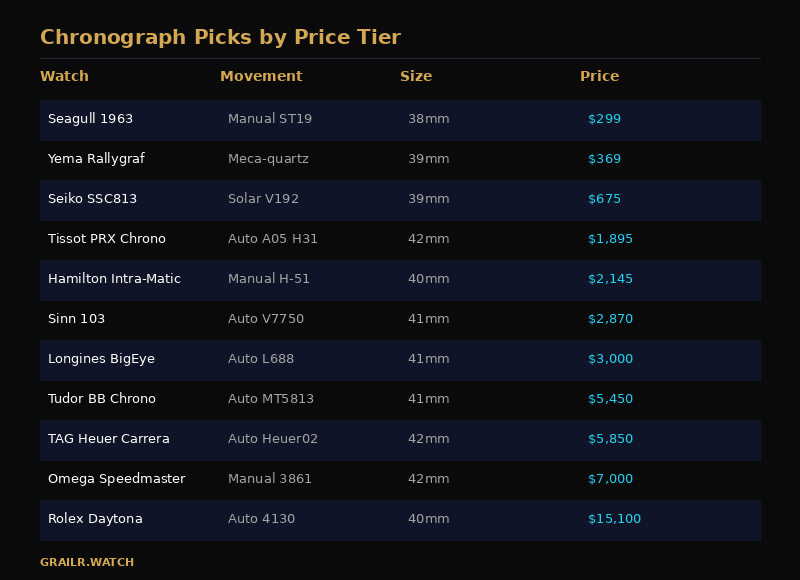
Chronographs span a wider price range than almost any other complication. Here are our picks across four tiers, from a $299 column-wheel manual to a $195,000 perpetual calendar. For a deeper look at the affordable end, see our affordable chronograph guide.
Budget: Under $1,000
The Seagull 1963 ($299) is the standout mechanical chronograph at this price. It uses the ST19 column-wheel movement — a descendant of the Venus 175 — with a sapphire caseback, 38mm acrylic-crystal case and a clean cream dial. The movement is hand-wound with a 45-hour power reserve.
For quartz precision, the Seiko Prospex Speedtimer SSC813 ($675) offers solar power, a six-month reserve, 100-metre water resistance and a 39mm case that sits well under a cuff. The Yema Rallygraf ($369) uses a meca-quartz VK64 movement for a sweeping chrono hand at a quartz price point, housed in a racing-inspired 39mm case.
Mid-Range: $1,000–$3,000
This is where Swiss mechanical chronographs become accessible. The Tissot PRX Automatic Chronograph ($1,895) packs the Valjoux A05 H31 into the integrated-bracelet PRX case. The Hamilton Intra-Matic Chronograph H ($2,145) uses the H-51 column-wheel hand-wound caliber with a 60-hour reserve in a retro-styled 40mm case.
The Sinn 103 ($2,870) is a pilot’s chronograph with a Valjoux 7750 base, 200-metre water resistance and a rotating 60-minute timing bezel. The Longines Avigation BigEye ($3,000) offers the L688 column-wheel caliber with flyback at a price that undercuts most column-wheel competitors by half. For more options in this range, see our TAG Heuer buying guide.
Luxury: $3,000–$10,000
The Tudor Black Bay Chrono ($5,450) is a 41mm bicompax with column-wheel movement and 200-metre water resistance. The TAG Heuer Carrera Chronograph ($5,850+) uses the in-house Heuer 02 with 80-hour power reserve.
The IWC Portugieser Chronograph ($8,400+) is the quintessential dress chronograph at 41mm with its clean 12/6 register layout, while the Breitling Navitimer B01 ($9,700+) at 43mm combines the in-house B01 caliber with the iconic slide-rule bezel.
High-End: $10,000+
The Omega Speedmaster Moonwatch Professional ($7,000+) straddles luxury and high-end — the most historically significant chronograph in production, worn on the Moon in 1969 and still hand-wound today. The Rolex Cosmograph Daytona ($15,100+ retail) commands premiums well above retail on the secondary market thanks to limited supply and the vertical-clutch caliber 4130.
At the exotic end, the Zenith Defy El Primero 21 ($13,000+) measures to 1/100th of a second, and the Patek Philippe 5270P ($195,000+) combines a perpetual calendar with a chronograph in a platinum case. The A. Lange & Söhne Triple Split remains the only triple-rattrapante flyback chronograph ever made.
A Brief History of the Chronograph
The chronograph is one of watchmaking’s oldest complications, predating even the wristwatch itself. Its development tracks the shift from pocket instruments to the wrist-worn tools we know today.
In 1816, Louis Moinet built what is now considered the first chronograph — a device that could measure 1/60th of a second using an ink-tipped hand. In 1821, Nicolas-Mathieu Rieussec patented a similar ink-based device commissioned by King Louis XVIII to time horse races at the Champ de Mars in Paris.
The first modern chronograph with a return-to-zero function appeared in the 1860s. By the early 1900s, chronographs had moved to the wrist for aviators and military officers who needed hands-free timing. Breitling introduced the separate stop and reset pushers in 1934, establishing the two-pusher layout that remains standard today.
The race to build the first automatic chronograph culminated in 1969, when three groups launched almost simultaneously: Zenith with the El Primero, Seiko with the 6139, and the Chronomatic consortium (Breitling, Heuer, Hamilton and Büren) with the Caliber 11. That year also saw the Omega Speedmaster travel to the Moon on the wrist of Buzz Aldrin. For more on that story, see our Speedmaster buying guide.
Frequently Asked Questions
What is a chronograph on a watch?
A chronograph is a built-in stopwatch function. Two pushers on the case side start, stop and reset a separate elapsed-time counter without affecting the regular timekeeping. The central seconds hand sweeps to time events, while sub-dials record minutes and hours.
Does running the chronograph drain the battery or power reserve?
On a quartz chronograph the battery impact is negligible. On a mechanical chronograph, running the timer continuously can reduce the power reserve by a few hours depending on the caliber, but most modern movements are rated with the chronograph engaged.
What is the difference between a chronograph and a chronometer?
A chronograph is a stopwatch complication. A chronometer is a precision-certified movement that has passed testing by an official body such as COSC. A watch can be both (like the Breitling Navitimer B01 Chronograph COSC), one, or neither.
What is a flyback chronograph?
A flyback lets you reset the chronograph seconds hand to zero and immediately restart timing in a single pusher press, skipping the usual stop–reset–start sequence. It was developed for pilots who needed to time successive legs of a flight without losing a beat.
Are chronograph watches more expensive to service?
Yes. A chronograph movement has 50 to 200 more parts than a time-only caliber. Full service costs typically run 30 to 60 percent higher — expect $400–$600 for a Valjoux 7750 service and $800–$1,200 for an in-house caliber like the Omega 9300 or Rolex 4130. Service intervals are similar at four to six years for mechanical models.
What is the best affordable chronograph watch?
The Seagull 1963 at around $299 is widely regarded as the best value mechanical chronograph, with a column-wheel ST19 movement and sapphire caseback. For quartz, the Seiko SSC813 Speedtimer at $675 offers solar power with a six-month reserve. See our full affordable chronograph guide for more picks.
Related Guides
The Bottom Line
A chronograph is one of the few watch complications that is genuinely useful in daily life. Whether you time a parking meter, a presentation or a track lap, the function earns its place on the dial. Prices start under $300 for a competent mechanical and scale to six figures for haute horlogerie — but the core function is the same at every tier. Pick the caliber type (manual, automatic, quartz or meca-quartz), the layout (bicompax or tricompax) and the budget that fits, and you’ll have a watch that does more than tell time.
Scan a Chronograph with Grailr