Breitling Navitimer Buying Guide: Every Model and Price in 2026
The slide rule chronograph that defined pilot watches — every current reference compared with real pricing, movement specs and resale expectations.
Price context: this guide includes indicative prices from its original publication period. They have not all been refreshed to current quotes. Use the linked primary sources for specifications and policies, and verify prices independently.
- The Navitimer lineup spans from the $4,950 Automatic 41 to roughly $25,000 for an 18k red gold B01 Chronograph
- The in-house Caliber B01 is an integrated column-wheel chronograph with a 70-hour power reserve and COSC certification
- The circular slide rule bezel, introduced in 1952 for the Aircraft Owners and Pilots Association, remains the Navitimer’s defining feature
- Pre-owned B01 Chronograph 43 models trade around $6,500–$7,500, representing roughly 70–75% retention of retail
- The 2026 Cosmonaute Artemis II limited edition ($11,900, 450 pieces) features a galaxy-blue meteorite dial
The Complete Navitimer Lineup
Navitimer Automatic 35 & 38 ($4,250–$4,700)
The entry point into the Navitimer family. These time-and-date models drop the chronograph complication and use the Breitling Caliber 17 (based on the ETA 2824), an automatic movement with a 38-hour power reserve. Available in steel, two-tone and with mother-of-pearl dials, they’re positioned as elegant daily wearers rather than pilot’s tools. The 35mm fits wrists under 6 inches comfortably, while the 38mm splits the difference between dressy and sporty.
Navitimer Automatic 41 ($4,950)
The mid-range option for buyers who want the slide rule aesthetic without the chronograph pushers. The Automatic 41 (reference A17326) uses the Caliber 17 with a date complication at three o’clock. At 41mm it wears like a modern sport watch, and without the chronograph subdials the dial reads more cleanly than the B01 variants. Available in black, blue, silver and green dials on bracelet or leather strap.
Navitimer B01 Chronograph 41 ($8,650–$9,100)
The smaller of the two B01 chronographs. It packs the same in-house Caliber B01 with a 70-hour power reserve and column-wheel chronograph into a 41mm case. This is the right pick for buyers with wrists in the 6–7 inch range who find the 43mm too dominating. The busier dial does require the extra millimetres for legibility, so try it on before committing.
Navitimer B01 Chronograph 43 ($9,100–$9,900)
The core Navitimer and the reference most people mean when they say “I want a Navitimer.” The 43mm case (reference AB0138) gives the slide rule and three chronograph subdials enough room to breathe. The B01 movement is visible through a sapphire caseback, and the watch comes on a seven-row navitimer bracelet, alligator leather or calfskin strap. Dial options include black, ice blue, silver, copper and green.
This is the sweet spot of the range: large enough for the complex dial to remain legible, small enough for daily wear, and powered by Breitling’s best movement. If you’re buying one Navitimer, this is the one.
Navitimer B01 Chronograph 46 ($9,500–$10,400)
The largest current-production Navitimer. At 46mm with the same B01 caliber, this is a wrist presence piece for larger frames. The extra dial real estate makes the slide rule markings noticeably easier to read. If you have a wrist over 7.5 inches and wear the watch primarily with a flight suit or casual clothing, the 46 earns its size. On a smaller wrist, it overwhelms.
Cosmonaute ($9,800–$11,900)
The 24-hour dial variant that went to space in 1962. The modern Cosmonaute uses the Caliber B02, a modified B01 with a 24-hour display instead of the standard 12-hour format. It reads differently from every other chronograph on the market — the hour hand makes one revolution per day rather than two — and takes some adjustment. The 2026 Artemis II edition ($11,900, limited to 450 pieces) features a galaxy-blue meteorite dial commemorating NASA’s lunar flyby crew.
Specifications and Pricing
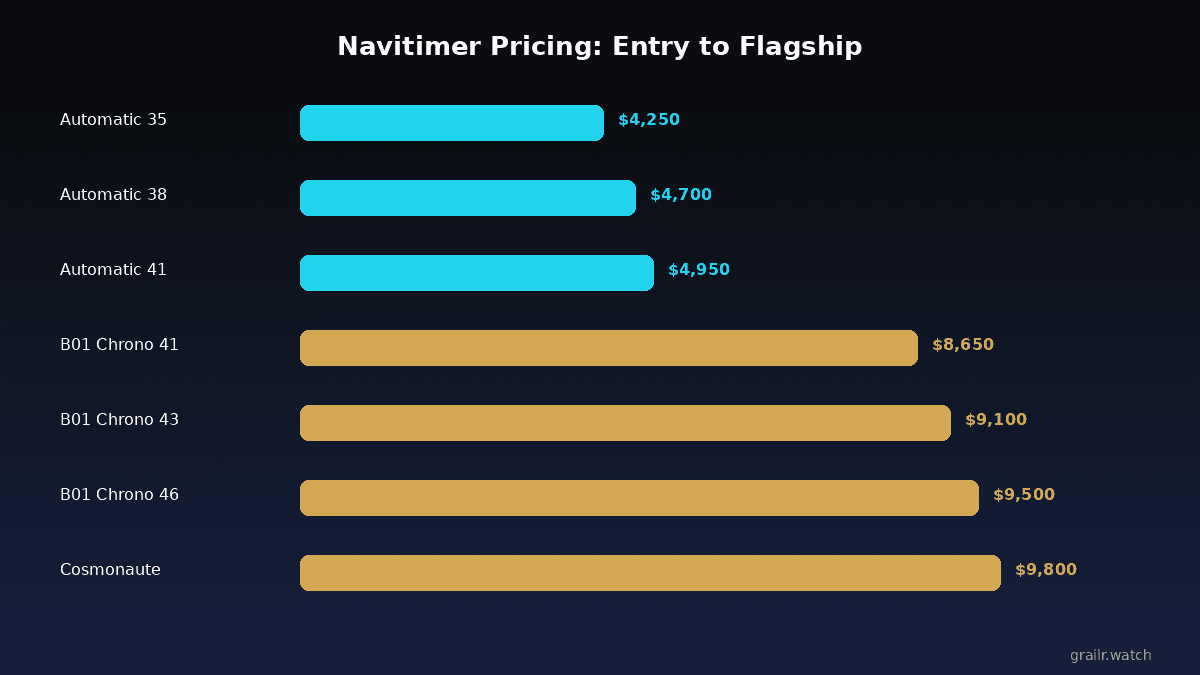
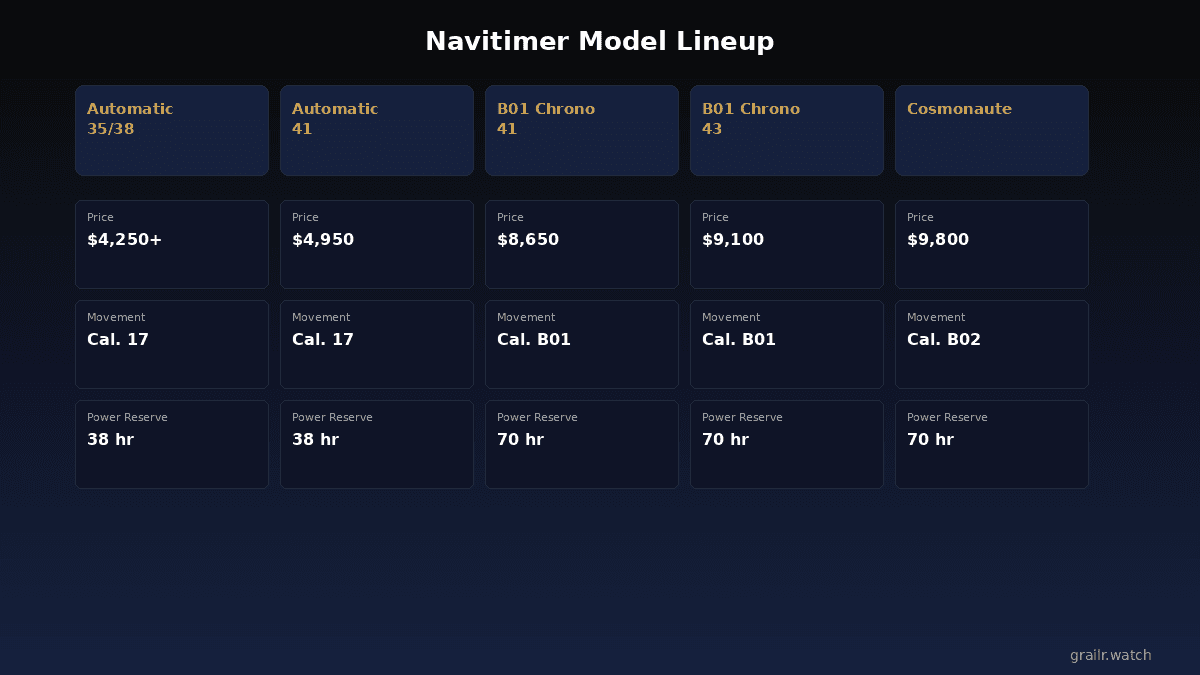
| Model | Size | Movement | Power Reserve | Retail (Steel) |
|---|---|---|---|---|
| Automatic 35 | 35mm | Cal. 17 | 38 hr | $4,250 |
| Automatic 38 | 38mm | Cal. 17 | 38 hr | $4,700 |
| Automatic 41 | 41mm | Cal. 17 | 38 hr | $4,950 |
| B01 Chrono 41 | 41mm | Cal. B01 | 70 hr | $8,650 |
| B01 Chrono 43 | 43mm | Cal. B01 | 70 hr | $9,100 |
| B01 Chrono 46 | 46mm | Cal. B01 | 70 hr | $9,500 |
| Cosmonaute | 41mm | Cal. B02 | 70 hr | $9,800 |
Prices shown are approximate 2026 retail for stainless steel models on bracelet. Leather strap variants are typically $200–$400 less. Two-tone, 18k red gold and limited editions carry significant premiums.
The Slide Rule Bezel Explained
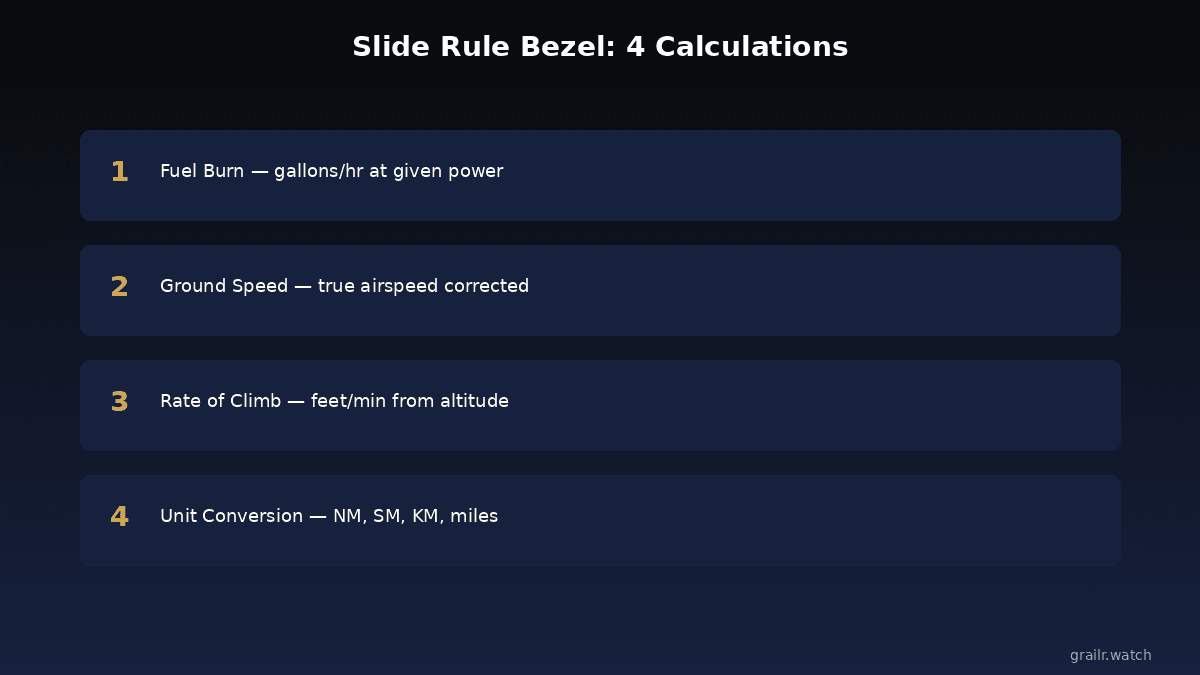
The Navitimer’s signature feature is a bidirectional rotating bezel with two logarithmic scales — one on the inner bezel ring and one on the outer dial edge. By aligning numbers on the two scales, a pilot could perform multiplication, division and unit conversions in flight. The calculations it was designed for include:
Fuel Burn
Gallons per hour at a given power setting, critical for range planning on long cross-country flights
Ground Speed
True airspeed corrected for wind, calculated by timing between two known fixes
Rate of Climb
Feet per minute derived from time and altitude gained between two points
Unit Conversion
Nautical miles to statute miles, kilometres to miles, and other conversions using pre-marked reference points
In practice, modern avionics and GPS have replaced the slide rule for in-flight calculations. But the bezel remains the visual identity of the Navitimer and the reason it looks unlike any other chronograph. The fine serrated edge that allows the bezel to turn is also the reason the Navitimer wears thicker than its case dimensions suggest — the bezel adds roughly 1.5mm to the perceived diameter.
Resale Value and Market Trends
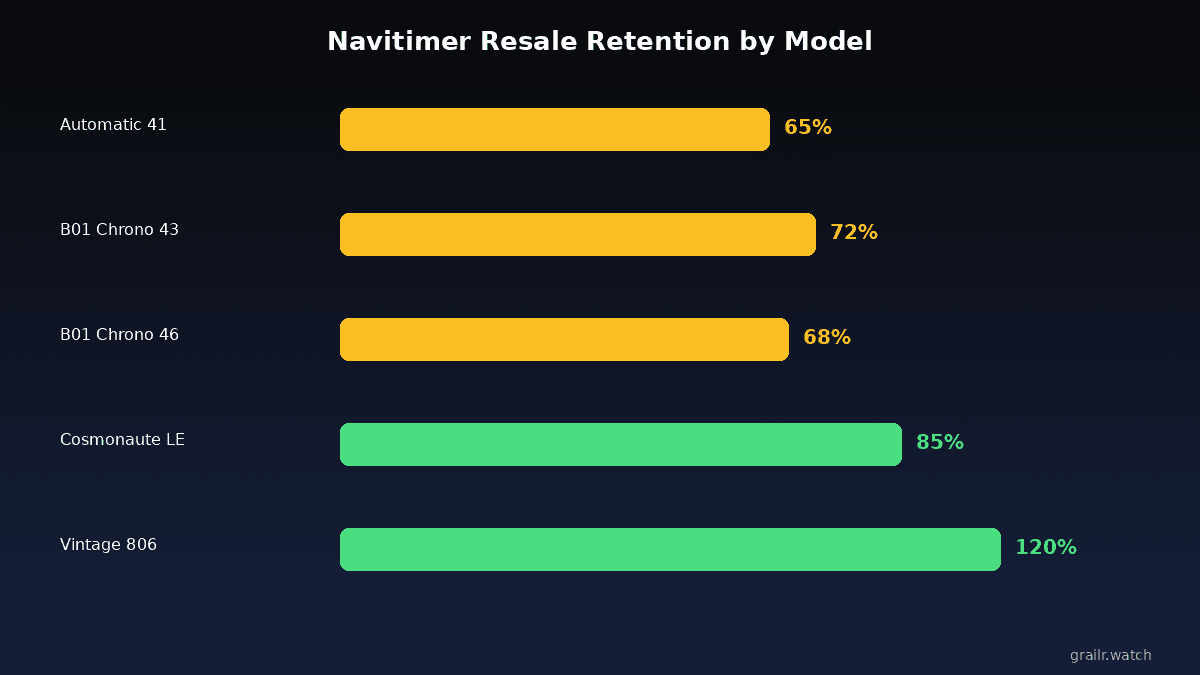
Breitling’s secondary market performance has improved since the brand’s 2017 acquisition by CVC Capital and Georges Kern’s leadership overhaul, but the Navitimer still depreciates meaningfully from retail. Indicative retention by reference:
Automatic 41
~65% retention
Pre-owned: $3,200–$3,600
B01 Chronograph 43
~72% retention
Pre-owned: $6,500–$7,500
B01 Chronograph 46
~68% retention
Pre-owned: $6,400–$7,000
Cosmonaute LE
~85% retention
Pre-owned: $8,500–$10,000
The trend to watch: Breitling’s overall pre-owned market has stabilized since 2024 after years of declining grey-market discounting. The B01 movement has given the brand a genuine in-house story to compete with Omega and TAG Heuer, and prices have firmed accordingly. Vintage Navitimers with the Venus 178 movement and AOPA logo at twelve o’clock remain the strongest performers in the secondary market, with clean examples of the reference 806 trading above $8,000.
Frequently Asked Questions
How much does a Breitling Navitimer cost?
Steel Navitimer prices range from roughly $4,950 for the Automatic 41 to about $9,900 for the B01 Chronograph 43 on bracelet. Two-tone and gold models run from $12,000 to $25,000, and limited editions like the Cosmonaute Artemis II reach $11,900.
What movement is inside the Navitimer B01?
The Navitimer B01 Chronograph uses Breitling's in-house Caliber 01, an integrated column-wheel chronograph with a 70-hour power reserve, 28,800 vph frequency, and COSC chronometer certification. It is manufactured entirely at Breitling's La Chaux-de-Fonds facility.
Is the Navitimer slide rule bezel actually useful?
Practically, very few owners use the circular slide rule for in-flight calculations today. It was designed in 1952 for pilots to compute fuel burn, ground speed and unit conversions. Modern avionics have replaced its function, but the bidirectional bezel remains the defining visual element of the Navitimer.
Does the Breitling Navitimer hold its value?
Navitimer resale retention is generally 65-80% of retail depending on the reference. The B01 Chronograph 43 in steel typically retains around 70-75%, while limited editions and heritage references can hold closer to 85-90%. This is competitive with Omega and TAG Heuer but below Rolex.
What size Navitimer should I buy?
The 43mm is the sweet spot for most wrists over 6.5 inches. The 41mm Automatic works well on slimmer wrists. The 46mm is a statement piece best suited to wrists over 7.5 inches. The busy dial benefits from size, so try the 43mm first if you have never worn a pilot chronograph.
Navitimer B01 vs Omega Speedmaster: which is the better chronograph?
The Speedmaster has stronger resale value and deeper cultural cachet from the Apollo programme. The Navitimer offers a more complex dial with the slide rule bezel and a longer 70-hour power reserve versus the Speedmaster's 50 hours. Both are excellent in-house chronographs at a similar price point.
Related Articles
The Bottom Line
The Navitimer is the pilot’s chronograph by which all others are measured. The B01 Chronograph 43 is the right pick for most buyers: it balances the complex dial, in-house movement and wearable size better than any other reference in the lineup. If you don’t need the chronograph, the Automatic 41 delivers the slide rule aesthetic at half the price. Either way, buy pre-owned if budget matters — the secondary market discount is real, and the B01 is built to the same standard whether you pay retail or not.
Sources and price context
- Breitling Navitimer official collection — Current models, specifications and retail pricing from the manufacturer.
- Breitling Navitimer B01 Chronograph 43 product page — Case dimensions, movement details, and Caliber B01 specifications for the AB0138 reference.
- AOPA — About the Aircraft Owners and Pilots Association — Founded in 1939, the association whose winged logo appeared on the original 1952 Navitimer reference 806.
These primary sources support the specific specification and pricing points noted above. Prices and resale percentages elsewhere in this guide are indicative editorial figures, not a verified transaction dataset or guaranteed returns. Confirm the exact reference, region, condition and current quote before buying; asking prices are not completed-sale prices.