How to Tell If a Used Watch Price Is Fair
A step-by-step method for checking sold prices, grading condition, and knowing when a used watch deal is worth taking — or walking away from.
Price context: this guide includes indicative prices from its original publication period. They have not all been refreshed to current quotes. Use the linked primary sources for specifications and policies, and verify prices independently.
- A fair price is the median of recent sold listings for the same reference in comparable condition — not the asking price
- Compare at least 3 completed sales before making an offer; eBay’s “Sold Items” filter is the most reliable free source
- Condition swings value dramatically: a missing bracelet link can cut value by 50%, and an overdue service by 45%
- Dealer prices include 30–50% margin — they set the ceiling, not the fair private-sale price
- Platform fees vary from 0% (Reddit) to 15% (eBay), and sellers bake those costs into their prices
Why Asking Prices Don’t Tell the Whole Story
The biggest mistake new buyers make is treating an asking price as a fair price. It isn’t. An asking price is a seller’s opening bid — a number shaped by hope, platform fees, and whatever the seller paid. The only reliable indicator of fair market value is what buyers have actually paid for the same watch recently.
Consider a Rolex Submariner ref. 116610LN. A dealer might list it at $12,500. On Chrono24, you’ll see asking prices between $11,000 and $13,000. But filter eBay for completed sales and you’ll find the same reference selling for $9,800 to $10,400 in comparable condition. The gap between the asking price and the actual transaction price can be 15–25%. That’s thousands of dollars on a single watch.
This gap exists because sellers on every platform anchor their prices to what other sellers are asking, not what buyers are paying. It creates a feedback loop where listed prices drift upward while real transaction values stay relatively stable. Learning how to tell if a used watch price is fair starts with ignoring the sticker and looking at what people have actually spent.
The same principle applies whether you’re shopping for a $500 Seiko or a $50,000 Patek Philippe. Asking prices are aspirational. Sold prices are factual. Your job is to find the facts before you open your wallet.
The Six Variables That Determine Fair Market Value
Two watches with the same brand and model name can differ in value by 50% or more based on specifics that casual buyers overlook. Before you can judge whether a price is fair, you need to understand what drives that price in the first place.
1. Reference Number
The reference number is the watch’s DNA. An Omega Speedmaster “Moonwatch” could be a ref. 310.30.42.50.01.001 (current production, ~$6,500) or a ref. 145.022 (vintage 1969, $8,000–$25,000 depending on condition and provenance). Same name, vastly different values. Always confirm the exact reference before comparing prices. If the seller doesn’t know the reference number, that’s a warning sign.
2. Condition
Condition is the largest variable after the reference number itself. A watch described as “mint” with original finish intact commands full market value. One with visible scratches, a scuffed crystal, or a faded dial trades at a significant discount. Deep scratches on a polished case are particularly costly because professional refinishing removes metal and changes the case profile — a concern for collectors who value originality.
3. Box and Papers
A complete set — original box, warranty card, instruction booklet, hang tags — adds 10–25% over a “watch only” sale. For high-value brands like Rolex, Audemars Piguet, and Patek Philippe, papers also serve as a provenance record. Buyers at every price point pay a premium for completeness, and the premium grows with the watch’s value.
4. Service History
A mechanical watch needs servicing every 5–10 years. A full service from a brand-authorised centre costs $400–$1,200 depending on the brand and complications. If a watch hasn’t been serviced in over a decade, budget for that cost and subtract it from your offer. A recently serviced watch with documentation is worth more — you’re buying years of trouble-free wear.
5. Bracelet vs. Strap
Original bracelets are expensive to replace — a Rolex Oyster bracelet costs $1,500–$3,000 from the manufacturer. A watch sold on a third-party leather strap when it originally came on a metal bracelet is worth considerably less. Missing bracelet links are another red flag: a missing link can reduce value by up to 50% because the buyer faces a costly bracelet replacement or a watch that simply doesn’t fit.
6. Dial Originality
An original, unrestored dial is critical for collectors. A “refinished” or “restored” dial — one that has been repainted or had its lume reapplied — can cut a vintage watch’s value in half. Even on modern watches, a replacement dial (identifiable by mismatched fonts, incorrect colour, or missing manufacturer marks) signals a watch with a complicated history. When evaluating dial condition, authentication is essential.
Where to Find Real Transaction Prices
Knowing what to compare is only half the equation. You also need to know where to find trustworthy price data. Not every source is equally useful, and understanding the strengths and limitations of each platform will sharpen your research.
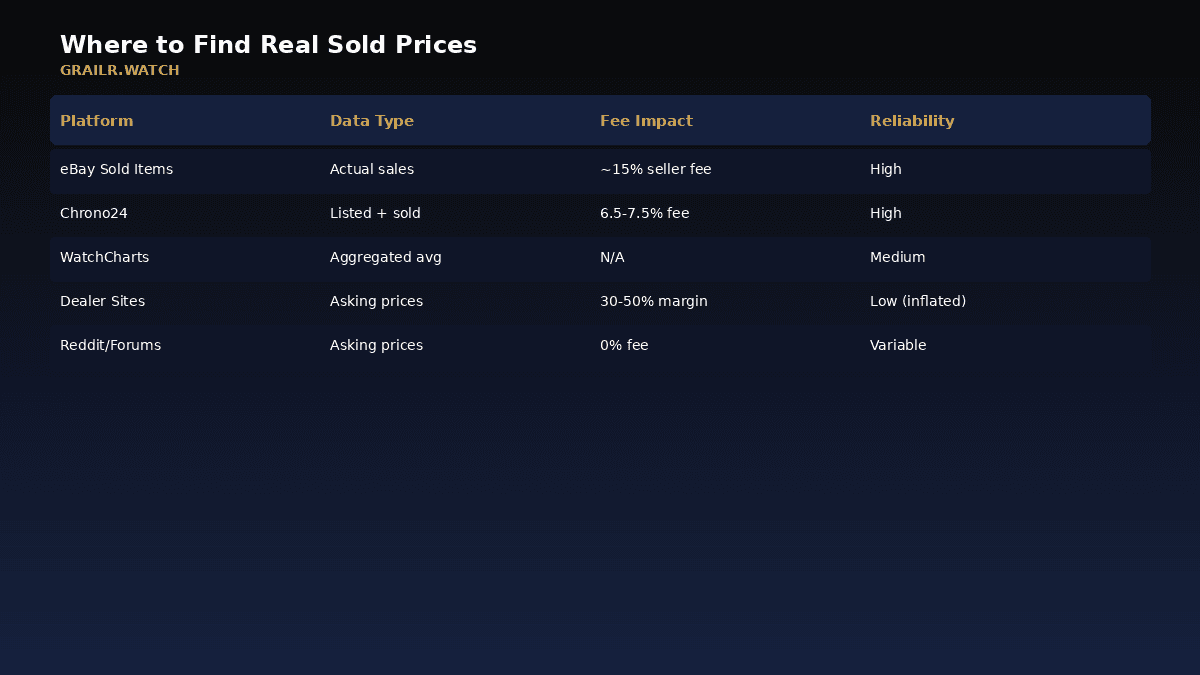
eBay Sold Items is the single best free resource for real transaction data. Go to eBay, search for the exact reference number, then filter by “Sold Items” under the Completed Listings option. This shows watches that actually sold, along with the final sale price. eBay’s seller fees run approximately 15%, so sellers factor that into their listing prices — but the sold price is still what the buyer paid, making it a reliable data point.
Chrono24 is the world’s largest watch marketplace with over 500,000 listings. Its strength is breadth: you’ll find nearly every reference represented. The limitation is that most listed prices are asking prices, not transaction prices. Seller fees on Chrono24 run 6.5–7.5%, which is baked into every listing. Use Chrono24 to confirm that a reference exists at a particular price range, then cross-reference with eBay sold data for the real number.
WatchCharts and WatchPatrol aggregate market data from multiple platforms and present trend lines, average prices, and historical price movements. WatchCharts is particularly useful for tracking whether a model is trending up or down in value — a watch at the bottom of a price dip may represent better value than one at a temporary peak.
Reddit r/WatchExchange offers $0 seller fees, which means prices there tend to be lower than any commercial platform. The trade-off is no built-in buyer protection — transactions rely on community reputation, PayPal Goods & Services, or trust. If you’re comfortable with the risk, r/WatchExchange prices often represent the true floor of what a watch sells for between knowledgeable enthusiasts.
For a broader view of where each platform fits, see our watch marketplace comparison guide.
How Condition Affects Value
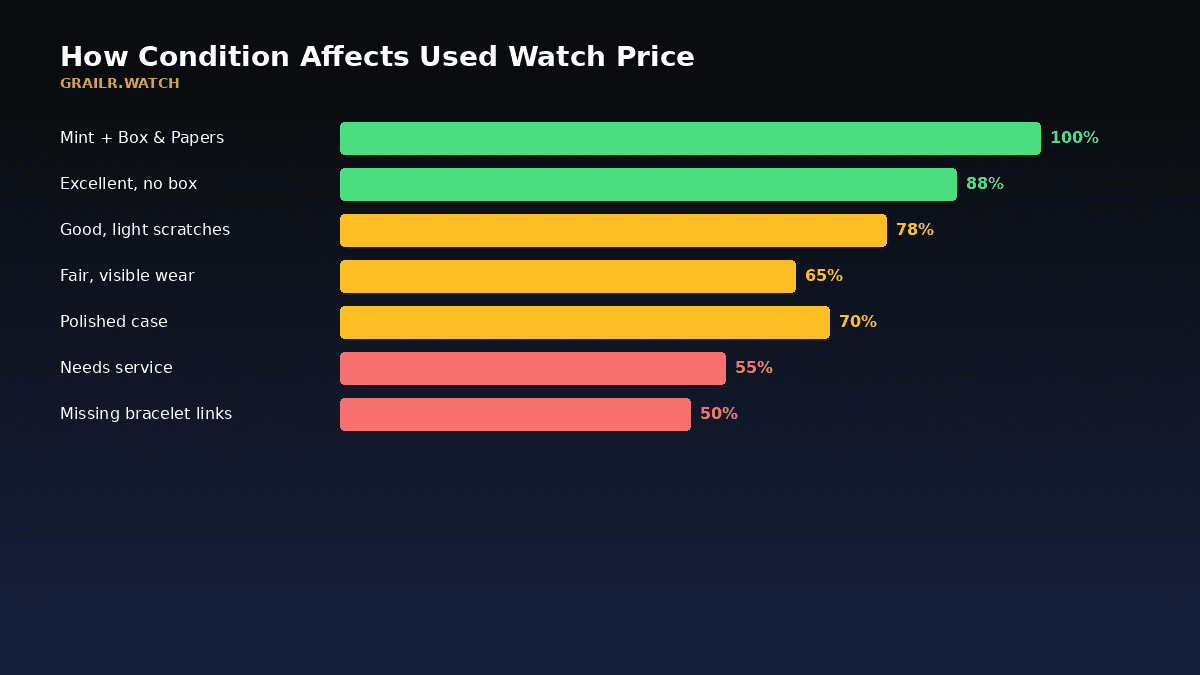
Condition is where most pricing conversations go wrong. A seller calls a watch “excellent” and prices it accordingly, but “excellent” is subjective. What matters is how specific, measurable condition factors translate into concrete price adjustments. The table below shows the typical impact of common condition issues on a used watch’s value relative to a mint-condition example with full box and papers.
| Condition Factor | Typical Impact | Notes |
|---|---|---|
| Mint with box & papers | Full value | The baseline for all comparisons |
| Excellent, watch only | −10 to −25% | No box, no papers; premium grows with watch value |
| Light scratches on case | −5 to −15% | Normal wear; polishing can remove but thins the case |
| Refinished or repainted dial | −30 to −50% | Destroys collector value on vintage models |
| Missing bracelet links | Up to −50% | OEM replacement links are expensive or discontinued |
| Needs service (overdue) | −30 to −45% | Factor in $400–$1,200 service cost |
| Non-original crystal | −10 to −20% | Aftermarket crystal is a reliability and authenticity concern |
When a watch has multiple condition issues, the discounts compound. A watch that’s missing its papers, needs a service, and has a scuffed bracelet could reasonably trade at 40–60% of what a mint-condition example fetches. If the seller’s price doesn’t reflect these realities, the watch isn’t fairly priced — regardless of what comparable listings show.
Step-by-Step: How to Price-Check Any Used Watch
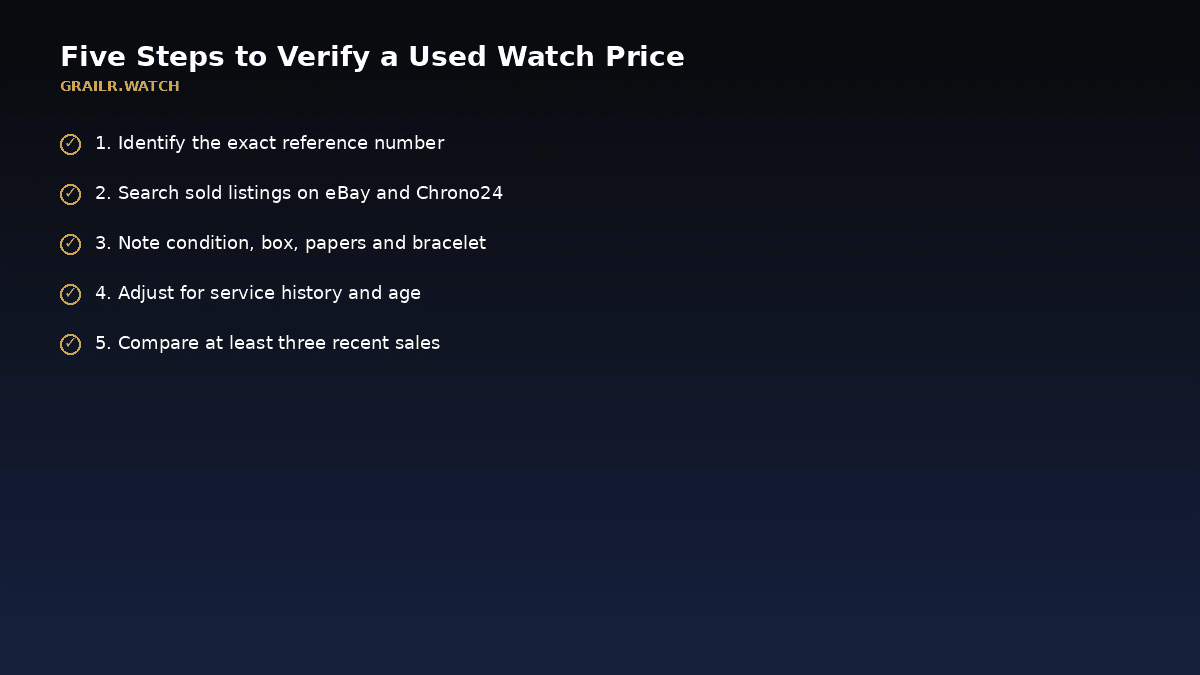
Here is the exact process we recommend for evaluating any used watch listing, whether you’re browsing online or standing in a dealer’s shop with the piece in your hand.
Step 1: Confirm the Exact Reference Number
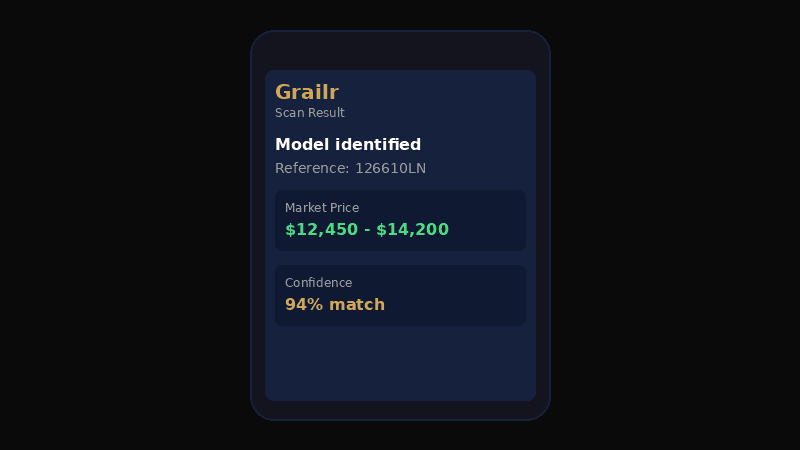
Ask the seller for the reference number and serial number. Check the case back, between the lugs, or on the movement. If the seller cannot provide a reference, proceed with extreme caution. You can also use Grailr’s scanner to photograph the watch and get a suggested identification with the reference number.
Step 2: Search eBay Sold Items
Enter the reference number on eBay. Click “Sold Items” under “Show only.” Record the last 5–10 sale prices. Note the condition descriptions and whether the sale included box and papers. Ignore auctions that ended with zero bids or “Best Offer Accepted” listings where the final price is hidden.
Step 3: Cross-Reference on Chrono24
Search the same reference on Chrono24. Note the lowest three listings in similar condition. These are asking prices, not sale prices, so expect actual transaction values to be 5–15% lower. Remember that Chrono24 seller fees of 6.5–7.5% are already embedded in every listing price.
Step 4: Check Aggregators
Visit WatchCharts or WatchPatrol to see the trailing 90-day price trend for the reference. Is the price rising, falling, or stable? A watch priced at the current market average during a declining trend may not hold that value. A watch priced below average during a stable or rising trend is a stronger buy.
Step 5: Adjust for Condition
Take the median sold price from Step 2 and apply the condition adjustments from the table above. If the watch you’re evaluating is missing papers, subtract 10–25%. If it needs a service, subtract another 30–45%. This adjusted figure is your fair-value estimate — the price a reasonable buyer should pay given what’s actually being offered.
Step 6: Make Your Decision
Compare the seller’s asking price to your adjusted fair-value estimate. If the asking price is within 5–10% of your estimate, you’re looking at a fair deal. If it’s more than 10% above, negotiate or walk away. If it’s below your estimate, look more carefully — an unusually low price sometimes signals condition problems or authenticity issues that aren’t disclosed.
Check Any Watch Price in Seconds
Grailr scans your watch photo and pulls live pricing from Chrono24, eBay, and Jomashop.
- AI identifies brand, model & reference number
- Live market prices from 3+ sources
- Authentication confidence score
Platform Fees and What They Mean for Prices
Every marketplace charges sellers differently, and those fees directly influence the prices you see. A seller on eBay, paying roughly 15% in fees, needs to list a watch 15% higher than they would on a zero-fee platform just to net the same amount. Understanding fee structures helps you decode why identical watches appear at different prices on different platforms — and where you’re most likely to find a fair deal.
| Platform | Seller Fee | Buyer Protection | Price Reliability |
|---|---|---|---|
| eBay | ~15% | Strong | Sold Items = real prices |
| Chrono24 | 6.5–7.5% | Trusted Checkout escrow | Asking prices only |
| WatchBox | Dealer margin | Full warranty | Dealer retail (30–50% margin) |
| Reddit r/WatchExchange | 0% | None built-in | Lowest market prices |
| Facebook Groups | 0% | None built-in | Variable, negotiable |
The takeaway: when comparing a watch listed at $5,000 on eBay versus $4,500 on Reddit, the eBay seller may actually be netting less than the Reddit seller after fees. The eBay price isn’t necessarily unfair — it includes buyer protection, a return policy, and an escrow system. Whether that’s worth the premium depends on your risk tolerance. For a deeper comparison of each platform’s strengths and risks, see our eBay versus retail watch pricing analysis.
Dealer Prices vs. Private-Sale Prices
If you’ve been using dealer websites as your price reference, you may have a distorted picture of fair value. Authorised pre-owned dealers and reputable grey-market shops serve an important purpose — authentication, warranty, and peace of mind — but their prices reflect a 30–50% margin over what they paid for the watch.
A dealer listing a Tudor Black Bay at $3,200 likely paid $2,000–$2,400 for it. That $3,200 covers their authentication process, overhead, marketing, and profit. It’s a legitimate business, but it is not the fair private-sale price. If a private seller is asking $3,200 for the same watch, they’re pricing it at dealer retail — and you’re getting none of the dealer benefits (warranty, return policy, authentication guarantee) for the dealer price.
A fair private-sale price for that same Tudor Black Bay, based on completed eBay sales and r/WatchExchange data, might be $2,400–$2,800 depending on condition and completeness. If you’re considering what your own watch is worth in a private sale, the same logic applies in reverse — our guide on selling a Rolex covers the seller’s perspective.
The exception is when a dealer offers something a private seller cannot: a multi-year warranty, a certified pre-owned programme, or an in-house authentication with a written guarantee. In those cases, the premium may be justified. Just don’t confuse a dealer’s retail price with the market’s fair value.
When to Walk Away from a Deal
Not every overpriced watch is a scam, but certain patterns should make you pause. If any of the following apply, walk away and keep looking — there will always be another watch.
The price is more than 15% above recent sold comparables and the seller won’t negotiate. A small premium for convenience or condition is normal. A 15%+ premium with no justification (such as recent service, rare dial variant, or celebrity provenance) means the seller either doesn’t know the market or is counting on you not knowing it.
The seller refuses to provide the reference or serial number. Without these, you cannot verify the model, production year, or whether the watch has been reported stolen. Every legitimate seller knows the reference number.
You cannot find three comparable sold listings. If a watch is so rare that no recent sales data exists, you’re pricing it in the dark. This isn’t necessarily a dealbreaker — but it does mean you need a professional appraisal ($50–$150) before committing. The cost of the appraisal is negligible compared to overpaying by thousands.
The listing photos are stock images or borrowed from another seller. A reverse image search takes ten seconds. If the seller is using someone else’s photos, you have no idea what you’re actually buying.
The price is suspiciously low. A watch priced 30%+ below market value is not a bargain — it’s a trap. The most common explanations are counterfeit watches, stolen goods, or a “watch only” listing that omits critical condition problems. If a deal seems too good to be true, it is. Trust the data, not the dopamine.
Frequently Asked Questions
How many sold listings should I compare before buying a used watch?
Compare at least three recent sold listings for the same reference number in similar condition. More data points give you a stronger sense of fair market value. If fewer than three comparable sales exist, the model may be too rare for simple price comparison — consider a professional appraisal.
Are dealer prices a good benchmark for fair value?
Dealer prices include a 30-50% margin over what they paid. They reflect the ceiling of the market, not the fair private-sale price. Use dealer listings to set an upper bound, then compare against completed private sales on eBay or Chrono24 for a realistic number.
Does a missing box and papers really matter for a used watch?
Yes. A complete set with original box, warranty card, and papers typically commands 10-25% more than the same watch without them. For brands like Rolex and Patek Philippe, the original papers also help establish provenance and authenticity, which matters for resale.
Is Chrono24 more reliable than eBay for used watch pricing?
Both platforms are useful but serve different roles. eBay's Sold Items filter shows actual completed transactions. Chrono24 lists asking prices from professional dealers — typically 6.5-7.5% higher to cover seller fees. Use eBay sold data as your baseline and Chrono24 listings as a cross-reference.
Should I get a professional appraisal before buying a used watch?
A professional appraisal costs $50-$150 per watch and is worth it for any purchase over $2,000. The appraiser will verify authenticity, check the movement, and provide an independent valuation. For lower-value watches, comparing sold listings and using a tool like Grailr may be sufficient.
Related Articles
The Bottom Line
A fair price for a used watch is not what the seller asks, not what a dealer charges, and not what your gut says feels right. It is the median of recent sold listings for the same reference number in comparable condition, adjusted for completeness and service needs.
The process is straightforward: confirm the reference, pull sold data from eBay, cross-check on Chrono24 and aggregator sites, adjust for condition, and compare the result to the asking price. If the number lands within 10%, you have a fair deal. If it doesn’t, either negotiate or move on. The used watch market rewards patience and research — and it punishes impulse. Take the extra thirty minutes to do the homework. Your wallet will thank you. If you want a faster starting point, try Grailr’s free appraisal tool for an indicative estimate, then verify the result with your own research.
Ready to Check a Price?
Snap a photo and Grailr identifies the watch, pulls live market data, and gives you an indicative value estimate in seconds. Compare the result against your own sold-listings research for a complete picture.
Scan a Watch NowSources and price context
- eBay seller fees overview — Current final value fee schedule for watches on eBay.
- Chrono24 dealer selling information — Explains the commission structure for professional and private sellers.
These primary sources support the fee structures and platform policies noted above. Condition discounts and price ranges elsewhere in this guide are indicative editorial figures based on observed market patterns, not a verified transaction dataset or guaranteed valuations. Confirm the exact reference, condition, and current quote before buying; asking prices are not completed-sale prices.