Best Dress Watches at Every Price in 2026
From the $130 Orient Bambino to the $37,000 Patek Philippe Calatrava — fifteen dress watches ranked by case size, movement quality and resale value.
Price context: this guide includes indicative prices from its original publication period. They have not all been refreshed to current quotes. Use the linked primary sources for specifications and policies, and verify prices independently.

- A dress watch sits between 34–40 mm, stays under 10 mm thick, and slips beneath a shirt cuff without snagging
- The Orient Bambino ($130) and Seiko Presage Cocktail Time ($350) are the strongest automatic dress watches under $500
- Mid-range standouts — the Hamilton Intra-Matic ($845) and Junghans Max Bill ($1,095) — deliver Swiss or German movements for under $1,200
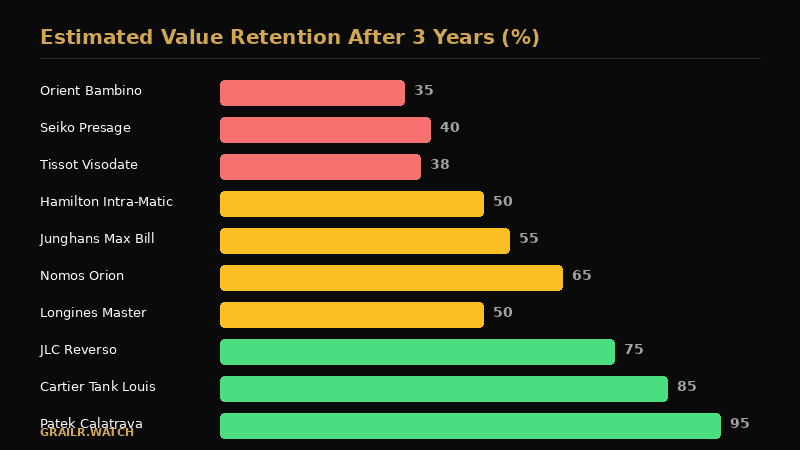
- At the luxury tier, the Cartier Tank and JLC Reverso hold 70–90% of their value, well above average for dress watches
- Patek Philippe’s Calatrava and Breguet’s Classique define the high end, where finishing and heritage command the premium
What Makes a Dress Watch
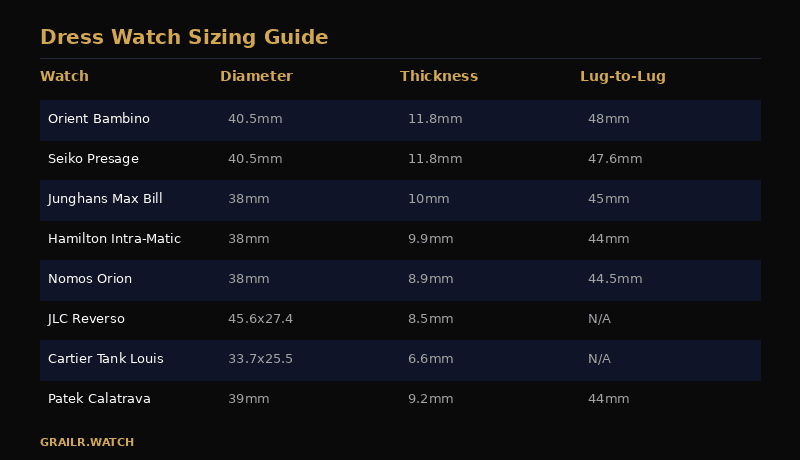
A dress watch is designed for one job: to look elegant without drawing attention to itself. The case is thin — usually under 10 mm — and the dial is clean, with two or three hands and little else. You won’t find rotating bezels, chronograph pushers or dive-depth ratings here. The idea is that when you reach for a cufflink, the watch disappears under your shirt.
Case diameters typically range from 34 mm to 40 mm, though some historic models run even smaller. Round cases dominate, but rectangular shapes — the Cartier Tank being the most famous — have been part of the category since 1917. Leather straps remain the default, though mesh bracelets and ultra-slim steel links have gained ground in the last decade.
Movement choice matters more than in a sport watch. Because the case is slim, the movement must be thin, which limits the complications a watchmaker can fit inside. That constraint is part of what makes a great dress watch impressive: the thinner the case, the harder it was to engineer. The Piaget Altiplano measures just 6.36 mm, while some Vacheron Constantin Patrimony references hit 8.1 mm with an automatic winding rotor inside.
Water resistance is usually 30 m (splash-proof) rather than the 100–300 m ratings on sport models. If you plan to wear a dress watch daily, look for at least 50 m and a sapphire crystal. For a deeper look at movement technology, our guide to automatic vs quartz breaks down the trade-offs.
Best Affordable Dress Watches Under $500
You don’t need to spend thousands to get a watch that looks right with a suit. The Japanese brands — Seiko, Orient and Citizen — have spent decades refining automatic movements that fit slim cases at democratic prices. Timex and Tissot round out the tier with quartz and Powermatic options that punch above their price tags.
Orient Bambino — from $130
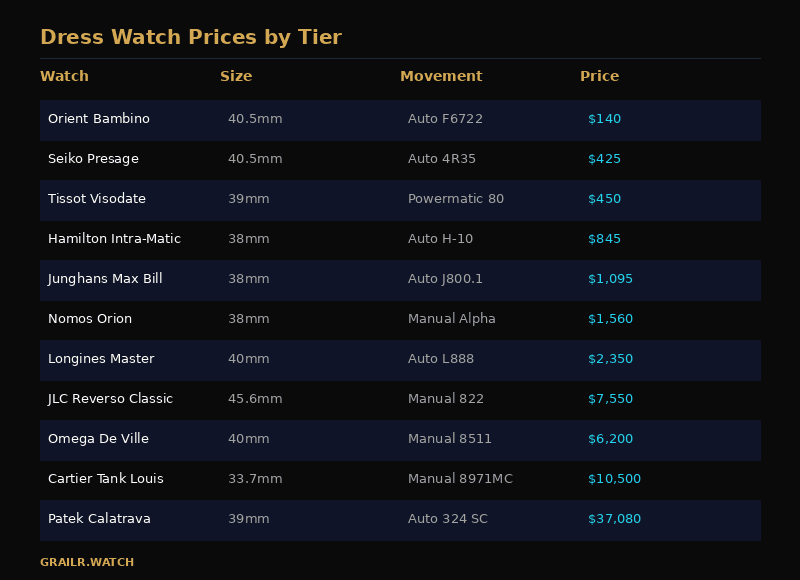
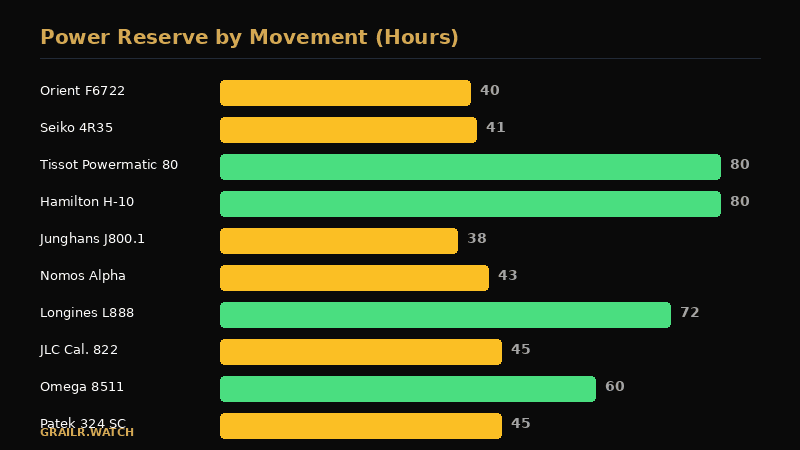
The Bambino has been the default budget dress watch recommendation for years, and nothing at this price has displaced it. The version 2 uses Orient’s in-house F6722 automatic caliber with hacking and hand-winding, a domed mineral crystal that catches light like vintage glass, and a 40.5 mm case that wears thinner than its 11.8 mm on-paper measurement suggests. Available in champagne, blue, cream, green and black dials. Power reserve is 40 hours, and the movement runs at 21,600 vph.
Seiko Presage Cocktail Time — from $325
The Cocktail Time line takes its names from classic cocktails, and the dials are the star: textured, layered finishes that change character under different lighting. The SRPD37 (“Mockingbird”) pairs a green sunburst dial with a 40.5 mm stainless-steel case and Seiko’s 4R35 automatic movement. Power reserve is 41 hours, and the Hardlex crystal sits in a case just 11.8 mm thick. At around $350, you get a movement that’s been refined over decades and a dial finish that rivals watches at three times the price.
Timex Marlin Automatic — from $229
The Marlin revival line uses a Miyota 8215 automatic in a 40 mm case that nods to Timex’s mid-century catalog. At 13.1 mm, it’s thicker than ideal for a purist dress watch, but the clean dial, acrylic crystal and retro applied indices give it a charm that works equally well with a blazer or a crew-neck sweater. The 37 mm hand-wound version is slimmer and dressier for smaller wrists.
Tissot Visodate Powermatic 80 — from $450
Tissot relaunched the Visodate for 2026 at 39 mm, down from 42 mm. Inside sits the Powermatic 80 caliber with an 80-hour power reserve — enough to survive a weekend in the watch box without losing time. The case measures 10.69 mm thick, sapphire crystal is standard, and the day-date complication adds utility without cluttering the dial. For more Swiss budget options, see our best affordable watches guide.
| Model | Price | Case | Movement | Power Reserve |
|---|---|---|---|---|
| Orient Bambino V2 | ~$130 | 40.5 mm | F6722 auto | 40 hr |
| Timex Marlin Auto | ~$229 | 40 mm | Miyota 8215 | 40 hr |
| Seiko Presage SRPD37 | ~$350 | 40.5 mm | 4R35 auto | 41 hr |
| Tissot Visodate PM80 | ~$450 | 39 mm | Powermatic 80 | 80 hr |
Best Mid-Range Dress Watches ($500–$3,000)
This is where the dial finishing, case construction and movement decoration start to separate from the budget tier. You’re paying for sapphire crystals as standard, polished case flanks, and calibers with longer power reserves and finer regulation.
Hamilton Intra-Matic — from $845
The Intra-Matic revives Hamilton’s 1960s dress line at 38 mm — a size that reads distinctly mid-century on a modern wrist. Inside is the H-10 automatic, a modified ETA 2824 with an 80-hour power reserve achieved by lowering the beat rate to 21,600 vph. The silver dial version with a black leather strap is as close to a universal dress watch as this price range gets. Case thickness is 9.95 mm, and the box-shaped sapphire crystal adds a vintage touch. For more from the brand, see our Hamilton Khaki Field guide.
Junghans Max Bill Automatic — from $1,095
Designed by the Bauhaus artist Max Bill in 1961, this 38 mm watch has barely changed. The domed Plexiglas crystal, stick indices and thin sword hands define minimalist dress-watch design. The J800.1 automatic (based on the Sellita SW200) delivers 38 hours of power reserve in a 10 mm case. It’s a watch that architects and designers have worn for sixty years, and the design still hasn’t dated.
Nomos Glashütte Orion — from $1,560
Nomos builds its movements in-house in Glashütte, Germany, and the Orion is its purest dress watch. The 33 mm hand-wound version uses the Alpha caliber (7.2 mm case thickness, 43-hour power reserve) and is one of the thinnest dress watches at this price. The 38 mm Neomatik version uses the DUW 3001 automatic with a date at 6 o’clock and measures 8.7 mm. Both feature a sapphire-crystal case back exposing Glashütte-finished movements with hand-engraved balance cocks.
Longines Master Collection — from $1,800
The Master Collection covers sizes from 25.5 mm to 42 mm and complications from time-only to annual calendar. The sweet spot for a dress watch is the 38.5 mm L2.628 with a silver barleycorn dial: it uses the L888 automatic caliber with a 72-hour power reserve, sapphire crystal front and back, and 30 m water resistance. At around $2,100, it’s one of the best-value Swiss dress watches you can buy.
Check Any Watch Price in Seconds
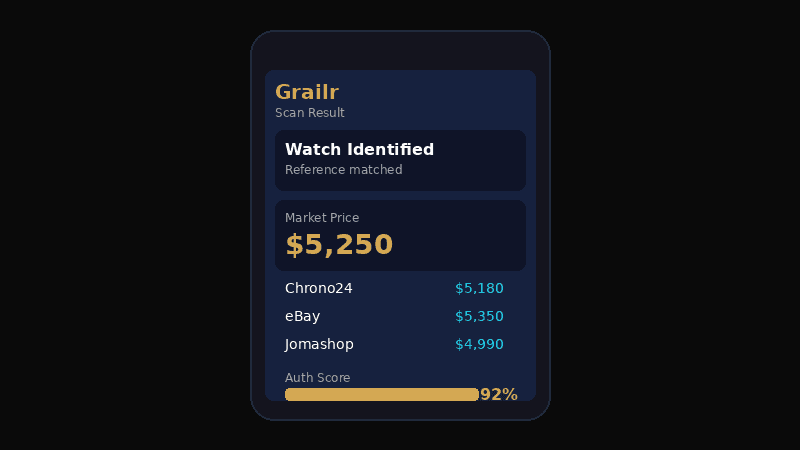
Grailr scans your watch photo and pulls live pricing from Chrono24, eBay, and Jomashop.
- AI identifies brand, model & reference number
- Live market prices from 3+ sources
- Authentication confidence score
Best Luxury Dress Watches ($3,000–$15,000)
At this price the movements become genuinely impressive, case finishing is done by hand, and the names on the dial carry a century or more of heritage. Resale value starts to matter here — the right reference from Cartier or Jaeger-LeCoultre can hold 70–90% of its retail price.
Omega De Ville Trésor — from $4,950
The Trésor (“treasure” in French) uses a hand-wound Co-Axial Master Chronometer caliber in a 40 mm case that measures just 10.2 mm thick. METAS certification means it resists magnetic fields up to 15,000 gauss — unusual for a dress watch and genuinely useful if you set your watch on a laptop. The steel models start around $4,950; gold versions climb to $13,950. For more Omega context, see our Omega watches for men guide.
Jaeger-LeCoultre Reverso Classic — from $7,550
The Reverso’s reversible case was designed in 1931 to protect the crystal during polo matches. Ninety-five years later, it remains one of the most recognisable dress watches ever made. The Classic Medium Thin at 24.4 mm × 40.1 mm uses the hand-wound Caliber 822/2 with a 45-hour power reserve. The Duoface models add a second time zone on the reverse dial. Resale retention sits around 75–85%, partly because the Art Deco design transcends trends.
Cartier Tank Louis — from $10,500
Louis Cartier designed the Tank in 1917, inspired by the plan view of a Renault FT tank. The Tank Louis in yellow gold remains the reference point for rectangular dress watches: Roman numerals, blued-steel hands, a cabochon crown, and an 18k gold case that measures 33.7 mm × 25.5 mm. Inside is the hand-wound 1917 MC caliber. Gold construction means resale holds well: expect 70–80% of retail for popular references. For the full Cartier lineup, our Cartier Tank buying guide covers every variant.
A. Lange & Söhne Saxonia 36mm — from $8,600
Lange’s Saxonia Thin at 36 mm is a masterclass in restraint. The hand-wound L093.1 caliber is assembled twice (a Lange signature), finished to a standard that rivals any watch at twice the price, and visible through a sapphire case back. Case thickness is 6.2 mm — barely more than a coin stack. The annual calendar version adds day, date and month displays at 38.5 mm for a much higher price. White gold starts around $8,600; rose gold runs slightly higher.
High-End Dress Watches ($15,000+)
At the top of the market, dress watches become statements about finishing, heritage and exclusivity. Movements are decorated by hand to standards that take years to learn. Cases are made from precious metals. And the brands — Patek Philippe, Breguet, Vacheron Constantin — have histories stretching back to the 18th century.
Vacheron Constantin Patrimony — from $19,300
The Patrimony Manual-Winding at 36 mm uses the Caliber 1400 (2.1 mm thick) in a case that measures just 6.77 mm. It is one of the thinnest dress watches from any of the “Big Three” (Patek, Vacheron, Lange). The 40 mm automatic version uses the Caliber 2450 and adds a date. Both feature full Geneva Hallmark certification and hand-applied gold indices.
Breguet Classique 5177 — from $25,000
Abraham-Louis Breguet invented the tourbillon, the Breguet overcoil and the hand style that bears his name. The Classique 5177 at 38 mm distills that heritage into one watch: a guilloché dial engine-turned in-house, Breguet numerals, pomme hands, and the automatic Caliber 777A with a 55-hour power reserve. The coin-edge case band and welded lugs are Breguet signatures visible only to those who know where to look.
Patek Philippe Calatrava 5227 — from $37,000
The Calatrava has defined Patek’s dress-watch aesthetic since 1932. The 5227 in rose gold at 39 mm uses the Caliber 324 S C, an ultra-thin automatic (3.3 mm) with a 35–45 hour power reserve and the Patek Philippe Seal. The officer’s-style case back opens on a hinge to reveal a hunter case back, a design detail borrowed from pocket watches. Resale retention is among the highest in the industry — expect 85–100% depending on dial colour and market conditions.
Full Comparison Table
Every dress watch in this guide, compared side by side. Prices are approximate and may vary by retailer and region.
| Watch | Price | Case | Thickness | Movement | Power Reserve | Est. Retention |
|---|---|---|---|---|---|---|
| Orient Bambino V2 | $130 | 40.5 mm | 11.8 mm | Auto | 40 hr | 30–40% |
| Timex Marlin Auto | $229 | 40 mm | 13.1 mm | Auto | 40 hr | 25–35% |
| Seiko Presage SRPD37 | $350 | 40.5 mm | 11.8 mm | Auto | 41 hr | 35–50% |
| Tissot Visodate PM80 | $450 | 39 mm | 10.7 mm | Auto | 80 hr | 30–40% |
| Hamilton Intra-Matic | $845 | 38 mm | 10.0 mm | Auto | 80 hr | 35–45% |
| Junghans Max Bill | $1,095 | 38 mm | 10.0 mm | Auto | 38 hr | 40–50% |
| Nomos Orion 33mm | $1,560 | 33 mm | 7.2 mm | Hand-wound | 43 hr | 55–65% |
| Longines Master 38.5mm | $2,100 | 38.5 mm | 9.5 mm | Auto | 72 hr | 40–55% |
| Omega De Ville Trésor | $4,950 | 40 mm | 10.2 mm | Hand-wound | 72 hr | 55–65% |
| JLC Reverso Classic | $7,550 | 24.4×40.1 mm | 8.5 mm | Hand-wound | 45 hr | 75–85% |
| Lange Saxonia Thin | $8,600 | 36 mm | 6.2 mm | Hand-wound | 72 hr | 70–80% |
| Cartier Tank Louis | $10,500 | 33.7×25.5 mm | 6.6 mm | Hand-wound | 38 hr | 70–80% |
| VC Patrimony | $19,300 | 36 mm | 6.8 mm | Hand-wound | 65 hr | 70–85% |
| Breguet Classique 5177 | $25,000 | 38 mm | 8.7 mm | Auto | 55 hr | 60–75% |
| Patek Calatrava 5227 | $37,000 | 39 mm | 9.2 mm | Auto | 35–45 hr | 85–100% |
How to Choose the Right Dress Watch
With fifteen watches across four price tiers, the decision comes down to three things: how often you’ll wear it, what matters to you in a movement, and whether resale value is a factor.
Frequency of wear
If this is a weekend-and-events watch, a hand-wound movement is fine — you wind it when you put it on and forget about it. If you want to grab it any morning and go, an automatic with at least 60 hours of power reserve (the Tissot, Hamilton or Longines) will still be running after a day off the wrist. For very occasional wear, quartz makes the most practical sense: the Cartier Tank Must at $3,050 uses a quartz movement in a steel case and keeps time to within ±2 seconds per day indefinitely.
Movement and finishing
Below $1,000, movements are functional but not decorated. Between $1,000 and $5,000, you start seeing Geneva stripes, blued screws and engraved rotors — especially from Nomos, Longines and Omega. Above $5,000, the movement becomes the point: Lange’s double assembly, Patek’s Seal, Breguet’s guilloché dials. If a transparent case back matters to you, budget accordingly.
Resale value
Dress watches generally depreciate faster than sport models because demand is narrower. The exceptions are iconic designs with brand power: the Cartier Tank, JLC Reverso, Patek Calatrava and Lange Saxonia all hold 70% or more. Budget dress watches from Orient, Timex and Seiko should be treated as purchases, not investments — expect to lose 50–70% if you sell. For deeper data on which watches hold value, see our watches that hold value guide.
Case shape and strap
Round cases are the safe choice and work with almost every suit and strap combination. Rectangular watches — the Tank, Reverso, Cartier Américaine — make a stronger style statement but are harder to match casually. A black or dark-brown leather strap is the most versatile; mesh bracelets add a contemporary edge. If you want to swap straps regularly, look for standard lug widths (18 mm, 20 mm) and quick-release spring bars, which are increasingly common even at the luxury tier.
The Bottom Line
The best dress watch is the one that matches your budget, your wrist and the occasions you’ll wear it. At $130, the Orient Bambino gives you a genuine automatic dress watch with a dial that punches well above its price. At $845, the Hamilton Intra-Matic is the sweet spot of Swiss movement quality and vintage design. At $7,550, the JLC Reverso is arguably the most timeless dress watch ever designed. And at $37,000, the Patek Calatrava is exactly what you think it is: the best.
Whichever you choose, try it on before you buy. A dress watch that sits too high, too wide or catches on your cuff defeats its own purpose — no matter what name is on the dial.
Frequently Asked Questions
What makes a watch a dress watch?
A dress watch is thin enough to slip under a shirt cuff — typically under 10 mm thick — with a clean dial, minimal complications, and a case diameter between 34 mm and 40 mm. Leather straps are traditional, though slim metal bracelets are increasingly common.
What is the best affordable dress watch under $500?
The Orient Bambino at around $130 and the Seiko Presage Cocktail Time at around $350 are the strongest picks. Both use automatic movements, offer domed crystals and keep cases between 38 mm and 40.5 mm. The Tissot Visodate at $450 adds an 80-hour power reserve and sapphire crystal.
Are dress watches good investments?
Most dress watches below $5,000 lose 30–50% on resale. Exceptions include the Cartier Tank, JLC Reverso and Patek Philippe Calatrava, which retain 70–100% depending on reference, material and condition. Treat sub-$2,000 dress watches as purchases, not investments.
What size dress watch should I buy?
For most wrists, 36 mm to 39 mm is the sweet spot. A 34 mm case reads more formally and suits slimmer wrists. Anything above 40 mm risks catching on a cuff and loses the understated look a dress watch is designed to deliver.
Should I choose quartz or automatic for a dress watch?
Quartz movements are thinner, more accurate and cheaper to maintain. Automatic movements offer a sweeping seconds hand and mechanical feel that many collectors prefer. For a watch worn only a few times a month, quartz avoids the hassle of resetting after the power reserve runs down.
Can you wear a dress watch every day?
You can, but most dress watches have low water resistance (30 m or less) and polished cases that show scratches. If daily wear is the plan, look for at least 50 m water resistance and a case material that handles minor impacts, such as the Nomos Orion or Longines Master Collection.
Related Articles
Thinking About a Dress Watch?
Snap a photo of any watch and Grailr will identify the reference and pull live market pricing from multiple sources.
Scan a Watch Now