Harry Winston Watches: What They Cost
From the $5,000 pre-owned Avenue to six-figure Opus collaborations — every Harry Winston collection explained with real prices and resale context.
Price context: this guide includes indicative prices from its original publication period. They have not all been refreshed to current quotes. Use the linked primary sources for specifications and policies, and verify prices independently.
- Harry Winston watches start at roughly $5,000 pre-owned (Avenue) and $8,700 new (Midnight), reaching $300,000+ for Opus and Histoire de Tourbillon pieces
- Founded as a jeweller in 1932, Harry Winston began watchmaking in 1989 and joined the Swatch Group in 2013 for roughly $1 billion
- Seven collections span jewellery watches (Avenue), dress complications (Midnight, Premier), sport (Ocean, Project Z), and haute horlogerie (Opus, Histoire de Tourbillon)
- Midnight and Premier models retain roughly 50–65% of retail after three years; Opus limited editions can appreciate significantly on the secondary market
- Almost every Harry Winston timepiece uses precious metals — no stainless-steel collection exists, which limits entry pricing but reinforces exclusivity
The King of Diamonds: Brand History
Harry Winston is one of the most recognized names in the jewellery world, but its watch division occupies a curious niche. The company was founded in New York in 1932 by Harry Winston himself, a man who built a legendary reputation buying and reselling some of the most famous diamonds in history — the Hope Diamond, the Jonker, the Star of the East. That gemstone heritage earned the house the title “King of Diamonds,” and it is the lens through which every Harry Winston timepiece should be understood: these are jeweller’s watches first, designed by a house whose core competency is setting stones and working with precious metals, not engineering movements from scratch.
Harry Winston did not begin making watches until 1989, nearly sixty years after the company was founded. The first Premier collection established the brand’s approach: precious-metal cases, gem-set bezels and dials, and high-grade Swiss movements sourced from established suppliers rather than developed in-house. That formula has remained the backbone of the watch division even as the house has expanded into sport watches and collaborative haute horlogerie.
In 2013, the Swatch Group acquired Harry Winston’s entire business — jewellery and watches — for approximately $1 billion. The deal placed Harry Winston alongside Breguet, Blancpain, and Omega within the world’s largest watch conglomerate. For the watch division specifically, Swatch Group ownership brought access to a vast movement-supply network and manufacturing infrastructure. For buyers, it means Harry Winston timepieces benefit from the same movement ecosystem that powers some of the most technically accomplished watches in the Swiss industry.
What Harry Winston does not have is a stainless-steel collection. Almost every watch in the catalogue uses white gold, rose gold, platinum, or Zalium (a proprietary zirconium-based alloy used in the Ocean and Project Z lines). This means the entry price for a new Harry Winston timepiece sits well above brands that offer steel as a starting point, but it also means that every piece carries a material weight — literal and figurative — that reinforces the house’s positioning as a jeweller rather than a volume watchmaker. Annual production numbers are low compared to Rolex or Omega, and the brand does not disclose exact figures, which adds a layer of natural scarcity.
Every Collection at a Glance
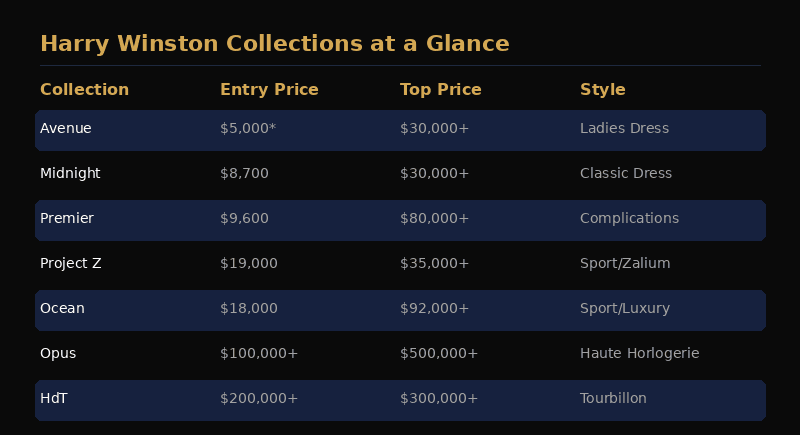
| Collection | Positioning | Price Range | Key Models |
|---|---|---|---|
| Avenue | Ladies’ jewellery watch | $5K–$30K+ | Avenue Classic, Avenue C |
| Midnight | Dress, men’s & women’s | $8.7K–$30K+ | Automatic, Moon Phase, Skeleton |
| Premier | Signature complications | $9.6K–$80K+ | Moon Phase, Chronograph, Perpetual Calendar |
| Ocean | Sport collection | $18K–$92K | Triple Retrograde Chrono, Dual Time |
| Project Z | Zalium sport | From ~$19K | Limited Zalium-cased editions |
| Opus | Collaborative haute horlogerie | $100K–$500K+ | Opus 1–14, independent watchmakers |
| Histoire de Tourbillon | Ultra-high complications | $300K+ | Triple tourbillon |
The table illustrates the breadth of Harry Winston’s watch catalogue. From the Art Deco Avenue at the lower end to the six-figure Opus editions, the price range spans two orders of magnitude — wider than most competitors outside the very top of the luxury watch landscape. That spread is partly a function of materials: even the most affordable Harry Winston watches use precious metals or proprietary alloys, and gem-set variants push every collection significantly higher than its base price suggests.
Avenue: The Jewellery Watch
The Avenue is Harry Winston’s entry-level collection and its most explicitly jewellery-focused watch line. Named after Fifth Avenue in New York, these are primarily ladies’ watches built around a rectangular case with Art Deco styling. The design language draws directly from the house’s gemstone heritage: clean geometric lines, diamond-set bezels on most references, and a proportioned elegance that reads more as wrist jewellery than horological instrument.
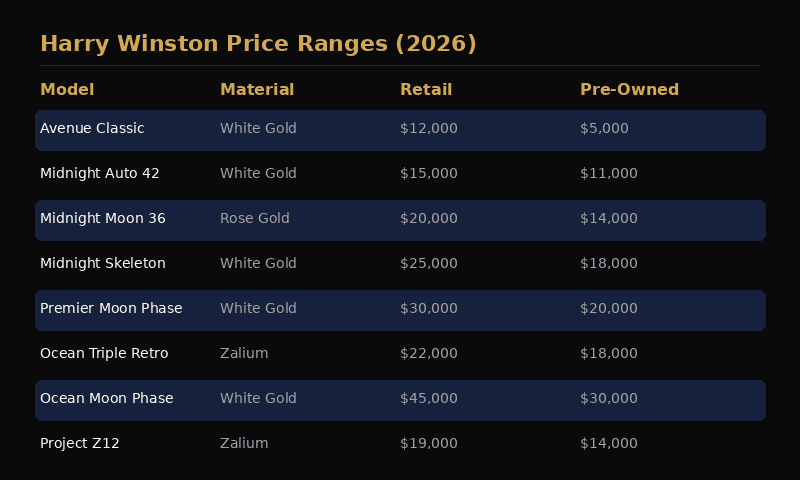
Pre-owned Avenue models represent the most accessible way to own a Harry Winston timepiece, with prices starting around $5,000 for simpler references in good condition. New pieces with diamond-set bezels and mother-of-pearl dials run from approximately $15,000 to $30,000+, depending on the stone count, metal, and dial complexity. The Avenue Classic Moon Phase, which pairs the rectangular case with a small moon-phase aperture, sits near the top of the range in white or rose gold.
These watches are not meant to compete with sports watches or dress-watch icons from brands like Cartier or Jaeger-LeCoultre on horological merit. Their value proposition is the Harry Winston name, the quality of the gem setting, and the precious-metal case — the same combination that sells the house’s engagement rings and necklaces. For buyers who want Harry Winston on the wrist without spending six figures, the Avenue is the practical starting point.
Midnight: Dress Watches Done Differently
The Midnight collection is where Harry Winston makes its strongest case as a watchmaker rather than strictly a jeweller. These are round-cased dress watches for men and women, available in 29mm, 36mm, and 42mm sizes across a range of complications. The entry point for a new Midnight is approximately $8,700, making it the most affordable way to buy a new Harry Winston watch, while the upper end of the collection reaches $30,000 or more for diamond-set and complicated variants.
The Midnight Automatic in 42mm white gold is the core men’s reference — a clean dial, applied indices, and a reliable automatic movement inside a case that wears thinner than its dimensions suggest. At around $11,000–$14,000 new, it positions itself against dress watches from Vacheron Constantin, Jaeger-LeCoultre, and Piaget, though with significantly less name recognition in the watch enthusiast community. Harry Winston’s strength here is the finishing of the case and the quality of the dial, not movement innovation.
Midnight Date Moon Phase — ~$18,000–$25,000
The moon-phase complication is one of the most visually rewarding additions to a dress watch, and Harry Winston executes it well in the Midnight family. The 42mm white gold version places a moon-phase display at six o’clock with a date window, set against a deep blue or silver dial. At $18,000 to $25,000, it occupies the same price territory as a Jaeger-LeCoultre Master Ultra Thin Moon, though the JLC carries stronger secondary-market retention.
Midnight Skeleton & Diamond Drops — $20,000–$30,000+
At the top of the Midnight range, Harry Winston’s jewellery DNA reasserts itself. The Diamond Drops models feature freely moving diamonds trapped between sapphire crystals on the dial, a design signature borrowed from the house’s high jewellery pieces. Skeleton variants open up the dial to expose the movement architecture. Both push above $20,000 and serve as conversation pieces rather than tool watches, which is precisely the point for a jewellery house that happens to make timepieces.
Premier: The Signature Collection
The Premier is Harry Winston’s signature watch collection and the line that best bridges the house’s jewellery heritage with serious watchmaking. Launched in 1989 as the brand’s first watch collection, the Premier established the design vocabulary that still defines Harry Winston’s approach: precious-metal cases only, signature arched lugs, and complications that range from moon phase through chronograph to perpetual calendar.
New Premier watches start at approximately $9,600 for the simplest references, but the collection’s sweet spot sits in the $15,000 to $40,000 range, where moon-phase and chronograph models live. The Premier Moon Phase 36mm in rose gold is one of the collection’s most popular references, pairing an automatic movement with a refined moon-phase display and Harry Winston’s signature case finishing. It lists around $20,000 to $25,000, positioning it as a mid-range option within the Premier family.
Premier Chronograph — ~$25,000–$40,000
The Premier Chronograph adds a column-wheel chronograph complication to the collection’s precious-metal case. It is not the flashiest chronograph in the luxury market, but the combination of Harry Winston’s case design and a high-quality Swiss chronograph movement delivers a watch that works equally well under a suit cuff or as a standalone statement piece. Most references use white gold or rose gold with a deployant clasp on an alligator strap.
Premier Perpetual Calendar — $60,000–$80,000+
At the top of the Premier range, the perpetual calendar represents Harry Winston’s most complex non-Opus complication. A full perpetual calendar tracks day, date, month, moon phase, and leap year automatically, requiring no manual correction until the year 2100. In white or rose gold, these pieces compete against perpetual calendars from Vacheron Constantin, Jaeger-LeCoultre, and A. Lange & Söhne, though at a lower secondary-market profile. For buyers who value the Harry Winston aesthetic and don’t prioritise resale, the Premier Perpetual Calendar offers serious horological content at a price that undercuts some Holy Trinity equivalents.
Check Any Watch Price in Seconds
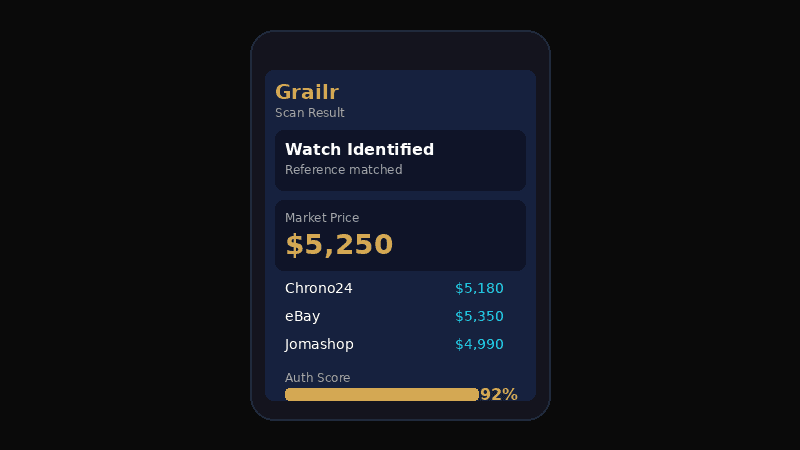
Grailr scans your watch photo and pulls live pricing from Chrono24, eBay, and Jomashop.
- AI identifies brand, model & reference number
- Live market prices from 3+ sources
- Authentication confidence score
Ocean and Project Z: Sport Watches
The Ocean collection is where Harry Winston steps away from its jewellery roots and into the sport-watch arena. These are larger, bolder watches built around complications like triple retrograde chronographs, dual time zones, and moon phases in 36mm and 42mm cases. The design is unapologetically assertive: oversized Arabic numerals, prominent subdials, and a case shape that would look out of place on any dress-watch shelf.
Prices for the Ocean collection start at roughly $18,000 and climb to approximately $92,000 depending on the complication and case material. The Ocean Triple Retrograde Chronograph is the collection’s signature model, using three retrograde subdials rather than conventional circular registers — an unusual display method that gives the watch a mechanical dynamism few sport chronographs can match. In white gold or rose gold, this piece runs $35,000 to $55,000 depending on dial and strap configuration.
Recent Ocean models have introduced Zalium — Harry Winston’s proprietary zirconium-based alloy. Zalium is lighter than gold, more scratch-resistant than steel, and has a distinctive dark grey colour that gives the Ocean a more modern, technical aesthetic. Zalium-cased Ocean models price lower than their precious-metal equivalents, starting around $18,000 to $25,000, which makes them the most accessible way to buy a Harry Winston sport watch new.
Project Z — From ~$19,000
Project Z is a spin-off line built entirely around Zalium cases. These are limited-edition sport watches produced in small quantities, often with a single complication and a more restrained design language than the Ocean proper. The “Z” stands for the zirconium alloy, and the line serves as Harry Winston’s most accessible sport-watch entry point at approximately $19,000 new. For buyers who want the Harry Winston name on a sport watch without the five-figure-plus premium of a gold Ocean, Project Z fills the gap — though availability on the secondary market is limited by the small production runs. If you are comparing across the wider sport-watch landscape, our watch appraisal guide covers how to benchmark a listing before you commit.
Opus and Haute Horlogerie
The Opus series is, in many ways, the most interesting thing Harry Winston has done in watchmaking. Launched in 2001, Opus is a collaborative project: for each edition, Harry Winston partners with an independent watchmaker who designs a unique movement, complication, or time-display mechanism. The house provides the case, the brand name, and the distribution, while the watchmaker provides the horological invention. Fourteen editions have been released, each more ambitious than the last.
The roster of collaborators reads like a who’s who of independent watchmaking. Opus 1 (2001) was created with F.P. Journe. Opus 3 featured a satellite hour display by Vianney Halter. Opus 5 paired Harry Winston with Felix Baumgartner (now of Urwerk), while Opus 11 was a collaboration with Max Büsser (MB&F) and Denis Flageollet, featuring a mechanical digital readout of hours and minutes. Opus 14, the most recent, was created with Franck Muller and features a diamond-set mechanical animation.
Every Opus edition is produced in limited quantities, typically fewer than 100 pieces per edition in any given case material. New-issue prices start at approximately $100,000 and can exceed $500,000 for the most complex editions. On the secondary market, rare Opus pieces trade at significant premiums — the lower-numbered editions with the most celebrated watchmakers (Journe, Halter, Greubel Forsey) have become genuine collectibles, with pre-owned prices of $136,000+ for more common references and $183,000+ for sought-after variants.
Histoire de Tourbillon — $300,000+
If the Opus series pushes creative boundaries through collaboration, the Histoire de Tourbillon pushes pure complication depth. This collection explores every variation of the tourbillon mechanism — from single to double to triple tourbillons, with some editions featuring bi-axial and tri-axial configurations where the tourbillon cage itself rotates on multiple planes simultaneously.
Prices start above $300,000 and reach considerably higher for multi-axis and gem-set versions. These are watches for collectors who operate at the pinnacle of the market and who appreciate Harry Winston’s ability to commission extraordinary mechanical feats from the Swatch Group’s manufacturing resources. The Histoire de Tourbillon is not a volume seller — it exists to demonstrate that a jewellery house can compete at the highest tier of haute horlogerie. For context on where these pieces sit in the broader landscape of high-end watches, our brand guide covers the full competitive field.
Resale Value and Market Position
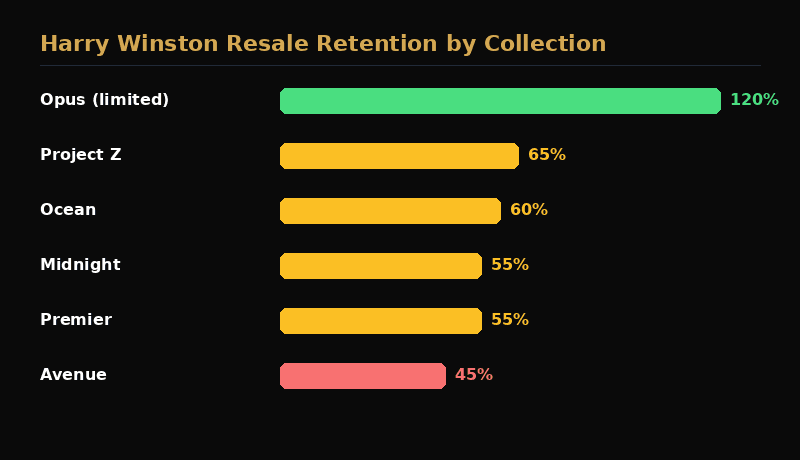
Harry Winston’s resale performance follows a pattern common among jewellery-house watch brands: standard production models depreciate moderately, while limited-edition and haute-horlogerie pieces hold value or appreciate. This is broadly similar to how brands like Chopard and Bvlgari perform, and meaningfully below the retention rates of Rolex, Patek Philippe, or Audemars Piguet.
| Collection | New Price Range | Pre-Owned Range | ~3-Year Retention |
|---|---|---|---|
| Avenue | $15K–$30K+ | $5K–$18K | 35–55% |
| Midnight | $8.7K–$30K+ | $5K–$18K | 50–65% |
| Premier | $9.6K–$80K+ | $6K–$45K | 50–65% |
| Ocean / Project Z | $18K–$92K | $10K–$55K | 45–60% |
| Opus | $100K–$500K+ | $136K–$500K+ | Varies; can appreciate |
The key takeaway from this data is that Harry Winston watches should not be purchased primarily as investments, with the notable exception of Opus limited editions. The Avenue collection takes the steepest depreciation hit, which is common among jewellery watches where a significant portion of the retail price reflects design, stone setting, and brand premium rather than intrinsic movement or metal value. Midnight and Premier pieces do better, retaining roughly 50 to 65 percent of retail after three years — a figure that aligns with other non-Rolex, non-Patek precious-metal dress watches from brands like Chopard, Piaget, and Bvlgari.
The Opus series is the outlier. Because production numbers are extremely low and each edition is designed by a well-known independent watchmaker, demand from collectors tends to sustain or increase prices over time. Lower-numbered editions — Opus 1 through 5 in particular — have seen the most consistent appreciation, driven by the fame of their collaborators and the growing recognition of independent watchmaking as a collectible category in its own right. None of this constitutes a guarantee; secondary-market prices reflect what buyers are willing to pay at a given moment, not a yield curve you can bank on.
Buying Advice for 2026
1. Know What You Are Buying Into
Harry Winston is a jewellery house that makes watches, not a watchmaker that sets stones. If you want pure horological value — in-house movements, technical innovation, strong resale — brands like Rolex, A. Lange, or Vacheron Constantin offer more per dollar. If you want the craftsmanship of a world-class jeweller in a wearable format, with precious metals and gemstones as the core proposition, Harry Winston makes sense.
2. Buy Pre-Owned for the Best Value
Given the 35–65% depreciation on standard models, buying a Harry Winston watch pre-owned — even a recent piece with box and papers — can save $5,000 to $30,000 compared with buying new. The Midnight and Premier collections offer the best value secondhand because they carry real horological content alongside the brand premium. Use Grailr’s appraisal tool to compare asking prices against live market data before committing.
3. Verify Diamonds and Stone Setting
On gem-set references, the quality, count, and setting of the stones account for a significant portion of the retail price. If buying pre-owned, request high-resolution close-ups of every stone under strong light. Missing, loose, or replaced stones can reduce a piece’s value by thousands of dollars. Harry Winston’s gem setting is among the best in the industry, so damage here is especially costly to restore.
4. Scan Before You Commit
Use Grailr’s free scanner to photograph a listing and get a suggested model identification alongside live pricing from multiple marketplaces. It is a starting point for due diligence, not proof of authenticity — pair it with an independent inspection and, for Harry Winston, a check of the stone certificates before sending payment. Our online watch appraisal guide covers the full process.
5. Consider the Opus as a Collector Piece
If your budget reaches six figures and you are drawn to independent watchmaking, the Opus series is one of the most creatively ambitious projects in the industry. Each edition is a self-contained collaboration with a different watchmaker, which means no two Opus watches share a movement or complication concept. The earlier editions with F.P. Journe (Opus 1), Vianney Halter (Opus 3), and Antoine Preziuso (Opus 2) carry the strongest collector demand.
Frequently Asked Questions
How much does a Harry Winston watch cost?
Entry-level Harry Winston watches start around $5,000 on the pre-owned market for Avenue models and roughly $9,000 new for Midnight references. Premier complications run $15,000 to $80,000, Ocean sport models $18,000 to $92,000, and Opus limited editions regularly trade above $100,000.
Does Harry Winston make their own movements?
Some models use in-house movements, but many Harry Winston watches are powered by high-grade Swiss movements from suppliers such as Jaeger-LeCoultre and Vaucher (a Sandoz Foundation subsidiary like Harry Winston itself). The Opus series is the exception, pairing Harry Winston with independent watchmakers who design bespoke calibers for each edition.
Do Harry Winston watches hold their value?
Standard Midnight and Premier models typically retain 50 to 65 percent of retail after three years, which is below Rolex and Patek Philippe but in line with other jewellery-house watch brands. Opus limited editions are the exception and can appreciate significantly, especially lower-numbered editions.
Is Harry Winston part of the Swatch Group?
Yes. The Swatch Group acquired Harry Winston in 2013 for roughly $1 billion, adding it alongside Breguet, Blancpain, and Omega. Harry Winston’s watchmaking benefits from Swatch Group movement supply and manufacturing, while the jewellery side remains the brand’s commercial anchor.
What is the Harry Winston Opus series?
The Opus series is a collaborative haute horlogerie project launched in 2001. Each edition pairs Harry Winston with an independent watchmaker who designs a unique complication or display. Fourteen editions have been released, with names like Max Büsser, Vianney Halter, and Greubel Forsey contributing designs that range from satellite hour displays to mechanical digital readouts.
Related Articles
The Bottom Line
Harry Winston watches occupy a distinctive position in the luxury market: they are the products of one of the world’s most celebrated jewellers, built with precious metals and gemstones as a baseline rather than an upgrade. The Avenue, Midnight, and Premier collections offer varying degrees of horological substance, from straightforward quartz and automatic movements to perpetual calendars and chronographs, all wrapped in a jewellery-first aesthetic that no pure watchmaker replicates. The Ocean and Project Z lines bring sport-watch proportions and the distinctive Zalium alloy to the range. At the very top, the Opus series stands as one of the most creative collaborations in the industry, pairing Harry Winston with independent watchmakers whose inventions routinely push the boundaries of what a mechanical watch can do.
The tradeoff is resale. Standard Harry Winston watches depreciate more steeply than Rolex, Patek Philippe, or Audemars Piguet, which means buying decisions should be driven by genuine desire for what the house offers — its gemstone expertise, its design sensibility, and its precious-metal commitment — rather than an expectation of investment-grade returns. Buy pre-owned for the best value, verify stone quality on gem-set pieces, and treat the Opus series differently from the rest of the catalogue: those are collector-grade watches whose limited production and independent-watchmaker provenance have historically supported or exceeded their original prices.
Considering a Harry Winston?
Grailr uses a photo to suggest a watch identity and an indicative price estimate, with active eBay listings where available. Check the exact reference and condition independently; a photo scan cannot authenticate a watch.
Get an Indicative EstimateSources and price context
- Harry Winston Timepieces — Official collection pages with specifications, case materials, and movement details for each current-production reference.
- Swatch Group brand portfolio — Corporate context for the 2013 acquisition and Harry Winston’s position within the group.
These primary sources support the specifications and history noted above. Prices and resale percentages elsewhere in this guide are indicative editorial figures, not a verified transaction dataset or guaranteed returns. Confirm the exact reference, region, condition and current quote before buying; asking prices are not completed-sale prices.