How to Wind a Manual Watch: The Complete Guide
Step-by-step instructions for winding a hand-wound mechanical watch — crown positions, turn counts, screw-down crowns, and how to avoid damaging the mainspring.
This guide covers general winding principles for manual mechanical watches. Specific crown positions, turn counts and power reserves vary by caliber. Consult your watch’s manual for model-specific instructions.

- Always remove the watch from your wrist before winding to avoid lateral stress on the stem
- Turn the crown clockwise 20–40 times and stop the moment you feel firm resistance
- Wind once daily at the same time for the best timekeeping accuracy
- Letting a manual watch stop does not damage it — just wind and set when you’re ready
What Is a Manual Wind Watch?
A manual wind watch — also called a hand-wound watch — is a mechanical timepiece that stores energy in a coiled mainspring inside the barrel. Unlike a quartz watch that runs on a battery or an automatic watch that winds itself through a weighted rotor, a manual watch depends entirely on you. You turn the crown, the crown rotates a series of gears, and those gears tension the mainspring. As the spring slowly uncoils, it releases energy through the gear train to the escapement, which regulates the steady tick of the balance wheel.
This is the oldest form of portable timekeeping. The first spring-driven clocks appeared in the 15th century, and the basic principle has not changed. What has changed is precision. A modern hand-wound caliber like the Omega Co-Axial 3861 inside the Speedmaster Professional achieves chronometer accuracy of ±5 seconds per day, and the Hamilton H-50 inside the Khaki Field Mechanical stores 80 hours of power from a single winding session.
The absence of a rotor means manual movements can be thinner, which is why the world’s slimmest dress watches — from brands like Piaget, Jaeger-LeCoultre, and Nomos at a more accessible price — are almost always hand-wound. For many collectors, the daily ritual of winding is not a chore but the entire point: a moment of deliberate connection with a mechanical object in a world of screens and notifications.
How to Wind a Manual Watch: Step by Step
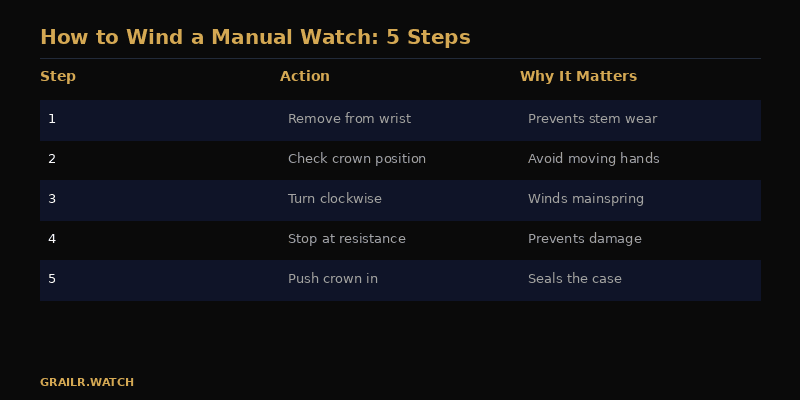
The process is simple, but the details matter. Follow these five steps every time you wind your watch, and the movement will reward you with years of reliable service. Longines recommends the same general approach in its own winding guide.
Step 1: Remove the Watch From Your Wrist
Winding while the watch is on your wrist puts lateral pressure on the crown stem. Over months and years, that sideways force wears the stem, the winding pinion, and the gasket that keeps moisture out. Take the watch off, hold the case firmly in one hand, and wind with the other. This takes five extra seconds and prevents the most common source of unnecessary stem wear.
Step 2: Check the Crown Position
Most manual watches wind in the first crown position — the crown pushed fully in against the case. If you pull the crown out and the hands start moving, push it back in immediately. That pulled position is for setting the time, not for winding. On a two-position crown, position one winds and position two sets. On a three-position crown common on date watches, position one winds, position two sets the date, and position three sets the time.
Step 3: If You Have a Screw-Down Crown, Unscrew It First
Dive watches and some field watches use a screw-down crown for water resistance. Turn the crown counter-clockwise until it pops out from the case tube. Do not force it. If it feels stuck, gentle back-and-forth pressure usually frees it. Once unscrewed, the crown sits in the winding position and you can proceed to the next step.
Step 4: Turn the Crown Clockwise, Slowly
With your thumb and index finger, turn the crown clockwise in smooth, steady half-turns. You will feel light resistance from the start as the mainspring begins to coil. Continue turning — most calibers need 20 to 40 full turns to reach a complete wind. The resistance builds gradually. When you feel a firm stop where the crown will not turn further without forcing it, the mainspring is fully wound. Stop there.
Step 5: Push (or Screw) the Crown Back In
Push the crown firmly back to its seated position against the case. If you have a screw-down crown, turn it clockwise until it threads home and seats flush. Never force it cross-threaded. A properly seated crown maintains the watch’s water resistance and prevents dust from entering the movement.
How Many Turns Does Your Watch Need?
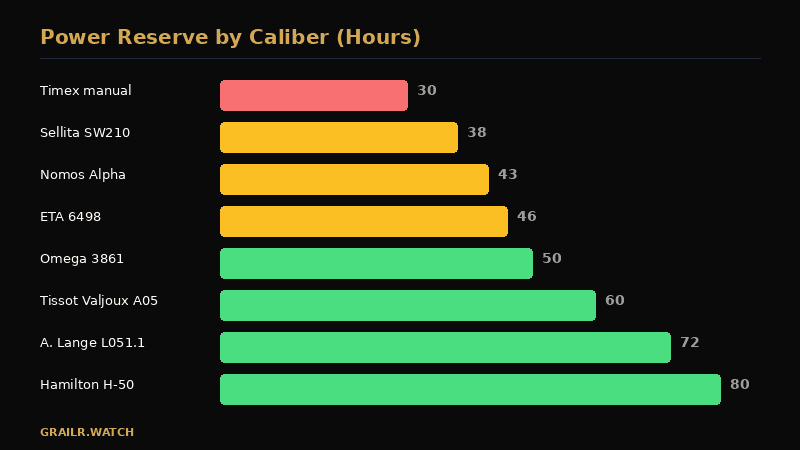
The number of crown turns depends on the mainspring length, barrel size, and gear ratios inside the movement. A short mainspring in a vintage dress watch might fully wind in 20 turns. A modern movement with an 80-hour power reserve can take 40 or more. The table below shows real turn counts and power reserves for popular manual calibers.
| Caliber | Found In | Power Reserve | Approx. Turns | Frequency |
|---|---|---|---|---|
| ETA 6497-1 | Stowa, Steinhart, Laco pilots | 46 hours | ~35 | 21,600 vph |
| Omega 3861 | Speedmaster Professional | 50 hours | ~40 | 21,600 vph |
| Hamilton H-50 | Khaki Field Mechanical | 80 hours | ~40 | 21,600 vph |
| Nomos Alpha | Tangente, Orion | 43 hours | ~30 | 21,600 vph |
| Seagull ST36 | Various Chinese pilot watches | 42 hours | ~30 | 21,600 vph |
| Miyota 6T33 | Orient Star, some Citizen | 50 hours | ~35 | 21,600 vph |
| Valjoux A05.291 | Tissot PR516 Chronograph | 60 hours | ~40 | 28,800 vph |
If your caliber is not listed, a general rule works: wind until you feel resistance, count the turns, and note it for next time. After two or three sessions you will know your watch’s exact count without thinking about it.
Manual Wind vs Automatic: Key Differences
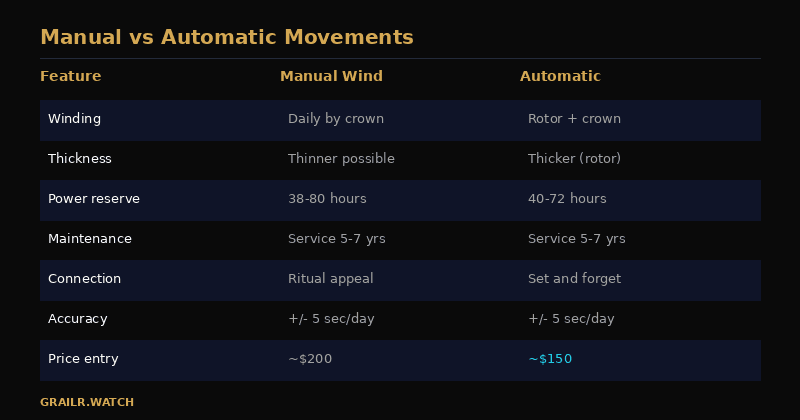
Both manual and automatic watches are mechanical — they run on a mainspring, not a battery. The difference is how that mainspring gets wound. Understanding the distinction helps you decide which type suits your lifestyle and explains why some collectors own both. For a deeper look at complications that appear in both types, see our guide to chronograph watches.
| Feature | Manual Wind | Automatic |
|---|---|---|
| Winding method | Crown only | Rotor + crown |
| Case thickness | Typically 7–11 mm | Typically 10–14 mm |
| Maintenance ritual | Daily hand winding | Wear it or use a winder |
| Typical power reserve | 38–80 hours | 38–72 hours |
| Movement visibility | Full view through caseback | Rotor partially obscures |
| Ideal wearer | Desk jobs, dress wear, collectors | Active daily wear |
| Entry price | From ~$200 (Timex Marlin) | From ~$150 (Seiko 5) |
Neither type is inherently better. Automatic watches are more convenient for people who wear the same watch every day. Manual watches are thinner, often more affordable at the entry level, and offer a more intimate mechanical experience. If you rotate between several watches in a collection, manual winding is actually simpler than maintaining a fleet of watch winders.
Check Any Watch Price in Seconds
Grailr scans your watch photo and pulls live pricing from Chrono24, eBay, and Jomashop.
- AI identifies brand, model & reference number
- Live market prices from 3+ sources
- Authentication confidence score

Common Winding Mistakes to Avoid
Winding a manual watch is straightforward, but a few habits can cause real damage over time. As Watch Obsession notes, the most frequent issues come from impatience and incorrect technique rather than any fault in the watch itself.
Forcing past resistance. This is the single most common mistake. When the mainspring is fully wound, the crown stops turning smoothly and meets a firm wall. Modern movements have a mechanical stop that prevents overwinding, but the stop mechanism itself can break if you muscle past it. The repair involves replacing the mainspring, the click spring, or both — a service bill of $150 to $400 depending on the caliber.
Winding on the wrist. It feels natural to give the crown a few quick turns while you’re already wearing the watch, but the angle forces the stem sideways. Over hundreds of winding sessions, this wears the stem tube, loosens the crown, and eventually compromises water resistance. A replacement stem and reseal typically costs $80 to $200.
Winding counter-clockwise. On most manual watches, counter-clockwise turns do nothing — the click spring only engages in the forward direction. However, on some calibers, repeated backward turns can wear the keyless works prematurely. Stick to smooth clockwise turns and avoid the back-and-forth “ratcheting” motion that some people use.
Winding too fast. Speed does not help. Rapid turns generate friction heat in the winding gears, and on vintage movements with aging lubricants, that heat accelerates wear. Aim for one turn per second — a calm, deliberate pace.
Forgetting the screw-down crown. After winding a dive watch, always screw the crown back down. An unseated screw-down crown is the number-one cause of water damage in mechanical dive watches. It takes three seconds to thread it home, and it can save you a complete movement replacement.
Best Manual Wind Watches at Every Price
Whether your budget is $200 or $6,500, there is a hand-wound watch worth owning. These are the models that collectors and reviewers consistently recommend, each offering something distinct at its price point. For more options under $1,000, see our best watches under $1,000 roundup.

Under $300: Timex Marlin Hand Wound — ~$200
The entry point. A 34mm stainless steel case with a domed acrylic crystal and a clean dial that channels 1960s American watchmaking. The movement is a basic hand-wound caliber with about 30 hours of power reserve. It’s thin, light, and teaches you the winding ritual without risking a serious investment. The leather strap versions are particularly good value.
$300–$700: Hamilton Khaki Field Mechanical — ~$500
The sweet spot for most buyers. The H-50 caliber delivers an 80-hour power reserve — the longest in this list — from a hand-wound movement. That means you can wind it Friday morning and it’s still running Monday. The 38mm case is perfectly sized for a field watch, and the military dial with its inner 24-hour track is one of the most legible designs in the industry. Read our full Hamilton Khaki Field guide for a complete breakdown.
$1,500–$2,500: Nomos Tangente — ~$2,180
German minimalism at its finest. The Tangente’s 35mm case measures just 6.8mm thick thanks to the hand-wound Alpha caliber, which Nomos finishes in-house in Glashütte with a three-quarter plate, blued screws, and Glashütte ribbing visible through the sapphire caseback. The 43-hour power reserve is modest but sufficient for daily wear. It is one of the thinnest watches you can buy at this price and one of the most beautiful movements you can see through a display back.
$2,000–$2,500: Tissot PR516 Chronograph — ~$2,100
A rare hand-wound chronograph at a mid-range price. The Valjoux-based A05.291 caliber gives you a 60-hour power reserve with a column-wheel chronograph mechanism. The 41mm case has a retro motorsport look that nods to Tissot’s 1960s racing heritage, and the panda dial variant is especially striking. If you want a manual chronograph without jumping to Speedmaster prices, this is the watch.
$6,000+: Omega Speedmaster Professional — ~$6,515
The Moonwatch. The Speedmaster Professional ref. 310.30.42.50.01.002 runs the Omega Co-Axial Master Chronometer Caliber 3861 with 50 hours of power reserve, METAS certification to ±5 seconds per day, and anti-magnetic resistance to 15,000 gauss. It is the single most famous manual wind watch in the world, worn on six lunar missions. The hesalite crystal version maintains the original Moonwatch look; the sapphire sandwich variant lets you see the 3861 through front and back. Our Omega buying guide covers the broader lineup.
Long-Term Care for Hand-Wound Movements
A well-maintained manual watch can last for generations. The movement itself has fewer parts than an automatic (no rotor, no reversing wheels), which means fewer components to service. Here is what keeps it running at its best.
Service interval. Most manufacturers recommend a full service every five to seven years. This involves disassembling the movement, cleaning every part in an ultrasonic bath, replacing worn components, re-lubricating the jewel bearings, and regulating the balance wheel. Budget $200 to $500 for a standard hand-wound caliber, more for chronographs.
Wind daily at the same time. A mainspring delivers its most consistent torque when fully wound. As it uncoils over 24 to 48 hours, the torque drops and accuracy drifts. By winding at the same time each day — most people choose morning — you keep the spring at peak tension during your active hours and get the best possible accuracy from the watch.
Store it correctly when not wearing it. Unlike automatics, manual watches do not need a winder. Simply let the watch run down, lay it on a soft surface or in a watch box, and leave it. The mainspring relaxing fully does not harm it. When you are ready to wear it again, wind it fully, set the time, and carry on. If you have a growing collection, a simple watch box is all you need.
Avoid magnets. Strong magnets from phone speakers, laptop clasps, and magnetic bag closures can magnetize the hairspring and cause the watch to run fast — sometimes gaining minutes per day. If your manual watch suddenly gains significant time, it may be magnetized. A watchmaker can demagnetize it in seconds with a handheld demagnetizer.
Keep it dry unless rated. Most dress watches and field watches with manual movements are rated to 30 to 50 meters, which means splash resistance only — not swimming. Always check the water resistance rating before exposing a manual watch to water, and remember that water resistance degrades over time as gaskets age. Have the gaskets checked during your regular service.
Frequently Asked Questions
How many times should I turn the crown to fully wind a manual watch?
Most manual watches need 20 to 40 clockwise turns to reach a full wind. Smaller movements with shorter mainsprings may need only 20 turns, while larger calibers with longer power reserves can take 40 or more. Stop when you feel firm resistance.
Can you overwind a manual watch?
Modern manual movements have a built-in stop that prevents the mainspring from being wound past its limit. You will feel firm resistance when the spring is fully wound. Forcing the crown beyond that point can damage the mainspring or the winding mechanism, so always stop at resistance.
Should I take my watch off before winding it?
Yes. Winding while the watch is on your wrist puts sideways pressure on the crown stem, which causes uneven wear on the winding mechanism over time. Remove the watch, hold the case in one hand, and wind with the other for the safest technique.
What is the difference between a manual wind and an automatic watch?
A manual wind watch uses only the crown to tension the mainspring. An automatic watch adds a weighted rotor that winds the mainspring as your wrist moves. Manual watches are typically thinner because they lack the rotor, and many collectors prefer the daily ritual of hand winding.
How often should I wind a manual watch?
Wind it once every 24 hours at the same time each day. This keeps the mainspring at consistent tension, which improves timekeeping accuracy. Even if your watch has a 60 to 80 hour power reserve, daily winding gives the best accuracy.
Do I need to wind a manual watch if I am not wearing it?
No. Letting a manual watch run down and stop does not damage the movement. The mainspring simply uncoils completely and the watch stops. Wind it again when you are ready to wear it. Unlike automatics, manual movements do not need a watch winder.
Related Articles
The Bottom Line
Winding a manual watch is one of the simplest things in horology — remove it from your wrist, turn the crown clockwise until you feel resistance, and push the crown back in. Do it once a day at the same time and your watch will keep accurate time for decades between services. The daily ritual is not a limitation of manual watches; it is what makes them different from everything else on your wrist. If you’re considering your first hand-wound timepiece, the Hamilton Khaki Field Mechanical at around $500 is the best balance of quality, power reserve, and price. If you already own one, scan it with Grailr to check its current market value.
Own a Manual Watch?
Grailr uses a photo to suggest a watch identity and an indicative price estimate, with active eBay listings where available. Check the exact reference and condition independently; a photo scan cannot authenticate a watch.
Scan a Watch NowSources and price context
- Longines: How to Wind a Mechanical Watch — Manufacturer winding guide recommending 20–30 turns for approximately 24 hours of power.
- Watch Obsession: How to Wind a Manual Watch — Step-by-step winding instructions with guidance on screw-down crowns and resistance feel.
These primary sources support the winding techniques described above. Prices and power-reserve figures are indicative editorial figures, not guaranteed specifications. Confirm exact caliber specs with the manufacturer and verify prices independently before buying.