Hublot Watch Prices: Every Collection in 2026
Classic Fusion, Big Bang, Spirit of Big Bang, and the new Big Bang Reloaded — retail prices, pre-owned values, and what depreciation actually looks like.
Price context: this guide includes indicative prices from its original publication period. They have not all been refreshed to current quotes. Use the linked primary sources for specifications and policies, and verify prices independently.
- Hublot retail prices range from roughly $6,500 (Classic Fusion 42mm Titanium) to $35,000+ for precious-metal Big Bang variants
- First-year depreciation typically runs 40–60%, making pre-owned the strongest value play in the lineup
- Ceramic, carbon-fiber, and limited-edition models retain value better than standard steel or titanium references
- The 2026 Big Bang Reloaded refreshes the flagship at $24,000–$25,200 with updated case geometry
- Pre-owned buyers can save 30–50% below retail on most current-production Hublot references
What Makes Hublot Different
Hublot was founded in 1980 by Carlo Crocco with a single radical idea: put a rubber strap on a gold case. At the time, the Swiss watchmaking establishment dismissed it as costume jewelry. Four decades later, Hublot is one of the most recognizable luxury watch brands on the planet, owned by LVMH since 2008, and its “Art of Fusion” philosophy — combining unexpected materials in a single watch — has become its defining identity rather than a gimmick.
That material innovation is what separates Hublot from nearly every competitor at its price point. The brand operates its own metallurgy lab in Nyon, Switzerland, and has developed proprietary alloys and composites that no other watchmaker uses: Magic Gold, a scratch-resistant 18k gold fused with ceramic that ranks roughly 1,000 Vickers on the hardness scale (standard gold sits around 400); Texalium, a carbon-fiber weave coated in aluminum for a metallic sheen without metal weight; and Sapphire Crystal cases machined from solid blocks of synthetic sapphire, a process that takes roughly 50 hours per case because sapphire is nearly as hard as diamond. The in-house UNICO movement family, meanwhile, gives the brand its mechanical credibility — a column-wheel flyback chronograph designed and manufactured entirely in Nyon, not sourced from an outside supplier and rebadged. Whether these innovations justify the retail ask is a separate conversation — one this guide will address with real numbers — but the engineering ambition is genuine, not borrowed.
Under LVMH and the creative direction of Jean-Claude Biver, who helmed the brand from 2004 to 2018, Hublot built its modern reputation on bold design, aggressive marketing (official timekeeper of FIFA, Formula 1, and the Premier League), and a willingness to polarize. You either respond to a 45mm ceramic chronograph with a skeletonized dial, or you do not — and Hublot has never pretended otherwise. That polarization affects resale value directly: the brand attracts passionate buyers at retail who pay full MSRP for the newness factor, but the secondary market has a smaller pool of repeat buyers willing to pay near-retail for a used piece, which accelerates depreciation relative to more universally popular brands. Understanding that dynamic is essential before committing to any reference in the catalog, because the gap between retail and pre-owned is wider for Hublot than for almost any other major Swiss manufacture.
Every Hublot Collection and What It Costs
Classic Fusion — From ~$6,500
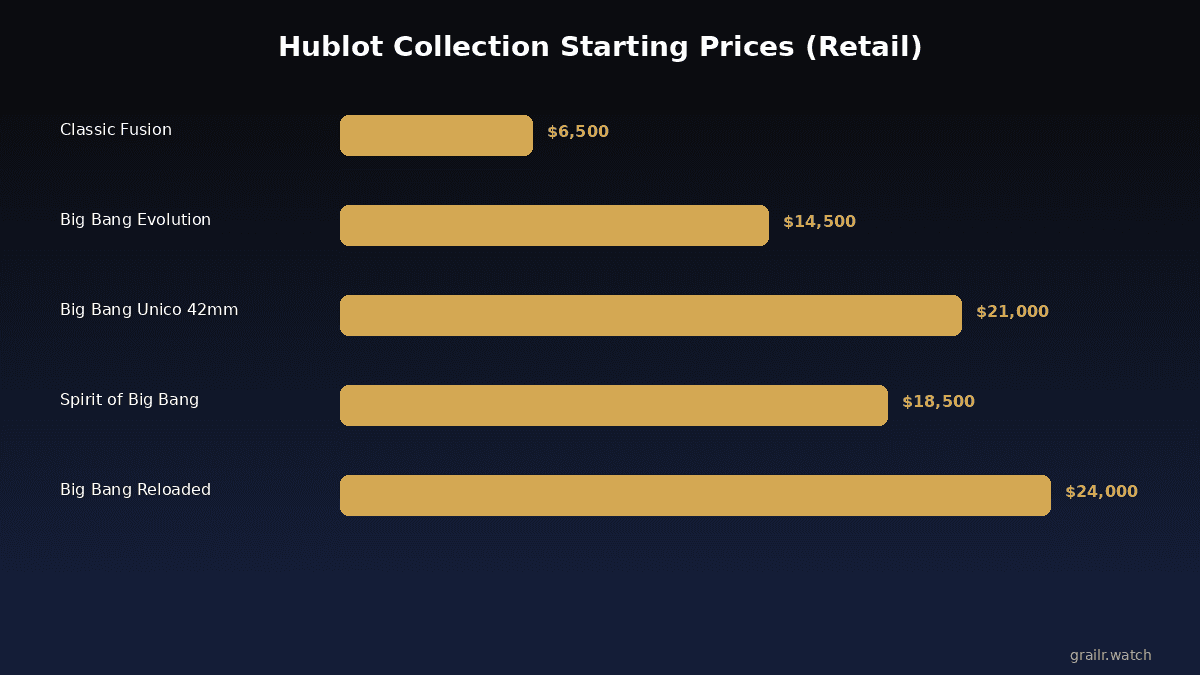
The Classic Fusion is Hublot’s quietest watch and its most accessible. Where the Big Bang shouts, the Classic Fusion speaks at conversation volume — thinner cases, cleaner dials, and a silhouette that traces its lineage back to Crocco’s 1980 original. The 42mm Classic Fusion Titanium is the entry point to the brand at roughly $6,500 retail, powered by the HUB1110 automatic movement with a 42-hour power reserve. At 42mm wide and 10mm thick, it wears noticeably slimmer than a Big Bang and slides under a shirt cuff without protest — a meaningful distinction for buyers who want Hublot’s material quality without the “look at me” proportions. Pre-owned examples in good condition start around $5,900, making it the most cost-effective way into genuine Hublot ownership. The Classic Fusion range extends to chronographs, King Gold variants, and skeleton dials that push past $20,000, but the three-hand titanium model is where most first-time buyers start. For a broader comparison of value-conscious luxury picks, see our guide to high-end watches.
Big Bang — From ~$14,500
The Big Bang is the watch that made Hublot a household name. Launched in 2005 under Biver’s direction, it combined a porthole-shaped case with visible screws, a rubber strap, and a layered sandwich construction that made the case itself a design statement. The six H-shaped screws on the bezel are Hublot’s most recognizable visual signature, and they are functional: they hold the bezel to the case and can be removed with Hublot’s proprietary tool to swap bezels or perform service.
In 2026, the Big Bang family is enormous, but the key entry points are the Big Bang Evolution in steel at roughly $14,500 retail and the Big Bang Unico 42mm in ceramic at $21,000–$25,900, depending on dial configuration. The Unico line uses Hublot’s in-house HUB1280 UNICO movement, a column-wheel flyback chronograph with a 72-hour power reserve — a genuine manufacture caliber, not a modified ETA. The flyback function lets the wearer reset and restart the chronograph with a single push, without stopping and zeroing first, which is genuinely useful for timing consecutive events. The Big Bang 44mm titanium ceramic sits at approximately $24,000, with the larger case size giving the watch a wrist presence that borders on sculptural.
Spirit of Big Bang — From ~$18,500
The Spirit of Big Bang takes the Big Bang’s design language and pours it into a barrel-shaped (tonneau) case. It is the same material philosophy — titanium, ceramic, carbon fiber, King Gold — translated to a shape that wears differently on the wrist and stands out from the round-case majority of the luxury market. Entry pricing starts around $18,500 for the titanium three-hand model, with chronograph and skeleton variants climbing toward $30,000. The barrel case divides opinion even among Hublot enthusiasts, which narrows demand on the secondary market and can push pre-owned discounts deeper than comparable Big Bang models.
Big Bang Reloaded — New for 2026
The Big Bang Reloaded is Hublot’s 2026 statement: a design refresh that updates the Big Bang case with smoother transitions between the bezel, mid-case, and lug structure while keeping the porthole DNA and those signature H-shaped screws intact. The titanium ceramic version enters at $24,000 and the blue ceramic at $25,200, both running the HUB1280 UNICO movement with 72 hours of power reserve. The blue ceramic is particularly notable — Hublot’s ceramic lab produces colored ceramic by adjusting the sintering process, and blue has historically been one of the brand’s stronger colors on the secondary market. Expect these to hold their initial values better than standard Big Bang references for the first twelve to eighteen months, as new-release demand typically outpaces the supply of pre-owned examples — but after that honeymoon period, secondary-market behavior will likely follow the broader Hublot depreciation pattern.
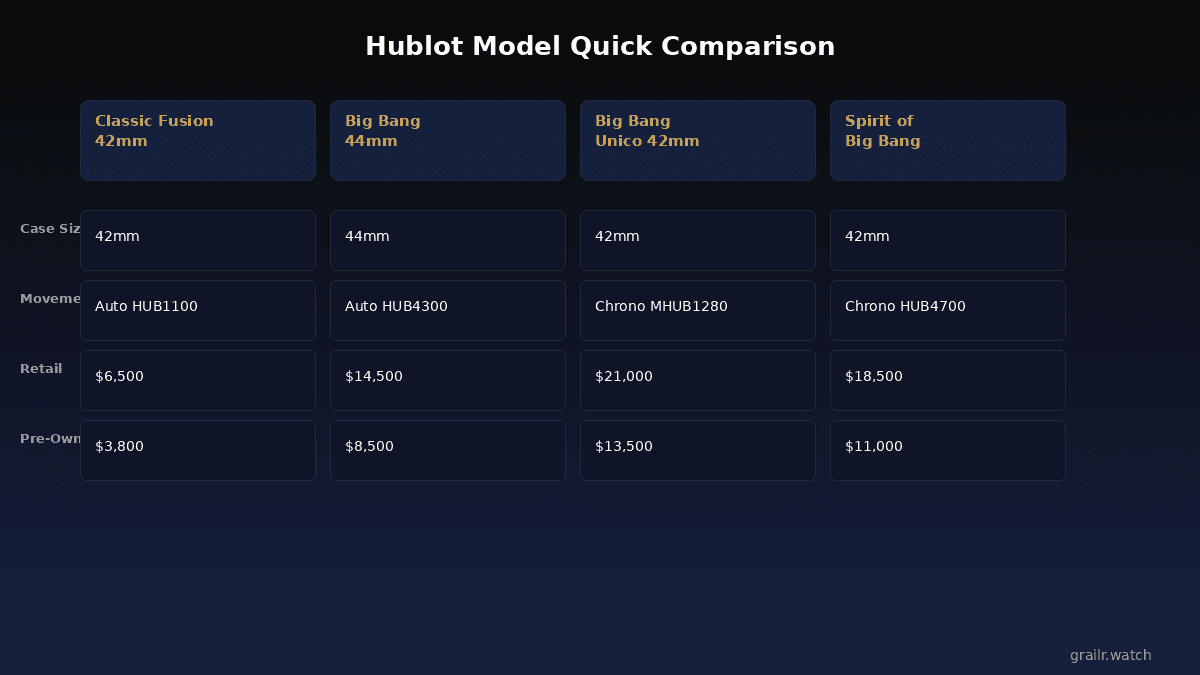
| Collection | Entry Model | Movement | Retail | Pre-Owned |
|---|---|---|---|---|
| Classic Fusion | 42mm Titanium | HUB1110 (42h) | ~$6,500 | ~$5,900 |
| Big Bang Evolution | 44mm Steel | HUB4100 (42h) | ~$14,500 | ~$6,000–$9,000 |
| Big Bang Unico | 42mm Ceramic | HUB1280 (72h) | $21,000–$25,900 | ~$14,000–$18,000 |
| Spirit of Big Bang | Barrel Titanium | HUB4700 (50h) | ~$18,500 | ~$10,000–$13,000 |
| Big Bang Reloaded | Ti Ceramic | HUB1280 (72h) | $24,000 | TBD (2026 launch) |
| Big Bang Reloaded | Blue Ceramic | HUB1280 (72h) | $25,200 | TBD (2026 launch) |
Retail prices are approximate 2026 USD MSRP. Pre-owned ranges reflect recent asking prices on major secondary-market platforms and vary with condition, box-and-papers status, and market timing.
MSRP vs Pre-Owned: Where the Real Savings Are
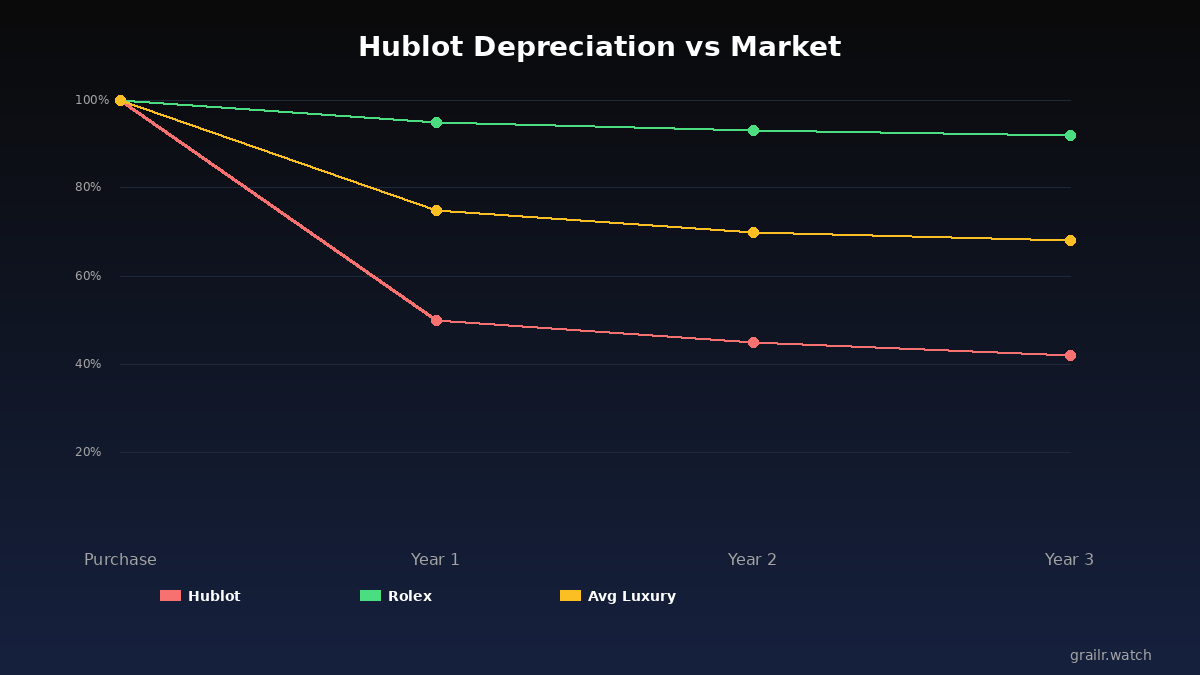
Hublot’s depreciation curve is one of the steepest in the luxury watch market, and understanding it is the single most important factor in deciding when and how to buy. A Big Bang that retails for $15,000 will typically trade for $6,000–$9,000 within twelve months of its first sale — a 40–60% loss that dwarfs comparable figures for Rolex (which often appreciates or holds flat) or Omega (which typically loses 15–30% in year one).
Over the past year, the broader Hublot secondary market has declined an average of roughly 6%, which is moderate by luxury-watch standards but tells only part of the story. That average masks wide variation: popular Unico ceramic references have tightened their retail-to-pre-owned gap slightly, while less sought-after steel chronographs and older Classic Fusion models have softened further. By contrast, Rolex sports models have remained flat or appreciated over the same period, and Omega’s Speedmaster and Seamaster lines have held within a 10–15% band of retail. The takeaway is simple — pre-owned Hublot is nearly always the smarter financial decision unless you specifically want the AD experience, the factory warranty, and the certainty of a brand-new watch on your wrist.
| Model | Retail MSRP | Pre-Owned (1 yr) | Approx. Loss | Savings % |
|---|---|---|---|---|
| Classic Fusion 42mm Ti | $6,500 | $5,900 | $600 | ~9% |
| Big Bang Evolution Steel | $14,500 | $6,000–$9,000 | $5,500–$8,500 | 38–59% |
| Big Bang Unico 42mm Ceramic | $21,000 | $14,000–$18,000 | $3,000–$7,000 | 14–33% |
| Big Bang 44mm Ti Ceramic | $24,000 | $14,500–$17,500 | $6,500–$9,500 | 27–40% |
| Spirit of Big Bang Ti | $18,500 | $10,000–$13,000 | $5,500–$8,500 | 30–46% |
The Classic Fusion stands out as an exception to the broader pattern. Its lower retail price means the absolute dollar loss is smaller, and its more conservative design appeals to a wider resale audience than the Big Bang’s polarizing aesthetic. It is also the model most likely to attract buyers who are cross-shopping Omega, TAG Heuer, or Breitling — brands with larger secondary-market audiences — which helps support demand even when the broader Hublot market softens. For buyers prioritizing total cost of ownership, the Classic Fusion in titanium is the clearest value in the current Hublot catalog. For a broader perspective on depreciation across brands, see our guide to watches that lose the most value.
Check Any Watch Price in Seconds
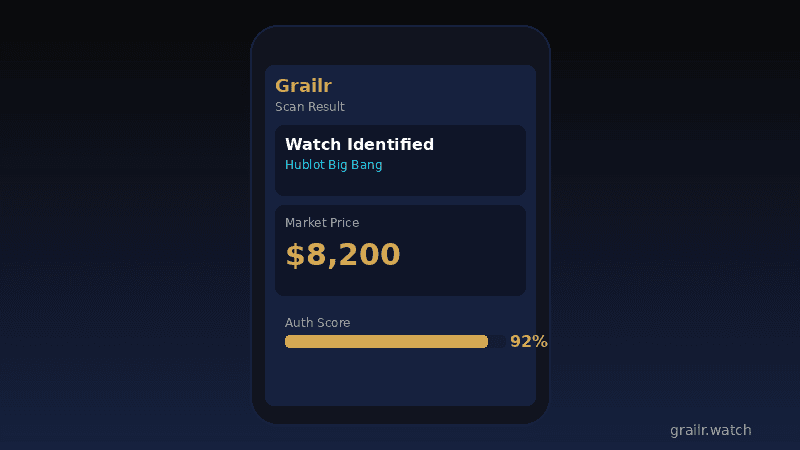
Grailr scans your watch photo and pulls live pricing from Chrono24, eBay, and Jomashop.
- AI identifies brand, model & reference number
- Live market prices from 3+ sources
- Authentication confidence score
Which Hublot Models Hold Value Best
Not every Hublot depreciates at the same rate, and the differences are large enough to matter if resale value factors into your buying decision. Three categories consistently outperform the rest of the lineup on the secondary market.
Ceramic-cased models hold value better than their steel or titanium counterparts. Hublot’s ceramic is scratch-resistant and ages without the scuffing that shows wear on a metal case, which keeps pre-owned examples looking closer to new and narrows the discount buyers expect. The Big Bang Unico in black ceramic, for example, typically retains 67–86% of its retail price after the first year — still a loss, but significantly tighter than the 40–60% the steel Big Bang Evolution sheds.
Limited editions benefit from scarcity, but the effect is inconsistent. A collaboration with a genuinely desirable partner — Ferrari, Berluti, or a run limited to 100 pieces — can hold notably tighter spreads, especially in the first two to three years when the limited supply has not yet fully entered the secondary market. However, Hublot produces a high volume of limited editions relative to competitors like Rolex or Patek Philippe, which dilutes the “limited” premium. Treat a limited Hublot as likely to depreciate less than a standard model, not as likely to appreciate. For broader context on which luxury brands hold value over time, see our luxury watch brands guide.
Carbon-fiber models occupy a niche with strong collector demand. The Spirit of Big Bang in carbon fiber and the Big Bang Unico Carbon both appeal to buyers who value material innovation — exactly the audience Hublot cultivates with its “Art of Fusion” positioning — and their secondary-market prices reflect steadier demand than standard titanium or steel references. If you are buying a Hublot partly as a store of value (which, to be clear, is a secondary consideration for a brand with this depreciation profile), ceramic and carbon are where the arithmetic works best.
One pattern worth noting: the models that hold value best tend to be the ones that lean hardest into what makes Hublot distinct. A steel Big Bang looks like a $14,500 fashion watch to a secondary-market buyer; a ceramic Unico or a sapphire-cased limited edition looks like something you cannot get anywhere else. The more a Hublot relies on materials and engineering that only Hublot can deliver, the more defensible its resale floor tends to be. Standard steel and titanium references, by contrast, compete against Omega, Breitling, and IWC at similar secondary-market price points, and those brands carry broader collector bases.
How to Buy a Hublot Smart
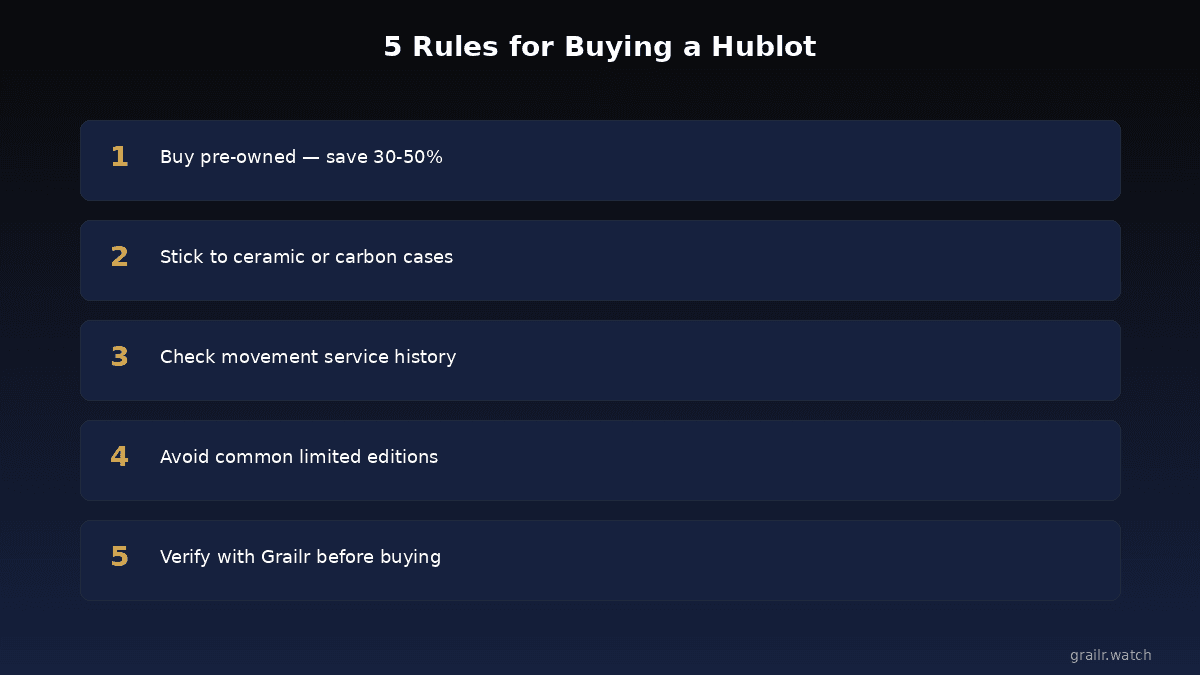
1. Buy Pre-Owned Unless You Need the Boutique Experience
The 40–60% first-year depreciation is the single strongest argument for pre-owned Hublot. A Big Bang that sold for $15,000 twelve months ago trades for $6,000–$9,000 today with minimal wear. The watch is mechanically identical; only the price tag and warranty status change. If the factory warranty matters to you, Hublot offers transferable warranties on newer references, so buying pre-owned with warranty remaining is possible through reputable dealers.
2. Prioritize Ceramic or Carbon Over Steel
If you plan to sell eventually, ceramic and carbon-fiber Hublot references hold tighter resale spreads than steel. Ceramic’s scratch resistance keeps the watch looking newer for longer, which directly translates to higher offers on the secondary market. The premium at purchase is typically $3,000–$7,000 above the steel equivalent, but you will recover more of it at resale.
3. Verify the Movement and Service History
Hublot uses both in-house movements (the HUB1280 UNICO family) and modified third-party calibers (the HUB4100 is based on a Zenith El Primero base). Both are reliable, but the in-house UNICO commands a premium for its 72-hour power reserve and integrated chronograph. On a pre-owned purchase, ask for the service history and last service date — a full Hublot service runs $800–$1,500 depending on complication, and that cost should be factored into any deal where the last service is more than five years ago.
4. Scan Before You Commit
Use Grailr’s free scanner to photograph a listing or a watch in hand and get a suggested identification alongside live pricing pulled from multiple marketplaces. It is a starting point for comparison, not proof of authenticity — always pair it with an independent inspection before sending payment, especially on high-value references where convincing counterfeits exist.
5. Compare the Full Cost of Ownership
A $14,500 Big Bang that will be worth $7,000 in three years costs you $7,500 plus servicing to own. A $6,500 Classic Fusion that retains $5,500 costs you $1,000 plus servicing. Before choosing a model, run the real arithmetic: purchase price minus expected resale value plus one service interval. That number is what the watch actually costs you to wear, and it can change which model makes sense. For more on this approach across different price points, see our best luxury sports watches guide.
Frequently Asked Questions
What is the cheapest Hublot watch you can buy new?
The Classic Fusion 42mm Titanium starts at approximately $6,500 retail, making it the most accessible new Hublot in 2026. Pre-owned examples trade from around $5,900.
How much does a Hublot Big Bang cost?
Big Bang prices start around $14,500 for the Evolution steel model. The Big Bang Unico 42mm ceramic runs $21,000 to $25,900, while the Big Bang 44mm titanium ceramic is approximately $24,000 retail.
Do Hublot watches hold their value?
Hublot typically loses 40-60% of its retail value in the first year on the secondary market. Limited editions and ceramic or carbon-fiber models tend to retain value better, but most standard references depreciate significantly compared to brands like Rolex or Patek Philippe.
Is buying a pre-owned Hublot worth it?
Pre-owned Hublot is often the smarter purchase, saving 30-50% below retail. The steep first-year depreciation means a one-year-old Big Bang that retailed for $15,000 can trade for $6,000 to $9,000, with essentially the same watch minus the initial markup.
What is the Hublot Big Bang Reloaded?
The Big Bang Reloaded is Hublot's 2026 refresh of its flagship collection. It updates the case design while keeping the core Big Bang DNA. The titanium ceramic version starts at $24,000 and the blue ceramic at $25,200.
Which Hublot models depreciate the least?
Ceramic-cased models, carbon-fiber editions, and limited-run collaborations tend to depreciate the least. The Big Bang Unico in ceramic and the Spirit of Big Bang in carbon fiber historically hold tighter spreads between retail and pre-owned prices than standard steel or titanium references.
Related Articles
The Bottom Line
Hublot makes genuinely innovative watches with materials and movements that few competitors can match at any price. The brand’s problem is not quality — it is depreciation. Buying a new Hublot at retail means accepting a 40–60% first-year loss on most references, which makes the pre-owned market the obvious entry point for anyone who cares about value as well as the watch itself.
If you want the most accessible Hublot with the smallest absolute depreciation, the Classic Fusion 42mm Titanium at ~$5,900 pre-owned is the clear pick. If you want the iconic Big Bang experience, buy a one-to-two-year-old Unico in ceramic and let someone else absorb the first-year hit. And if you want the newest thing in the catalog, the Big Bang Reloaded is worth seeing in person at an authorized dealer before the secondary market sets its own price — just know that the secondary market will, and it will be lower.
Considering a Hublot?
Grailr uses a photo to suggest a watch identity and an indicative price estimate, with active eBay listings where available. Check the exact reference and condition independently; a photo scan cannot authenticate a watch.
Get an Indicative EstimateSources and price context
- Hublot official collection — Current retail pricing, specifications, and movement details for all collections including the Big Bang, Classic Fusion, Spirit of Big Bang, and Big Bang Reloaded.
- Chrono24 Hublot listings — Live secondary-market asking prices used to derive the pre-owned ranges and depreciation estimates in this guide.
These primary sources support the specifications and pricing noted above. Prices and depreciation percentages elsewhere in this guide are indicative editorial figures, not a verified transaction dataset or guaranteed returns. Confirm the exact reference, region, condition and current quote before buying; asking prices are not completed-sale prices.