Watches That Lose the Most Value, and Why
The watches that lose the most value, and the ones that barely move — a data-driven look at depreciation across brands, models, and price tiers.
Price context: this guide includes indicative prices from its original publication period. They have not all been refreshed to current quotes. Use the linked primary sources for specifications and policies, and verify prices independently.
- Most luxury watches lose 20–50% of their retail value the moment they leave the authorized dealer
- Hublot, Panerai, and TAG Heuer lead depreciation in the mainstream luxury segment, with first-year losses of 20–60%
- Even blue-chip brands have weak spots: Rolex Cellini, AP Code 11.59, and Patek Calatrava all underperform their siblings
- Buying pre-owned skips the steepest depreciation and can save 20–40% compared to retail
The Depreciation Reality Nobody Talks About
The luxury watch world has a narrative problem. Scroll through any enthusiast forum and you’ll hear about Rolex Daytonas appreciating 200%, Patek Philippes treated as alternative assets, and vintage pieces selling for multiples of their original retail price. All true — and all deeply misleading about what happens to most watches after purchase.
The uncomfortable reality: the majority of luxury watches lose significant value the moment you walk out of the boutique. Industry data consistently shows that the typical luxury timepiece sheds 20–50% of its retail price in the first year of ownership. Some categories do worse. Fashion watches — those from non-watchmaking luxury houses — can lose 70–90% of their value.
This is not a flaw in the market. It’s the normal behavior of a consumer product. Cars depreciate. Electronics depreciate. The handful of watches that appreciate are the anomaly, not the rule. Understanding which watches lose value and why is essential whether you’re buying your first serious timepiece or building a collection. A watch purchased for enjoyment at a fair price is a good buy. A watch purchased as an “investment” that loses 40% in twelve months is a financial mistake wrapped in sapphire crystal.
This guide examines the brands, models, and price tiers where depreciation hits hardest. It draws on secondary market data, dealer margins, and the structural factors that separate watches that hold value from those that don’t. If you want the other side of the coin, see our companion guide on watches that hold their value.
Brands That Lose the Most Value
Not all luxury brands depreciate equally. Some have built structural moats — controlled supply, iconic designs, decades of waitlists — that insulate them from secondary-market discounting. Others rely heavily on retail markup, seasonal collections, and marketing budgets that evaporate the moment a watch is pre-owned.
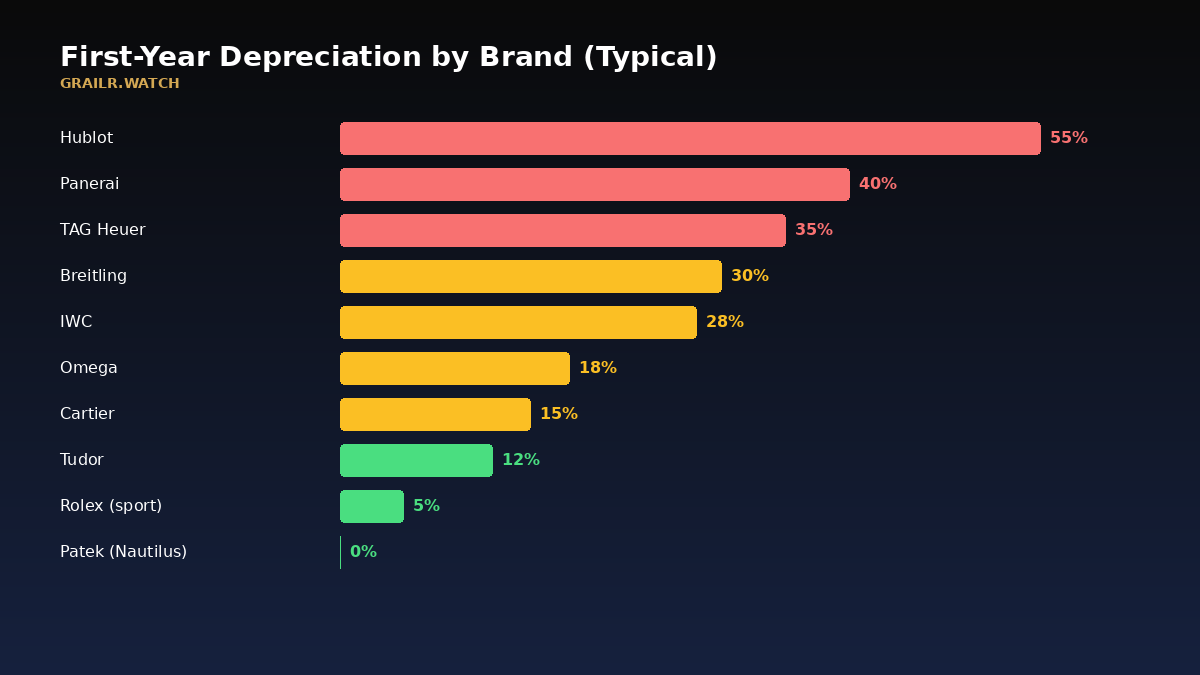
Hublot: 40–60% First-Year Loss
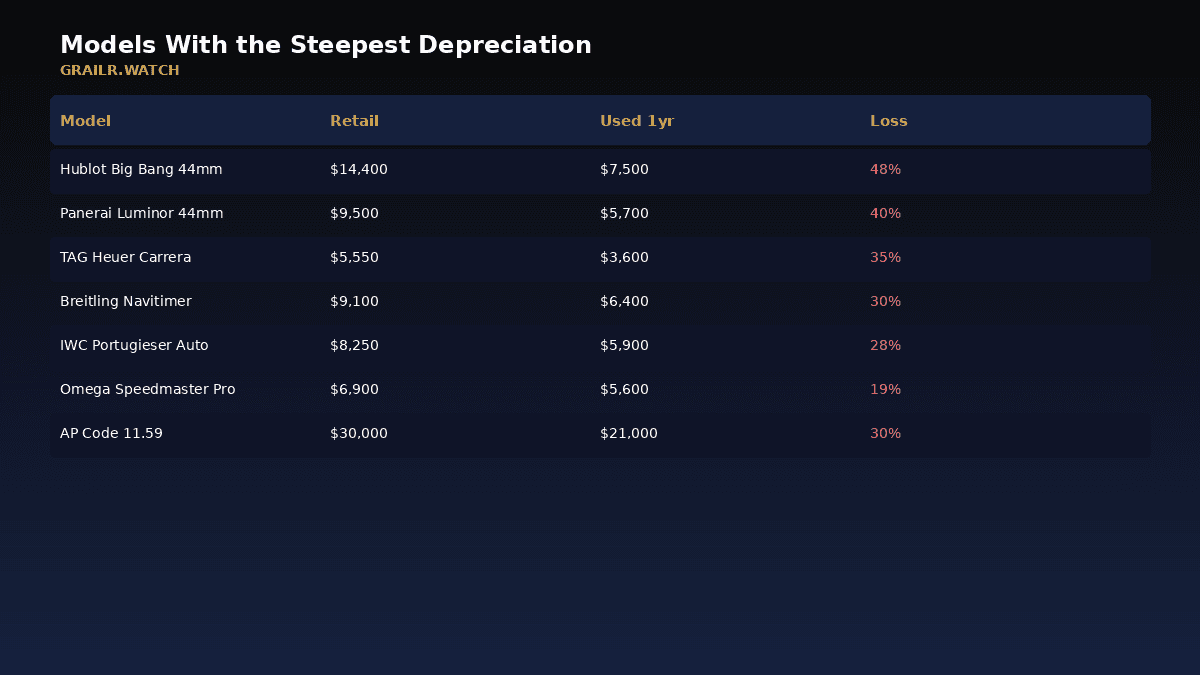
Hublot sits at the top of every depreciation chart in the luxury watch world, and the reasons are structural. The brand produces in relatively high volume, releases frequent limited editions that dilute exclusivity, and prices its pieces at retail levels that the secondary market simply won’t support. A Big Bang that retails for $15,000 often trades for $6,000–$9,000 within twelve months of purchase. The Classic Fusion line fares similarly. Even the more exotic Spirit of Big Bang models shed 35–50% once they leave the boutique.
This does not make Hublot a bad watch. The Unico movement is genuinely impressive, and the Big Bang’s design language is instantly recognizable. But buying a new Hublot at retail is a decision to accept steep depreciation from day one. Buyers who love the brand are often better served on the pre-owned market, where the price already reflects the correction.
Panerai: 30–45% First-Year Loss
Panerai carved out a devoted following with its bold Italian military aesthetic, but the brand has struggled with value retention for years. The Luminor and Submersible lines typically lose 30–45% of their retail value in the first year. ETA-movement models — where Panerai uses an off-the-shelf Swiss movement rather than its own in-house calibre — depreciate most aggressively, as buyers are reluctant to pay a premium for third-party mechanics in a case that costs $7,000 or more at retail.
In-house movement Panerais (the P.9010 and its derivatives) hold somewhat better, but even these rarely retain more than 65–70% of retail. The brand’s large 44mm+ case sizes also limit the resale audience; wrist trends have shifted toward 38–42mm, and oversized watches face a shrinking pool of buyers.
TAG Heuer: 20–40% First-Year Loss
TAG Heuer occupies a difficult middle ground. It’s a genuine watchmaking name with heritage (the Carrera debuted in 1963, the Monaco in 1969), but its retail pricing often sits above what the secondary market will bear. The Formula 1 line — TAG’s most accessible range, mostly quartz — can lose 30–40% in the first year. The Aquaracer fares slightly better at 20–30%, while the mechanical Carrera holds relatively well within the brand at a 15–25% discount.
The Connected smartwatch line, priced in the $1,800–$2,500 range, is in a category of its own. Like all luxury smartwatches, it faces obsolescence as well as depreciation — a two-year-old model is outdated technology, and the pre-owned market reflects that.
Breitling: 20–35% First-Year Loss
Breitling has undergone a substantial brand overhaul since Georges Kern took the helm, trimming the collection and refining the aesthetic. But the secondary market hasn’t fully caught up. Navitimer and Superocean models typically trade 20–35% below retail within the first year. The larger, busier pilot-style pieces face the steepest discounts, while the cleaner 41mm Chronomat holds somewhat better.
One bright spot: vintage Breitling references, especially early Navitimers with the Venus 178 movement, have appreciated considerably. But current-production pieces are a different market entirely.
IWC: ~28% First-Year Loss
IWC makes technically impressive watches — the Portugieser Perpetual Calendar and the Big Pilot are genuine complications from a respected manufacture — but the brand’s resale values have historically lagged behind its retail prices. A typical IWC loses around 28% in the first year. The Pilot’s Watch line, priced in the $5,000–$8,000 range, competes with watches from Omega and Tudor that hold their value considerably better. IWC’s market position — above Omega, below Lange — means it faces pressure from both directions.
Models That Underperform Their Own Brands
Brand reputation is not uniform across a catalogue. Even the strongest names have models that disappoint on the secondary market. These are watches where the brand name on the dial sets expectations the specific model cannot meet.
| Model | Brand Avg. Retention | Model Retention | Gap |
|---|---|---|---|
| Rolex Cellini | 95–105% | 75–85% | −20% |
| AP Code 11.59 | 90–100% | ~70% | −25% |
| Patek Calatrava | 95–120% | 90–100% | −15% |
| A. Lange & Söhne (select) | 60–75% | ~56% | −12% |
| Omega De Ville | 70–80% | 55–65% | −15% |
Rolex Cellini
Rolex’s dress watch line is an anomaly in a catalogue where almost everything trades at or above retail. The Cellini Moonphase (Ref. 50535), retailing near $27,000, often trades for $20,000–$22,000 on the secondary market. Why? Rolex buyers want sport watches — Submariners, GMTs, Daytonas. The Cellini lacks a rotating bezel, an Oystersteel case, and the wrist presence that defines the brand for most collectors. It’s a beautiful watch in an identity crisis.
Audemars Piguet Code 11.59
When AP launched the Code 11.59 in 2019, the response was hostile. Collectors wanted another Royal Oak variant, not a round-cased dress watch. The initial reception has softened — the finishing is genuinely excellent, and the double-curved sapphire crystal is technically impressive — but the secondary market has not forgiven the launch. Models that retail for $30,000–$35,000 regularly trade at $20,000–$24,000, roughly a 30% discount. For a brand where the Royal Oak trades at or above retail, that gap stings.
Patek Philippe Calatrava
The Calatrava is Patek’s defining dress watch — elegant, understated, and the foundation of the brand’s identity since 1932. But in a market obsessed with steel sport watches, the Calatrava trades at or just below retail, sometimes dipping to 90% of its list price. For a brand where the Nautilus commands a 60–80% premium over retail and the Aquanaut trades at 130%+, the Calatrava’s flat performance stands out. It’s not losing money in absolute terms the way a Hublot does, but relative to the Patek name, it underdelivers.
A. Lange & Söhne: Prestige Without Price Protection
Lange makes some of the finest mechanical watches on earth. The Zeitwerk, the Datograph, the Lange 1 — these are pieces that serious collectors consider the pinnacle of German watchmaking. But prestige doesn’t guarantee value retention. Certain Lange models have shown first-year losses of 44% or more, a figure that feels shocking for a watch with hand-finished movements and five-figure retail prices. The issue is supply-demand imbalance: Lange produces more units than the collector market absorbs at retail prices, and the brand lacks the mass-market recognition of Rolex or Patek that would bring casual buyers to the secondary market. For those interested in watches that do appreciate, we cover the opposite end of the spectrum in our guide on watches that appreciate in value.
Depreciation by Price Tier
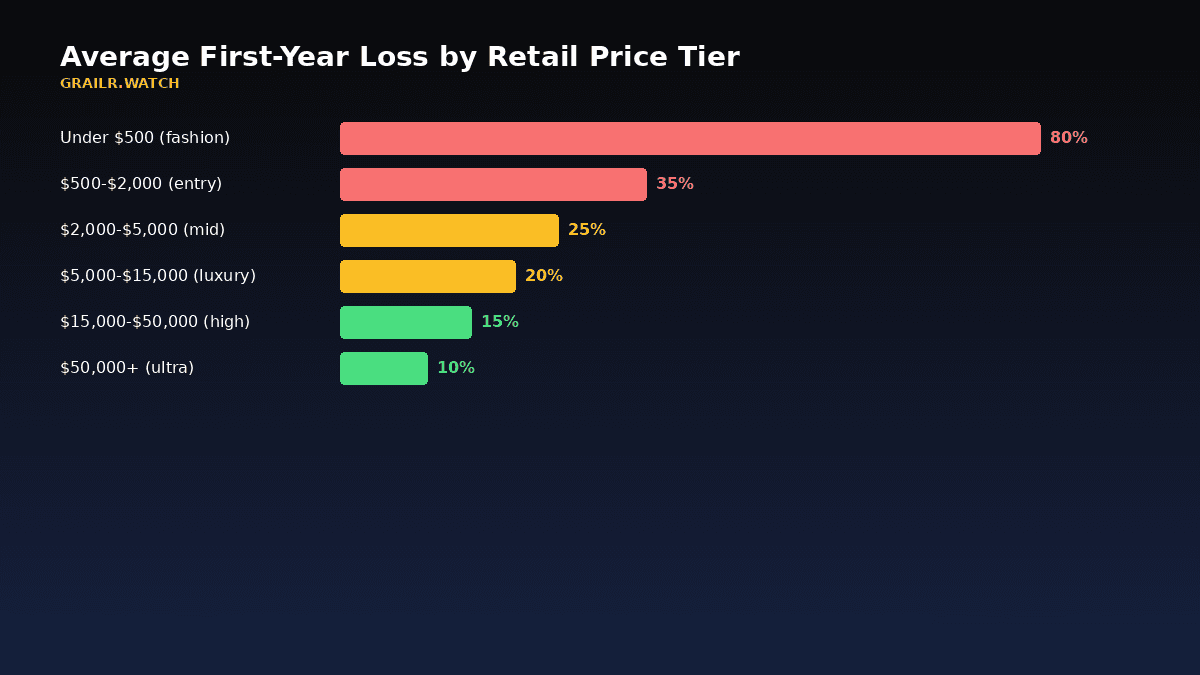
The price you pay for a watch strongly predicts how much value you’ll lose — but not always in the direction you’d expect. Here is how first-year depreciation varies across the main luxury tiers, based on indicative secondary-market data.
| Price Tier | Retail Range | Typical First-Year Loss | Examples |
|---|---|---|---|
| Fashion / Accessible | $200–$500 | 70–90% | Michael Kors, Gucci, Versace |
| Entry Luxury | $500–$2,000 | 25–40% | Tissot, Hamilton, Longines |
| Mid Luxury | $2,000–$8,000 | 15–30% | Omega, Tudor, TAG Heuer |
| High Luxury | $8,000–$30,000 | 15–45% | IWC, Panerai, Breitling, Hublot |
| Ultra-Premium | $30,000+ | 10–44% | Patek, AP, Lange, Rolex sport |
A few patterns emerge. Fashion watches lose the most in percentage terms because they were never priced for their horological content — the retail price is almost entirely brand markup, and the pre-owned market strips that away immediately. Entry luxury watches lose less in percentage terms but represent a real dollar loss that hurts at their price point. The high-luxury and ultra-premium tiers show the widest range: a Rolex Submariner or Patek Nautilus might hold 100%+ of its retail value, while an A. Lange & Söhne or Hublot in the same price bracket loses 40–60%.
The mid-luxury tier is where buyers often find the best balance of enjoyment and value. An Omega Speedmaster or Tudor Black Bay purchased for $4,000–$6,000 will typically trade at $3,200–$5,000 after a year — meaningful depreciation, but not catastrophic, and you’ve worn a genuinely excellent watch.
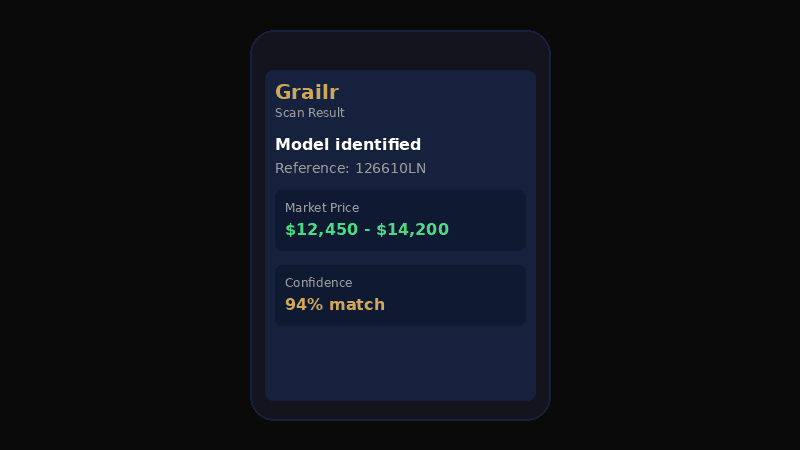
Check Any Watch Price in Seconds
Grailr scans your watch photo and pulls live pricing from Chrono24, eBay, and Jomashop.
- AI identifies brand, model & reference number
- Live market prices from 3+ sources
- Authentication confidence score
Why Some Watches Bleed Value
Depreciation is not random. The same structural factors appear repeatedly in watches that lose significant value, and understanding them helps you anticipate which purchases will hurt your wallet the most.
High Retail Margins
Some brands price their watches with enormous retail margins — 60–70% above manufacturing cost. The secondary market corrects for this immediately. Brands with tighter margins (Rolex, Grand Seiko) lose less because there’s less air to come out of the price. When a watch’s retail price includes a large component of marketing spend and boutique overhead, the pre-owned buyer is not going to pay for those things twice.
Overproduction and Frequent Releases
Scarcity drives value retention. Brands that produce in high volume or release new “limited editions” every quarter dilute their own secondary market. When there are always new models arriving, last season’s watch has to compete not just with pre-owned inventory but with the next new thing at the authorized dealer. Hublot’s frequent collaboration releases are a textbook case of this dynamic.
Weak Secondary-Market Demand
Value retention requires buyers on both ends of the transaction. A watch only holds its price if someone is willing to pay that price when the first owner sells. Brands with strong collector communities (Rolex, Omega Speedmaster, Patek) generate persistent demand. Brands without that community infrastructure — or that appeal primarily to first-time buyers who don’t resell — face thinner markets and lower prices.
Third-Party Movements
Watches that use off-the-shelf ETA or Sellita movements face a harder resale argument. Buyers wonder why they should pay $7,000 for a pre-owned Panerai with an ETA movement when they can buy a new Tissot with the same movement family for $700. In-house calibres are not inherently better, but they signal brand commitment and create a perceived exclusivity that supports pre-owned pricing.
Trend Sensitivity
Watches whose appeal is primarily aesthetic — trendy dial colors, unconventional case shapes, fashion-forward designs — depreciate faster than watches with timeless proportions. The Hublot Big Bang looked radical in 2005 and fresh through 2015. By 2026, the design language has aged, and the secondary market reflects that fatigue. Classic designs (Reverso, Speedmaster, Datejust) resist this cycle because they were never trend-driven to begin with.
The 2022 Peak and the 2026 Correction
Any discussion of watch depreciation in 2026 has to account for what happened in 2022. Between early 2021 and March 2022, the secondary market for luxury watches experienced an unprecedented bubble. Stimulus-driven demand, cryptocurrency wealth, social media hype, and a genuine supply shortage combined to push prices on popular models to absurd levels. A Rolex Submariner Date traded for $18,000–$20,000 against a $9,150 retail price. A Patek Nautilus 5711, listed at $35,000, sold for $150,000 or more.
Then the market corrected. By mid-2023, most of those inflated models had lost 20–40% from their peaks. By 2026, many have stabilized — but at levels considerably below their 2022 highs. For more on the current state of the market, see our 2026 luxury watch market trends analysis.
Anyone who bought at the peak paid a bubble premium that the market has not restored. A buyer who paid $19,000 for a Submariner in March 2022 now holds a watch trading at $12,000–$13,000. That’s a $6,000–$7,000 loss — not because the Submariner is a bad watch, but because the entry price was irrational. The watch itself has “depreciated” only in the sense that the market returned to sanity.
The lesson: timing matters, but not in the way speculators think. The best time to buy a watch is when prices reflect underlying demand, not hype. For most watches, that means buying pre-owned, buying during a quiet market, or simply buying at retail from an authorized dealer when a waitlist opens up. Trying to time the market like a stock trader is how people end up with a $19,000 Submariner receipt and a $12,000 watch.
Hidden Costs That Compound Depreciation
The retail-to-resale gap is not the only cost of ownership. Several hidden factors make the real depreciation picture even steeper than the headline numbers suggest.
Service Costs
A basic mechanical service runs $500–$1,500 depending on the brand. A chronograph service can cost $2,000–$3,500. A grand complication? $5,000 or more. These costs come every 5–8 years and are non-negotiable if you want to maintain the watch’s value — but they’re rarely factored into depreciation calculations.
Insurance
A $10,000 watch typically costs $100–$200 per year to insure. Over a decade of ownership, that’s $1,000–$2,000 in premiums — pure cost with no return unless you make a claim. Not insuring the watch is cheaper but riskier.
Opportunity Cost
$10,000 invested in an index fund averaging 8% annual returns would grow to roughly $21,600 over ten years. A $10,000 watch that loses 30% in year one and stabilizes at $7,000 has cost you not just $3,000 in depreciation but $14,600 in unrealized growth. This is not an argument against buying watches — it’s an argument against calling them investments.
Condition Deterioration
Desk-diving scratches, crystal nicks, bracelet stretch — all reduce resale value. A watch in “excellent” condition commands 10–20% more than one in “good” condition on the secondary market. Polishing can restore appearance but removes metal, which purists penalize. You’re caught between wearing the watch and preserving its value.
When you add service costs, insurance, and condition degradation to the headline depreciation figure, the true cost of owning a depreciating luxury watch is considerably higher than the resale gap alone suggests. A Hublot Big Bang that loses 50% of its $15,000 retail price is not just a $7,500 loss — it’s $7,500 plus $1,500 in service costs, $1,000 in insurance, and the opportunity cost of having $15,000 tied up in a depreciating asset. To check where a specific watch stands in the current market, use Grailr’s instant appraisal tool.
How to Buy Smart and Minimize Losses
Depreciation is not avoidable in most watch purchases, but it can be managed. The same market dynamics that punish uninformed buyers reward careful ones.
1. Buy Pre-Owned
The single most effective way to minimize depreciation is to let someone else absorb it. A one-year-old watch in excellent condition has already taken its biggest hit. You can often buy it for 20–40% less than retail and hold it with minimal further loss. The pre-owned market for brands like Panerai and Hublot offers exceptional value precisely because the first-year depreciation is so steep.
2. Stick to Core Models
Within any brand, the historically significant models hold value best. The Omega Speedmaster, not the Seamaster Planet Ocean. The Breitling Navitimer, not the Avenger. The TAG Heuer Monaco, not the Formula 1. Core models have collector demand that limited editions and seasonal variations do not.
3. Research Before You Buy
Check secondary-market prices on Chrono24, WatchCharts, and eBay completed sales before buying at retail. If a watch’s pre-owned price is 35% below retail, you know exactly what your day-one loss will be. Grailr’s scanner can give you an indicative estimate in seconds from a photo. For deeper context, our luxury watch investment guide covers the fundamentals of buying for value.
4. Avoid Fashion Watches at Retail
A $350 Michael Kors or Gucci watch will be worth $50–$100 in a year. The brand cachet that justifies the retail price evaporates entirely on the secondary market. If you want a fashion watch, buy it pre-owned for a fraction of the price, or redirect the budget toward an entry-level mechanical watch from a real watchmaker.
5. Keep Box and Papers
A complete set — box, papers, warranty card, hang tags — adds 5–15% to resale value across almost every brand. Keep everything that came with the watch, including the receipt. The secondary market penalizes incomplete sets disproportionately, especially for higher-value pieces. For a deeper look at which watches perform best on the resale market, see our guide on the best watches for value.
Frequently Asked Questions
Which watch brand loses the most value?
Hublot consistently shows the steepest depreciation in the luxury segment, with many models losing 40-60% of their retail value within the first year. Fashion-branded watches from houses like Gucci and Louis Vuitton can lose even more, often 70-90%.
Do all luxury watches lose value?
No. Certain sport models from Rolex, Patek Philippe, and Audemars Piguet consistently hold or exceed their retail prices on the secondary market. However, these are the exception. Most luxury watches, even from prestigious brands, lose 15-40% once they leave the retailer.
How much value does a TAG Heuer lose?
TAG Heuer watches typically lose 20-40% of their retail value in the first year. Entry-level quartz models depreciate more steeply than mechanical pieces like the Carrera or Monaco, which hold slightly better due to collector interest.
Is it worth buying a watch that depreciates?
Yes, if you are buying it to wear and enjoy rather than as an investment. Many watches that depreciate on paper are excellent timepieces. Buying pre-owned lets you skip the steepest part of the depreciation curve and often saves 20-40% compared to retail.
How can I check how much my watch is worth right now?
Grailr lets you photograph any watch and receive an indicative value estimate based on live market data from sources like Chrono24 and eBay. For a formal valuation, consult a certified appraiser or compare completed sales on multiple platforms.
Related Articles
The Bottom Line
Most luxury watches depreciate. This is normal, expected, and not a reason to avoid buying them — as long as you go in with open eyes. The watches that lose the most value share common traits: high retail margins, overproduction, weak collector communities, and trend-dependent designs. The watches that hold value share opposite traits: controlled supply, iconic design, strong collector infrastructure, and brand heritage that transcends fashion cycles.
Buy what you love, buy at a price you can afford to lose, and buy pre-owned whenever the depreciation curve is steep. A $6,000 pre-owned Panerai is a better buy than a $10,000 new one, not because it’s a different watch but because someone else already paid the depreciation tax. And before you buy anything, check the current market value so you know exactly where you stand.
Know What Your Watch Is Worth
Grailr uses a photo to suggest a watch identity and an indicative price estimate, with active eBay listings where available. Check the exact reference and condition independently; a photo scan cannot authenticate a watch.
Scan a Watch NowSources and price context
- Chrono24 Watch Value Retention Analysis — Secondary-market pricing data and brand retention rankings.
- WatchCharts Market Overview — Market index tracking and pre-owned price trends across brands.
These primary sources support the general market dynamics noted above. Prices, depreciation percentages, and resale figures elsewhere in this guide are indicative editorial figures, not a verified transaction dataset or guaranteed outcomes. Confirm the exact reference, region, condition and current quote before buying or selling; asking prices are not completed-sale prices.