12 Watches That Appreciate in Value: Real ROI Data for 2026
Data-backed analysis of the watches that actually go up in value — Rolex Daytona, Patek Nautilus, AP Royal Oak, and 9 more with real secondary market pricing and annual returns.
- Fewer than 50 watch references out of thousands consistently appreciate — most luxury watches depreciate
- Rolex Daytona, Patek Philippe Nautilus, and AP Royal Oak are the “blue chips” of watch investing with 5–15% annual appreciation at retail
- Stainless steel sport watches from top brands appreciate; precious metal models from the same brands typically depreciate
- Buying at retail price is essential — paying secondary market premiums kills ROI potential
The Truth About Watch Appreciation
Let’s start with an uncomfortable fact: most luxury watches lose value. The secondary watch market peaked in early 2022, and the WatchCharts Overall Market Index has corrected roughly 25–30% since that peak. Many watches that people bought expecting appreciation have instead depreciated significantly.
However, a select group of watches — primarily stainless steel sport models from Rolex, Patek Philippe, and Audemars Piguet — have defied that correction and continue to trade above their retail prices. These are the watches that genuinely appreciate, and they share specific characteristics that make them outliers in a market where depreciation is the norm.
This guide focuses exclusively on watches with documented appreciation data. No speculation, no “this might go up someday” picks. Every watch listed below currently trades above its retail price on the secondary market, with verifiable pricing data. For a broader look at which brands hold value (even if they don’t appreciate), see our watches that hold value guide.
The 5 Factors That Drive Watch Appreciation
Before diving into specific models, understanding why certain watches appreciate will help you evaluate future opportunities. Every appreciating watch shares these characteristics:
1. Supply Constraint
The brand produces fewer units than the market demands. Rolex makes roughly 1.2 million watches per year across all models — the Daytona gets a tiny fraction. Patek Philippe produces approximately 70,000 watches annually. When demand exceeds supply, prices rise.
2. Brand Prestige
Only a handful of brands command the kind of prestige that drives appreciation. Rolex, Patek Philippe, and Audemars Piguet sit in a tier of their own. Cartier and Vacheron Constantin occupy the next tier. Strong brand equity creates a floor under secondary market prices.
3. Iconic Design
Watches that appreciate tend to have designs that haven’t fundamentally changed in decades. The Submariner, Daytona, Nautilus, and Royal Oak look essentially the same as they did 20–50 years ago. Design stability creates continuity of demand.
4. Stainless Steel Construction
This is counterintuitive, but steel sport watches appreciate while gold versions of the same model depreciate. A steel Rolex Daytona trades at 160–200% of retail; a gold Daytona trades at 80–90% of retail. Steel is scarcer relative to demand.
5. Cultural Significance
The Speedmaster went to the Moon. The Submariner appeared in Bond films. The Nautilus redefined luxury sports watches. Cultural touchpoints amplify demand beyond the core collector base.
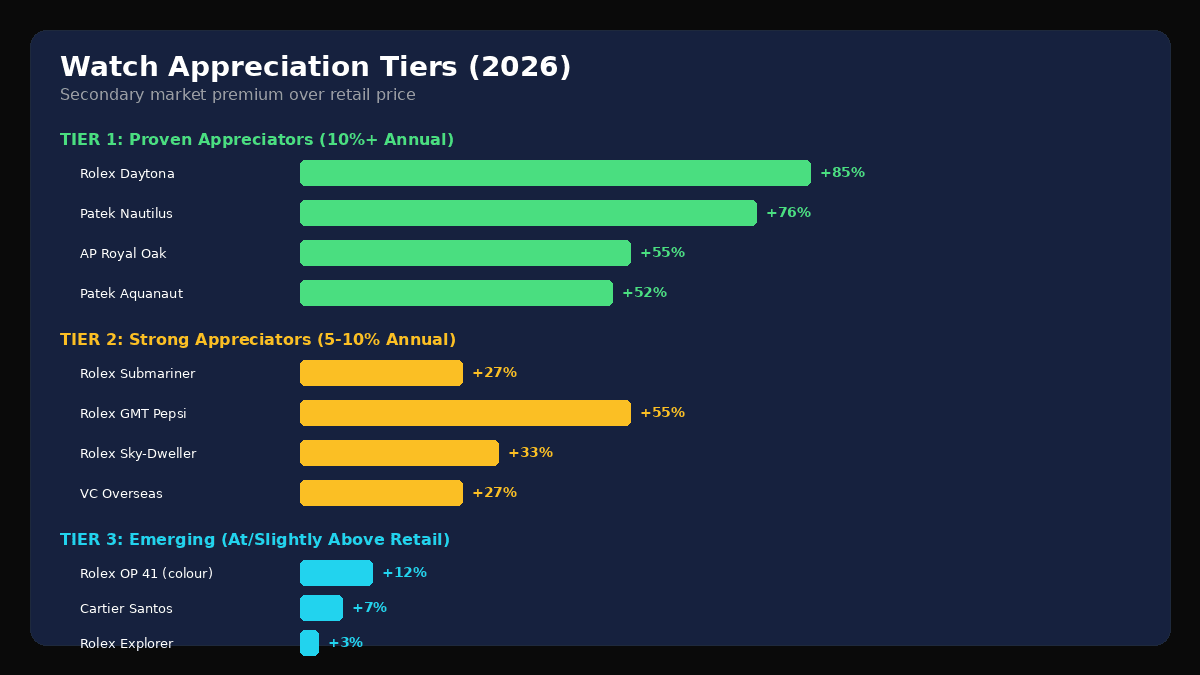
Tier 1: Proven Appreciators — 10%+ Annual Returns at Retail
1. Rolex Daytona (ref. 126500LN)
The steel Rolex Daytona is the gold standard of watch investment. Retail price: $15,500. Current secondary market: $25,000–$32,000. That’s 161–206% of MSRP, translating to roughly 12–15% annualized returns if purchased at retail within the last five years. The Daytona has appreciated consistently through every market cycle since 2016. The challenge? Getting one at retail requires an established relationship with an authorized dealer and, typically, significant purchase history.
2. Patek Philippe Nautilus 5811/1G
The successor to the legendary 5711, the Nautilus 5811 in white gold retails for $52,530 and trades for $85,000–$100,000+ on the secondary market. That’s roughly 162–190% of retail. The original 5711 in steel became one of the most valuable modern watches ever produced, and the 5811 has inherited much of that demand. Patek’s annual production is minuscule, and allocation is extremely limited. Our Patek Philippe price guide covers every current reference.
3. Audemars Piguet Royal Oak 15500ST
The Royal Oak in stainless steel (41mm, ref. 15500ST) retails for approximately $27,800 and trades for $38,000–$48,000. That’s 137–173% of retail. AP’s decision to restrict authorized dealers and limit production has kept demand well ahead of supply. The Royal Oak’s octagonal bezel and integrated bracelet design, created by Gérald Genta in 1972, remains as desirable today as ever. See our Royal Oak buying guide.
4. Patek Philippe Aquanaut 5167A
The “more accessible” Patek sports watch retails for $27,230 and trades for $38,000–$45,000 — roughly 140–165% of retail. The Aquanaut benefits from a younger, trendier image than the Nautilus and a tropical rubber strap that appeals to a wider demographic. Production numbers are tightly controlled.
Check Any Watch Price in Seconds
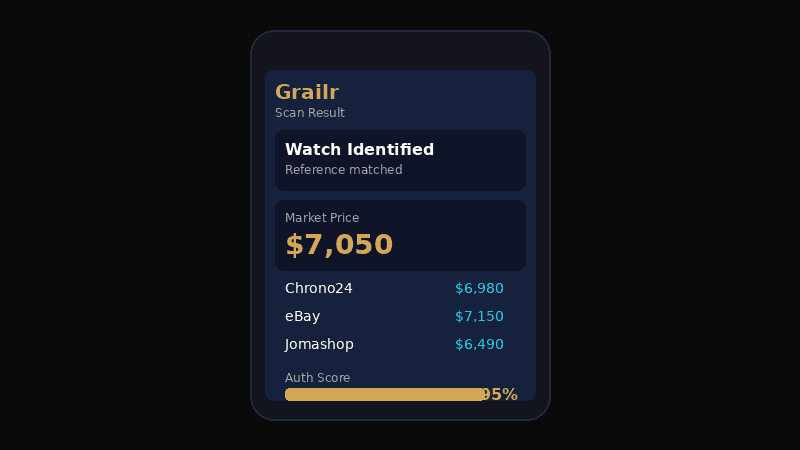
Grailr uses your photo to suggest a watch identification and an indicative price estimate. Active eBay listings, when available, offer asking-price comparisons.
- Grailr suggests brand, model & reference number
- Active eBay asking-price comparisons
- Identification confidence score
Tier 2: Strong Appreciators — 5–10% Annual Returns at Retail
5. Rolex Submariner (ref. 126610LN)
The steel Submariner Date retails for $10,250 and trades for $12,000–$14,000 — roughly 117–137% of MSRP. While the premium isn’t as dramatic as the Daytona, the Submariner is far easier to obtain at retail, making it a more realistic “investment entry point” for most buyers. It’s also the most liquid luxury watch on the secondary market — you can sell a Submariner anywhere in the world within days.
6. Rolex GMT-Master II “Pepsi” (ref. 126710BLRO)
The Pepsi GMT retails for $11,300 and trades for $16,000–$19,000 on the secondary market. That’s 142–168% of retail. The red-and-blue Cerachrom bezel is one of the most recognizable designs in all of watchmaking. With Rolex discontinuing the Jubilee bracelet version in favor of the Oyster bracelet, remaining Jubilee examples may see additional premiums. Our GMT Pepsi vs Batman vs Sprite guide breaks down every variant.
7. Rolex Sky-Dweller (ref. 336934)
The steel Sky-Dweller with blue dial retails for $15,800 and trades for $19,000–$23,000. At 42mm with an annual calendar complication and dual time zone, it’s Rolex’s most technically sophisticated watch. Demand has surged over the past three years as collectors discovered it combines genuine complication watchmaking with the Rolex name.
8. Vacheron Constantin Overseas 4500V
The steel Overseas (ref. 4500V/110A) retails for approximately $27,600 and trades for $32,000–$38,000. Vacheron Constantin is one of the “Holy Trinity” alongside Patek Philippe and Audemars Piguet. The Overseas has gained significant traction among collectors looking for an alternative to the crowded Nautilus and Royal Oak market. Our Vacheron Constantin guide covers the full collection.
Complete Appreciation Data Table
| Watch | Retail | Market | Premium | Tier |
|---|---|---|---|---|
| Rolex Daytona 126500LN | $15,500 | $25,000–$32,000 | +61–106% | Tier 1 |
| Patek Nautilus 5811/1G | $52,530 | $85,000–$100,000 | +62–90% | Tier 1 |
| AP Royal Oak 15500ST | $27,800 | $38,000–$48,000 | +37–73% | Tier 1 |
| Patek Aquanaut 5167A | $27,230 | $38,000–$45,000 | +40–65% | Tier 1 |
| Rolex Submariner 126610LN | $10,250 | $12,000–$14,000 | +17–37% | Tier 2 |
| Rolex GMT Pepsi 126710BLRO | $11,300 | $16,000–$19,000 | +42–68% | Tier 2 |
| Rolex Sky-Dweller 336934 | $15,800 | $19,000–$23,000 | +20–46% | Tier 2 |
| VC Overseas 4500V | $27,600 | $32,000–$38,000 | +16–38% | Tier 2 |
| Rolex OP 41 (colour dial) | $6,150 | $6,500–$7,200 | +6–17% | Tier 3 |
| Cartier Santos Medium | $7,050 | $7,200–$7,800 | +2–11% | Tier 3 |
| Rolex Explorer 40 | $7,350 | $7,100–$7,800 | −3 to +6% | Tier 3 |
| Omega Speedmaster Moonwatch | $6,900 | $5,800–$6,500 | −6 to −16% | Value Hold |
Tier 3: Emerging Appreciators — At or Slightly Above Retail
9. Rolex Oyster Perpetual 41 (Colour Dials)
The OP 41 with coloured dials (turquoise, candy pink, coral red) trades at 106–117% of the $6,150 retail price. The turquoise dial — sometimes called the “Tiffany” dial — commands the highest premium. At $6,150 retail, it’s the most affordable entry point into the world of appreciating watches. Standard silver and black dials trade closer to 90–95% of retail.
10. Cartier Santos Medium (ref. WSSA0029)
The Santos has quietly become one of the best-performing watches in its price bracket. At $7,050 retail, it trades for $7,200–$7,800 on the secondary market. Cartier’s price increases in 2026 (up to 10% on some references) have pushed secondary market values upward. The Santos benefits from growing collector interest in historically significant designs and Cartier’s rising position in the watch hierarchy.
11. Rolex Explorer 40 (ref. 224270)
The Explorer 40 sits right at the boundary between appreciation and value retention. At $7,350 retail, it trades for $7,100–$7,800 depending on condition and availability. The Explorer is Rolex’s most understated sports watch, and its 3-6-9 dial has a devoted following. As one of the more accessible Rolex models at authorized dealers, it’s a practical choice for buyers who want a Rolex that holds its value without the Daytona waitlist drama.
12. Omega Speedmaster Professional (Honourable Mention)
The Speedmaster doesn’t technically appreciate — it trades at roughly 84–94% of its $6,900 retail price. But it’s included here because (a) it holds value better than 95% of watches on the market, (b) its historical significance as the Moonwatch creates a permanent demand floor, and (c) Omega’s recent retail price increases have been closing the gap between retail and secondary market. If you’re looking for a watch that won’t depreciate significantly while providing exceptional daily wearability and heritage, the Speedmaster is the one. Read our Rolex vs Omega resale value analysis for the full comparison.
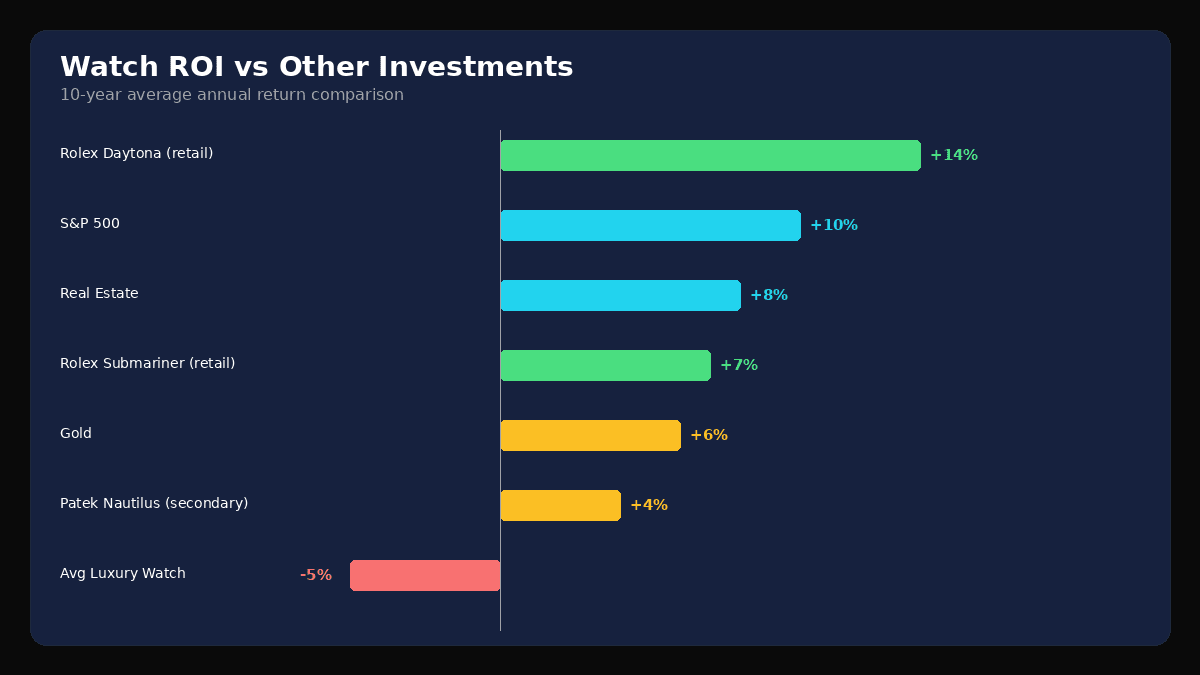
Watches vs Other Investments: An Honest Comparison
Watch content creators love to present luxury watches as “investment-grade assets.” Let’s be honest about the comparison:
| Asset | 10-Year Avg Return | Liquidity | Carrying Cost | Enjoyment |
|---|---|---|---|---|
| S&P 500 | ~10%/yr | Instant | 0.03–0.5% | None |
| Real Estate | ~7–9%/yr | Weeks–months | 1–3% (taxes, maintenance) | Moderate |
| Rolex Daytona (at retail) | ~12–15%/yr | Days–weeks | 0.5–1% (insurance) | Daily |
| Rolex Submariner (at retail) | ~5–8%/yr | Days | 0.5–1% (insurance) | Daily |
| Gold | ~5–7%/yr | Days | 0.2–0.5% (storage) | None |
The unique advantage of watches as investments is the enjoyment factor. You can’t wear your S&P 500 index fund on your wrist. A Rolex Daytona that appreciates 12% while you wear it every day is delivering both financial and experiential returns — no other asset class does that.
The unique disadvantage is concentration risk. A $15,500 Daytona is a single asset in a single market. If that market corrects — as it did in 2022–2023 — your “investment” can lose 20% in months. Never invest more in watches than you can afford to lose, and always check current pricing before buying. Grailr’s scanner provides indicative estimates and active eBay listings when available.
How to Maximise Your Watch’s Appreciation
Buy at Retail, Not Secondary
If you pay $25,000 for a Daytona on the secondary market and it trades for $28,000 a year later, your return is 12%. If you paid $15,500 at retail and it trades for $28,000, your return is 81%. The entire watch appreciation thesis depends on retail acquisition.
Keep Box, Papers, and Warranty Card
A Rolex Submariner with full set (box, papers, warranty card, hang tags) trades for 10–15% more than the same watch without. For Patek Philippe, the difference can be 20–30%. Store them safely from day one.
Service at the Right Intervals
Rolex recommends service every 10 years. A recently serviced watch with stamped service card commands a premium. But over-servicing (refinishing case and bracelet) can actually reduce value for collectors who prefer original condition. Learn more in our watch service cost guide.
Monitor Market Prices Regularly
Watch markets move. What appreciated last year might plateau this year. Use Grailr’s appraisal tool for an indicative estimate; record dated comparable sales separately when monitoring value.
Frequently Asked Questions
Do luxury watches actually appreciate in value?
Some do, but most don’t. Out of the thousands of luxury watch references on the market, fewer than 50 consistently appreciate. Models from Rolex (Daytona, Submariner), Patek Philippe (Nautilus, Aquanaut), and Audemars Piguet (Royal Oak) account for the majority. The key factors are limited supply, strong brand equity, and sustained collector demand.
What is the best watch to buy as an investment in 2026?
The Rolex Daytona (ref. 126500LN) remains the most reliable appreciating watch. It retails for $15,500 and trades for $25,000–$32,000 on the secondary market. The Patek Philippe Nautilus 5811 and Audemars Piguet Royal Oak 15500ST also show consistent appreciation. However, buying at retail is essential — paying secondary market premiums severely reduces potential returns.
How much do Rolex watches appreciate per year?
It varies by model. Steel sport Rolex models (Daytona, Submariner, GMT-Master II) have appreciated 5–15% annually over the last decade when purchased at retail. Professional models like the Datejust and Oyster Perpetual tend to hold value (90–106% retention) rather than appreciate significantly. Precious metal Rolex models typically depreciate 10–30% from retail.
Are watches a better investment than stocks?
For most people, no. The S&P 500 has averaged roughly 10% annual returns over the long term with high liquidity. Watches are illiquid, require insurance and storage costs, and only a tiny percentage actually appreciate. However, watches offer the unique advantage of being wearable assets that provide daily enjoyment alongside potential returns.
What makes a watch appreciate in value?
Five factors drive watch appreciation: (1) limited production relative to demand, (2) strong brand prestige and heritage, (3) iconic design that doesn’t change frequently, (4) stainless steel construction (precious metals typically depreciate), and (5) cultural significance or celebrity association. Condition, box, and papers also significantly affect resale value.
Related Articles
The Bottom Line
Watches that appreciate in value are the exception, not the rule. The Rolex Daytona, Patek Philippe Nautilus, and Audemars Piguet Royal Oak lead the pack with documented 10–15% annual returns when purchased at retail. But the secret isn’t finding the right watch — it’s buying at the right price. Every appreciating watch becomes a depreciating one if you pay a secondary market premium. Buy at retail, keep the full set, wear it with joy, and let the market do the rest.
Track Your Watch’s Value
Grailr can suggest a model and reference from a clear photo and provide an indicative price estimate. Active eBay listings, when available, show asking prices for comparison. Confirm the reference and condition with the seller; a photo scan does not authenticate a watch.
Scan a Watch NowSources and price context
- Chrono24 ChronoPulse methodology — A transaction-based market index; its movements are not returns for every individual watch.
- eBay Product Research — How to research actual sold prices separately from active asking prices.
The links identify the specific manufacturer information and marketplace guidance used for this guide. Price ranges and resale percentages in this guide are illustrative, not live quotes or guaranteed returns; compare the exact reference, condition and sale date before relying on them.