Oak and Oscar Watches: Every Model Reviewed
Olmsted, Burnham, Humboldt GMT and Atwood — specs, pricing, resale data and honest comparisons with Hamilton, Sinn and Christopher Ward.
Price context: this guide includes indicative prices from its original publication period. They have not all been refreshed to current quotes. Use the linked primary sources for specifications and policies, and verify prices independently.

- Oak & Oscar is a Chicago-based microbrand offering four core models from $1,245 to $2,950
- Every watch ships with an extra strap and custom carrying case — the full package experience
- Swiss movements throughout: Sellita SW200-1, SW330, Soprod C125 and the AMT5100M flyback
- The Olmsted at $1,575 is the sweet spot for most buyers — 38mm, versatile dial, screw-down crown
The Oak & Oscar Story
Oak & Oscar was founded by Chase Fancher in Chicago, Illinois, with a straightforward premise: build watches good enough to keep forever and sell them directly to the people who wear them. No authorized-dealer network, no grey-market middlemen, no inflated MSRPs subsidizing retail margins. The brand sells through its own site at oakandoscar.com and ships worldwide.
What separates Oak & Oscar from the flood of Kickstarter microbrands is consistency. While many small brands launch a single model and disappear, Fancher has steadily grown the collection — the Burnham, then the Olmsted, the Humboldt GMT and finally the Atwood chronograph — each one building on genuine community feedback rather than chasing trends. The brand name itself references two Chicago parks, anchoring the identity in the city where every design decision is made.
The community angle is real, not performative. Oak & Oscar hosts annual owner meetups, publishes detailed design journals explaining why they chose a particular hand shape or dial texture, and offers a level of after-sales support that larger brands struggle to match. Every watch ships with an extra strap and a custom carrying case — small touches that signal a brand thinking about the full ownership experience, not just the sale. For collectors exploring the microbrand space beyond the usual suspects, our best affordable watches guide covers more options in the segment.
The Complete Model Lineup
Olmsted — The Versatile Field Watch ($1,575)
The Olmsted is the watch most Oak & Oscar owners reach for first. At 38mm, it sits in the sweet spot between modern sport watches and the dressier pieces that disappear under a shirt cuff. The two-layer sandwich dial creates depth that belies the price — light catches the cut-outs differently throughout the day, giving the face a character you normally associate with watches costing three or four times as much.
Inside is the Sellita SW200-1, the Swiss workhorse automatic that has earned its reputation across hundreds of microbrands and established houses alike. It beats at 28,800 vph with a 38-hour power reserve, hackable and hand-windable. The screw-down crown and 100m water resistance mean you can swim with it without worry, though the 38mm case and refined dial make it equally comfortable at a dinner table. A FEW Edition variant, produced in a smaller run with exclusive dial details, pushes the price to around $1,850.
Burnham — The Sports Automatic ($1,245)
The Burnham is the entry point and arguably the best value in the collection. At 40mm, it wears like a modern sports watch with enough presence to hold its own alongside pieces from Hamilton and Tissot. Super-LumiNova indices glow reliably in low light, and the same Sellita SW200-1 movement keeps time accurately within COSC-adjacent tolerances once regulated.
Where the Burnham distinguishes itself from similarly priced competitors is finishing. The case brushing is even, the dial printing is crisp, and the bracelet end links fit without the wobble that plagues many sub-$1,500 watches. For buyers stepping up from a Seiko Presage or Orient Star, the Burnham delivers a noticeable quality jump without entering four-figure Swiss territory — because at $1,245, it barely crosses the threshold.
Humboldt GMT — The Travel Watch ($2,175)
The Humboldt GMT is the collection’s most technically ambitious standard model. The 40mm case houses either a Sellita SW330 or Soprod C125 — both true GMT movements with independently adjustable hour hands, not the “office GMT” caller movements that simply jump the 24-hour hand. A bi-directional bezel lets you track a third time zone, and 20ATM (200m) water resistance makes this a genuine tool watch.
At $2,175, the Humboldt undercuts the Tudor Black Bay GMT and the Longines Spirit Zulu Time by a wide margin while offering a comparable complication. The SAR limited edition, developed in collaboration with search-and-rescue professionals, adds high-visibility dial elements and pushes to around $2,350. Collectors who travel frequently and want a single watch that handles every scenario — business dinners, beach days, airport sprints — will find the Humboldt hard to fault. Our best watches under $2,000 guide covers alternatives in the tier just below.
Atwood Chronograph — The Flagship ($2,950)
The Atwood is the statement piece. At 39mm, it is compact for a chronograph, and the manual-wind AMT5100M flyback caliber with a column wheel is the kind of movement you usually find in watches starting north of $5,000. Flyback means you can reset and restart the chronograph in a single pusher press — no stop-reset-start sequence. The 58-hour power reserve, 23 jewels and 12.9mm case thickness keep it wearable despite the complication density. Water resistance is 5ATM (50m), appropriate for a dress-sport chronograph but not a dive tool. The Eric Wind limited edition, produced in a run of just 25 pieces, matches the standard retail at $2,950 but will almost certainly command a premium on the secondary market once the run sells out.
Head-to-Head Model Comparison
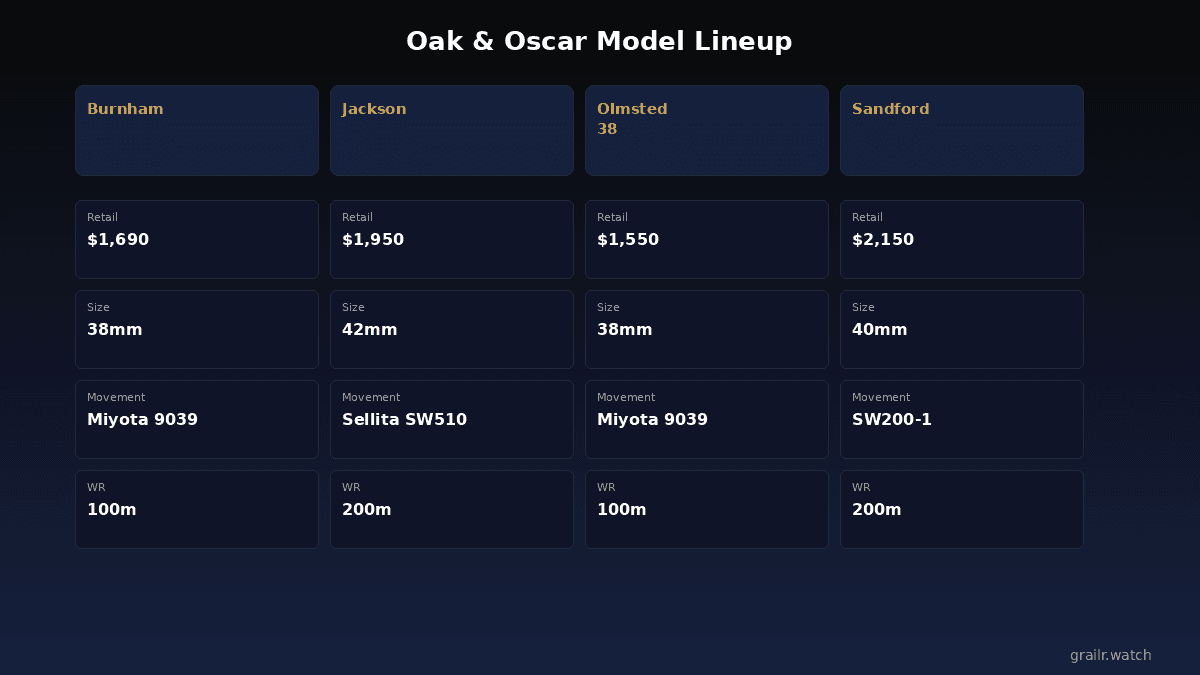
Every Oak & Oscar model shares a design language — clean lines, legible dials, considered proportions — but the spec sheets diverge meaningfully. The table below lays out the numbers side by side so you can see exactly where each model sits.
| Model | Case Size | Movement | WR | Retail |
|---|---|---|---|---|
| Olmsted | 38mm | Sellita SW200-1 | 100m | ~$1,575 |
| Burnham | 40mm | Sellita SW200-1 | 100m | ~$1,245 |
| Humboldt GMT | 40mm | Sellita SW330 / Soprod C125 | 200m | ~$2,175 |
| Atwood Chrono | 39mm | AMT5100M (manual flyback) | 50m | ~$2,950 |
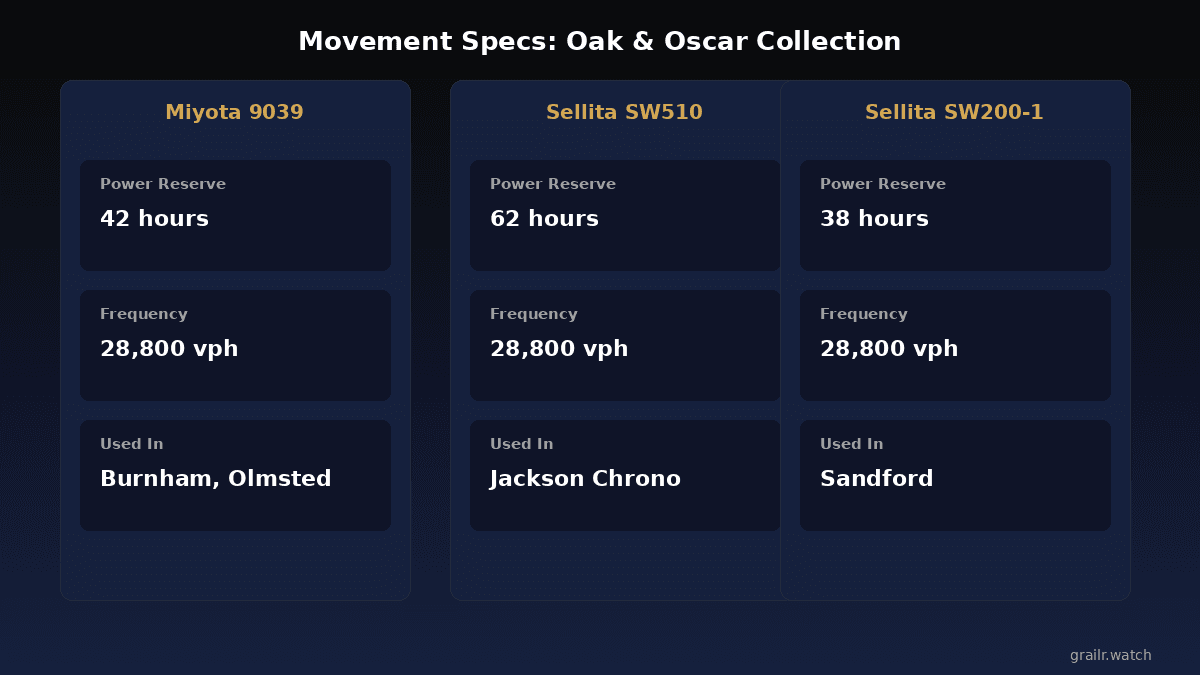
A few things stand out. The Burnham is the only model over 39mm, yet it is the cheapest — a consequence of using the same base movement as the Olmsted without the sandwich dial or screw-down crown. The Humboldt’s 200m water resistance is serious dive-watch territory and the highest in the lineup by a wide margin. And the Atwood’s manual-wind flyback, normally a $5,000-plus complication, represents the single most ambitious movement spec in the microbrand space.
Check Any Watch Price — Instantly
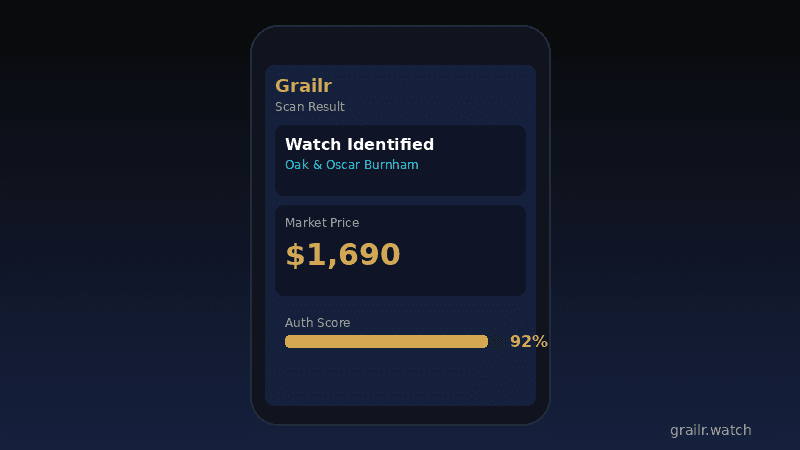
Grailr uses a photo to suggest a watch identity and an indicative price estimate, with active eBay listings where available. Check the exact reference and condition independently; a photo scan cannot authenticate a watch.
- Instant model identification
- Active eBay listings where available
- Authentication confidence scoring
Oak & Oscar vs the Competition
Oak & Oscar occupies a deliberate middle ground in the market. It costs more than the mass-produced Swiss and Japanese automatics from Hamilton and Seiko, but less than established tool-watch brands like Sinn and Oris. The question is whether the premium over Hamilton buys you enough, and whether the savings versus Sinn costs you anything important. As Fratello’s review of the Olmsted noted, the finishing punches above its weight class.
| Brand / Model | Price Range | Movement | Distribution | Standout Trait |
|---|---|---|---|---|
| Hamilton Khaki Field | $500 – $900 | H-10 (ETA base) | Global retail + AD | 80-hr power reserve, heritage |
| Oak & Oscar Olmsted | $1,575 – $1,850 | Sellita SW200-1 | Direct-to-consumer | Sandwich dial, small-batch |
| Sinn 556 | $1,400 – $1,600 | Sellita SW200-1 | ADs + direct | German engineering, Tegiment |
| Christopher Ward C63 | $795 – $995 | Sellita SW200-1 | Direct-to-consumer | Twin-frame case, 5-year warranty |
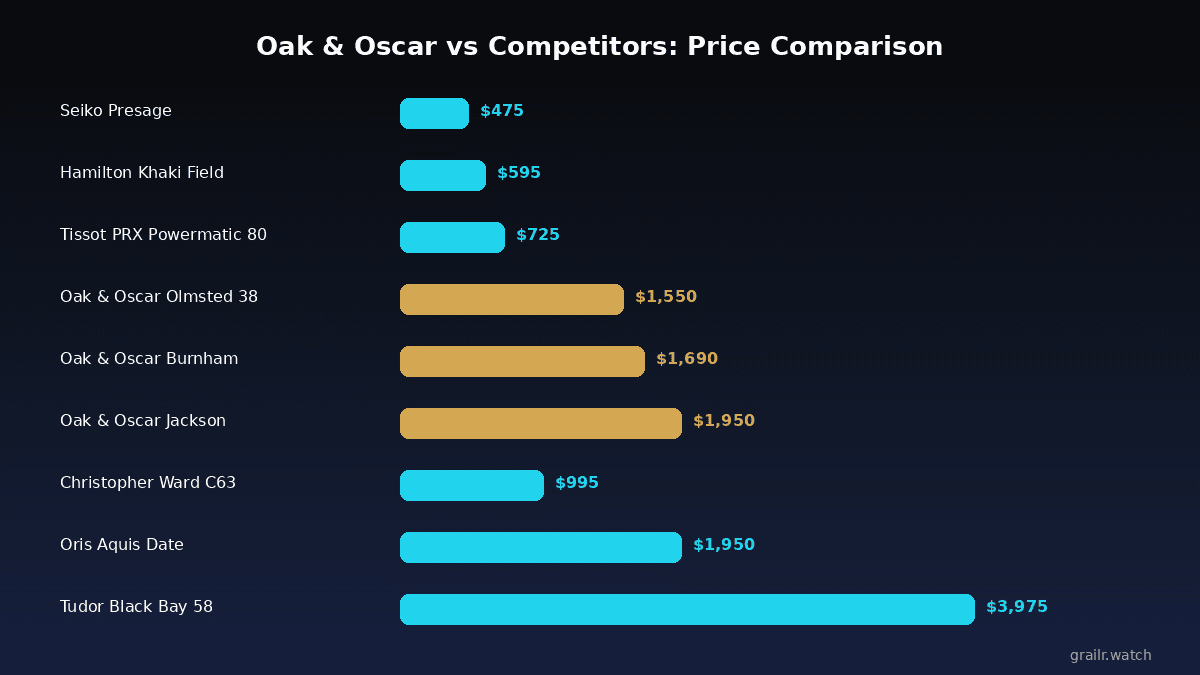
Against the Hamilton Khaki Field, the Olmsted costs roughly twice as much. You get a more refined dial, a smaller-batch exclusivity and a personal relationship with the brand — but you lose Hamilton’s 80-hour power reserve and its global service network. If you primarily value raw specs per dollar, the Hamilton wins. If you value ownership experience and design depth, the Olmsted justifies the premium.
Against the Sinn 556, which shares the same Sellita base movement, the comparison is closer. Sinn offers Tegiment hardening on some models and has decades of German tool-watch credibility. Oak & Oscar offers warmer design language, the extra strap, and a community that feels more like a club than a customer base. Christopher Ward, priced below both, delivers exceptional value with its twin-frame case and five-year warranty, but its scale means less exclusivity. Collectors weighing all three segments should also look at our best watches for value guide.
Resale Value and Market Position
Microbrand resale is a different game from Rolex or Omega. There is no established grey market with transparent pricing, no Chrono24 depth of listings and no dealer network setting floor prices. Oak & Oscar watches trade primarily on collector forums like Watchuseek, the brand’s own community and occasionally on eBay. That means prices are less predictable but also less subject to speculative swings.
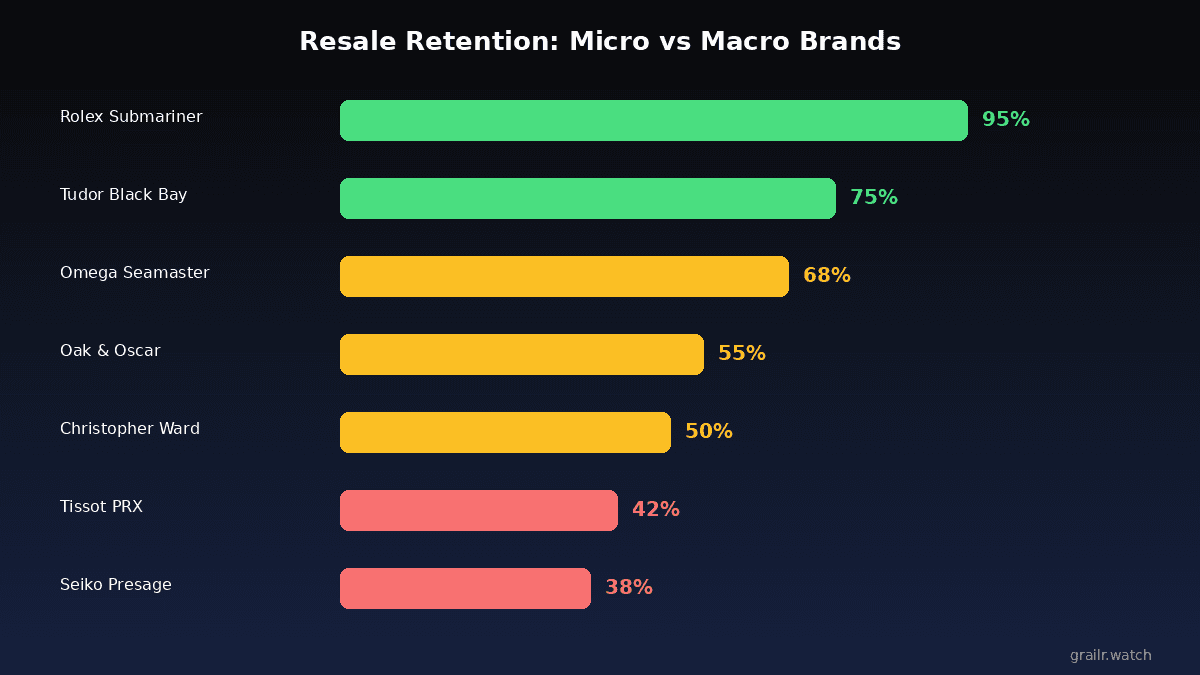
Pre-owned Olmsted models typically trade between $700 and $1,200 depending on condition, dial variant and whether the full kit (box, papers, extra strap) is included. That represents roughly 45–75% of the original retail price — respectable for a microbrand but below the 85–95% retention that established Swiss brands achieve. Limited editions fare better: the Humboldt SAR and Atwood Eric Wind variants tend to hold closer to retail, and truly scarce runs can command modest premiums.
The takeaway: buy Oak & Oscar because you want to wear it, not because you expect to flip it. The depreciation curve is steepest in the first year, flattening considerably after that. Buyers who plan to keep the watch for three or more years will find the effective cost of ownership — purchase price minus eventual resale — quite reasonable compared to fashion brands that hold almost no value at all. If resale retention is a priority, our best watches under $2,000 guide highlights models from brands with deeper secondary markets.
Buying Advice and What to Watch For
Best First Oak & Oscar
Olmsted — ~$1,575
The sandwich dial and 38mm case make it the most versatile model. Dresses up, dresses down, and the screw-down crown handles daily wear without babying.
Best Budget Entry
Burnham — ~$1,245
Everything you need from an automatic sports watch at the lowest Oak & Oscar price. Super-LumiNova, clean dial, solid finishing.
Best for Travel
Humboldt GMT — ~$2,175
True GMT complication with 200m water resistance. The most capable tool watch in the collection by a wide margin.
Best Collector Piece
Atwood Chrono — ~$2,950
Manual-wind flyback chronograph with a column wheel at a price that embarrasses the Swiss establishment. A genuine conversation starter.
1. Buy Direct Whenever Possible
Oak & Oscar sells exclusively through its own site. Buying direct ensures you get the warranty, the extra strap and the full unboxing experience. Secondary market purchases miss the carrying case and may not transfer the warranty.
2. Watch for Limited Editions
Oak & Oscar drops limited editions with little warning. Follow the brand on Instagram and sign up for the newsletter. FEW Editions, SAR variants and collaboration pieces sell out within days and rarely reappear at retail.
3. Size Matters More Than You Think
The jump from 38mm (Olmsted) to 40mm (Burnham, Humboldt) is noticeable on smaller wrists. Oak & Oscar cases tend to wear true to size thanks to moderate lug-to-lug dimensions, so check your wrist measurement against the brand’s published specs before ordering sight unseen.
4. Scan Before You Buy Pre-Owned
Use Grailr’s free scanner to photograph any listing and get a suggested identification and indicative price estimate. Check the result against the seller’s documentation; a photo scan cannot authenticate a watch.
Frequently Asked Questions
Who is behind Oak and Oscar?
Oak and Oscar was founded by Chase Fancher in Chicago, Illinois. It is a small-batch, direct-to-consumer microbrand focused on thoughtful design, quality materials and an inclusive collector community.
What movements do Oak and Oscar watches use?
Most models use Swiss automatic movements. The Olmsted and Burnham run the Sellita SW200-1. The Humboldt GMT uses a Sellita SW330 or Soprod C125. The Atwood chronograph uses the manual-wind AMT5100M flyback caliber with a column wheel.
How much does an Oak and Oscar watch cost?
Prices range from about $1,245 for the Burnham to $2,950 for the Atwood chronograph. Limited editions like the Humboldt SAR (~$2,350) and Atwood Eric Wind ($2,950 for 25 pieces) carry modest premiums or sell out at retail.
Do Oak and Oscar watches hold their value?
Pre-owned Olmsted models typically sell for $700 to $1,200 on forums, representing roughly 45-75% retention. Limited editions hold closer to retail. Buy because you want to wear it, not to flip it.
How does Oak and Oscar compare to Sinn or Hamilton?
Oak and Oscar sits between Hamilton ($500-$900, mass-produced) and Sinn ($1,400-$1,600, German tool watches). It offers higher finishing than Hamilton and a more personal buying experience than either, with pricing that overlaps Sinn on the Olmsted and exceeds it on the Humboldt and Atwood.
What comes in the box with an Oak and Oscar watch?
Every Oak and Oscar watch ships with an extra strap and a custom carrying case. The brand is known for a thoughtful unboxing experience that goes beyond what most microbrands offer at any price point.
Related Articles
The Bottom Line
Oak & Oscar does something rare in the watch world: it delivers genuine quality, thoughtful design and a personal ownership experience at prices that make the established Swiss brands look complacent. The Olmsted is the watch to start with — 38mm, sandwich dial, versatile enough for anything — but the entire lineup rewards careful consideration. If you want a tool watch, the Humboldt GMT offers 200m water resistance and a true GMT complication for less than half what Tudor or Longines charge. If you want a collector’s conversation piece, the Atwood’s flyback chronograph is genuinely special at under $3,000. These are not watches you buy because a brand ambassador wore one on television. They are watches you buy because you did the research, understood the value and wanted something with substance behind the dial.
Considering an Oak & Oscar?
Grailr uses a photo to suggest a watch identity and an indicative price estimate, with active eBay listings where available. Check the exact reference and condition independently; a photo scan cannot authenticate a watch.
Scan a Watch NowSources and price context
- Oak and Oscar official site — Current model specifications, pricing and availability direct from the brand.
- Fratello Watches Olmsted 38 review — Independent hands-on review covering dial finishing, wrist presence and value proposition.
These primary sources support the specific specification and review points noted above. Prices and resale percentages elsewhere in this guide are indicative editorial figures, not a verified transaction dataset or guaranteed returns. Confirm the exact reference, condition and current quote before buying; asking prices are not completed-sale prices.