Omega Constellation Buying Guide: Models and Prices
Manhattan, Globemaster and vintage pie-pan references compared — with caliber specs, 2026 retail pricing and secondary-market data.
Price context: this guide includes indicative prices from its original publication period. They have not all been refreshed to current quotes. Use the linked primary sources for specifications and policies, and verify prices independently.

- The Constellation is Omega’s flagship chronometer line, in production since 1952, with Manhattan and Globemaster sub-collections
- Steel automatics start around $6,500 (41mm Cal. 8900) with METAS Master Chronometer certification and 15,000-gauss magnetic resistance
- Pre-owned steel models trade at 55–70% of retail, making the secondary market the best value entry point
- The Globemaster 39mm with its pie-pan dial is the collector’s pick and the first watch certified to METAS standards
A Brief History of the Constellation
Omega launched the Constellation in 1952 to house its most accurate movements — the ones that had been winning chronometry trials at Geneva and Neuchâtel observatories since the 1930s. The name was literal: the caseback carried an engraving of an observatory dome beneath eight stars, one for each of Omega’s record-setting precision awards. Where the Seamaster was built for water and the Speedmaster for racing, the Constellation was Omega’s dress-watch flagship, designed to be the most accurate wristwatch a civilian could buy.
The 1950s and 1960s models established two design signatures still visible today. The first was the “pie-pan” dial — a faceted, sector-style surface that curves upward toward the edges like an inverted pie tin, catching light across multiple planes. The second was the observatory caseback medallion with its constellation of stars. Vintage Constellation references from this era, particularly those with Calibre 551 or 561, are among the most collected Omega watches on the secondary market, with clean examples trading from roughly $1,500 to $5,000 depending on dial condition and case material.
The watch went through a quiet period in the 1970s before Omega redesigned it in 1982 as the Constellation Manhattan. That redesign introduced the four metal “claws” — also called griffes — on the bezel at 12, 3, 6 and 9 o’clock. Originally the claws served a structural purpose: they secured the sapphire crystal and gasket to the monocoque case. On modern Constellations they are purely aesthetic, but they remain the most immediately recognizable element of the design. The Manhattan line continues today as Omega’s core Constellation offering.
The Manhattan Lineup: Every Size and Price
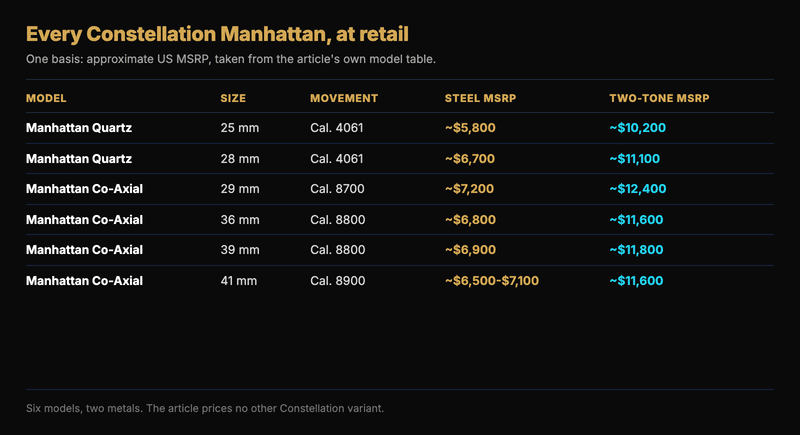
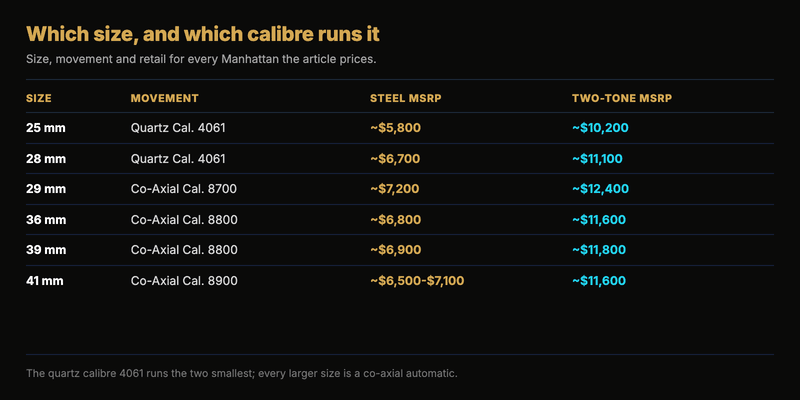
The current Manhattan range spans six case diameters — 25mm, 28mm, 29mm, 36mm, 39mm and 41mm — covering everything from a small quartz dress watch to a full-size automatic. The two smallest sizes (25mm and 28mm) are quartz-powered with the Calibre 4061. The 29mm and above use Omega’s Co-Axial Master Chronometer automatics.
Every Manhattan shares the same visual DNA: the four-claw bezel, a half-moon facet on the bracelet links, a star at 6 o’clock on the dial, and the observatory medallion on the caseback. Case materials range from full stainless steel to Sedna gold (Omega’s proprietary 18k rose gold alloy that resists fading) and full 18k yellow gold. Two-tone steel-and-gold models sit in between.
| Model | Size | Movement | Steel MSRP | Two-Tone MSRP |
|---|---|---|---|---|
| Manhattan Quartz | 25mm | Cal. 4061 | ~$5,800 | ~$10,200 |
| Manhattan Quartz | 28mm | Cal. 4061 | ~$6,700 | ~$11,100 |
| Manhattan Co-Axial | 29mm | Cal. 8700 | ~$7,200 | ~$12,400 |
| Manhattan Co-Axial | 36mm | Cal. 8800 | ~$6,800 | ~$11,600 |
| Manhattan Co-Axial | 39mm | Cal. 8800 | ~$6,900 | ~$11,800 |
| Manhattan Co-Axial | 41mm | Cal. 8900 | ~$6,500–$7,100 | ~$11,600 |
Prices are approximate 2026 US retail for standard dial options. Diamond-set, precious-metal and limited editions cost substantially more. Verify current pricing with an Omega authorized dealer.
The Globemaster: Omega’s Pie-Pan Revival
Omega revived the Constellation Globemaster name in 2015, and it was no ordinary product launch. The Globemaster became the first wristwatch in history to receive METAS Master Chronometer certification — a standard that goes beyond COSC by testing the fully assembled watch (not just the bare movement) for accuracy, magnetic resistance, water resistance and power reserve. Every Globemaster sold today still meets both COSC and METAS standards simultaneously.
The Globemaster’s design borrows directly from the 1950s originals. The pie-pan dial is back — that faceted, sector-style surface that vintage collectors have chased for decades. The fluted bezel replaces the Manhattan’s four claws, giving the Globemaster a dressier, more classical silhouette. At 39mm in steel with the Calibre 8900 (the same METAS-certified movement used in the 41mm Manhattan), the Globemaster retails for approximately $6,500. Pre-owned examples in good condition trade between $4,500 and $5,500.
For buyers who want a Constellation that nods to the line’s chronometry heritage rather than the 1982 Manhattan aesthetic, the Globemaster is the obvious choice. It is also the model that watch collectors tend to prefer, because the pie-pan dial and fluted bezel give it a visual identity distinct from the Aqua Terra and every other watch in Omega’s range.
Movements and Master Chronometer Certification
The headline movement across the Constellation automatic range is the Co-Axial Master Chronometer Calibre 8900. It powers both the 41mm Manhattan and the 39mm Globemaster, and its specs read like a technical checklist designed to make the Rolex Datejust’s Calibre 3235 look nervous: METAS-certified accuracy of 0/+5 seconds per day (tested on the wrist, not in a static position), a 60-hour power reserve, and magnetic resistance up to 15,000 gauss — roughly 100 times the level that would stop a conventional movement.
Smaller automatics use the Calibre 8800 (36mm and 39mm Manhattan) or the Calibre 8700 (29mm), both of which are also Master Chronometer certified with the same magnetic resistance and accuracy standards. The quartz references run the Calibre 4061, which is accurate to roughly ±10 seconds per month. For anyone who simply wants a beautiful Omega that always shows the right time without thinking about winding or wearing schedules, the quartz Manhattan is an underrated option.
METAS certification is worth understanding because it distinguishes the Constellation from most of its competition. While COSC tests a bare movement in five positions and three temperatures, METAS tests the finished watch — cased, with crystal, crown and bracelet attached — for magnetism, water resistance, accuracy and power reserve. The result is a watch that has been validated as a complete system, not just a movement that might perform differently once it is inside a case. As of 2026, only Omega uses METAS certification across its mechanical lineup.
Check Any Watch Price in Seconds
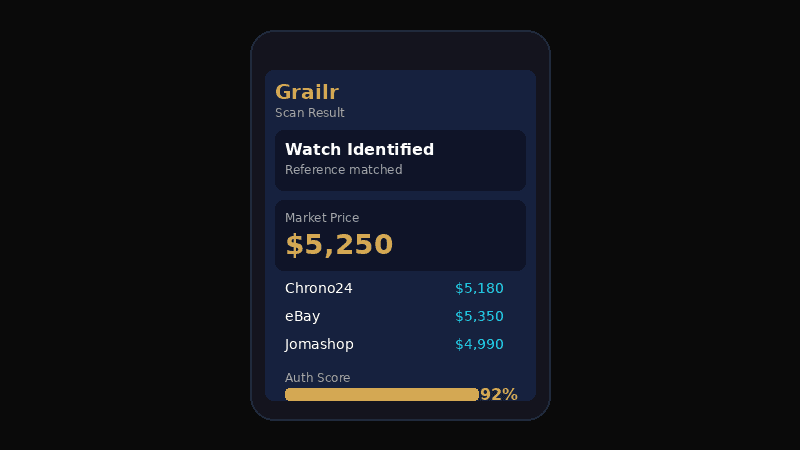
Grailr scans your watch photo and pulls live pricing from Chrono24, eBay, and Jomashop.
- AI identifies brand, model & reference number
- Live market prices from 3+ sources
- Authentication confidence score
Price Comparison: Retail vs Pre-Owned
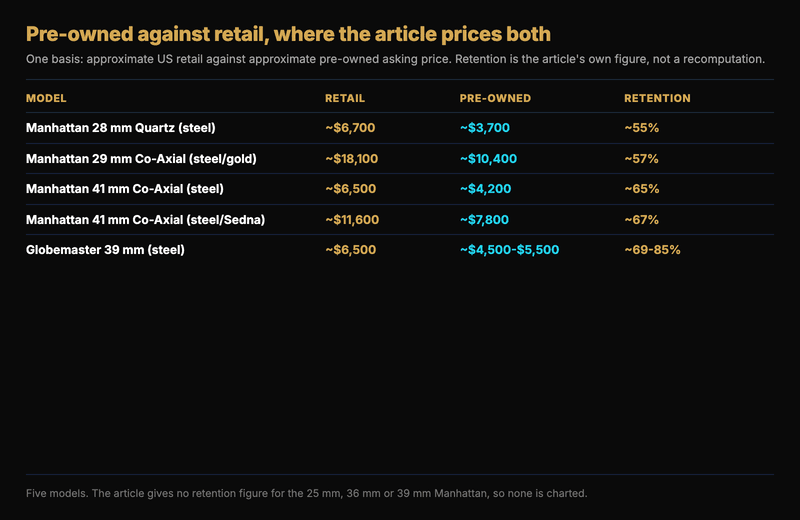
Unlike the Speedmaster Moonwatch or certain Seamaster 300M colours that hold their value tightly, the Constellation generally depreciates on the secondary market. Steel Manhattan automatics lose roughly 30–45% from retail, which is standard for a non-limited-production luxury watch and comparable to the De Ville range. That depreciation is good news for buyers: it means you can pick up a barely-worn Constellation for substantially less than retail.
| Model | Retail | Pre-Owned | Retention |
|---|---|---|---|
| Manhattan 28mm Quartz (steel) | ~$6,700 | ~$3,700 | ~55% |
| Manhattan 29mm Co-Axial (steel/gold) | ~$18,100 | ~$10,400 | ~57% |
| Manhattan 41mm Co-Axial (steel) | ~$6,500 | ~$4,200 | ~65% |
| Manhattan 41mm Co-Axial (steel/Sedna) | ~$11,600 | ~$7,800 | ~67% |
| Globemaster 39mm (steel) | ~$6,500 | ~$4,500–$5,500 | ~69–85% |
Pre-owned prices reflect 2026 market averages for complete sets in excellent condition. Actual prices vary by reference, box and papers, and dial variant. See WatchCharts Constellation market data for live secondary-market tracking.
How the Constellation Compares
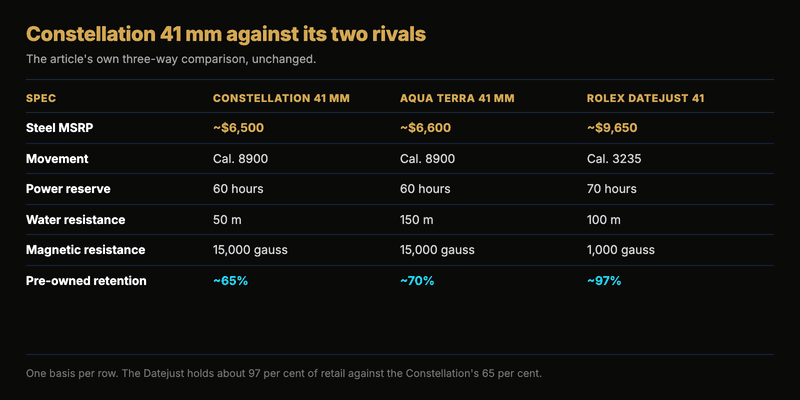
The Constellation occupies an interesting middle ground in the luxury-watch market. It is dressier than the Aqua Terra (which has a sportier dial and higher water resistance), more recognizable than the De Ville (which is Omega’s understated dress line), and considerably more affordable than a Rolex Datejust in equivalent configuration. Here is how it stacks up against the most common cross-shopping choices:
| Spec | Constellation 41mm | Aqua Terra 41mm | Rolex Datejust 41 |
|---|---|---|---|
| Steel MSRP | ~$6,500 | ~$6,600 | ~$9,650 |
| Movement | Cal. 8900 | Cal. 8900 | Cal. 3235 |
| Power Reserve | 60 hours | 60 hours | 70 hours |
| Water Resistance | 50m | 150m | 100m |
| Magnetic Resistance | 15,000 gauss | 15,000 gauss | 1,000 gauss |
| Pre-Owned Retention | ~65% | ~70% | ~97% |
The Constellation’s magnetic resistance advantage is real and measurable — 15 times the Rolex specification — but the Datejust’s resale performance remains in a different league entirely. If you are buying for the wrist and not the spreadsheet, the Constellation delivers more technical watch per dollar.
Buying Tips and What to Avoid
1. Buy Pre-Owned for the Best Value
Steel Constellations lose 30–45% on the secondary market, so a one- or two-year-old example with box and papers saves you $2,000–$3,000 over retail with minimal wear. Scan the listing photo with Grailr to confirm the reference and check the price against current market data before committing.
2. Try It On — The Claws Change the Wrist Feel
The Manhattan’s four claws add visual bulk beyond the listed diameter. A 41mm Manhattan wears closer to 43mm because the claws extend beyond the bezel line. If the Manhattan feels too large, the 39mm Globemaster uses a fluted bezel without claws and sits noticeably smaller on the wrist.
3. Prioritize Complete Sets
A Constellation with its original box, papers, warranty card and hang tag commands a 10–15% premium over a “watch only” listing on the secondary market. The warranty card also carries the reference number and serial, making it much easier to verify authenticity and authenticate the watch.
4. Avoid Refinished Cases
The Constellation’s polished centre links and brushed outer links create a distinctive contrast. Aggressive polishing by a non-Omega service centre can soften the edges of the claws and round off the half-moon facets on the bracelet. If the transitions between polished and brushed surfaces look blurred, the case has likely been over-polished — and that hurts resale value.
5. Consider the Quartz for a Gift
Not every buyer wants to think about winding schedules or service intervals. The 25mm and 28mm quartz Manhattans are beautifully finished, carry the same Constellation design language, and start at roughly $5,800 in steel. They make excellent gifts for someone who values aesthetics over mechanical romance.
Vintage Constellation: What to Look For
Vintage Omega watches are a world unto themselves, and the Constellation is one of the most collected families. The pie-pan-dial references from the late 1950s and 1960s — particularly those with gold cases and original dials in clean condition — are the most sought-after. Expect to pay $1,500–$3,500 for a steel or gold-cap model with a service dial, and $4,000–$8,000 for a solid gold example with an original, untouched dial.
Watch for “frankenwatches” — vintage Constellations assembled from parts of different references. The dial, case, movement serial and caseback should all correspond to the same production year. If the seller cannot provide a service history or the caseback stars look re-engraved, proceed with caution. A good independent watchmaker can verify whether the movement matches the case reference before you buy. Use Grailr’s identification tool to cross-check the reference from a photo, but remember that visual identification is a starting point, not proof of authenticity.
Frequently Asked Questions
What is the cheapest new Omega Constellation you can buy?
The Manhattan 25mm quartz in stainless steel retails for approximately $5,800, making it the most affordable new Constellation. The 28mm quartz starts around $6,700.
What movement does the Omega Constellation use?
The 41mm and 39mm automatic models use the Co-Axial Master Chronometer Calibre 8900, which is METAS-certified, resists magnetic fields up to 15,000 gauss, and provides a 60-hour power reserve. Smaller quartz models use the Calibre 4061.
What does pie-pan dial mean on the Omega Constellation?
The pie-pan dial is a faceted, sector-style dial that curves upward toward the edges like an inverted pie tin. It first appeared on the Constellation in the 1950s and remains a defining design element, most visible today on the Globemaster.
Is the Omega Constellation a good investment?
Steel Constellation models typically lose 30 to 45 percent on the secondary market, which is standard for a non-limited luxury watch. Precious-metal Globemasters and vintage pie-pan references hold value better. Buy because you want the watch, not because you expect it to appreciate.
What are the claws on the Omega Constellation?
The four claws, or griffes, are metal tabs on the bezel at 3, 6, 9 and 12 o'clock. Introduced with the 1982 Manhattan redesign, they originally secured the crystal and gasket. On modern Constellations they are a signature design element rather than a structural necessity.
What is the difference between the Manhattan and the Globemaster?
The Manhattan is the main Constellation line with the four-claw bezel, available from 25mm to 41mm. The Globemaster is a separate sub-collection at 39mm with a fluted bezel, pie-pan dial, and no claws. It was the first watch to receive METAS Master Chronometer certification in 2015.
Related Articles
The Bottom Line
The Omega Constellation is one of the best-specified watches you can buy under $7,000 — a Master Chronometer movement with 15,000-gauss magnetic resistance, a 60-hour power reserve, and a design lineage stretching back to 1952. It does not hold value like a Rolex Datejust, but it offers more technical substance per dollar and far better availability. The Globemaster 39mm is the connoisseur’s choice for its pie-pan dial and historical significance. The Manhattan 41mm is the everyday wearer’s pick for its size range and bracelet comfort. Either way, buy pre-owned if value matters and new if the warranty and unboxing experience matter more.
Interested in a Constellation?
Scan any Constellation listing photo with Grailr for an instant reference check and indicative price estimate. Verify the exact reference and condition independently before buying.
Scan a Watch NowSources and price context
- Omega Constellation collection page — Official specifications, reference numbers and current retail pricing for all Manhattan and Globemaster models.
- WatchCharts Omega Constellation market data — Secondary-market price history and average transaction data across Constellation references.
These primary sources support the specific specification and pricing points noted above. Prices and resale percentages elsewhere in this guide are indicative editorial figures, not a verified transaction dataset or guaranteed returns. Confirm the exact reference, region, condition and current quote before buying; asking prices are not completed-sale prices.