Vintage Omega Buying Guide: Seamaster, Constellation and What to Avoid
A reference-by-reference walk through the vintage Omega market — Seamaster, Constellation, and the pre-moon Speedmaster — with real pricing, the movements worth chasing, and the red flags that separate an honest watch from a franken-watch.
Price context: this guide includes indicative prices from its original publication period. They have not all been refreshed to current quotes. Use the linked primary sources for specifications and policies, and verify prices independently.

- Vintage Omega spans $500 dress watches to a $40,000 Seamaster 300 “grail,” roughly 3–5x cheaper than equivalent vintage Rolex
- The Seamaster 120 (ref 166.010) at $1,200–3,000 is the best-value entry point into the range
- The Constellation “Pie Pan” dial (ref 168.005) offers chronometer-grade finishing for $2,500–6,000
- Aftermarket dials, polished cases, and wrong crowns are the most common ways a vintage Omega loses value
- Always confirm serial number, dial, crown and movement calibre match the reference before paying
Why Buy Vintage Omega in 2026
Every vintage Rolex conversation eventually turns into a budget conversation, and that is where vintage Omega earns its place. A vintage omega wrist watch gives you the same era of tool-watch design — dive watches built for the same divers, chronographs that flew on the same missions, dress watches finished to the same chronometer standard — at roughly a third to a fifth of the price of the equivalent Rolex reference. A clean 1960s Seamaster dive watch that would cost $30,000–$50,000 as a Rolex Submariner reference can be found in the $8,000–18,000 range as an Omega Seamaster 300.
That price gap is not a quality gap. Omega was Rolex’s direct competitor through the 1950s, 60s and 70s, sharing the same Swiss supply chains, the same in-house movement ambitions, and in several cases outright besting Rolex on specific technical points — the calibre 321 chronograph movement and Omega’s early adoption of chronometer-certified automatic calibres among them. What Omega lacks is Rolex’s brand-driven secondary market mania, and for a buyer who wants the watch rather than the speculative asset, that is an advantage.
The trade-off is that the vintage Omega market is less standardized. Reference numbers were reused across dial variants, case styles changed mid-production run, and because prices have historically been lower, fewer watches were treated with the same conservation care as a comparable Rolex. That makes homework more important, not less. This guide walks through the specific references worth chasing, the movements that matter, and the checks that keep you from overpaying for a watch with the wrong parts.
It also helps to think about why you are buying before you start browsing listings. Someone chasing a wearable piece of 1960s design history has a very different shopping list than someone assembling a small collection around Omega’s dive-watch or chronograph heritage specifically. The Seamaster line covers the first buyer comfortably at almost any budget; the Speedmaster and the earliest Seamaster 300 references reward the second buyer, at a meaningfully higher price and with a much smaller margin for error on originality. Set that budget and purpose first, and the rest of this guide will be far easier to apply to an actual listing in front of you.
The Seamaster Family: From $500 Dress Watches to the $40,000 Grail
“Seamaster” covers more ground in Omega’s vintage catalogue than any other name, spanning dive watches, dress watches, and everything in between across three decades. Knowing which reference you are looking at — not just the model name printed on the dial — is the single most useful thing you can learn before shopping.
Seamaster 300, CK2913 (1957–63) — $15,000–40,000
The original Seamaster 300 is the grail reference of vintage omega seamaster collecting. Launched alongside the Speedmaster and Railmaster as one of Omega’s three 1957 “professional” tool watches, the CK2913 has a broad-arrow handset, a bakelite bezel insert, and a dial layout that later dive watches across the industry would echo. Values swing hard on originality: an unpolished case with a matching, un-refinished dial sits at the top of the range, while a heavily polished or redialed example can fall well below $15,000 even with the right case reference.
Seamaster 300, ref 165.024 (1964–70) — $8,000–18,000
The second-generation Seamaster 300 traded the broad-arrow hands for a more conventional baton and dot handset and moved to a screw-down crown with improved water resistance. It is the reference most collectors mean when they say “vintage Omega dive watch,” and it is the best point of entry into serious Seamaster 300 collecting — genuinely wearable, still running the automatic calibre 552, and priced well under half of the CK2913.
Seamaster 120, ref 166.010 (1966–75) — $1,200–3,000
This is where we point most first-time buyers. The Seamaster 120 is a genuine 120m dive watch with a screw-down crown, a rotating bezel, and the dependable calibre 565/1012 automatic family inside a case that has aged well over sixty years. It is common enough that patient buyers can be selective about condition, and cheap enough that a first vintage purchase does not feel like a financial risk.
Seamaster Day-Date, ref 166.0163 (1970s) — $800–2,000
A 1970s automatic with a day-and-date complication and the wider case proportions typical of the decade. Less sought after than the dive watch Seamasters but a comfortable, affordable daily wearer with a genuinely useful complication.
Geneve Dynamic, ref 136.0104 (1970s) — $600–1,500
Omega’s Geneve Dynamic line used a distinctive asymmetric case shape and sits at the affordable end of the market. It will not carry the same collector recognition as a Seamaster reference, but it is an honest, characterful 1970s Omega for buyers who want vintage character on a tight budget.
De Ville, ref 131.019 (1960s–70s) — $500–1,500
A slim dress watch that represents the cheapest realistic entry into vintage Omega ownership. Simple two-hand or three-hand dials, manual or automatic movements depending on the exact reference, and a case size that suits a smaller wrist. This is the tier most collectors describe simply as “entry-level vintage Omega,” running roughly $500–1,500 across most 1970s dress references.
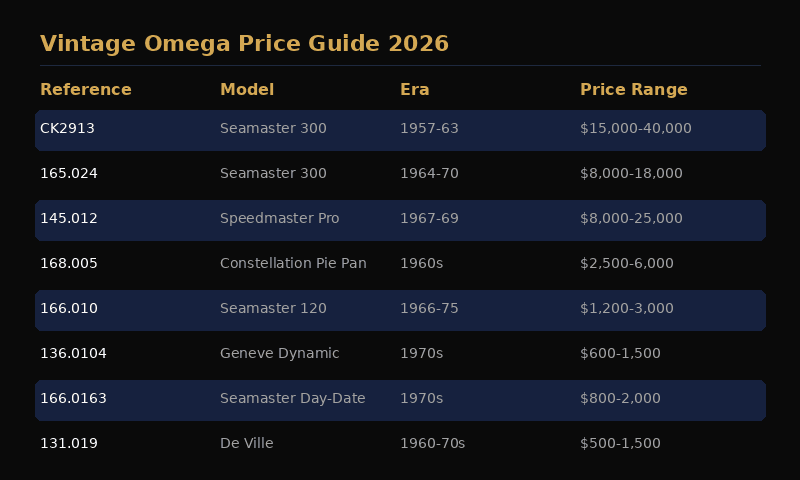
| Reference | Years | Movement | Price Range | Tier |
|---|---|---|---|---|
| Seamaster 300 CK2913 | 1957–63 | Cal. 501 | $15,000–40,000 | Grail |
| Speedmaster 145.012 | 1967–69 | Cal. 321 | $8,000–25,000 | Grail |
| Seamaster 300, 165.024 | 1964–70 | Cal. 552 | $8,000–18,000 | Collector |
| Constellation Pie Pan, 168.005 | 1960s | Cal. 561/564 | $2,500–6,000 | Mid-range |
| Seamaster 120, 166.010 | 1966–75 | Cal. 565/1012 | $1,200–3,000 | Mid-range |
| Seamaster Day-Date, 166.0163 | 1970s | Automatic | $800–2,000 | Entry |
| Geneve Dynamic, 136.0104 | 1970s | Automatic | $600–1,500 | Entry |
| De Ville, 131.019 | 1960s–70s | Manual/Auto | $500–1,500 | Entry |
The Constellation “Pie Pan”: Omega’s Most Underrated Vintage Watch
If the Seamaster is Omega’s tool watch, the omega constellation vintage line is its dress chronometer, and the 1960s “Pie Pan” dial — nicknamed for its faceted, upward-sloping segments that resemble an inverted baking dish — is the reference collectors chase hardest. The ref 168.005 and its close siblings carried Omega’s in-house chronometer certification at a time when that meant an independently tested, individually numbered movement, not a marketing line.
At $2,500–6,000, a Pie Pan Constellation buys genuinely high finishing: applied indices, a faceted dial that catches light in a way no modern flat dial can replicate, and the “C-case” or “pan-case” construction with an integrated caseback medallion of the observatory that inspired the name. It runs the calibre 561 or 564, both dependable automatic movements with a date function on later examples.
Because the Constellation never carried the tool-watch mystique of the Seamaster or Speedmaster, it has historically traded below its finishing quality, which is exactly why value-focused buyers should look here. Confirm the dial text matches the case reference — Constellation dial variants changed frequently, and mismatched dial-to-case combinations are common enough to check carefully.
Condition matters more on a Pie Pan than on a flat-dial watch, because the faceted surface shows polishing damage and dial wear differently than a conventional dial would. Look for crisp, undamaged facet edges under raking light, and be wary of listings that show only a straight-on dial photo — that angle is the easiest way to hide flattened or worn facets. A well-preserved Pie Pan with its original bracelet, often a beads-of-rice or brick-link design specific to the era, commands a real premium over the same reference on a generic strap.
The Pre-Moon Speedmaster: A Different Kind of Grail
No vintage Omega guide is complete without the Speedmaster, even though its collecting logic runs on a separate track from the Seamaster and Constellation. The pre-moon Speedmaster, ref 145.012 (1967–69), is the last reference to carry the hand-wound, column-wheel calibre 321 before Omega switched to the calibre 861 in 1968–69 — and it is the movement architecture that flew on the Apollo missions.
Pre-moon 145.012 examples run $8,000–25,000 depending on dial condition, bezel originality, and whether the case retains its factory finish. For buyers specifically drawn to the chronograph side of vintage Omega, our dedicated Omega Speedmaster guide goes deeper on reference differences and movement generations across the full Speedmaster family.
Movements That Matter: Calibre 321, 551, 561, 564
A vintage Omega is only as good as the movement inside it, and unlike the dial or case, a movement is much harder to fake convincingly — which makes it one of your best authentication tools as well as a genuine performance factor.
The calibre 321 is the legend. A hand-wound column-wheel chronograph movement used in Speedmasters from 1957 to 1968, it is prized by watchmakers for the smoothness of its column-wheel chronograph engagement compared to the cam-switching mechanism that followed. Servicing a 321 costs more than a standard vintage service because parts are scarcer and the movement demands a watchmaker experienced with column-wheel chronographs specifically.
The calibre 551, 561 and 564 family covers the bulk of vintage Seamaster and Constellation automatics from the 1960s and early 1970s. These are dependable, well-regarded movements — the 564 added a date complication over the 561 — and parts remain reasonably available for basic service, though certain wear components are getting harder to source as the supply of donor movements shrinks industry-wide.
Budget $300–800 for a basic service on any of these calibres from a qualified independent watchmaker, more if the movement needs parts replaced rather than just cleaning, lubricating and regulating. Ask any seller when the watch was last serviced, and treat “running strong, never serviced” as a cost you should factor into your offer, not a reassurance.
It is worth asking specifically whether the movement inside a watch you are considering is the correct calibre for that case reference. Omega used several closely related calibres across a single model run, and a service replacement from a later or earlier variant will still keep time perfectly well while quietly reducing the watch’s collector value. A watchmaker who works regularly with vintage Omega can usually confirm this from a clear photograph of the movement through the case back, which is worth asking any private seller for before you agree a price.
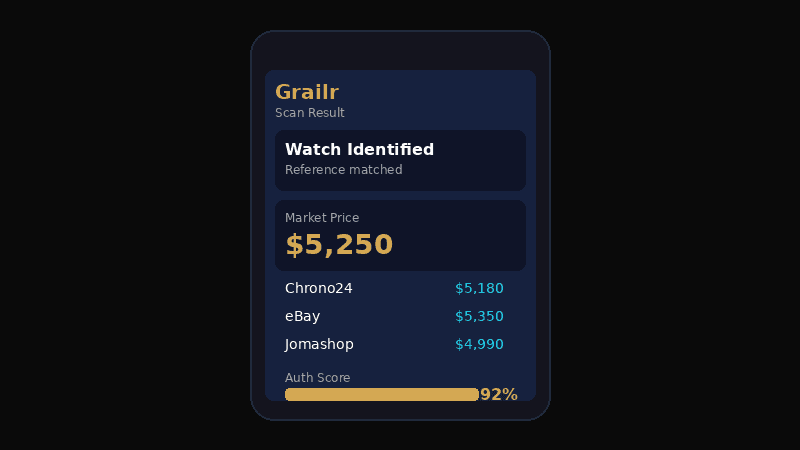
Check Any Watch Price in Seconds
Grailr scans your watch photo and pulls live pricing from Chrono24, eBay, and Jomashop.
- AI identifies brand, model & reference number
- Live market prices from 3+ sources
- Authentication confidence score
Vintage Omega vs Vintage Rolex: The Value Case
The comparison collectors make constantly is Omega against Rolex, because for most of the mid-20th century the two brands were direct competitors selling into the same tool-watch and dress-watch categories. The gap that exists today is almost entirely a secondary-market brand premium rather than a build-quality gap.
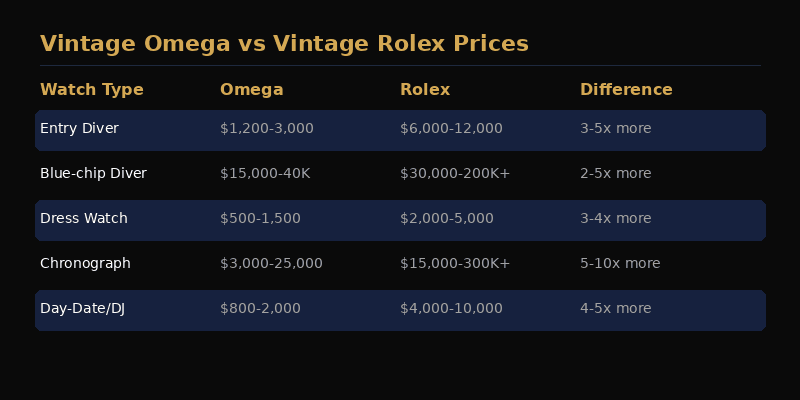
| Factor | Vintage Omega | Vintage Rolex |
|---|---|---|
| Comparable dive watch entry | $8,000–18,000 (Seamaster 300) | $25,000–60,000+ (Submariner) |
| Comparable chronograph | $8,000–25,000 (Speedmaster 321) | $40,000–150,000+ (Daytona) |
| Dress watch entry | $500–1,500 (De Ville) | $3,000–8,000 (Datejust) |
| Price appreciation pattern | Steadier, less speculative | More volatile, hype-driven |
| Parts and service network | Good for common calibres, thinning for rare ones | Broad independent watchmaker network |
As a rule of thumb, vintage Omega runs roughly 3–5x cheaper than the equivalent vintage Rolex reference in similar condition. That does not make Omega the better investment — Rolex’s brand premium has proven durable across decades — but it does make Omega the more accessible way to own genuine mid-century Swiss watchmaking. For a deeper dive on how the two brands compare on resale specifically, see our Rolex vs Omega resale value comparison.
Five Red Flags That Kill a Vintage Omega’s Value
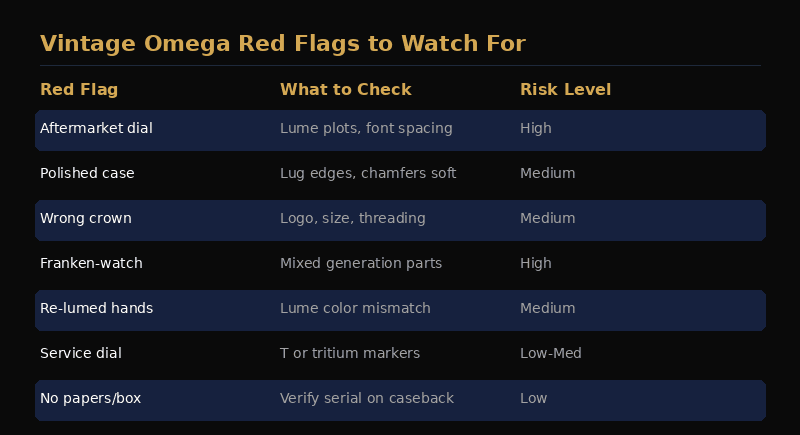
1. Aftermarket or Refinished Dials
Look closely at font spacing and logo placement — aftermarket dials often have slightly uneven letter spacing compared to genuine period printing. Check the lume plot shape under UV light too; the size and position of the lume plots should match verified examples of that exact reference and production year.
2. Over-Polished Cases
Soft, rounded lug edges are the giveaway. A case that has been polished repeatedly loses the crisp bevels and sharp lug lines Omega cut at the factory, and it can also thin the case walls enough to affect water resistance and long-term durability.
3. Wrong or Mismatched Crowns
Crowns get swapped for generic replacements when the original is damaged or lost. A correct crown should carry the right Omega logo style for the era and thread correctly onto the case tube — a loose, ill-fitting, or unbranded crown is an easy tell.
4. Franken-Watches
A franken-watch mixes parts from different production generations — a later-generation case with an earlier dial, or a movement calibre that was never fitted to that case reference from the factory. Cross-check the case serial number era against the dial style and movement calibre before you buy.
5. Re-Lumed Hands
Original lume ages to a consistent cream or brown tone matched between the dial plots and the hands. Hands with noticeably brighter, whiter, or differently textured lume than the dial plots have usually been re-lumed — a legitimate restoration choice for some buyers, but it should be disclosed and priced accordingly, not sold as fully original.
Every check above is something Grailr’s authentication tool is built to help you work through systematically before you commit to a purchase, cross-referencing what your photos show against known reference details.
Where to Buy Vintage Omega Safely
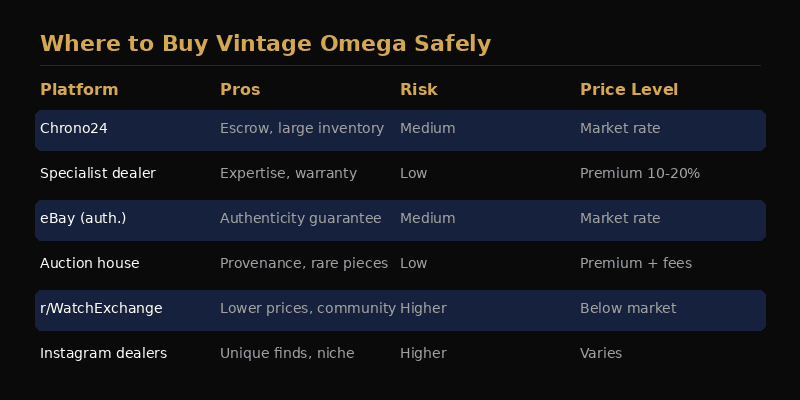
Chrono24
The largest global marketplace for vintage watches, with an escrow-style Trusted Checkout service that holds payment until you have inspected the watch. Filter by seller rating and always read the full condition description before bidding.
Specialist Vintage Dealers
Dealers who specialize in vintage Omega and pre-owned Swiss watches typically offer a short warranty period and a documented condition report, which is worth the modest premium over a private sale for anyone buying above $2,000.
eBay with Authenticity Guarantee
Eligible watch listings over a certain price threshold go through eBay’s third-party authentication before shipping to the buyer, which adds meaningful protection over a standard eBay purchase — confirm the specific listing qualifies before you bid.
Auction Houses
For grail-tier references like the CK2913 Seamaster 300 or a pre-moon Speedmaster, established auction houses provide the strongest provenance research and condition vetting, though buyer’s premiums typically add 15–25% to the hammer price.
Wherever you buy, get clear photographs of the case back, movement, and dial before paying, and run them through Grailr’s identification tool to confirm the reference matches what the listing claims. Our authentication guide covers the broader process in more depth if you are buying your first vintage piece of any brand.
Value Retention: What Holds and What Doesn’t
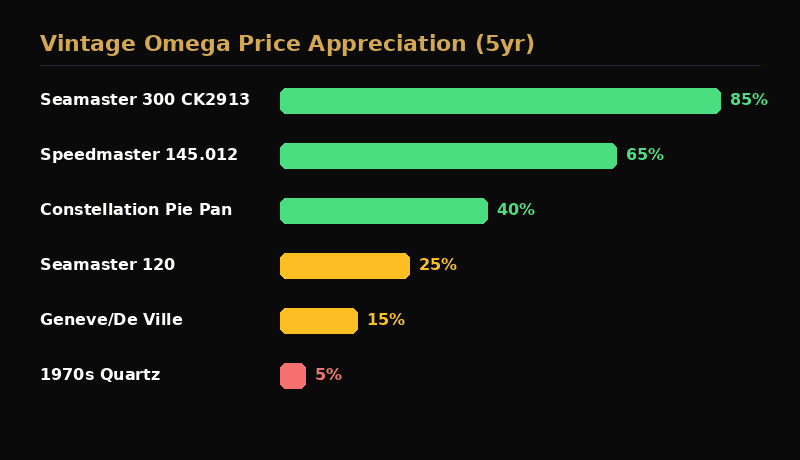
Within vintage Omega, retention correlates closely with originality and rarity rather than model name alone. A CK2913 Seamaster 300 with its original bakelite bezel and unpolished case will hold and grow in value far more reliably than a later Seamaster 300 that has been redialed, even though both carry the same model name.
Entry-level dress references like the De Ville and Geneve Dynamic hold value more modestly, but they also carry the least downside risk — at $500–1,500, the cost of a service and a strap is a small fraction of the purchase price, which makes them a low-stakes way to learn what you like before stepping up to a Seamaster or Constellation. For a wider view of which vintage watches tend to hold their value across brands, see our guide to watch brands that hold value. If you already own a piece and want a sense of what it might be worth today, Grailr’s appraisal tool is a useful starting point before you get a formal valuation.
Frequently Asked Questions
What is a good entry-level vintage Omega?
The Seamaster 120 (ref 166.010, 1966-75) is a strong starting point at roughly $1,200-3,000, with a robust case and the reliable calibre 565/1012 family. The Geneve Dynamic and De Ville dress models run $500-1,500 for buyers on a tighter budget.
How much is a vintage Omega Seamaster worth?
It depends entirely on the reference. A 1970s Seamaster Day-Date (166.0163) trades around $800-2,000, a Seamaster 120 around $1,200-3,000, the 165.024 dive watch $8,000-18,000, and the original 1957-63 CK2913 Seamaster 300 $15,000-40,000 depending on originality and condition.
Is vintage Omega a good investment compared to vintage Rolex?
Vintage Omega is generally 3-5x cheaper than a comparable vintage Rolex reference, which makes entry easier, but it has historically shown less consistent price appreciation at the top end. Buy vintage Omega because you want the watch and the history, not purely as a speculative asset.
How do I know if a vintage Omega dial is original?
Compare font spacing and logo placement against verified period examples, check the lume plot shape under UV light for a pattern consistent with the reference and decade, and look for an even, undisturbed refinish line around the dial edge.
What movements should I look for in a vintage Omega?
The column-wheel calibre 321 used in pre-1968 Speedmasters is the most celebrated vintage Omega movement. For everyday wear, calibres 551, 561 and 564 are dependable automatic movements found across Seamaster and Constellation references from the 1960s and 1970s.
Where is the safest place to buy a vintage Omega?
Specialist vintage dealers who offer a warranty and a documented condition report carry the least risk. Chrono24's Trusted Checkout and eBay's Authenticity Guarantee on eligible listings both add protection over a private, unverified sale.
Related Articles
The Bottom Line
Vintage Omega rewards buyers who do their homework. The Seamaster 120 and De Ville dress models make an honest, low-risk entry point; the Constellation Pie Pan offers real chronometer-grade finishing at mid-range prices; and the Seamaster 300 and pre-moon Speedmaster sit at the top as genuine collector-grade grails. At every tier, the same rule applies — check the dial, check the case, check the crown, and check that the movement calibre actually belongs in that reference before you pay. Authenticate before you buy, not after.
Found a Vintage Omega You Like?
Grailr uses a photo to suggest a watch identity and an indicative price estimate, with active eBay listings where available. Check the exact reference and condition independently; a photo scan cannot authenticate a watch.
Scan a Watch NowSources and price context
- Omega Seamaster heritage collection — Manufacturer background on the Seamaster 300 and its design lineage.
- Omega Speedmaster Moonwatch heritage — Manufacturer history covering the calibre 321 and pre-moon references.
These primary sources support the specific history and specification points noted above. Prices and value tiers elsewhere in this guide are indicative editorial figures based on general secondary-market observation, not a verified transaction dataset or guaranteed returns. Confirm the exact reference, originality, condition and current quote independently before buying; asking prices are not completed-sale prices, and identification or estimate results from Grailr do not establish authenticity or professional appraisal value.