Ralph Lauren Watches: Collections, Prices and Value
IWC movements, Jaeger-LeCoultre complications, a 1938 Bugatti on the dial — and pre-owned prices that make the whole lineup a genuine sleeper buy.
Price context: this guide includes indicative prices from its original publication period. They have not all been refreshed to current quotes. Use the linked primary sources for specifications and policies, and verify prices independently.

- Ralph Lauren watches are produced through a 50/50 joint venture with Richemont, using movements from IWC, Jaeger-LeCoultre and Piaget
- Five core collections span equestrian (Stirrup), automotive (Automotive), sport (Sporting), field (RL67 Safari) and dress (Slim Classique)
- The RL67 Safari Chronometer was the entry-level at roughly $3,250, while Automotive and Stirrup pieces reached $70,000+ at retail
- Pre-owned prices run 50–70% below original retail, making these some of the strongest value propositions in Swiss watchmaking
- The Automotive Skeleton houses an IWC-derived RL1967 hand-wound caliber — genuine manufacture horological content behind a fashion label
The Richemont Partnership: How Ralph Lauren Entered Watchmaking
When Ralph Lauren debuted its watch collection at the Salon International de la Haute Horlogerie (SIHH) in January 2009, the timing could scarcely have been worse. The global financial crisis was at its deepest, luxury spending was contracting sharply, and a fashion brand launching into high watchmaking looked like a vanity project destined to fail. What most observers missed was the structure behind the launch: Ralph Lauren Watch & Jewelry Co. was not a licensing deal with a mass-market case assembler. It was a 50/50 joint venture with Richemont, the Swiss luxury conglomerate that owns Cartier, IWC, Jaeger-LeCoultre, Vacheron Constantin and Piaget.
That partnership gave Ralph Lauren something almost no other fashion brand has had in watchmaking: direct access to manufacture-grade movements from the same houses that supply the most respected names in Swiss horology. The cases were finished to a standard that matched Richemont’s own portfolio, the dials were produced in Swiss facilities, and every watch carried a “Swiss Made” designation earned through genuine manufacture processes rather than the minimal-assembly threshold some fashion brands use to claim the label.
The commercial reality, however, never matched the horological ambition. Launching during a financial crisis, fighting the perception that a polo ralph lauren watch could not compete with established Swiss houses, and pricing well above the fashion-watch segment without the collector credibility of a Richemont mainline brand created a difficult position. Distribution was limited to Ralph Lauren boutiques and select Richemont-affiliated authorized dealers, which kept volumes low and awareness lower. The watches that came out of this partnership are genuinely interesting objects — the gap between what they contain and how the market perceives them is where the value lies today.
Every Collection at a Glance
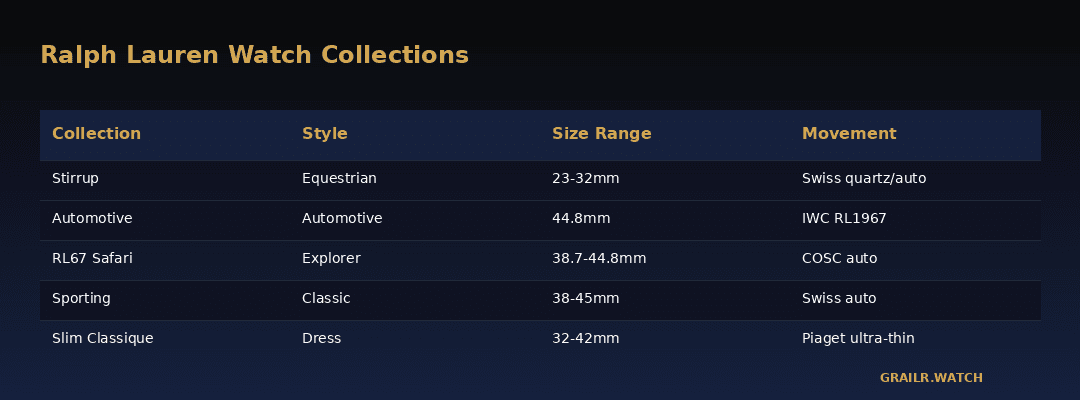
| Collection | Inspiration | Retail Range | Movement Source |
|---|---|---|---|
| Stirrup | Equestrian heritage | $12K–$70K+ | Swiss automatic / manual |
| Automotive | 1938 Bugatti 57SC | $15K–$75K+ | IWC (RL1967 caliber) |
| Sporting | Sport / chronograph | $5K–$25K | Jaeger-LeCoultre chrono |
| RL67 Safari | Field / military | ~$3,250 | COSC-certified automatic |
| Slim Classique | Dress / ultra-thin | $8K–$30K+ | Piaget ultra-thin |
The breadth of the range reflects Ralph Lauren’s deliberate approach: rather than building a single product line, the brand created distinct collections tied to different facets of the Lauren lifestyle — equestrian sport, vintage automobiles, safari adventure and black-tie elegance. Each one draws its movement from a different Richemont manufacture, which means a ralph lauren watch can contain anything from a COSC-certified field movement to an IWC-derived skeleton caliber, depending on the collection and reference.
Stirrup: The Equestrian Flagship
The Stirrup is the watch most closely identified with Ralph Lauren’s brand DNA. Its case takes its shape from an actual equestrian stirrup — an asymmetric rounded-rectangle form that reads as immediately distinctive on the wrist and is unlike anything else in Swiss watchmaking. First introduced at the 2009 SIHH debut, the Stirrup was the collection that signaled Ralph Lauren’s intent to be taken seriously as a watchmaker, not simply as a fashion label licensing its name for a quartz product.
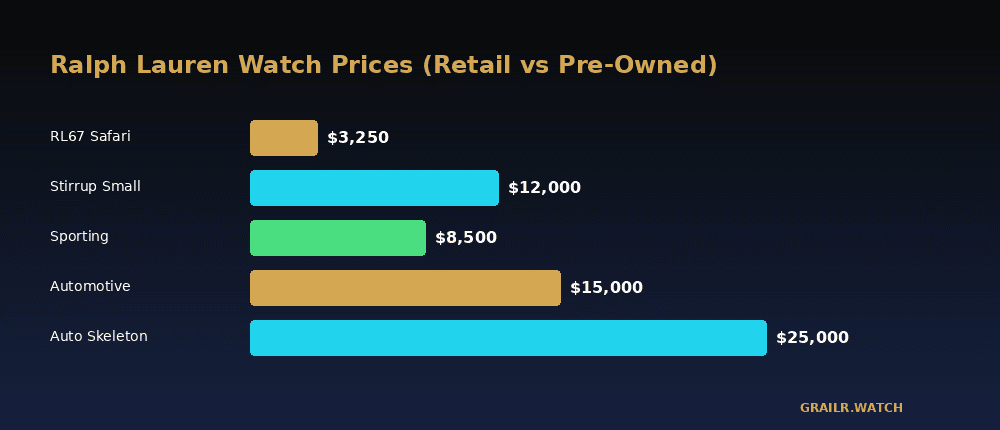
Retail prices for the Stirrup started at roughly $12,000 for steel references with automatic movements and climbed into the $50,000–$70,000 range for precious-metal variants with complications. The small and large sizes accommodated both men’s and women’s wrists, and dial options ranged from classic silver and champagne to more ornate diamond-set configurations for the jewellery-oriented buyer.
On the secondary market, the Stirrup represents both the brand’s greatest design achievement and its most pronounced depreciation. Pre-owned Stirrup models regularly trade at 50–65% below their original retail price, which means a watch that listed at $15,000 new can be found for $5,000–$7,500 in excellent condition. For buyers who appreciate the design on its own merits and are not chasing resale value, this is among the more interesting shapes in the shaped-case watch category — an alternative to the Cartier Tank or Crash at a fraction of the pre-owned cost.
Automotive: From the Bugatti to the Wrist
The ralph lauren automotive collection is arguably the line that earns the most respect from dedicated watch enthusiasts, and the story behind it explains why. Ralph Lauren personally owns a 1938 Bugatti Type 57SC Atlantic — one of only four ever built, valued at over $30 million, and widely considered one of the most beautiful automobiles in existence. The Automotive watch translates that car’s design language into a wristwatch: engine-turned guilloching on the dial evokes the Bugatti’s riveted aluminum body panels, and the overall aesthetic walks a line between instrument and art object that few watch designs attempt.
The heart of the Automotive collection is the RL1967 caliber, a hand-wound movement derived from IWC’s manufacture base. The name references 1967, the year Ralph Lauren founded his company, but the movement itself carries the engineering heritage of IWC Schaffhausen — one of the most technically accomplished watchmakers in the Richemont stable. In the Automotive Skeleton variant, this movement is fully visible through the dial side, its bridges finished with the same engine-turned guilloching that decorates the standard dial variants.
At the upper end of the automotive range, the Automotive Double Tourbillon in black steel represented the brand’s highest complication. With two tourbillon cages visible on the dial side, it sat at the pinnacle of the collection and carried a retail price that reflected its complexity. Few were produced, and pre-owned examples are genuinely rare.
Retail pricing for the Automotive collection ranged from roughly $15,000 for time-only steel references to above $75,000 for the skeleton and tourbillon variants. Pre-owned Automotive watches are among the best values in the entire Ralph Lauren range, with skeleton models occasionally appearing below $10,000 — meaning buyers can acquire a watch with an IWC-derived hand-wound movement, genuine guilloched finishing and a sapphire-backed exhibition case for less than a new Omega Speedmaster.
RL67 Safari and Slim Classique: The Accessible End
The RL67 Safari Chronometer was Ralph Lauren’s most accessible watch and, for many buyers, the natural entry point into the brand. At a retail price of approximately $3,250, it was positioned well below the Stirrup and Automotive collections and offered genuine horological substance: a COSC-certified automatic movement, a khaki dial inspired by Ralph Lauren’s safari-themed clothing line, and a case built in either 44.8mm or 38.7mm to accommodate different wrist sizes. The RL67 name references the founding year of the brand, a recurring motif across Ralph Lauren’s watch collections.
The Slim Classique occupies the opposite end of the spectrum in purpose if not in price. Built around an ultra-thin Piaget movement — one of the acknowledged masters of thin watchmaking — the Slim Classique is a formal dress watch designed for black-tie and boardroom wear. Retail prices started around $8,000 and climbed past $30,000 for precious-metal references with enamel dials. Where the Safari was a tool watch with field-watch proportions, the Slim Classique was pure elegance: slim enough to disappear under a French cuff, refined enough to justify its position alongside Piaget’s own Altiplano collection.
Both collections demonstrate the depth of the Richemont relationship. A COSC chronometer at $3,250 and a Piaget-powered ultra-thin dress watch under the same brand umbrella — that is not something a fashion label achieves through a licensing agreement. It requires the kind of integrated manufacture access that only a Richemont joint venture could provide, and it is the clearest evidence that watch polo ralph lauren deserves a closer look than most collectors give it.
Movement Sources and Horological Credibility
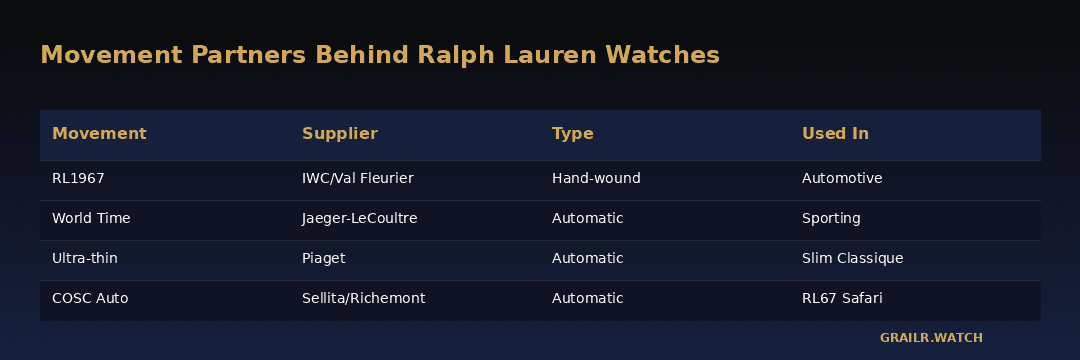
The single most important thing to understand about Ralph Lauren watches is where their movements come from. Unlike most fashion brands that use off-the-shelf ETA or Sellita movements — or, worse, low-cost quartz modules — Ralph Lauren drew its calibers directly from Richemont’s specialist watchmaking houses. The result is a watch that wears a fashion label on its dial but carries the same mechanical heart you would find in watches costing two to three times as much from the supplying manufacture.
| Collection | Movement | Origin | Type |
|---|---|---|---|
| Automotive / Skeleton | RL1967 | IWC Schaffhausen | Hand-wound |
| Sporting World Time | RL300-series | Jaeger-LeCoultre | Automatic world time |
| Sporting Chronograph | RL750 | Jaeger-LeCoultre | Automatic chronograph |
| Slim Classique | RL430 | Piaget | Ultra-thin automatic |
| RL67 Safari | COSC automatic | Swiss (COSC certified) | Automatic chronometer |
This movement sourcing is the core of the ralph lauren watch value proposition, and it is what separates these timepieces from every other fashion-brand watch on the market. When you buy a pre-owned Automotive Skeleton for $8,000, you are getting a hand-wound IWC-derived movement in a case with genuine guilloched finishing — the kind of mechanical and decorative content that costs $15,000–$25,000 when it wears an IWC badge. The fashion label on the dial suppresses the resale value, but it does not change what is inside the case. For a broader perspective on where different brands sit in the value hierarchy, our best watches for value guide covers the field.
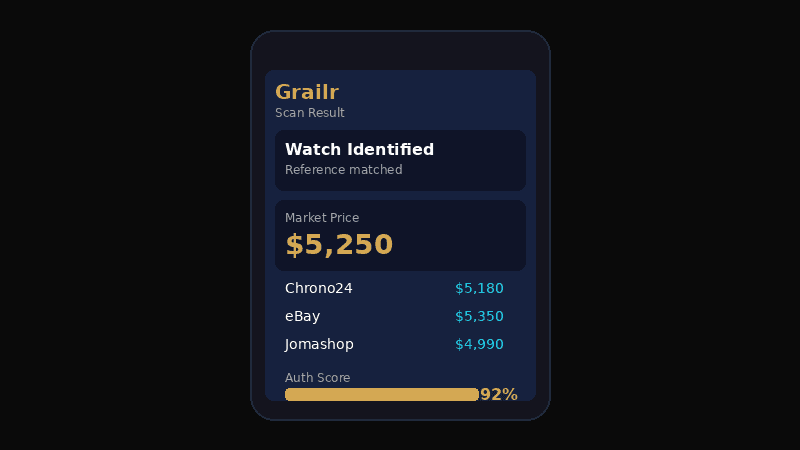
Check Any Watch Price in Seconds
Grailr scans your watch photo and pulls live pricing from Chrono24, eBay, and Jomashop.
- AI identifies brand, model & reference number
- Live market prices from 3+ sources
- Authentication confidence score
Pre-Owned Value and Market Reality
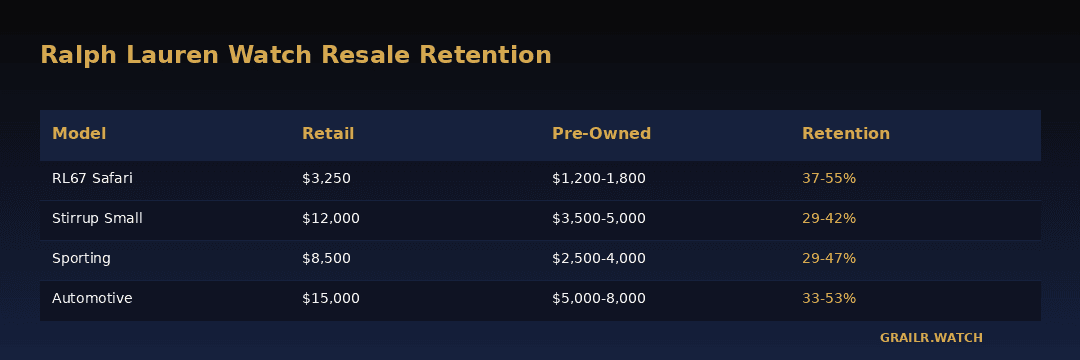
The elephant in the room with any ralph lauren watch discussion is resale value, and the numbers are stark. Most Ralph Lauren timepieces trade at 50–70% below their original retail prices on the secondary market. That level of depreciation is significantly steeper than what you would see from the Richemont brands whose movements are inside these watches — an IWC Portugieser or Jaeger-LeCoultre Reverso typically retains 65–80% of retail — and it is among the steepest in the Swiss luxury segment, comparable to other fashion-label watches from brands covered in our watches that lose the most value guide.
Several factors drive this depreciation. First, the fashion-brand perception is a real barrier in the collector market: enthusiasts who would happily pay $15,000 for an IWC will not pay $8,000 for the same movement in a case that says “Ralph Lauren,” regardless of the case finishing or dial quality. Second, the brand launched during the worst possible economic moment and never built the collector community or secondary-market infrastructure that supports resale demand. Third, distribution was always limited, which kept the watches out of the hands of the dealers and reviewers who shape collector opinion.
50–70%
Typical discount below original retail on the secondary market
$3K–$8K
Pre-owned range for Automotive and Stirrup references
IWC / JLC
Manufacture movements inside at a fraction of their branded price
But depreciation is a two-sided equation. The same market dynamics that punish original buyers create extraordinary opportunities for pre-owned buyers who care about what is on the wrist rather than what it will be worth in five years. An Automotive Skeleton with an IWC-derived movement for under $10,000, a Piaget-powered Slim Classique for $4,000–$6,000, or an RL67 Safari Chronometer for under $2,000 — these are prices that put genuine Swiss watchmaking within reach of buyers who would otherwise be shopping for entry-level Swiss pieces with far less interesting movements. Use Grailr’s watch identification tool to confirm the exact reference before comparing secondary-market prices.
Buying Advice for 2026
1. Buy Pre-Owned, Not New
Given the 50–70% depreciation on the secondary market, buying a Ralph Lauren watch new at retail is difficult to justify on value grounds alone. Pre-owned examples with box and papers offer the same watch at a fraction of the cost, and the Richemont-sourced movements are robust enough that a well-maintained used piece has years of reliable service ahead. Grailr’s appraisal tool can help benchmark a listing before you commit.
2. Prioritize the Automotive and Slim Classique
These two collections carry the most horological substance relative to their pre-owned prices. The Automotive Skeleton with its IWC-derived RL1967 movement is the standout — a genuine manufacture hand-wound caliber with visible engine-turned guilloching, available for less than $10,000. The Slim Classique with its Piaget movement offers ultra-thin dress-watch refinement at prices that undercut Piaget’s own Altiplano line by a wide margin.
3. Verify Service Access
Because Ralph Lauren’s watch distribution is limited, confirm where the watch can be serviced before purchasing. The Richemont-sourced movements can generally be serviced by independent watchmakers with experience in JLC, IWC or Piaget calibers, but sourcing parts for case-specific components such as crowns and crystals may require going through Ralph Lauren directly. Ask the seller whether service history is documented.
4. Scan Before You Commit
Use Grailr’s free scanner to photograph a listing and get a suggested model identification alongside live pricing from multiple marketplaces. It is a starting point for due diligence, not proof of authenticity — pair it with an independent inspection before sending payment.
5. Do Not Expect Appreciation
Ralph Lauren watches are not investment pieces. The brand has not built the collector following needed to support secondary-market price growth, and the fashion-label perception is unlikely to shift meaningfully. Buy because you want the watch on your wrist, not because you expect it to be worth more in five years. The value is in the wearing, not the reselling.
Frequently Asked Questions
Are Ralph Lauren watches real luxury watches?
Yes. Ralph Lauren watches are produced through a 50/50 joint venture with Richemont, the group behind Cartier, IWC, and Jaeger-LeCoultre. Movements are sourced from those manufacture-grade suppliers, and cases are finished in Swiss facilities. They are genuine Swiss-made luxury watches, not fashion-branded quartz pieces.
How much does a Polo Ralph Lauren watch cost?
New retail prices have historically ranged from roughly $3,250 for the RL67 Safari Chronometer to above $70,000 for the Automotive Skeleton and Stirrup in precious metals. Pre-owned prices are dramatically lower, with many models available at 50 to 70 percent below their original retail price.
What movements do Ralph Lauren watches use?
Ralph Lauren sources movements from Richemont-owned manufactures. The Automotive collection uses the IWC-derived RL1967 hand-wound caliber, world time and chronograph models use Jaeger-LeCoultre movements, and the Slim Classique uses Piaget ultra-thin calibers.
Do Ralph Lauren watches hold their value?
Generally not well on the secondary market. Most Ralph Lauren watches trade at 50 to 70 percent below their original retail prices. The fashion-brand perception creates buying resistance among watch collectors, which suppresses resale demand despite the genuine horological content inside.
Where can I buy a Ralph Lauren watch?
New Ralph Lauren watches are available through Ralph Lauren boutiques and select Richemont-affiliated authorized dealers. Pre-owned examples appear on secondary-market platforms such as Chrono24 and occasionally at specialist watch dealers. Availability for new pieces has become increasingly limited.
What is the Ralph Lauren Automotive watch inspired by?
The Automotive collection draws its design from Ralph Lauren's personal 1938 Bugatti Type 57SC Atlantic, one of only four ever built and valued at over $30 million. The watch's dial features engine-turned guilloching that evokes the car's riveted aluminum body panels, and the hand-wound IWC-derived RL1967 caliber is visible through a sapphire caseback.
Related Articles
The Bottom Line
Ralph Lauren watches are the most undervalued Swiss-made timepieces on the secondary market today. Built through a genuine Richemont joint venture with movements from IWC, Jaeger-LeCoultre and Piaget, these watches contain manufacture-grade horological content that matches or exceeds what you would find in watches costing two to three times as much from their supplying brands. The Stirrup’s distinctive case shape, the Automotive’s Bugatti-inspired guilloching, the RL67 Safari’s COSC chronometer at a field-watch price — each collection offers something that no other brand in the market replicates at these pre-owned price points.
The tradeoff is clear: resale value is poor, brand recognition in the watch-collector community is low, and service infrastructure is thinner than what IWC or JLC offer directly. These are watches for buyers who prioritize what they wear over what they might sell, who appreciate the gap between a polo ralph lauren watch’s market price and its mechanical substance, and who understand that the fashion-brand label on the dial does not diminish what Richemont’s finest manufactures built beneath it. Buy pre-owned, buy for the wrist, and enjoy the kind of Swiss watchmaking that no other fashion brand has ever delivered.
Considering a Ralph Lauren Watch?
Grailr uses a photo to suggest a watch identity and an indicative price estimate, with active eBay listings where available. Check the exact reference and condition independently; a photo scan cannot authenticate a watch.
Get an Indicative EstimateSources and price context
- Ralph Lauren Watches — Official collection pages with specifications, case materials, and movement details for current and recent references.
- Richemont specialist watchmakers — Corporate context for the Richemont group’s manufacture portfolio, including IWC, Jaeger-LeCoultre and Piaget, whose movements power Ralph Lauren’s collections.
These primary sources support the specifications and history noted above. Prices and resale percentages elsewhere in this guide are indicative editorial figures, not a verified transaction dataset or guaranteed returns. Confirm the exact reference, region, condition and current quote before buying; asking prices are not completed-sale prices.