Rolex Watch Flipping: How It Works and Why Most Lose
The secondary market data, selling fees, allocation barriers and blacklist risks that most flipping guides leave out.
Price context: this guide includes indicative secondary market prices from its publication period. They have not all been refreshed to current quotes. Use the linked primary sources for live data and verify prices independently before any transaction.
- The average Rolex secondary premium has compressed to about 6.7% above retail as of early 2026 — down from double-digit premiums during the 2022 boom
- Only allocation-limited references like the Daytona and certain GMT-Master II bezels consistently flip for profit after selling fees
- Selling fees range from 6.5% on Chrono24 to 13% on eBay and up to 25% at auction houses — eating most of the remaining margin
- Rolex traces serial numbers, and authorized dealers can blacklist clients whose watches appear on the secondary market shortly after purchase
- Datejust 36 ($9,127 avg) and Date ($6,203 avg) models carry zero flip premium in 2026 — selling one costs you money after fees
What Is Watch Flipping?
Watch flipping means buying a watch at or below market price — ideally at retail from an authorized dealer — and reselling it on the secondary market for a profit. The margin exists when demand for a specific reference outstrips supply at the retail level, pushing pre-owned and unworn prices above the manufacturer’s suggested retail price.
Rolex is the most commonly flipped brand because its controlled distribution creates a persistent gap between retail availability and collector demand on certain references. An authorized dealer might allocate a Cosmograph Daytona to a client at $15,100 retail, while the same unworn watch lists for $30,000 or more on Chrono24 the same week.
That gap looks like free money. It is not. The math on paper always looks cleaner than the math after fees, holding costs and the access problem that most guides skim past. This guide walks through what the numbers actually say in 2026, which references still carry a premium, and why the majority of casual Rolex watch flippers lose money on the transaction.
The 2020–2022 Boom and What Came After
The modern Rolex flipping era started in earnest around 2020. Stimulus spending, low interest rates and a surge of new collectors pushed secondary market prices into territory nobody had seen before. A steel Cosmograph Daytona that traded near $25,000 in early 2020 crossed $50,000 by winter 2022. The WatchCharts overall market index hit its all-time high in March 2022.
Then the correction came. Within a year of the peak, prices fell back to roughly autumn 2021 levels. The speculative premium on most steel sports models — Submariners, GMT-Masters, Explorer IIs — compressed sharply. By mid-2023, many references that had traded 40–60% above retail were back to single-digit premiums or trading at retail parity.
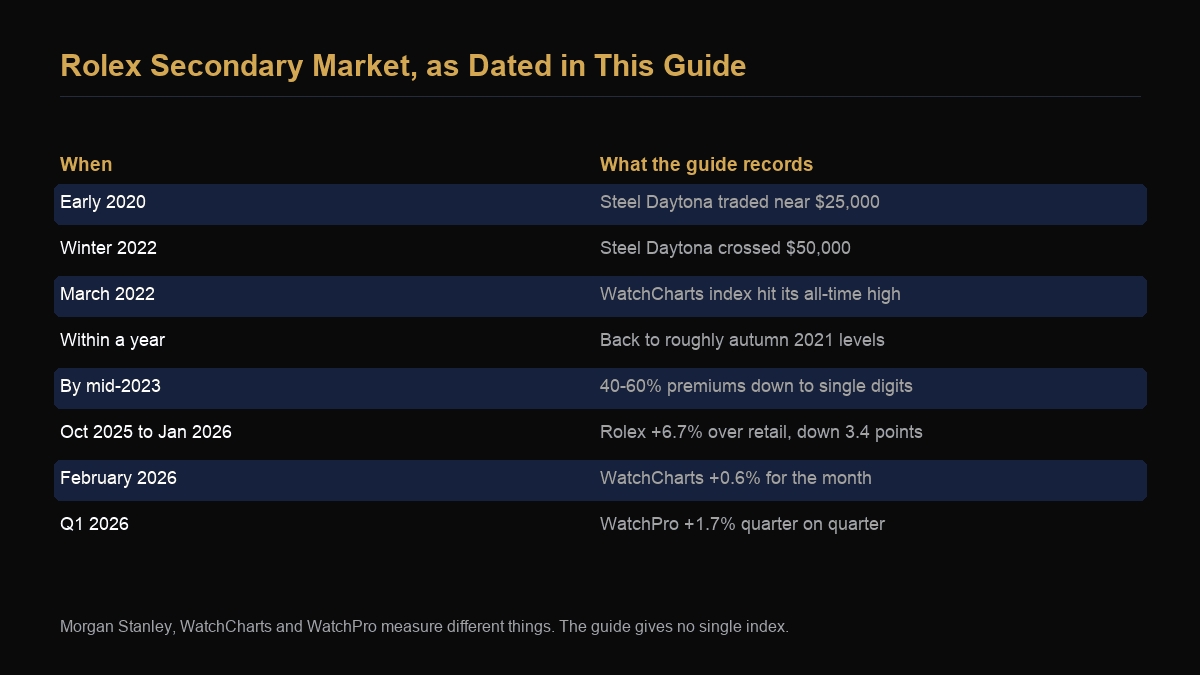
The numbers tell the story of the aftermath. As of January 2026, Morgan Stanley data showed Rolex trading about 6.7% above retail on the secondary market — down 3.4 percentage points from October 2025 alone. WatchCharts reported a modest 0.6% gain in February 2026, and WatchPro data put the quarter-on-quarter move at roughly 1.7% through Q1 2026. These are not flipping margins. They are rounding errors once fees enter the equation.
Meanwhile, Rolex raised US retail prices by approximately 7% on 1 January 2026, with gold models rising more than steel. Some dealers argued the secondary floor moved up with retail, making pre-owned steel sports watches more expensive rather than cheaper. The gap between retail and secondary narrowed further — not because pre-owned prices rose, but because the starting price did. For a deeper look at the full price trajectory, see our Rolex price history guide.
Which Rolex Models Still Flip for Profit
Not all Rolex references are created equal for flippers. In 2026, the market splits cleanly into allocation-limited references that still carry a premium and everything else. The Q2 2026 data from Bob’s Watches makes the divide clear:
| Reference | Model | Avg Secondary Price | QoQ Change | Flip Premium |
|---|---|---|---|---|
| 126500LN | Cosmograph Daytona | $33,322 | Strong | Yes — consistently above retail |
| 126710BLRO | GMT-Master II Pepsi | $22,365 | Moderate | Yes — demand ahead of supply |
| 116610LN | Submariner Date (prev gen) | — | +38.8% | Situational — discontinued halo |
| 124060 | Submariner No Date | $12,000–$14,000 listing | Flat | Minimal after fees |
| 126334 | Datejust 41 | $9,127 | Flat | None |
| 115200 | Oyster Perpetual Date | $6,203 | Flat | None |
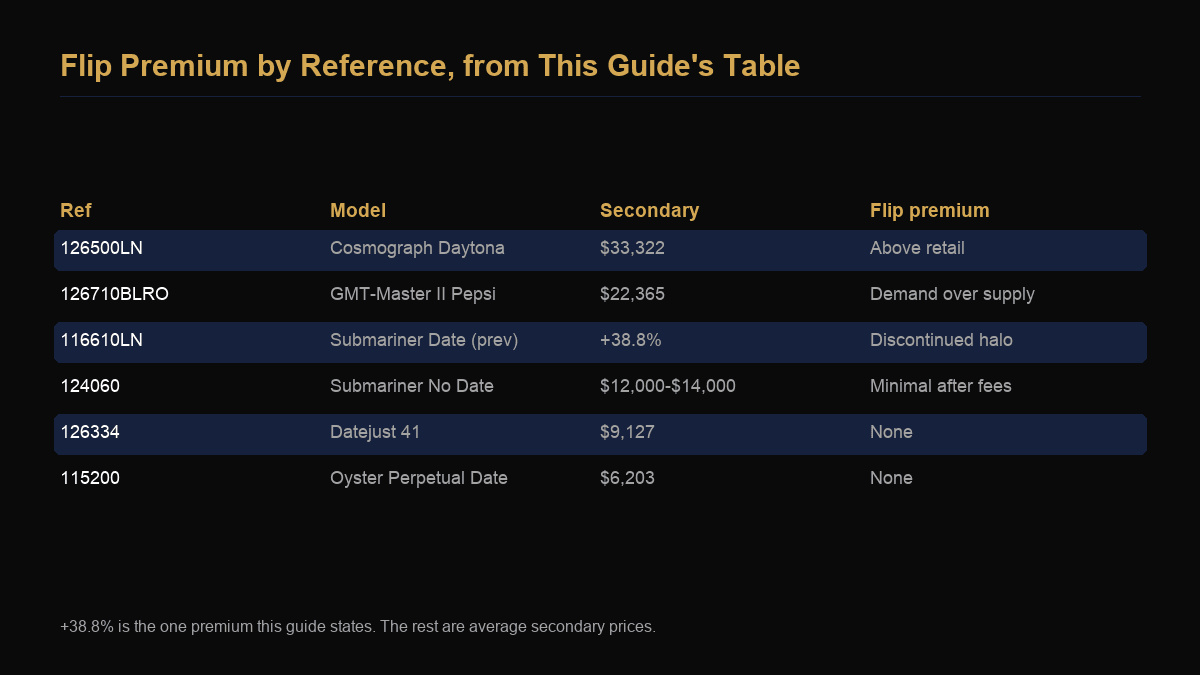
The pattern is straightforward. The Daytona remains the one reference where flipping consistently works because Rolex production cannot keep up with demand. The GMT-Master II in Pepsi and Batman bezel configurations sits a tier below — premiums exist but are smaller and more volatile. Everything else — Datejust, Date, most Submariner configurations — trades near or below retail once you account for the cost of selling.
The previous-generation Submariner 116610 is an exception worth noting. Its 38.8% quarter-on-quarter gain in Q2 2026 reflects the discontinued-reference halo effect: once Rolex stops making a specific model, collector interest can push prices above where the reference traded when it was current. This is not flipping in the traditional sense — it rewards long-term holders, not quick resellers. For a broader look at which models actually appreciate, see our Rolex investment guide.
Selling Fees by Platform
The gap between what a buyer pays and what a seller actually receives is where most flipping profits disappear. Every platform takes a cut, and the percentages add up faster than most first-time sellers expect. Here is what you actually pay in 2026:
| Platform | Seller Fee | Authentication | Buyer Pool | Typical Sale Speed |
|---|---|---|---|---|
| eBay | ~13% combined | Authenticity Guarantee >$2,000 | Very large | 1–4 weeks |
| Chrono24 | ~6.5% | Trusted Checkout escrow | Watch-focused, global | 2–8 weeks |
| Auction House | 10–25% seller premium | In-house experts | High-end collectors | 6–12 weeks |
| Dealer Buyout | Wholesale spread (15–30% below listing) | Handled by dealer | Instant | Same day |
| Private Sale | 0% (but no buyer protection) | None | Limited | Variable |
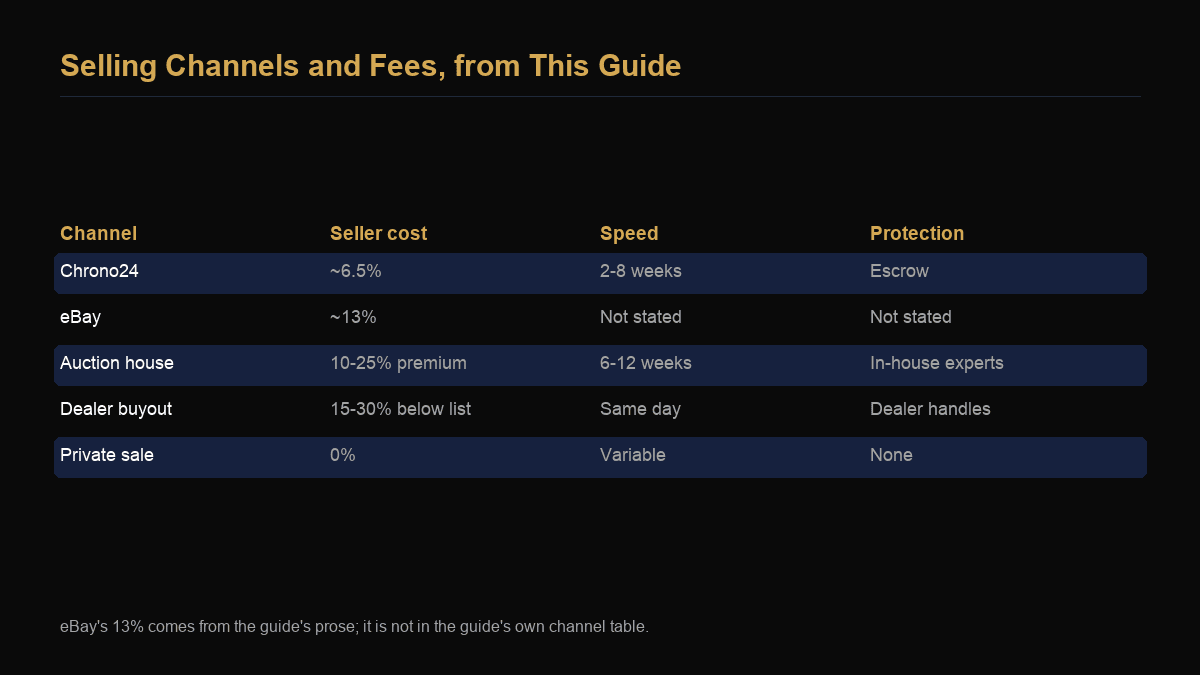
The dealer buyout path deserves special attention because it is the fastest way to sell and the worst for margin. A Submariner 124060 that a seller might list at $12,000–$14,000 on Chrono24 draws a dealer buy-in offer of $9,500–$11,500. If you paid $9,100 retail, you might break even or lose a few hundred dollars on a same-day dealer sale. For a full comparison of selling channels, see our guide to selling watches online.
Check Any Watch Price in Seconds
Grailr scans your watch photo and pulls live pricing from Chrono24, eBay, and Jomashop.
- AI identifies brand, model & reference number
- Live market prices from 3+ sources
- Authentication confidence score
Real Profit Math: A Worked Example
Let’s walk through the math on two real scenarios using Q2 2026 data. One works. One does not.
Scenario A: Cosmograph Daytona 126500LN
- Retail price (2026): $15,100
- Avg secondary price: $33,322
- Chrono24 seller fee (6.5%): –$2,166
- Shipping & insurance: –$150
- Net proceeds: $31,006
- Gross profit: $15,906
This is the dream scenario — and it requires getting the allocation in the first place, which is the hardest part.
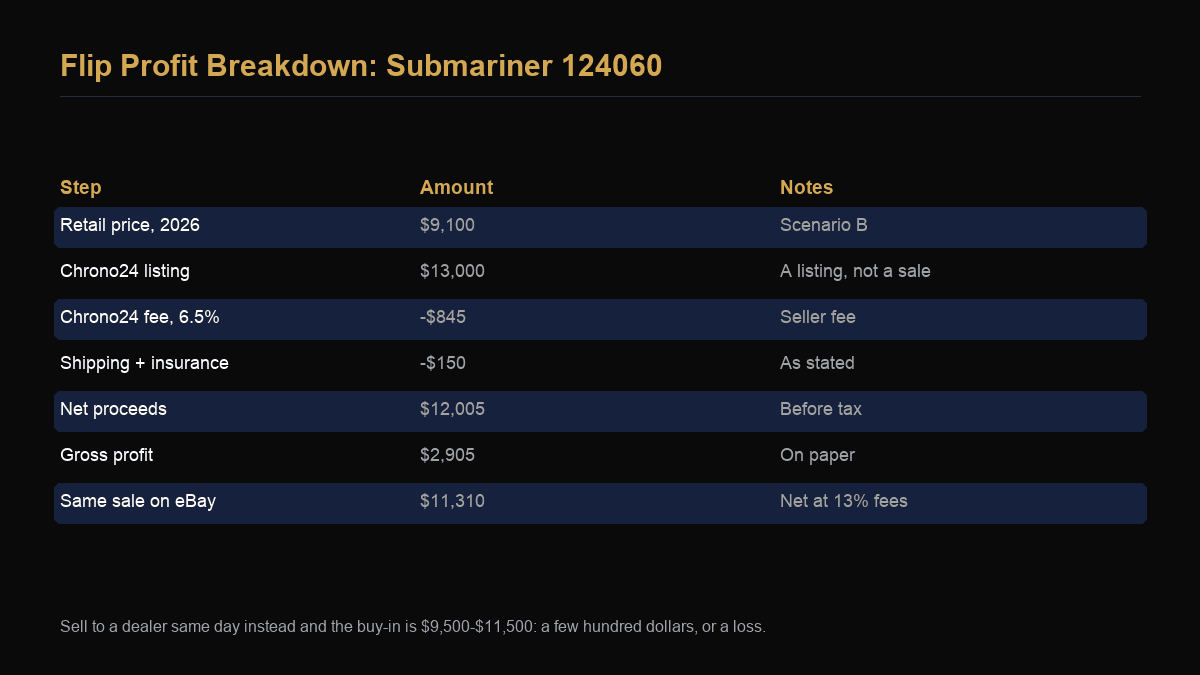
Scenario B: Submariner No Date 124060
- Retail price (2026): $9,100
- Listing price on Chrono24: $13,000
- Chrono24 seller fee (6.5%): –$845
- Shipping & insurance: –$150
- Net proceeds: $12,005
- Gross profit: $2,905
Looks positive on paper. But if you sell to a dealer instead of waiting weeks for a Chrono24 buyer, the buy-in is $9,500–$11,500 — potentially a loss after tax. And the listing price is not guaranteed; actual sale prices may be lower after negotiation.
The Daytona math is compelling — $15,906 gross profit on a $15,100 outlay is over 100% return. But that profit requires something money alone cannot buy: the allocation. A first-time walk-in to an authorized dealer will not receive a Daytona. You need purchase history, a relationship, and often purchases of less-desirable references first. The real cost of the Daytona includes the watches you bought to build that history.
The Submariner math is tighter. A $2,905 gross margin on Chrono24 sounds workable until you factor in the weeks or months of holding time, the possibility of a lower negotiated sale price, and the tax implications of a short-term capital gain. Sell to a dealer same-day and the margin collapses to a few hundred dollars at best. On eBay at 13% fees, the net proceeds drop to about $11,310 — still positive, but barely worth the effort and risk.
The Allocation Barrier
This is the part that most flipping guides skim past or ignore entirely: you cannot buy the watches that actually flip for profit without dealer allocation, and allocation is not for sale.
Rolex authorized dealers decide who gets access to allocation-limited references. The criteria are not published, but the pattern is consistent across markets: repeat customers who buy across collections — including less-desirable references — build the purchase history that eventually leads to a call when a Daytona or Pepsi GMT arrives. A one-time boutique visit usually produces nothing.
As the watch industry publication 5D Watches put it in August 2026: “Repeatable profit requires access most first-time buyers do not have.” The allocation system exists precisely to prevent casual flipping. Rolex wants its watches on wrists, not on Chrono24 listings with “unworn” tags.
Some aspiring flippers try to circumvent allocation by buying from the grey market — unauthorized dealers who source watches through their own networks. The problem is obvious: grey market prices already include the flip premium. A grey market Daytona at $30,000 leaves zero room for profit on resale. You are buying someone else’s flip, not creating your own. For more on how the authorized versus grey market split works, see our guide to buying used Rolex.
Risks, Blacklists and Authentication
Beyond the math, Rolex watch flippers face three risks that can turn a profitable flip into a loss or worse.
Manufacturer Blacklisting
Rolex traces serial numbers and monitors the secondary market. When a watch appears for sale shortly after purchase, the authorized dealer who sold it can flag the client. The consequence is straightforward: future allocation-limited purchases are declined. This is not a formal public policy — Rolex does not publish a blacklist — but it is widely reported by dealers and collectors across forums and industry publications. One flip can cost you a decade of purchase history.
Authentication and Counterfeits
If you are buying watches to flip rather than selling allocations you received, authentication is critical. Sophisticated Rolex counterfeits have reached a level where visual inspection alone is not sufficient. A “super clone” Submariner can pass a casual inspection and fool an inexperienced buyer. Buying a counterfeit to resell creates legal liability and financial loss. Any watch purchased for resale should be authenticated before the transaction — whether through a service like Bob’s Watches, a platform’s escrow service, or an independent watchmaker.
Market Timing and Holding Risk
Capital sitting in a watch is capital not earning returns elsewhere. During the 2022–2023 correction, flippers who held inventory saw their paper profits evaporate in weeks. The Rolex secondary market can move 5–10% in a quarter, and the direction is not always up. The 6.7% average premium as of early 2026 is not a guarantee — it is a snapshot that had already dropped 3.4 percentage points from three months prior.
Tax treatment adds another layer. In most jurisdictions, a watch sold within a year of purchase generates a short-term capital gain taxed at ordinary income rates. A $3,000 gross profit on a Submariner can become $1,800 after federal and state taxes in the US. That is not a business — that is an expensive hobby. For eBay-specific selling strategies and fee structures, see our guide to selling watches on eBay.
Frequently Asked Questions
Can you still make money flipping Rolex watches in 2026?
Which Rolex models are most profitable to flip?
What fees do you pay when selling a Rolex?
Will Rolex blacklist you for flipping?
How much did Rolex prices drop after the 2022 peak?
Is it better to sell a Rolex on eBay or Chrono24?
The Bottom Line
Rolex watch flipping in 2026 is not the easy-money opportunity it appeared to be in 2021. The secondary market premium has compressed to single digits, selling fees eat 6.5–13% of the sale price, and the references that still flip for a meaningful profit require dealer allocation that most buyers cannot obtain.
The Daytona remains an exception — its $15,000+ gross margin survives any fee structure — but getting one at retail requires years of purchase history and a relationship with an authorized dealer. For every Daytona that nets five figures, there are Datejust and Date flips that net nothing or lose money after fees and taxes.
If you want to buy a Rolex, buy one you want to wear. If it appreciates, that is a bonus. If you are treating Rolex watches purely as inventory to flip, the numbers say that most casual entrants will not beat a savings account — and the blacklist risk means a failed attempt can close doors that took years to open.
Know What Your Watch Is Worth
Before you buy or sell, scan any watch with Grailr to see live market prices from multiple sources and an authentication confidence score.
Scan a Watch Free