Rolex Price History: From the 2022 Peak to 2026 Reality
Four years after prices hit record highs, we trace what actually happened to the Submariner, Daytona and GMT-Master — model by model, with the numbers that matter.
Price disclaimer: All figures in this article are indicative estimates drawn from secondary-market asking prices and reported transactions. They are not live quotes, verified sale prices, or professional appraisals, and they do not establish authenticity. A watch’s actual resale value depends on its specific reference, serial, condition, provenance, and the terms of a completed sale. Consult a qualified appraiser before making purchase or sale decisions.
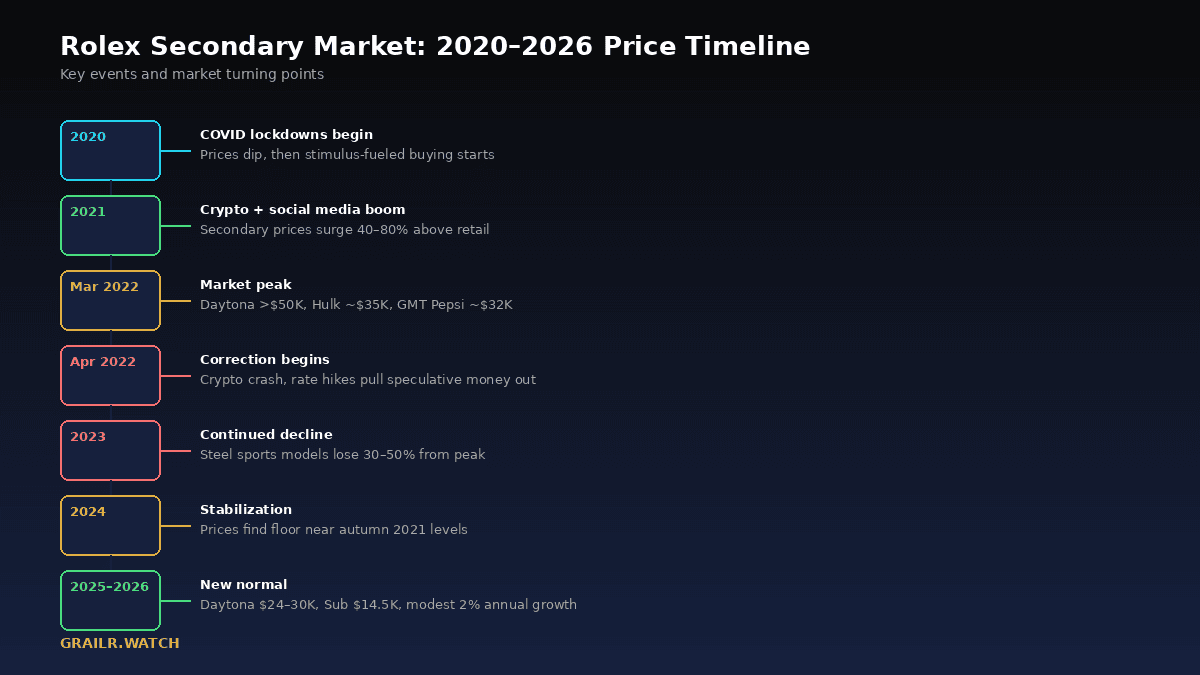
- Rolex secondary-market prices peaked in March 2022, fuelled by stimulus money, crypto gains and social media hype
- Steel sports models lost 30–50% from peak, consolidating back to roughly autumn 2021 levels by mid-2023
- The Submariner Hulk (116610LV) fell from ~$35,000 to $22,000–$23,000; the steel Daytona from above $50,000 to $24,000–$30,000
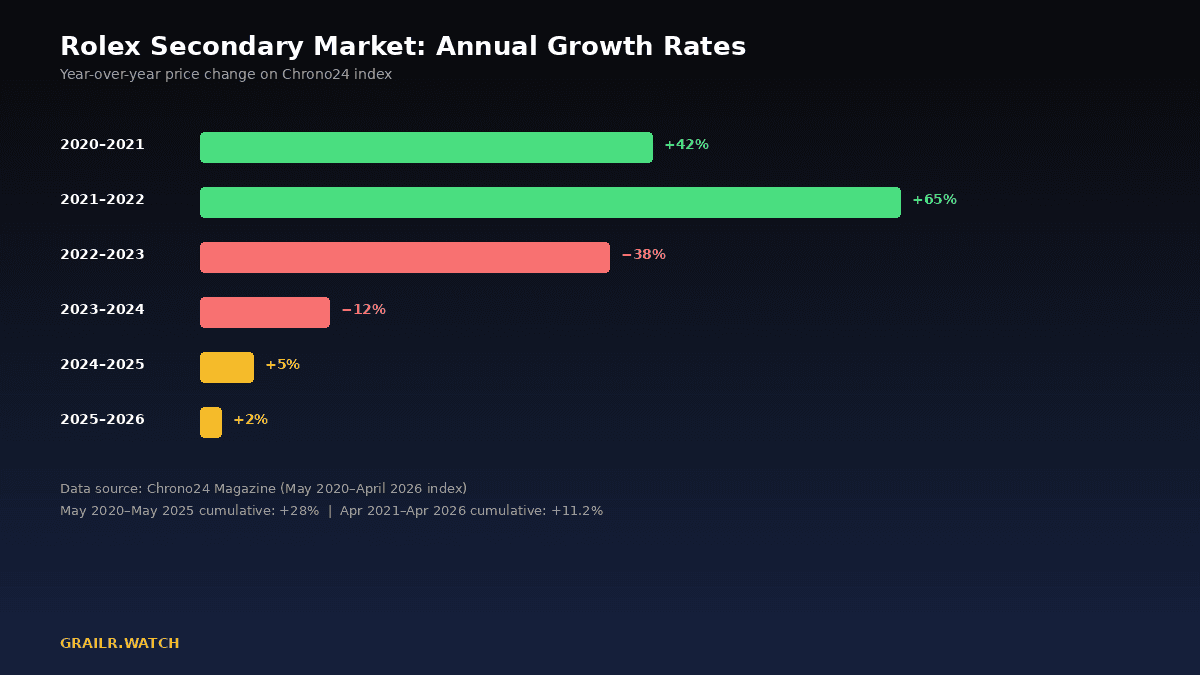
- Chrono24 index data shows overall Rolex prices rose 28% from May 2020 to May 2025 and just 2% from April 2025 to April 2026
- The GMT-Master II Pepsi (126710BLRO), discontinued spring 2026, is climbing — a 500% surge in purchase requests hit in March 2026
The 2022 Bubble: What Drove Rolex Prices to Record Highs
Between late 2020 and March 2022, Rolex secondary-market prices went parabolic. A steel Daytona that traded at $25,000 in early 2020 crossed $50,000 by winter 2022. A green-bezel Submariner “Hulk” that had been a $15,000 watch before the pandemic touched $35,000 at the top. Waitlists for new steel sport models at authorised dealers stretched past two years, and grey-market dealers charged premiums that made the watches feel more like speculative instruments than wristwatches.
The causes were several, and they reinforced one another. COVID-era stimulus money gave buyers across income brackets a sudden pool of cash at a moment when travel, dining and entertainment spending was curtailed. Much of that money found its way into tangible assets: watches, sneakers, trading cards, and NFTs. Cryptocurrency profits amplified the effect. Bitcoin hit its then-all-time high near $69,000 in November 2021, and a generation of newly liquid crypto holders cycled gains into luxury goods — Rolex steel sports models, in particular, because the brand carried both universal recognition and a reputation for “holding value.”
Social media provided the accelerant. Instagram watch dealers, YouTube flippers, and TikTok creators built audiences around the narrative that buying a Rolex was a financial no-brainer — a watch that “always goes up.” The more prices rose, the more attention the narrative attracted, and the more buyers entered the market chasing the same handful of steel references. The result was a textbook speculative bubble: prices driven not by the utility or intrinsic quality of the watches themselves, but by the expectation that someone else would pay even more tomorrow.
| Measure | Before the run-up | At the March 2022 peak |
|---|---|---|
| Daytona, steel (116500LN) | $25,000 (early 2020) | $50,000+ |
| Submariner “Hulk” (116610LV) | $15,000 (pre-pandemic) | ~$35,000 |
| AD waitlist, steel sports models | months | past two years |
| Bitcoin (the crypto profits feeding in) | — | ~$69,000 (Nov 2021 high) |
The music stopped in March 2022. Crypto prices began their extended decline. Rising interest rates made risk assets less attractive. Stimulus spending dried up. From April 2022 onward, Rolex secondary-market prices consolidated sharply, returning roughly to autumn 2021 levels within a year. For buyers who purchased at or near the peak, the correction was painful. For those who had been priced out, it created opportunities that are still playing out in 2026.
The speed of the correction surprised even experienced dealers. Watches that had been listed at $40,000 in February 2022 were struggling to find buyers at $30,000 by summer. Grey-market inventory that had been turning over in days started sitting for weeks, then months. The social media accounts that had promoted watch flipping as a lifestyle shifted their content or went quiet. What remained after the dust settled was a market that had to rediscover what Rolex watches were actually worth when stripped of the speculative premium — and that process of rediscovery is the real story of the four years that followed.
How Far Did Prices Fall? Model by Model
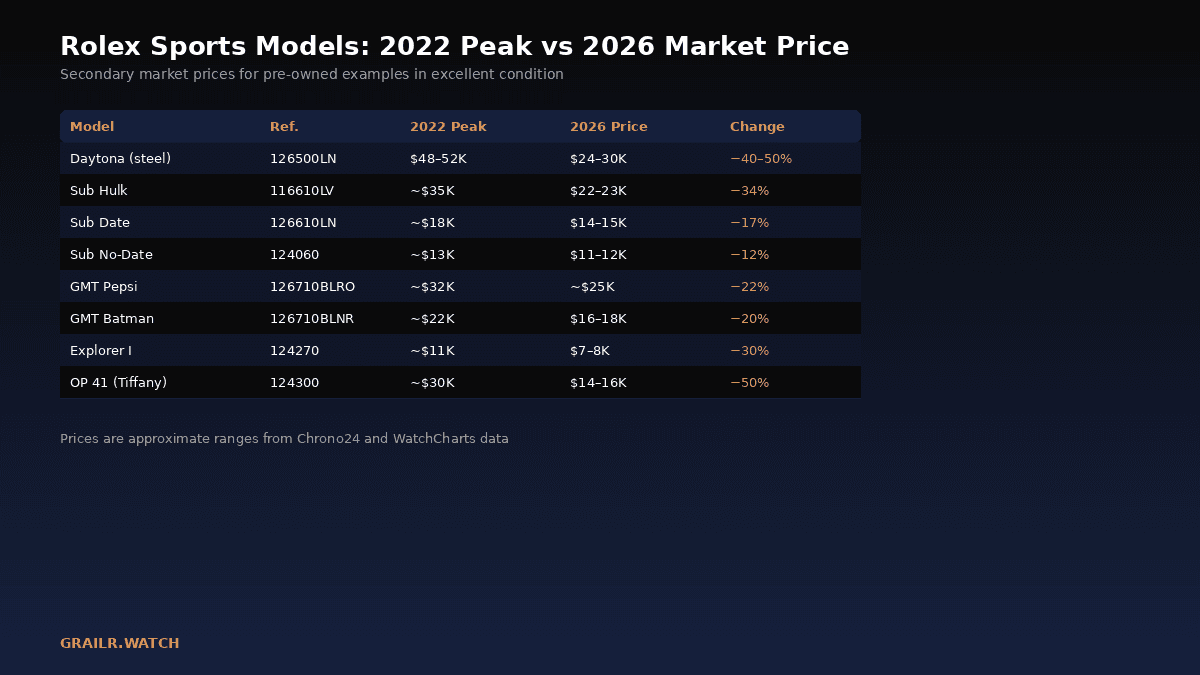
The headline “30–50% off peak” is accurate as a summary, but it hides important variation across the Rolex catalogue. Some models gave back nearly half their bubble gains. Others corrected modestly and have since stabilised. The table below tracks the five references most frequently cited in the price-history conversation — each one peaked around March 2022 and sits at a meaningfully different price four years later.
| Model | Reference | ~2022 Peak | ~2026 Price | Drop from Peak |
|---|---|---|---|---|
| Daytona (steel) | 116500LN | $50,000+ | $24,000–$30,000 | ~40–52% |
| Submariner “Hulk” | 116610LV | ~$35,000 | $22,000–$23,000 | ~34–37% |
| Submariner Date | 126610LN | ~$18,000 | $14,500–$15,000 | ~17–19% |
| Submariner No-Date | 124060 | ~$13,000 | $11,000–$14,500 | ~0–15% |
| GMT-Master II Pepsi | 126710BLRO | ~$28,000 | ~$25,000 | ~11% |
Daytona 116500LN. The poster child of the bubble. At its peak the steel ceramic Daytona traded above $50,000 — more than three times its $14,550 retail price. The correction has been severe: listings in 2026 cluster between $24,000 and $30,000 depending on condition, box-and-papers status, and dial configuration. The panda dial (white face, black sub-dials) still commands a modest premium over the inverse panda. For the full Daytona buying picture, see our Rolex Daytona buyer’s guide.
Submariner Hulk 116610LV. Rolex discontinued the green-dial, green-bezel Submariner in 2020, replacing it with the 126610LV “Starbucks” (green bezel, black dial). The Hulk’s discontinued status helped push it to roughly $35,000 at the peak. It has since settled around $22,000–$23,000 — still well above its original retail of approximately $9,050, but a painful correction for anyone who bought at the top.
Submariner Date 126610LN. The current-production black-bezel Submariner Date briefly touched $18,000 on the secondary market, nearly double its $10,250 retail price at the time. It has stabilised around $14,500–$15,000 on Chrono24 in 2026 — still above retail, but the premium is no longer dramatic enough to attract flippers.
Submariner No-Date 124060. The no-date Submariner tells a more nuanced story. It touched roughly $13,000 in early 2022, corrected, and has since traded in a wide $11,000–$14,500 band. Because its retail price has crept up with annual increases (now approximately $9,350), the upper end of that band still carries a meaningful premium — but the lower end approaches a range where selling costs could erase any gain.
GMT-Master II Pepsi 126710BLRO. The Pepsi’s trajectory is the outlier in this table. It peaked around $28,000 in early 2022, corrected to the low $20,000s during 2023, and has since climbed back to roughly $25,000 by April 2026 — a recovery driven by the model’s spring 2026 discontinuation. Unlike every other reference on this list, the Pepsi’s current asking price is higher than it was twelve months ago. We cover that story in detail below. For a broader look at which Rolex references have been the strongest performers, see our guide to Rolex investment performance.
Where Steel Sports Models Stand in 2026
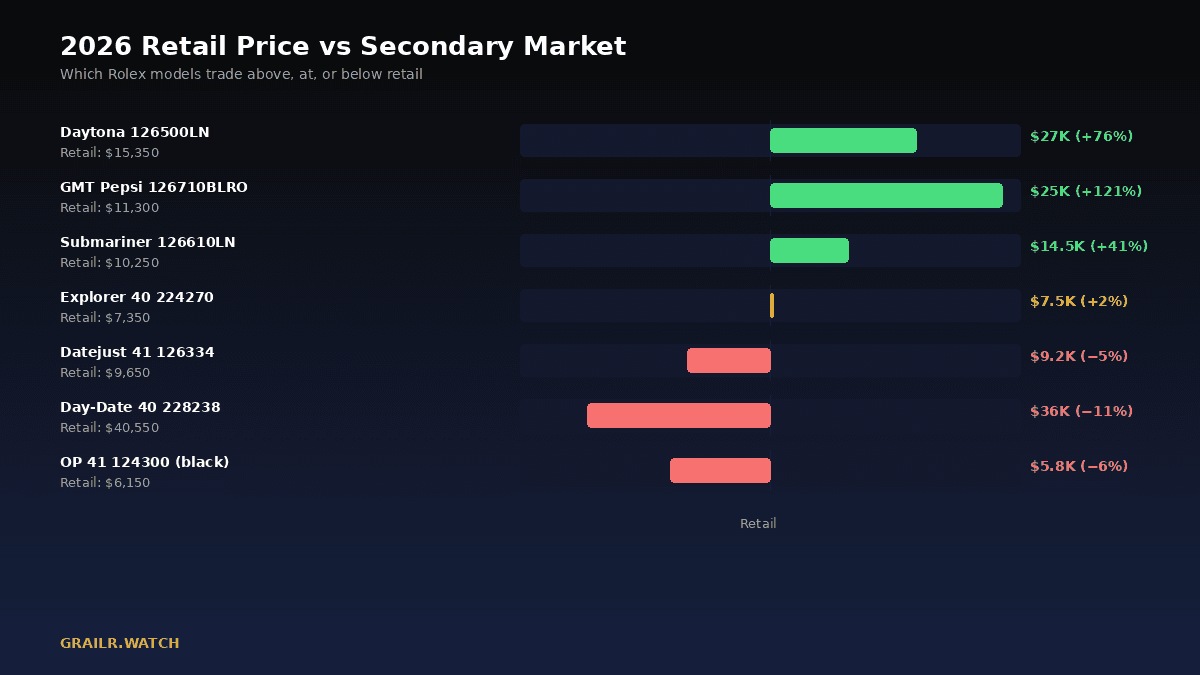
The defining feature of the 2026 Rolex secondary market is the split between models that still carry premiums and models where the premium has effectively evaporated. The steel Daytona 126500LN remains firmly above retail: its secondary-market price sits $15,000–$22,000 above the roughly $16,800 MSRP in mid-2026, representing an 88–130% premium. That is a large number in isolation, but it is a fraction of the 200%+ premiums the Daytona commanded during 2022. For buyers, the direction of the trend matters as much as the current level.
The Submariner Date and No-Date both trade above retail, but not by enough to make flipping worthwhile once you account for platform fees, shipping, insurance and the opportunity cost of capital. The models are settling into what seasoned dealers call a “wear premium” rather than a “trade premium” — the secondary market charges a modest markup because authorised-dealer waitlists still exist, but that markup is an access fee for wearing the watch now, not a tradeable asset.
Then there are the models where premiums have disappeared entirely. Datejust, Day-Date and Oyster Perpetual references now often trade at or below retail on the secondary market. A Datejust 41 in steel with a fluted bezel and jubilee bracelet — one of Rolex’s most popular configurations — can be found pre-owned at or near its new retail price. Certain Oyster Perpetual configurations, particularly the 36mm and 41mm in less sought-after dial colours, have dipped below retail altogether. These were never bubble watches to begin with, but the post-correction market has made their pricing advantage obvious to buyers who might not have considered pre-owned before. For a broader view of how Rolex holds value against other brands, see our Rolex vs Omega resale value comparison.
The practical consequence: in 2026, buying a Rolex for personal use has never been more rational. The fever-pitch premiums that priced out everyday buyers are gone for most references. The models that still carry premiums are premium for a reason — genuine scarcity at authorised dealers — and even those premiums are a fraction of their 2022 extremes.
For anyone who has been watching the market from the sidelines, this is the window that the 2022 bubble never offered: the chance to buy a steel Rolex at a price that reflects what the watch is, rather than what the next buyer might pay for it. Condition, completeness and provenance still matter — a pre-owned Submariner with box and papers commands more than a watch-only example — but the days of paying $18,000 for a $10,000 watch simply because everyone else was are over.
The Retail Price Trap: Why MSRP Keeps Climbing
While secondary-market prices fell 30–50% from their peaks, Rolex moved in the opposite direction. The brand raised retail prices by approximately 4–6% in 2026, continuing a pattern of annual increases that has been in place for years. Since the 2022 peak, cumulative retail increases have added several hundred dollars to the price of most steel sport references.
This creates what collectors now call the “retail price trap.” During the bubble, secondary-market premiums ran so far above MSRP that Rolex’s retail prices felt almost irrelevant — a $10,000 retail Submariner that traded at $18,000 on the open market did not make retail pricing a buyer’s primary concern. Now that premiums on many references have compressed or vanished, the retail price is the ceiling for a large part of the catalogue. Buyers who purchased at bubble premiums own watches that have not only declined in secondary-market value but are also being undercut by Rolex’s own, steadily climbing retail number.
The trap is sharpest for non-sport models. A buyer who paid $14,000 for a Datejust 41 on the secondary market in early 2022 now holds a watch that trades at roughly its current $12,650 retail price — a price that Rolex will likely raise again next year. For sport models, the maths is less dire because some premium persists, but the pattern is clear: rising MSRP and falling premiums are converging, and for references where the lines have already crossed, the secondary-market discount makes buying pre-owned the smarter move.
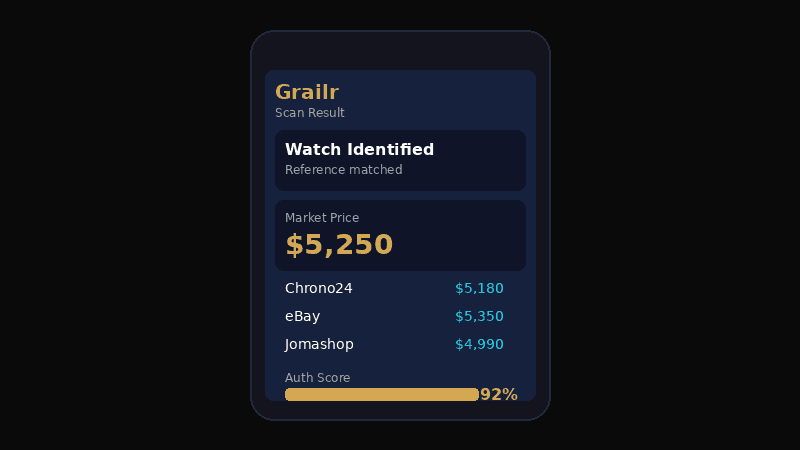
If you are considering a Rolex purchase today and want a quick read on where a specific reference sits relative to its current market value, you can get an indicative estimate on Grailr by uploading a photo. The estimate draws from live secondary-market listings and is not a professional appraisal, but it puts a reference’s current asking-price range in front of you in seconds.
Check Any Watch Price in Seconds
Grailr scans your watch photo and pulls live pricing from Chrono24, eBay, and Jomashop.
- AI identifies brand, model & reference number
- Live market prices from 3+ sources
- Authentication confidence score
The GMT-Master II Pepsi Discontinuation Effect
Not every Rolex reference is in decline. The GMT-Master II “Pepsi” (126710BLRO) — with its iconic red-and-blue ceramic bezel — was discontinued in spring 2026, and its secondary-market trajectory has broken sharply from the broader correction. Pre-owned values have been climbing since late 2025 in anticipation of the discontinuation, with the median asking price reaching approximately $25,000 by April 2026.
The market’s reaction was immediate and measurable. Chrono24 reported a 500% surge in purchase requests for the 126710BLRO in March 2026, the month the discontinuation was confirmed. Dealers who had been holding Pepsi inventory saw their phones light up. The pattern is consistent with Rolex discontinuation dynamics: when a reference with strong collector demand and cultural recognition leaves the catalogue, a scramble for remaining inventory drives prices upward in the short term.
Whether the Pepsi’s price holds or fades depends on what replaces it and how the collector community receives the successor. If the new GMT carries a similar aesthetic with updated specs — as happened when the 126500LN Daytona replaced the 116500LN — the discontinued model may give back some of its discontinuation premium over the following twelve months. If the replacement is sufficiently different that the 126710BLRO becomes the “last true Pepsi,” as some collectors already frame it, the premium could prove more durable. For the full GMT-Master II lineup and how each bezel variant compares, see our GMT-Master II buying guide.
The Pepsi’s behaviour is a useful reminder that Rolex price history is not a single line on a chart. It is a collection of individual reference stories, each driven by its own supply, demand, and discontinuation calendar. The same market that has compressed Datejust premiums to zero is simultaneously bidding up a freshly discontinued GMT reference to new highs.
Collectors who remember the 2020 discontinuation of the Submariner Hulk will recognise the playbook. The Hulk spiked on discontinuation news, traded above $30,000 before the broader market correction pulled it back, and eventually settled into its current $22,000–$23,000 range. The Pepsi may follow a similar arc, or it may not — the Pepsi’s cultural status and the intensity of the purchase-request surge suggest a stronger floor, but no discontinuation premium is guaranteed to last. The only certainty is that supply of this specific reference will never increase again.
What the Index Data Shows About Long-Term Returns
Zooming out from individual models, the Chrono24 Rolex price index provides a composite view of where the brand sits as a whole. The numbers tell a clear story: the longer the time window, the better Rolex looks, but the most recent returns have been mediocre.
| Time Window | Overall Rolex Index Change | Annualised | Context |
|---|---|---|---|
| May 2020 – May 2025 | +28% | ~5.1%/yr | Includes the full bubble and correction |
| Apr 2021 – Apr 2026 | +11.2% | ~2.1%/yr | Post-stimulus entry, through correction and recovery |
| Apr 2025 – Apr 2026 | ~2% | ~2% | Barely keeping pace with inflation |
The five-year return of 28% — roughly 5.1% annualised — looks respectable until you consider that it includes the extraordinary pandemic-era run-up. Strip that out by starting from April 2021, when the market was already hot, and the five-year return drops to 11.2%, or about 2.1% per year. The most recent twelve months delivered approximately 2%, which does not beat a savings account, let alone equities.
The WatchCharts Rolex Market Index paints a similar picture: a post-bubble stabilisation that has left aggregate Rolex pricing in a narrow sideways channel since mid-2023. Individual references diverge sharply from the aggregate — the GMT-Master II Pepsi is climbing while the Sea-Dweller is flat — but the composite message is that the era of double-digit annual Rolex appreciation is over for now.
This does not mean Rolex watches are a bad purchase. It means they are not a financial instrument. The 2020–2022 period was an anomaly, not a baseline. The long-term value proposition of a Rolex remains what it was before the bubble: a well-built luxury product that depreciates less than most consumer goods and, for select references in select conditions, can appreciate modestly over time. For a broader look at how the luxury watch market is moving in 2026, see our luxury watch market trends report.
The index also highlights a subtlety that gets lost in headline numbers: the entry point matters enormously. A buyer who entered the Rolex market in May 2020 is up 28% on the index even after the correction — a respectable return that outpaces inflation. A buyer who entered in April 2021, near the start of the most aggressive phase of the bubble, is up just 11.2% over five years, most of which was given back and then slowly recouped. And a buyer who entered at the March 2022 peak is still significantly underwater on most references. Timing, not brand loyalty, is the variable that has separated winners from losers in the Rolex secondary market over the past half-decade.
What This Means for Buyers and Sellers Today
If you are buying: The 2026 market is the most rational Rolex market in half a decade. Premiums on most references are compressed or gone. Authorised-dealer waitlists still exist for the Daytona, Submariner and remaining GMT models, but the secondary-market alternative no longer requires paying double retail. Datejust, Day-Date and Oyster Perpetual configurations can be had pre-owned at or below current retail, which means you avoid the waitlist, save money, and still get the watch — often with box and papers. The best buying strategy in this market is to decide what you actually want to wear and buy it for that reason, treating any future appreciation as a bonus rather than an expectation.
If you are selling: Unless you hold one of the few references still climbing (the Pepsi GMT, certain vintage references), the secondary market is not going to hand you the windfall it would have in 2022. Selling costs — platform fees, dealer margins, shipping, insurance — typically run 8–15% of the sale price. A watch that has already corrected 30% from peak and then loses another 10% to selling costs can leave you significantly below your purchase price. If you do not need to sell, holding may be the better option: the market appears to have stabilised, and the next meaningful catalyst — whether a new Rolex release, a macroeconomic shift, or another discontinuation — could move prices in either direction.
If you are watching the market: The Rolex price history from 2022 to 2026 is ultimately a story about reversion to mean. Prices overshot on the way up, corrected on the way down, and have now settled into a range that better reflects underlying demand for the watches as products rather than as speculative vehicles. The models with genuine scarcity and collector heritage — the Daytona, the recently discontinued Pepsi, select vintage references — still command premiums. The models without that structural support have returned to earth. Understanding which category a reference falls into is the single most important thing a buyer or seller can do in this market. For detailed guidance on navigating a pre-owned purchase, see our guide to buying a used Rolex.
Frequently Asked Questions
How much did Rolex prices drop after 2022?
Are Rolex watches still a good investment in 2026?
Why did Rolex prices spike in 2022?
How much is a Rolex Submariner worth in 2026?
What is the Rolex retail price trap?
Is the Rolex Daytona still trading above retail?
Related Articles
The Bottom Line
The Rolex price history from 2022 to 2026 is a story with three acts. Act one was the bubble — stimulus cash, crypto profits and social media hype driving steel sport references to prices that bore no relation to their utility or manufacturing cost. Act two was the correction — a 30–50% drawdown for most steel sports models as the factors that inflated the bubble reversed. Act three is where we are now: a stabilised market where individual reference stories have replaced the single-direction narrative.
The Daytona still carries a premium, but it is a fraction of what it was. The Submariner sits in a comfortable range above retail but is no longer a flip-for-profit proposition. The recently discontinued GMT-Master II Pepsi is climbing on scarcity. The Datejust, Day-Date and Oyster Perpetual families have returned to — or dipped below — retail. And the Chrono24 index tells us that, in aggregate, the Rolex market has barely moved for the past twelve months.
The lesson is not that Rolex watches are “bad” or “good” to buy in 2026. It is that the bubble taught the market a lesson about the difference between a luxury product and a financial instrument. Buy a Rolex because you want to wear it. If it appreciates, that is a bonus. If it does not, you still have one of the best-made mechanical watches on the planet.
Check Your Rolex’s Current Value
Snap a photo of your Rolex and get an indicative value estimate with live market comparisons from Chrono24, eBay, and Jomashop.
Scan Your Watch NowSources and price context
- Chrono24 Magazine: Rolex Price Development — Composite index and individual reference price histories based on Chrono24 transaction data.
- WatchCharts Rolex Market Index — Aggregated market data tracking secondary-market pricing trends for Rolex references; movements are not guaranteed returns for individual watches.
- Bob’s Watches — Pre-owned Rolex dealer; quoted price ranges reflect their current inventory and buying priorities, not independently verified transaction prices.
Price ranges, percentage changes, and premium estimates in this article are illustrative and based on secondary-market asking prices and reported transactions as of September 2026. They are not live quotes, verified sale prices, professional appraisals, or guarantees of future performance. Compare the exact reference, serial number, condition, and sale date before relying on any figure.