Which Rolex Models Appreciate, and Which Ones Stall
Secondary market data for the twelve months ending September 2026: which Rolex references gained value, which ones flatlined, and the factors that separate the two.
Key Takeaways
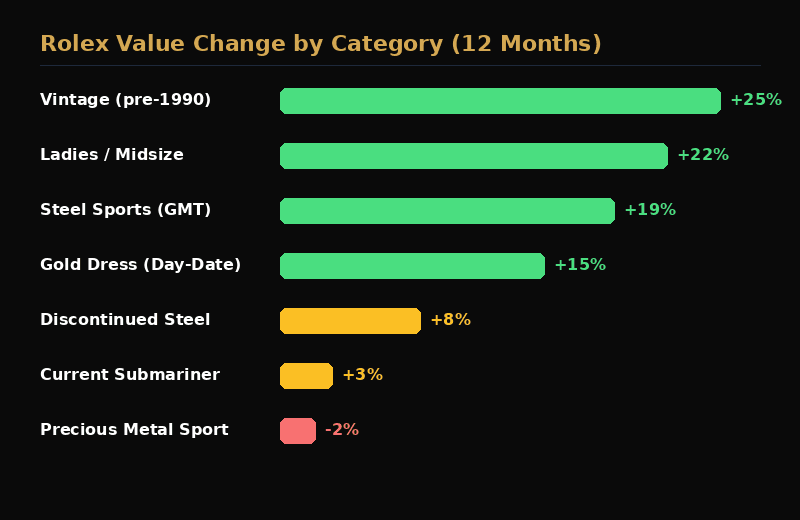
- Rolex averaged 7.9% secondary-market appreciation over the past year, but individual models ranged from -2% to +48%
- Vintage GMT-Master 1675 references led appreciation at roughly 48%, followed by Lady-Datejust 26mm models at 36%
- The Submariner family gained only about 3% overall, below inflation, while the discontinued Daytona 116500LN dipped roughly 2%
- Box and papers add 10–20% to resale value; unworn condition adds another 15–30% over good-condition examples
- Under-$10,000 sleeper picks include the Explorer 214270, Explorer II 16570, and Lady-Datejust 179174
Price disclaimer: All figures in this article are indicative estimates drawn from secondary-market asking prices and reported transactions. They are not live quotes, verified sale prices, or professional appraisals, and they do not establish authenticity. A watch’s actual resale value depends on its specific reference, serial, condition, provenance, and the terms of a completed sale. Consult a qualified appraiser before making purchase or sale decisions.
The Case for Rolex as an Investment (and Its Limits)
Rolex occupies a unique position among consumer goods: a mass-produced luxury product that routinely trades above its retail price on the secondary market. Over the twelve months ending September 2026, the brand’s secondary-market index rose approximately 7.9% — outpacing inflation and comfortably beating savings accounts. For context, the broader luxury-watch market index was essentially flat over the same period, making Rolex the standout performer among major Swiss brands.
That headline number, though, hides enormous variation beneath it. A vintage GMT-Master 1675 in collector-grade condition gained roughly 48% in asking price. A discontinued Daytona 116500LN — the watch that once commanded double retail — actually declined about 2%. A Submariner gained a modest 3%, which barely kept pace with the cost of living. The lesson is not that “Rolex is a good investment.” It is that specific Rolex references, in specific conditions, at specific price points have appreciated, while others have stalled or lost ground.
This distinction matters because watch investment discussions tend to collapse the entire brand into a single narrative. You will hear that Rolex “always goes up,” which is demonstrably false for many references. You will also hear that the watch market “crashed,” which ignores the models quietly climbing 10–20% per year. The reality is more nuanced, and the data rewards buyers who learn which references to target and which to avoid.
Before diving into the model-by-model breakdown, it is worth stressing: watches are a tangible luxury asset, not a financial instrument. They carry no yield, no dividend, and no contractual obligation to appreciate. Selling costs — dealer commissions, platform fees, shipping, insurance — typically run 8–15% of the sale price. A watch that gained 6% in market value may net you a loss after those costs. For a broader framework on buying watches with resale in mind, see our luxury watches investment guide.
The Models That Appreciated Most in 2026
The biggest movers over the past twelve months share a few common threads: collector heritage, production scarcity, and in several cases a demographic shift in buyer demand. Here are the references that gained the most, ranked by approximate percentage appreciation.
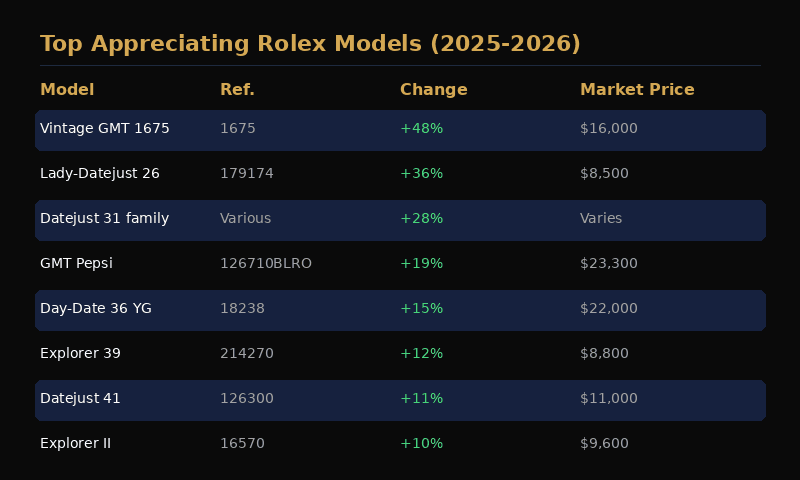
Vintage GMT-Master 1675: +48%, approximately $16,000. The original GMT-Master, produced from 1959 to 1980, has entered a new phase of collector demand. Prices had been relatively stable in the $12,000–$14,000 range for “average condition” examples through 2024, but vintage-Rolex buyers shifted their attention toward GMT references as Submariner 5513 and 1680 prices plateaued. Early “gilt dial” examples with original bezels now trade well above $20,000. The 1675 benefits from a shrinking supply of good-condition examples and growing recognition as one of the most historically significant Rolex sports watches ever produced.
Lady-Datejust 26mm 179174: +36%, approximately $8,500. This is perhaps the most surprising mover on the list. The 26mm Lady-Datejust was long considered a “secondary” Rolex — smaller, less visible on the wrist, and typically discounted on the secondary market. That perception has reversed sharply. Dealers report surging demand from women buying their first luxury watch and from collectors seeking vintage-proportioned pieces as an alternative to the oversized trend. Bob’s Watches, one of the largest Rolex dealers in the United States, noted that “clean 26mm and 31mm ladies’ Datejusts” are among the watches they are “most aggressively trying to buy right now.”
Datejust 31 family: +28%. The 31mm Datejust follows the same demographic tailwind as the 26mm. Rolex discontinued several 26mm references in favour of the 31mm as the new “ladies’” size, and pre-owned demand has risen in tandem. Fluted-bezel, jubilee-bracelet configurations in steel and white gold perform best.
GMT-Master II Pepsi 126710BLRO: +19%, approximately $23,300. The “Pepsi” GMT remains one of the hardest Rolex models to buy at retail. Authorised-dealer waitlists still run twelve months or longer in most markets, and the secondary premium — roughly $12,000 above the $11,300 retail price — has been climbing steadily as supply dries up and new-configuration rumours stall. For a full reference breakdown, see our GMT Pepsi, Batman and Sprite comparison.
Day-Date 36 Yellow Gold 18238: +15%, approximately $22,000. The vintage Day-Date “Presidential” in yellow gold has benefited from a broader trend toward gold watches in streetwear and hip-hop culture. The 18238, with its sapphire crystal and 3155 movement, sits at the intersection of affordability (by Day-Date standards) and classic design. Double-quick day-date setting and a proven movement make it a practical daily wearer as well.
Explorer 39mm 214270: +12%, approximately $8,800. Rolex discontinued the 39mm Explorer I in 2021, replacing it with the 36mm 124270. The 39mm case size has proven more popular on the secondary market than the current 36mm, and prices have climbed accordingly. At under $9,000, the 214270 remains one of the more accessible current-generation Rolex sport watches.
Datejust 41 126300: +11%, approximately $11,000. The Datejust 41 in steel with a smooth bezel has emerged as a quiet performer. Its clean design appeals to buyers who want a versatile daily watch without the sport-model premium. Blue and slate dials command the strongest premiums.
Explorer II 16570: +10%, approximately $9,600. The “polar” white-dial 16570, produced from 1991 to 2011, has developed a cult following. It offers GMT functionality, a 40mm case, and Rolex sport-watch provenance at a price that still sits under $10,000 for most examples. Collectors increasingly view it as an undervalued alternative to the GMT-Master II.
Models That Stalled or Declined
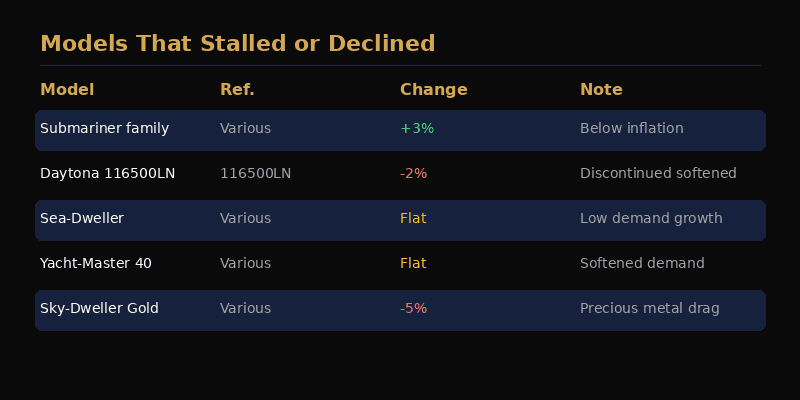
Not every Rolex moved in the right direction. Several high-profile references either barely kept pace with inflation or lost ground outright. Understanding why these models stalled is just as important as knowing which ones climbed.
| Model | Reference | 12-Month Change | Approx. Price |
|---|---|---|---|
| Submariner No-Date | 124060 | +6% | ~$14,000 |
| Submariner (family avg) | Various | +3% | Varies |
| Daytona (discontinued) | 116500LN | -2% | ~$30,500 |
| Daytona (current) | 126500LN | +7% | ~$31,900 |
| Sea-Dweller | 126600 | ~0% | ~$14,200 |
| Yacht-Master | Various | Softened | Varies |
Submariner family: +3% overall. The Submariner is the most recognised dive watch in the world, but its secondary-market performance has been middling. After the post-pandemic frenzy pushed prices to unsustainable levels in 2022, the market corrected. Prices stabilised through 2024–2025 and have barely moved since. The no-date 124060 fared slightly better at +6%, while date models with green or black bezels hovered closer to flat. The Submariner remains an excellent watch, but it is no longer the automatic appreciator it once was.
Daytona 116500LN: -2%. The discontinued ceramic-bezel Daytona was, for years, the poster child for Rolex premiums — trading at $25,000–35,000 against a $14,550 retail price. The introduction of the 126500LN successor in 2023 pulled attention (and premium dollars) toward the new reference. The 116500LN has settled into a slow decline as the “previous generation” tag softens demand. It remains a desirable watch, but the days of 2x-retail premiums appear to be over for this reference.
Sea-Dweller 126600: essentially flat. The Sea-Dweller occupies an awkward middle ground between the Submariner and the Deepsea. Its 43mm case is too large for many wrists, and its helium-escape valve is irrelevant for most buyers. Demand has never matched its sibling models, and the secondary market reflects that with stagnant pricing around $14,200.
Yacht-Master: softened. The Yacht-Master has always been a polarising line — too dressy for sport-watch collectors, too sporty for dress-watch buyers. The two-tone and precious-metal configurations depreciate more steeply than steel sport models, and even the Oysterflex-strap Everose Gold versions have seen asking prices drift downward. For a deeper look at which models hold value across brands, see our guide to watch brands that hold value.
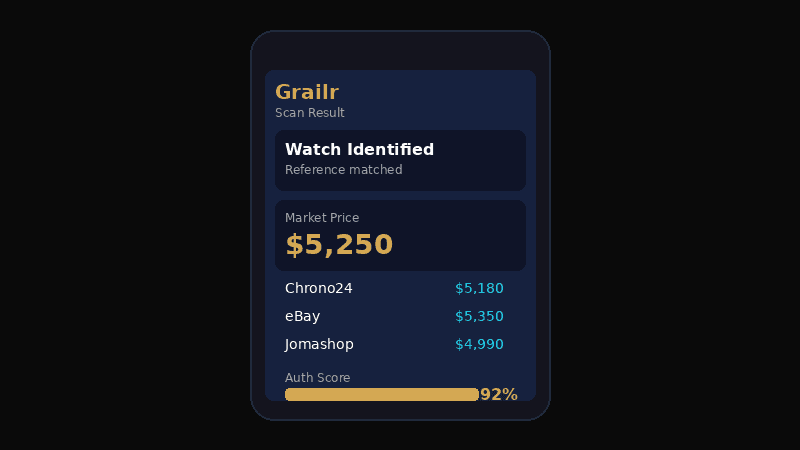
Check Any Watch Price in Seconds
Grailr scans your watch photo and pulls live pricing from Chrono24, eBay, and Jomashop.
- AI identifies brand, model & reference number
- Live market prices from 3+ sources
- Authentication confidence score
What Drives Rolex Appreciation
The models that climbed and the models that stalled share a pattern. Four factors explain most of the variation in Rolex secondary-market performance, and they interact in ways that are not always intuitive.
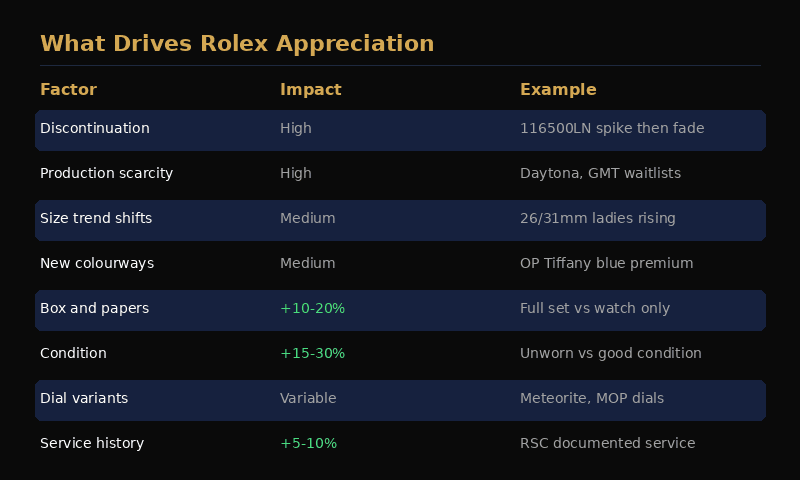
Production scarcity and waitlists. Rolex produces an estimated 1.1–1.2 million watches per year, but demand for professional models exceeds supply by a wide margin. The GMT-Master II Pepsi, Daytona, and Submariner all carry authorised-dealer waitlists that can stretch beyond a year. This structural undersupply creates a price floor on the secondary market: buyers who cannot wait simply pay the premium. Models without meaningful waitlists — the Yacht-Master, Air-King, and many Datejust configurations — lack that floor and are more susceptible to softening.
Discontinuation dynamics. When Rolex discontinues a reference, the immediate reaction is usually a price spike as buyers scramble for remaining inventory. The 116500LN Daytona spiked when the 126500LN was announced. The 214270 Explorer spiked when the 124270 replaced it. But the spike does not always hold. If the successor model is objectively better (larger case, updated movement, improved bracelet), the discontinued reference tends to fade after the initial burst. The 116500LN is a case study: its premium is eroding as the 126500LN establishes itself. Conversely, if the discontinued reference had a feature the successor lacks — such as the 39mm case size on the Explorer 214270 — the discontinued model can sustain or grow its premium over time.
Demographic shifts. The 2026 data reveals something the market did not fully expect: smaller watches are gaining ground. The Lady-Datejust 26mm, the Datejust 31mm, and vintage references in 36mm and 38mm cases are all outperforming the 40mm+ models that dominated the 2020–2022 boom. This shift is driven partly by women entering the luxury-watch market in larger numbers and partly by male collectors rediscovering the proportions of vintage sport watches. The trend creates opportunities in references that were previously overlooked and underpriced.
Condition and completeness. Across every reference in this article, the spread between “unworn with box and papers” and “good condition, watch only” runs 25–50%. That spread has widened over the past two years as the market has matured and buyers have become more discriminating. A complete set (box, papers, warranty card, hang tags, purchase receipt) typically commands 10–20% more than a watch-only sale. Unworn condition adds another 15–30% over examples in “good” condition with normal wear. For vintage references, original dials, hands, and bezels can multiply the premium further.
The Under-$10,000 Sleeper Picks
Not every appreciating Rolex requires a five-figure entry point. Several references sit below $10,000 and have shown consistent upward momentum — the kind of watches that are easy to overlook when the conversation centres on Daytonas and GMT-Masters.
Lady-Datejust 179174 (approximately $8,500). Already discussed above for its 36% gain, the 179174 deserves special mention as a sleeper. Two years ago, clean examples could be found for $5,500–6,000. The window has narrowed, but sub-$9,000 examples with box and papers still exist. The watch offers a Rolex sport-watch movement (calibre 2235), sapphire crystal, and the classic fluted-bezel-plus-jubilee-bracelet combination that has defined the Datejust for decades. Dealers are actively seeking inventory, which is a leading indicator of continued demand.
Explorer 214270 (approximately $8,800). The discontinued 39mm Explorer offers everything a Rolex sport watch should: robust 3132 movement, 100-metre water resistance, a clean dial with luminous numerals, and the most understated design in the current Rolex canon. Its 39mm case sits between the perceived “too small” 36mm successor and the 40mm+ models that dominate the professional lineup, making it a Goldilocks choice for buyers who prefer modern proportions without excess. At $8,800, it is roughly $2,500 below the retail price of the current 36mm Explorer 124270, which creates a compelling value argument. Read our full Explorer buying guide for reference-by-reference pricing.
Explorer II 16570 (approximately $9,600). The “polar” white-dial 16570 is a twenty-year production run (1991–2011) that offers GMT functionality, a fixed 24-hour bezel, and 40mm Oyster-case proportions. It has long been considered the “value play” in the Rolex sport lineup, and its 10% gain over the past year suggests the market is beginning to agree. Clean examples with original tritium or luminova dials are becoming scarce, and prices for those variants are pulling away from later super-luminova-dial production.
| Model | Reference | Approx. Price | 12-Mo. Trend | Why It’s a Sleeper |
|---|---|---|---|---|
| Lady-Datejust | 179174 | ~$8,500 | +36% | Women’s market rally; shrinking supply |
| Explorer | 214270 | ~$8,800 | +12% | Discontinued 39 mm; below current retail |
| Explorer II “Polar” | 16570 | ~$9,600 | +10% | GMT function; tritium dials scarce |
Each of these watches sits below the psychological $10,000 barrier, which matters because it broadens the buyer pool. More potential buyers means more liquidity, which in turn supports continued appreciation. If you are building a first Rolex collection with an eye on resale, these three references deserve serious consideration. For more entry-level options, see our best entry-level Rolex guide.
How to Protect Your Investment
Buying the right reference is only half the equation. How you maintain, document, and eventually sell the watch determines whether paper appreciation translates into realised returns. These practices apply to every Rolex reference discussed in this article.
Keep the full set. Box, papers, warranty card, chronometer certification, hang tags, and the original purchase receipt. Store them in a cool, dry place away from direct sunlight. For vintage references, original documentation is increasingly rare and commands a significant premium. If you buy a watch without its papers, note the serial number and keep your own purchase receipt — it becomes the provenance chain for the next buyer.
Service through Rolex. A Rolex Service Centre overhaul costs $800–1,200 depending on the model and comes with a two-year warranty and a service record that buyers recognise. Independent watchmakers can do excellent work for less, but the branded service history carries more weight on the secondary market. Plan for a service every 8–10 years or when timekeeping degrades beyond +/- 5 seconds per day.
Avoid aftermarket modifications. Custom dials, aftermarket bezels, polished cases, and non-original bracelets reduce a Rolex’s resale value by 10–30% depending on the modification. The collector market overwhelmingly prefers original-condition watches. If you must modify, keep the original parts so the watch can be returned to factory specification before sale.
Insure it. A dedicated watch-insurance policy (through a provider such as Hodinkee Insurance or a specialist rider on your homeowner’s policy) typically costs 1–2% of the watch’s value per year. It covers theft, loss, and accidental damage — risks that a safe-deposit box alone does not eliminate. Update the insured value annually as secondary-market prices shift.
Track the market. Secondary-market prices move. Use tools like Grailr’s appraisal feature to monitor indicative values for your reference. Price-check every six months at minimum so you have a sense of where your watch stands relative to the market and can make informed buy, hold, or sell decisions.
The Risks Nobody Talks About
Watch investment content tends toward optimism. The sellers, the platforms, and the publications all benefit when prices go up. Here are the risks that rarely make the headline.
Rolex can increase production. The company opened a new facility in Bulle, Switzerland, in 2024 and is expanding its Bienne factory. If production catches up to demand, waitlists shrink and secondary premiums compress. There is no public production data, so the market is always guessing at supply — and sometimes it guesses wrong.
New releases cannibalise old ones. When Rolex launched the 126500LN Daytona, the 116500LN’s premium began to erode. This pattern repeats with nearly every model refresh. If you are holding a current-production reference, you are one Watches & Wonders announcement away from your watch becoming the “previous generation.”
Liquidity is not guaranteed. A Rolex may be “worth” $15,000 on Chrono24, but that is an asking price. Selling it for that figure means finding a buyer, negotiating, paying platform fees (6–10% on Chrono24), absorbing shipping and insurance costs, and potentially waiting weeks or months. Dealer buyout offers typically run 15–25% below market, which is faster but eats into your gain. For a walkthrough of the selling process, see our guide to selling a Rolex.
Counterfeits are sophisticated. The replica market has advanced significantly. High-quality counterfeits (“super fakes”) can fool casual buyers and even some dealers. Buying from unknown sellers without independent authentication is a real risk, especially at below-market prices. Use Grailr’s watch identification tool as a first screening step, but always follow up with a professional authentication service for high-value purchases. For detailed authentication guidance, see our guide to spotting fake Rolex watches.
Past performance does not predict future returns. The 48% gain on the vintage GMT-Master 1675 happened in a specific market context. There is no guarantee it continues. Market cycles, economic downturns, shifting fashion trends, and regulatory changes (such as import duties or money-laundering reporting requirements) can all affect the luxury-watch market in ways that historical data cannot forecast.
Frequently Asked Questions
Is a Rolex a good investment in 2026?
Which Rolex model appreciates the most?
Do all Rolex watches go up in value?
How much does box and papers add to a Rolex?
What is the best entry-level Rolex for investment?
Should I buy a Rolex new or pre-owned for investment purposes?
Related Articles
The Bottom Line
Rolex watches can appreciate, but the brand name alone is not a buy signal. The data is clear: vintage GMT-Masters, ladies’ Datejusts in 26mm and 31mm, and select discontinued sport references have been the strongest performers over the past twelve months. Meanwhile, the Submariner — arguably the most famous watch on the planet — barely kept pace with inflation, and the once-untouchable Daytona 116500LN slipped into the red.
The factors that separate appreciating references from stalling ones are identifiable: production scarcity, collector heritage, demographic shifts toward smaller case sizes, and the discontinuation dynamics that create short-term spikes and long-term winners. Condition and completeness amplify every other factor — a watch with box and papers in unworn condition will always outperform a well-worn, watch-only example of the same reference.
If you are buying a Rolex with an eye on value, buy the reference, not the brand. Do your research on the specific model, verify asking prices against actual sale data, budget for selling costs, and treat any future appreciation as a bonus rather than a guarantee. The smartest watch buyers are the ones who would be happy wearing the watch even if it never gained a dollar.
Check Your Rolex’s Current Value
Snap a photo of your Rolex and get an indicative value estimate with live market comparisons from Chrono24, eBay, and Jomashop.
Scan Your Watch NowSources and price context
- Chrono24 ChronoPulse methodology — A transaction-based market index; its movements are not returns for every individual watch.
- Bob’s Watches — Pre-owned Rolex dealer; quoted dealer commentary reflects their buying priorities, not independent appraisals.
- eBay Product Research — How to research actual sold prices separately from active asking prices.
Price ranges, appreciation percentages, and resale estimates in this article are illustrative and based on secondary-market asking prices and reported transactions as of September 2026. They are not live quotes, verified sale prices, professional appraisals, or guarantees of future performance. Compare the exact reference, serial number, condition, and sale date before relying on any figure.