Rolex Explorer & Explorer II Buying Guide 2026: Every Reference, Price & Comparison
From the summit of Everest to the depths of cave systems, the Explorer family has done it all. Here’s every reference you need to know — with real 2026 pricing, market data, and honest buying advice.
- The Explorer I comes in 36mm (Ref. 124270) and 40mm (Ref. 224270), both at $7,350 MSRP with the Cal. 3230 movement
- The Explorer II (Ref. 226570) adds a GMT complication at $10,250 MSRP — the Polar dial commands an $800 premium over the black
- Vintage references like the 1016 ($20K–$50K+) and 1655 ($50K–$100K+) have become serious collector’s pieces
- The Explorer family offers value retention between 93% and 107% depending on reference and dial colour
Explorer I vs Explorer II: Which One Is for You?
The Rolex Explorer and Explorer II share a name, a heritage, and a reputation for toughness — but they’re fundamentally different watches designed for fundamentally different purposes. Understanding the distinction is the first step toward making the right choice.
The Explorer I is Rolex’s purest sports watch. It tells the time and nothing else. No date window on the current models, no rotating bezel, no complications. Just a black dial with Chromalight lume, the iconic 3-6-9 Arabic numeral layout, and one of the best automatic movements ever made. It’s available in 36mm and 40mm, and it’s the watch Rolex created to celebrate the first ascent of Mount Everest in 1953. If you want a watch that does one thing perfectly, the Explorer I is it.
The Explorer II is a tool watch for people who actually need a second timezone. At 42mm, it wears larger and bolder. It features a fixed 24-hour bezel, an orange GMT hand, a date window at 3 o’clock, and the Cal. 3285 GMT movement. It was designed for speleologists and polar explorers who lose track of day and night — the 24-hour hand and fixed bezel let you distinguish AM from PM at a glance. It’s more complex, more expensive, and more divisive in terms of style.
The short version: if you want elegant simplicity and a versatile everyday watch, go Explorer I. If you travel frequently, want a GMT complication, and prefer a chunkier tool watch, go Explorer II. Both are 100m water resistant, both use Oystersteel, and both carry Rolex’s Superlative Chronometer certification at ±2 seconds per day.
The Current Rolex Explorer I Lineup: 124270 & 224270
For the first time in the Explorer’s 70+ year history, Rolex offers it in two sizes simultaneously. The Ref. 124270 (36mm) launched in 2021, returning the Explorer to its original case diameter after the divisive 39mm era. The Ref. 224270 (40mm) arrived in 2023 for buyers who wanted the Explorer DNA in a more contemporary size. Both are priced identically at $7,350 MSRP.
Ref. 124270 — The 36mm Classic
The 124270 is a love letter to Explorer history. At 36mm, it wears almost identically to the legendary Ref. 1016 that adorned wrists from 1963 to 1989. Inside, the Cal. 3230 delivers a 70-hour power reserve — meaning you can take it off Friday evening and it’ll still be running Monday morning. The black dial features the classic 3-6-9 Arabic numerals with Chromalight lume that glows blue in the dark.
On the secondary market, the 124270 trades between $6,800 and $7,100 — roughly 93–97% of retail. That modest discount makes pre-owned a smart play if you can find one in excellent condition. The 36mm size suits wrists up to about 7 inches comfortably, though plenty of collectors with larger wrists wear it as a statement of restraint.
Ref. 224270 — The 40mm Modern Explorer
When Rolex introduced the 224270 at Watches & Wonders 2023, it answered a question the market had been asking since the 124270 shrunk back to 36mm: “Where’s the bigger option?” The 224270 shares every specification with its smaller sibling — same Cal. 3230, same 70-hour power reserve, same dial layout, same Oystersteel case and Oyster bracelet. The only difference is 4mm of additional diameter.
That extra size gives it noticeably more wrist presence without straying into oversized territory. At 40mm, it occupies the sweet spot that the 39mm Ref. 214270 was reaching for but never quite achieved. Market pricing sits between $7,100 and $7,400 — tighter to retail than the 36mm, which reflects stronger demand.
If you’re deciding between the two, try them both on at an authorised dealer. The 4mm difference is more significant on the wrist than it sounds on paper. For most modern buyers with wrists 6.75 inches and above, the 40mm will feel more natural. But if you appreciate vintage proportions or have a smaller wrist, the 36mm is one of the most perfectly proportioned watches Rolex makes.
The Rolex Explorer II 226570: Polar vs Black Dial
The Explorer II is Rolex’s underdog — overshadowed by the GMT-Master II in the brand’s travel watch lineup, yet beloved by collectors who appreciate its utilitarian design and surprisingly competitive pricing. The current Ref. 226570 launched in 2021, marking the Explorer II’s 50th anniversary with a refined case, slimmer profile, and the upgraded Cal. 3285 movement.
At 42mm in Oystersteel, the 226570 features a fixed 24-hour bezel — unlike the rotating bezels on the GMT-Master II. The orange GMT hand sweeps the fixed bezel to indicate a second timezone in 24-hour format, while the standard hour and minute hands display local time. It’s a true GMT, not a traveler’s bezel. The Cal. 3285 offers a 70-hour power reserve, Rolex’s Chronergy escapement, and the Parachrom hairspring for shock and magnetic resistance.
Black Dial — $10,200 Market Price
The black-dial 226570 is the stealthier option. It blends in more easily with everyday wear, and the orange GMT hand pops against the dark background. At roughly $10,200 on the secondary market (March 2026), it trades slightly below its $10,250 MSRP — making it one of the few Rolex sport models you can buy without a grey market premium.
Polar (White) Dial — $11,000 Market Price
The Polar dial has been the Explorer II’s signature look since the Ref. 16550 introduced it in 1985. The white face with black indices and that unmistakable orange hand creates one of the most distinctive dial compositions in all of horology. At roughly $11,000 on the secondary market, it commands an $800 premium over the black dial.
That premium has been consistent across every Explorer II generation. The Polar simply generates more demand and retains value better. If you’re buying purely as an investment, the Polar is the safer bet. If you prefer the look of a black dial and plan to wear it daily, the black 226570 offers arguably the best value in Rolex’s entire sport lineup — a genuine GMT sports watch at retail price.
Explorer Family at a Glance: Full Comparison
Here’s every current-production Explorer side by side. Use Grailr’s scanner to check any specific listing against an indicative estimate and active eBay asking prices when available.
| Model | Reference | Size | Movement | MSRP | Market Price | Retention % |
|---|---|---|---|---|---|---|
| Explorer I 36mm | 124270 | 36mm | Cal. 3230 | $7,350 | $6,800–$7,100 | 93–97% |
| Explorer I 40mm | 224270 | 40mm | Cal. 3230 | $7,350 | $7,100–$7,400 | 97–101% |
| Explorer II Black | 226570 | 42mm | Cal. 3285 | $10,250 | ~$10,200 | ~100% |
| Explorer II Polar | 226570 | 42mm | Cal. 3285 | $10,250 | ~$11,000 | ~107% |
Check Any Watch Price in Seconds
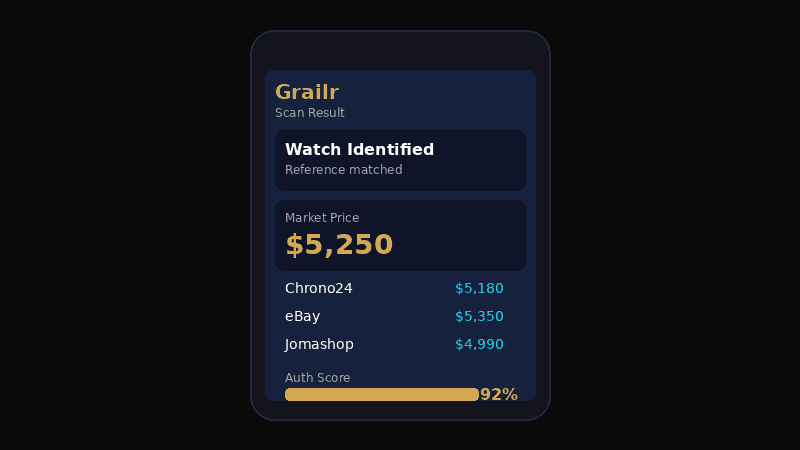
Grailr uses your photo to suggest a watch identification and an indicative AI price estimate. Active eBay listings, when available, offer asking-price comparisons.
- AI suggests brand, model & reference number
- Active eBay asking-price comparisons
- Identification confidence score
Vintage Explorer References Worth Knowing
The Explorer family has produced some of the most collectible Rolex references in existence. Whether you’re a serious collector or simply curious about the heritage behind what you’re buying, these are the vintage references that shaped the modern Explorer. Use Grailr’s appraisal tool to check current values on any vintage reference.
Ref. 6350 — The Original (1953)
The very first Explorer, created to celebrate Sir Edmund Hillary and Tenzing Norgay’s conquest of Everest. Produced in tiny numbers, surviving examples are museum-grade pieces that rarely appear at auction. When they do, expect six figures. This is the watch that started it all — the 3-6-9 dial, the “Explorer” name, and the philosophy that Rolex could build a watch tough enough for the world’s highest peak.
Ref. 1016 — The Legend (1963–1989)
The longest-running Explorer reference and arguably the most important vintage Rolex sports watch outside the Submariner. Produced for 26 years across multiple dial variants — gilt, matte, and lume-dot — the 1016 is the watch that defined what an Explorer should be. Current market: $20,000–$50,000+ depending on condition, dial, and provenance. Gilt-dial examples with original radium lume can push well past $50,000. The 1016 is the vintage Explorer, full stop.
Ref. 1655 “Steve McQueen” — Explorer II Origin (1971)
The first Explorer II and the genesis of the orange-hand, fixed-bezel formula that continues today. Despite being nicknamed the “Steve McQueen,” there’s no confirmed evidence McQueen ever wore one — the name stuck anyway. With its distinctive straight-seconds hand tipped in orange, the 1655 is a genuine trophy piece. Current market: $50,000–$100,000+. Early “Mark I” dials with the straight-line bezel text command the highest premiums.
Ref. 16550 — First Polar Dial (1985–1989)
The reference that introduced the white “Polar” dial and sapphire crystal to the Explorer II line. Produced for only four years, making it relatively rare. The 16550 also came in a “cream” dial variant that has developed a cult following. Current market: $12,000–$20,000 depending on variant and condition. A stepping stone between the raw vintage feel of the 1655 and the more refined modern references.
Ref. 16570 — The Collector’s Sweet Spot (1989–2011)
Produced for 22 years, the 16570 is the most accessible vintage Explorer II and the one most collectors recommend as a starting point. It’s the last Explorer II with the slimmer 40mm case, and the Cal. 3185/3186 movements are proven workhorses. Current market: $8,000–$14,000 depending on condition, dial colour, and serial range. Polar dials command the usual premium. If you want vintage Explorer II character without six-figure pricing, this is your watch.
Ref. 214270 — The Divisive One (2010–2021)
Rolex grew the Explorer I to 39mm and initially omitted lume from the 3 and 9 markers — a decision that frustrated purists. The “Mk2” version (2016+) corrected the lume issue and added slightly longer hands. Despite the controversy, the 214270 is a thoroughly excellent watch that now represents strong value on the pre-owned market at $6,500–$7,500. The Mk2 with lumed numerals is the one to get.
Explorer I vs Explorer II: Real Market Data Compared
Let’s talk about value retention, because it’s one of the main reasons people buy Rolex in the first place. Across the Explorer family, the numbers paint an interesting picture.
The Explorer I has historically been the steadier performer. The current 40mm Ref. 224270 retains 97–101% of its retail value, and the 36mm Ref. 124270 holds at 93–97%. Neither model generates the insane premiums of a Daytona or a “Pepsi” GMT-Master II, but they don’t crater either. The Explorer I is a steady, dependable store of value — which mirrors its character as a watch.
The Explorer II is more volatile and, frankly, more interesting from an investment perspective. The black-dial 226570 hovers right at MSRP, which means you’re buying at fair market value whether you go AD or pre-owned. The Polar dial trades at a consistent 7% premium. But here’s the sleeper angle: the Explorer II has historically been undervalued relative to the GMT-Master II, despite sharing a GMT complication. The 226570 at $10,250 does essentially the same job as a GMT-Master II at $11,350+, with a far shorter waitlist.
For buyers who view watches partially as financial assets, the Polar Explorer II may be the most undervalued current-production Rolex sport watch. It’s already trading above retail, it has strong collector appeal, and it’s available at authorised dealers with reasonable wait times. Compare that to the GMT-Master II “Pepsi” or “Batman,” which carry multi-year waitlists and 30–40% grey market premiums.
That said, buying any watch purely as an investment is a gamble. Markets shift. Rolex adjusts production. New references appear. Buy what you want to wear, and let the resale value be a welcome bonus. To track real-time pricing trends on any Explorer reference, snap a photo with Grailr and we’ll show you exactly where the market stands today.
How to Buy a Rolex Explorer in 2026
Good news: the Explorer family is among the most accessible in Rolex’s sport lineup. You won’t face the multi-year waitlists associated with Daytonas, Submariners, or GMT-Masters. But “accessible” doesn’t mean you can walk into any AD and leave with one the same day. Here’s what the landscape actually looks like.
Authorised Dealer (AD) Route
Explorer I models (both 36mm and 40mm) typically have wait times of 1–6 months at most ADs — significantly shorter than the 12–24 months you’ll wait for a Submariner or GMT-Master. The Explorer II is even easier to find, with some ADs keeping them in stock. If you have an existing purchase history with a Rolex AD, an Explorer is often available within weeks.
The AD route gives you the full five-year Rolex warranty, retail pricing ($7,350 for Explorer I, $10,250 for Explorer II), and the peace of mind that comes with a known provenance. The trade-off is wait time and limited dial/size selection — you get what they allocate, not necessarily what you wanted.
Pre-Owned & Grey Market
Because Explorer models trade at or slightly below retail on the secondary market, pre-owned is a genuinely smart strategy here. A one-year-old Explorer I in excellent condition can save you $250–$550 compared to retail, and you skip the waitlist entirely. The Explorer II in black is available at essentially retail price from reputable dealers.
If you go pre-owned, authentication is critical. The Explorer’s clean design makes it a popular target for “franken-watches” — watches assembled from mixed genuine and aftermarket parts. Always verify authenticity before committing, and insist on the original box and papers (which add 5–10% to resale value). Use Grailr to scan any listing photo and compare the asking price with an indicative AI estimate and active eBay listings when available.
Vintage Buying Tips
If you’re looking at vintage references (1016, 1655, 16570), the rules change. Condition is everything. Dial originality matters more than case condition — a “service dial” replacement can halve the value of a vintage 1016. Always buy from specialist vintage dealers or auction houses with return policies. And use serial number verification to confirm the production year matches the seller’s claims.
Explorer vs the Competition: How It Stacks Up
The Explorer I competes most directly with the Omega Seamaster Aqua Terra ($5,600–$6,400) and the Tudor Black Bay 36/41 ($2,925–$3,325). The Aqua Terra offers a similar clean-dial sports watch with a co-axial movement and slightly lower price, while the Tudor gives you Rolex-adjacent quality at a fraction of the cost. Both are excellent watches. Neither carries the Explorer’s Everest heritage or Rolex cachet.
The Explorer II competes with the Omega Seamaster Planet Ocean GMT and, within Rolex’s own lineup, the GMT-Master II. The Planet Ocean GMT is arguably more watch for the money with 600m water resistance, but it’s larger and lacks the cult following. The GMT-Master II is the bigger name but costs more and is far harder to acquire. For a deeper dive on the Rolex vs Omega comparison, we’ve covered it extensively.
The Explorer’s unique position is that it’s the most understated Rolex sport watch. It doesn’t shout. It doesn’t have a colourful bezel. It doesn’t say “look at me.” For many buyers, that restraint is exactly the point. It’s a watch for people who know watches — and that insider quality is precisely what makes it so enduringly desirable.
Frequently Asked Questions
What is the difference between the Rolex Explorer and Explorer II?
The Explorer I is a time-only sports watch (36mm or 40mm) with the Cal. 3230 movement. The Explorer II is a 42mm GMT watch with the Cal. 3285, featuring a fixed 24-hour bezel and orange GMT hand for tracking a second timezone. The Explorer I retails for $7,350, the Explorer II for $10,250.
How much does a Rolex Explorer cost in 2026?
The Explorer I (Ref. 124270 and 224270) retails for $7,350 MSRP. On the secondary market, the 36mm trades around $6,800-$7,100 and the 40mm around $7,100-$7,400. The Explorer II (Ref. 226570) retails for $10,250, with the black dial at ~$10,200 and the Polar at ~$11,000 pre-owned.
Is the Rolex Explorer II Polar worth the premium over the black dial?
The Polar (white dial) Explorer II trades at approximately $11,000 versus $10,200 for the black dial. The Polar has historically held stronger resale value and collector demand. If you like both dials equally, the Polar is the better investment. If you prefer the black dial aesthetically, the $800 savings makes it a strong value play.
Should I buy a 36mm or 40mm Rolex Explorer?
The 36mm (Ref. 124270) suits wrists under 7 inches and appeals to vintage enthusiasts. The 40mm (Ref. 224270) fits modern sizing preferences and wrists 6.75 inches and above. Both share the same MSRP, movement, and specs. Try both on at an AD before deciding.
Is the Rolex Explorer a good first Rolex?
The Explorer is widely considered the ideal first Rolex. It combines strong heritage (born on Everest in 1953), an iconic 3-6-9 dial, versatile styling for any occasion, and solid value retention around 93-97%. At $7,350, it sits in the sweet spot of the entry-level Rolex lineup.
How much is a vintage Rolex Explorer 1016 worth?
The Ref. 1016, produced from 1963 to 1989, trades between $20,000 and $50,000+ depending on condition, dial variant, and provenance. Gilt dials and tropical dials command the highest premiums, with exceptional examples exceeding $50,000 at auction.
Related Articles
The Bottom Line
The Rolex Explorer family is one of the most compelling propositions in the entire Rolex catalogue. The Explorer I offers the purest expression of what a sports watch should be — clean, tough, and timeless. The Explorer II delivers genuine GMT functionality at a price point and availability that makes the GMT-Master II look overrated.
If you’re buying your first Rolex, the Explorer I 40mm (Ref. 224270) is our top pick for its perfect blend of heritage, modern sizing, and value retention. If you need a second timezone, the Explorer II Polar (Ref. 226570) is the best-kept secret in Rolex’s sport lineup. And if you’re building a collection, a vintage Ref. 16570 Polar gives you Explorer II heritage at an accessible price point. Whichever you choose, you’re getting a watch designed to last a lifetime — and one that’ll hold its value along the way.
Found an Explorer You Like?
Grailr can suggest a model and reference from a clear photo and provide an indicative AI price estimate. Active eBay listings, when available, show asking prices for comparison. Confirm the reference and condition with the seller; a photo scan does not authenticate a watch.
Scan a Watch NowSources and price context
- Rolex Explorer — Explorer history and links to current models.
- Rolex ownership FAQ — Availability, retail pricing and care guidance from Rolex.
The links identify the specific manufacturer information and marketplace guidance used for this guide. Price ranges and resale percentages in this guide are illustrative, not live quotes or guaranteed returns; compare the exact reference, condition and sale date before relying on them.