Seikosha Watches: The Origin Story Behind Seiko
How a 21-year-old Tokyo clockmaker built the factory that would change watchmaking forever — from the 1892 Seikosha workshop to the quartz revolution and beyond.
Price context: this guide includes indicative prices from its original publication period. They have not all been refreshed to current quotes. Use the linked primary sources for specifications and policies, and verify prices independently.
- Kintarō Hattori founded the Seikosha clock factory in 1892 — the direct ancestor of today’s Seiko Group
- The 1913 Laurel was Japan’s first wristwatch; the 1969 Astron was the world’s first quartz wristwatch
- Vintage Seikosha pocket watches sell for $200–$1,000; early Laurel wristwatches reach $300–$2,000
- The 62MAS diver and first-generation Grand Seiko are the most sought-after vintage models at $3,000–$15,000
Kintarō Hattori and the Founding of Seikosha
In 1881, a 21-year-old entrepreneur named Kintarō Hattori opened a small watch and clock repair shop in Tokyo’s Ginza district. The business, K. Hattori & Co., sold and serviced imported timepieces at a time when Japan relied almost entirely on Western manufacturers for precision instruments. Within a decade, Hattori had become the largest watch retailer in Japan — but selling other people’s watches was never the end goal.
By 1892, Hattori had saved enough capital and gathered enough technical knowledge to take the decisive step. He partnered with engineer Tsuruhiko Yoshikawa and established the Seikosha factory in Yanagishima, a working-class district in eastern Tokyo. The name Seikosha translates roughly to “House of Exquisite Workmanship” or “House of Precision” — an aspiration as much as a description. The factory initially produced wall clocks using movements modelled on American designs, but Hattori’s ambition was clear from the start: build everything in-house, from the mainspring to the dial.
What made Hattori unusual for his era was his insistence on vertical integration. While European watchmakers parcelled out components to specialists across the Jura mountains, Hattori wanted a single factory that controlled every step of production. That philosophy — design, manufacture and assemble under one roof — would define Seiko’s approach for the next 130 years and distinguish it from nearly every Swiss competitor.
From Clocks to Pocket Watches (1892–1913)
Seikosha’s first products were wall clocks and table clocks, built with a workforce of roughly a dozen craftsmen. Quality improved rapidly. By 1895, the factory had produced its first pocket watch: the Seikosha Timekeeper. It was a relatively simple piece, but it proved that Japanese manufacturing could produce a portable timekeeping instrument — a market then dominated entirely by Swiss and American firms like Waltham and Elgin.
The Timekeeper sold modestly in Japan, but it established a pattern that Seikosha would follow for decades: study the best foreign designs, replicate them with Japanese labour and materials, then incrementally improve on the originals. By 1899, the factory had added alarm clocks to its catalogue. By the early 1900s, Seikosha clocks were winning prizes at international exhibitions, and the company had begun exporting to China and Southeast Asia.
The real breakthrough came in 1913, when Seikosha produced its first wristwatch: the Laurel. With a 12-ligne movement housed in a silver case, the Laurel was Japan’s first domestically manufactured wristwatch. It arrived just as World War I was demonstrating to soldiers everywhere that a watch strapped to the wrist was more practical than one tucked in a pocket. The timing was fortunate, and the Laurel — though produced in small numbers — proved that Seikosha could build precision instruments at the wristwatch scale.
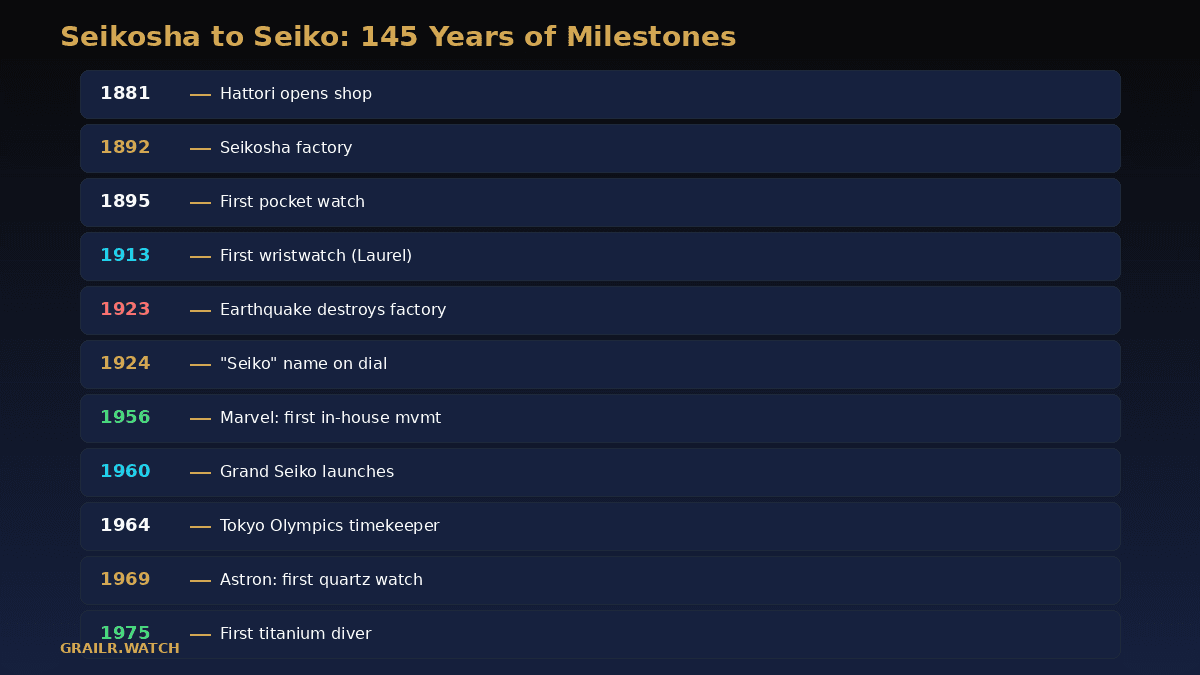
| Year | Milestone | Significance |
|---|---|---|
| 1881 | K. Hattori & Co. founded | Tokyo watch repair and retail shop |
| 1892 | Seikosha factory established | Japan’s first clock manufacturing facility |
| 1895 | Seikosha Timekeeper | First Japanese-made pocket watch |
| 1913 | Laurel wristwatch | Japan’s first domestically made wristwatch |
| 1923 | Great Kanto Earthquake | Factory destroyed; Hattori rebuilds and donates clocks |
| 1924 | “Seiko” name on dials | Brand identity shift from Seikosha |
| 1956 | Seiko Marvel | First fully in-house movement |
| 1960 | Grand Seiko launched | Japan’s first luxury watch line |
| 1964 | Tokyo Olympics timing | Official timekeeper; introduced printing timer |
| 1967 | 62MAS diver | Japan’s first professional dive watch (150m) |
| 1969 | Seiko Astron | World’s first quartz wristwatch |
The Laurel and the Great Kanto Earthquake
The Laurel wristwatch represented a genuine technical achievement for early-twentieth-century Japan, but its production was limited. Seikosha’s primary business remained clocks and pocket watches, and the wristwatch market in Japan was still small. The company continued refining its pocket watch lines through the 1910s, producing increasingly accurate timepieces that undercut Swiss imports on price while approaching them in quality.
Then, on September 1, 1923, the Great Kanto Earthquake struck. The magnitude 7.9 quake and the fires that followed destroyed much of Tokyo and Yokohama, killing over 100,000 people. The Seikosha factory in Yanagishima was levelled. Stock, tooling, machinery and years of accumulated know-how were lost in a single afternoon. For many companies, this would have been the end.
Hattori’s response defined the company’s character. He rebuilt the factory, upgraded the equipment, and made a gesture that became part of Japanese civic memory: he donated replacement clocks to public buildings across Tokyo, including the iconic Wako clock tower in Ginza that still stands today. The rebuilding effort took years, but by the mid-1920s, Seikosha was producing watches again — and producing them better than before.
Pre-earthquake Seikosha pieces are among the rarest items a collector can find. A confirmed pre-1923 Seikosha pocket watch, particularly one with original enamel dial and signed movement, can command $500 to $1,000 at specialist dealers. The scarcity is genuine: most were physically destroyed in the quake and its aftermath, and those that survived were often damaged by water or fire. If you encounter one, verify the reference details before buying.
The Seiko Name and the March Toward Precision
In 1924, a year after the earthquake, the word “Seiko” appeared on a watch dial for the first time. The name — meaning “exquisite” or “precision” in Japanese — was shorter, more modern, and easier to market internationally than “Seikosha.” By 1929, the Seikosha name had been retired from dials entirely, though the corporate entity retained it for decades. The transition was deliberate: Hattori was preparing the brand for export markets even before Japan’s post-war economic boom made that strategy viable.
Through the 1930s and 1940s, Seiko continued producing watches, though wartime disruption and post-war scarcity limited both output and ambition. The critical turning point came in 1956 with the Seiko Marvel. According to the Seiko Museum, this was the first Seiko watch whose movement was designed entirely in-house from scratch — not adapted from a Swiss caliber or licensed design. The Marvel used a hand-wound movement with 17 jewels and established that Seiko could stand on its own engineering.
Four years later, Seiko launched Grand Seiko in 1960 — the brand’s first attempt at a true luxury watch. The original Grand Seiko was a 35mm hand-wound dress watch with a level of finishing that surprised Swiss observers. It was followed by the Lord Marvel and Lord Seiko lines, which pushed accuracy and decoration further.
In 1964, Seiko served as the official timekeeper for the Tokyo Olympic Games, deploying over 1,200 timing instruments and introducing the world’s first portable quartz chronometer for sports timing. The Olympics contract did more than any advertisement could: it put Seiko in front of a global audience and demonstrated Japanese precision engineering at its best. Within five years, that precision would upend the entire Swiss watch industry.
Check Any Watch Price in Seconds
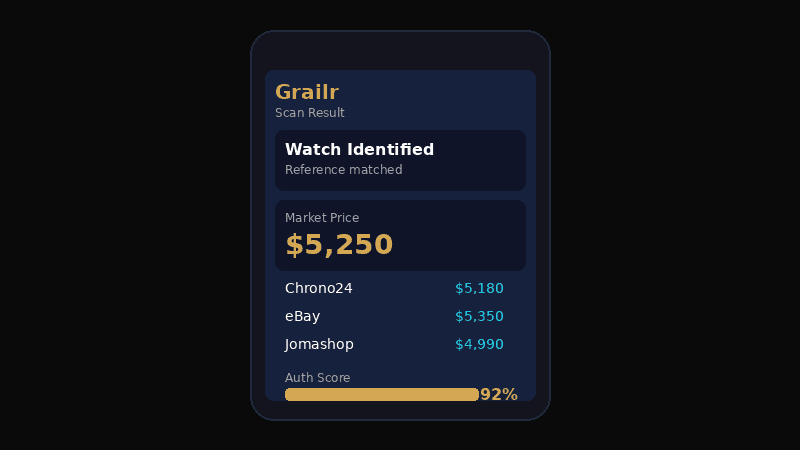
Grailr scans your watch photo and pulls live pricing from Chrono24, eBay, and Jomashop.
- AI identifies brand, model & reference number
- Live market prices from 3+ sources
- Authentication confidence score
Milestone Models Every Collector Should Know
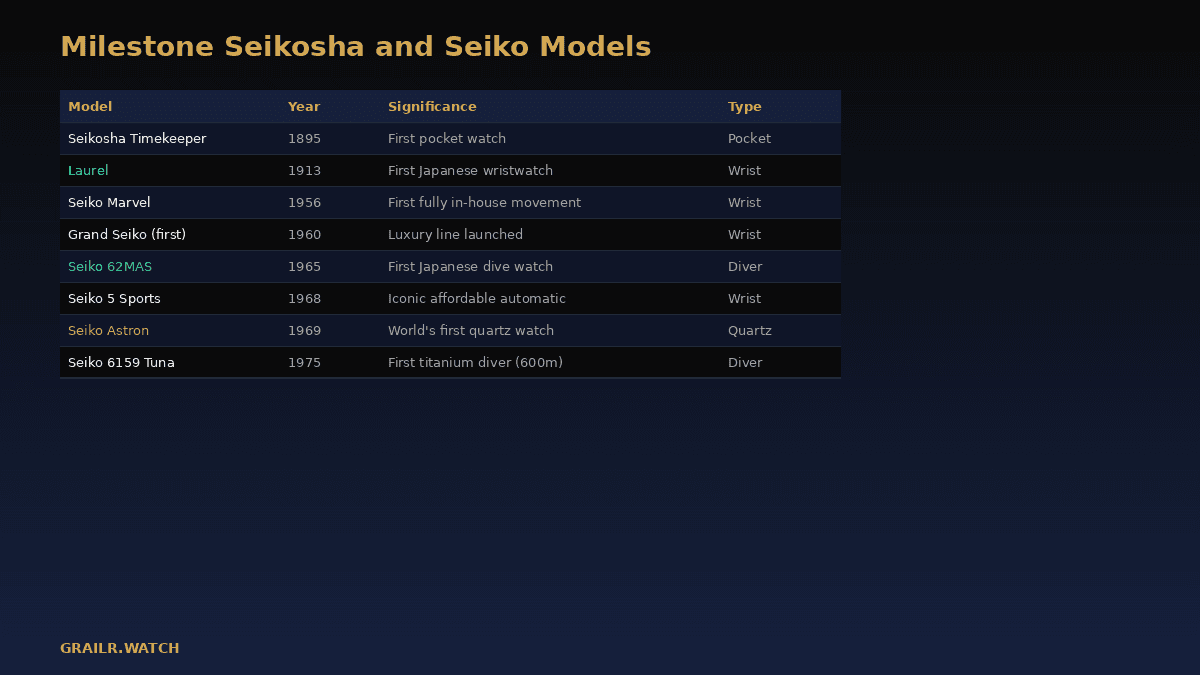
Seiko’s catalogue from the 1950s through the 1970s contains dozens of historically significant references. Some are affordable entry points into vintage Japanese watchmaking; others have become genuine collector’s pieces with five-figure asking prices. Here are the models that define the Seikosha-to-Seiko arc.
The Marvel (1956)
The Marvel was Seiko’s declaration of independence from Swiss movement designs. Its 17-jewel hand-wound caliber was modest by European standards, but it worked reliably and was built entirely in Suwa, Nagano Prefecture. Today, clean examples of the Marvel sell for $150 to $800, making it one of the most accessible entry points into vintage Seiko collecting. The Seiko 5 line that followed decades later inherited the Marvel’s philosophy of reliable, affordable mechanical watchmaking.
The 62MAS Diver (1965–1968)
Japan’s first professional dive watch, the 62MAS (reference 6217-8000 and 6217-8001), was rated to 150 meters and featured an automatic movement. It was purpose-built for the Japanese Antarctic Research Expedition and proved its ruggedness in conditions that would have destroyed lesser watches. The 62MAS has become one of the most collectible vintage Seiko references — clean, original examples now trade for $3,000 to $8,000, and fully restored pieces with correct bezels can push higher.
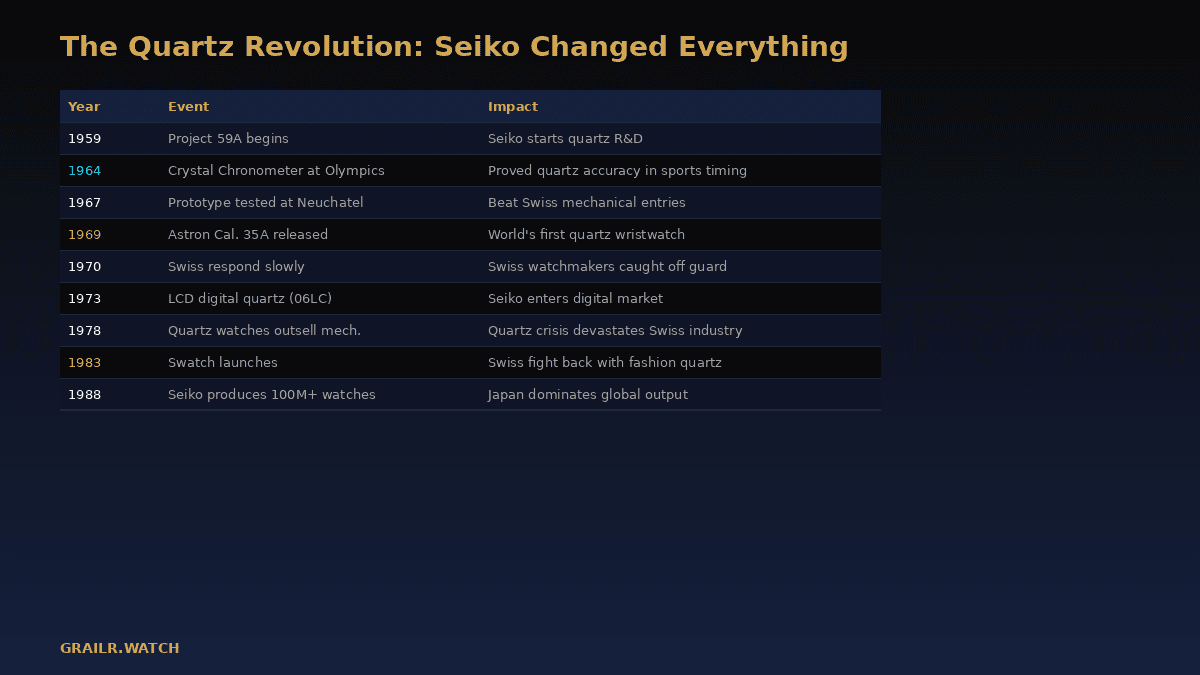
The Seiko Astron (1969)
On Christmas Day 1969, Seiko released the Astron (caliber 35A) — the world’s first quartz wristwatch. It kept time to ±0.2 seconds per day, roughly 100 times more accurate than the best mechanical chronometers. The original Astron was a gold-cased limited edition priced at 450,000 yen — the same as a Toyota Corolla at the time. Only 100 pieces were produced in the initial run, and surviving examples have sold at auction for $30,000 to $50,000.
The Astron triggered what the Swiss call the “quartz crisis.” Within a decade, cheap quartz movements from Japan and Hong Kong had devastated the Swiss mechanical watch industry, wiping out hundreds of small manufacturers and forcing the survivors to consolidate under groups like Swatch. Seiko didn’t cause the crisis alone — Casio, Citizen and Hong Kong assemblers played major roles — but the Astron was the starting gun.
The 1975 Titanium Diver (6159-7010)
In 1975, Seiko produced the world’s first diver’s watch with a titanium case, rated to 600 meters. The “Tuna” (named for its can-shaped shroud) was designed for saturation divers working in Japan’s offshore oil and construction industry. It introduced the external case shroud design that Seiko still uses in its modern Prospex professional divers. Vintage examples sell for $1,500 to $4,000 depending on condition and reference.
Collecting Vintage Seikosha and Early Seiko
The vintage Seiko market has matured significantly over the past decade. What was once an affordable niche for Japanese-watch enthusiasts now includes references that rival mid-tier Swiss pieces in price. Understanding what drives value — and what to watch out for — is essential before spending serious money.
What Drives Value
Three factors dominate vintage Seiko pricing: originality, historical significance, and condition. A watch with its original dial, hands, crystal and crown will always command a premium over one with replacement parts, even if the replacement parts are period-correct. Historically significant references — the first Grand Seiko, the 62MAS, early King Seiko models — carry a brand-heritage premium that simpler models don’t. And condition matters more than in Swiss collecting because Seiko’s softer alloys and plated cases show wear more readily than stainless steel.
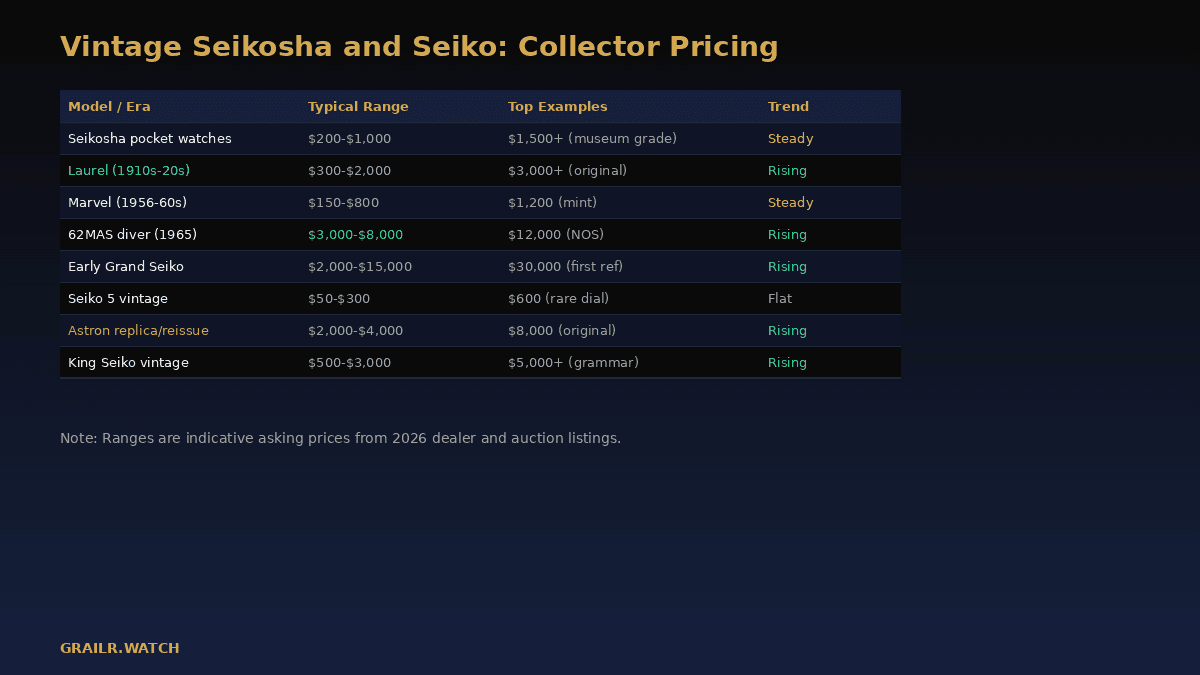
| Model / Era | Era | Typical Range | Key Factor |
|---|---|---|---|
| Seikosha pocket watches | 1895–1923 | $200–$1,000 | Pre-earthquake provenance |
| Laurel wristwatches | 1913–1990s | $300–$2,000 | 1910s–1920s originals command top prices |
| Seiko Marvel | 1956–1960s | $150–$800 | First in-house movement; accessible entry |
| King Seiko | 1961–1975 | $400–$3,000 | Grammar of Design case shape |
| 62MAS diver | 1965–1968 | $3,000–$8,000 | Japan’s first pro dive watch |
| First Grand Seiko | 1960 | $2,000–$15,000 | Rarity and luxury-line origin |
| 6159 Tuna diver | 1975 | $1,500–$4,000 | First titanium diver case |
Red Flags and Authentication
Vintage Seiko watches are among the most commonly faked or “Frankened” watches on the market. Parts swapping between similar references is widespread, and Chinese-made aftermarket dials, bezels and cases are readily available. Before purchasing any vintage Seiko above $500, verify:
- The serial number format matches the claimed production year (seven digits before 1970; first digit equals the year within that decade)
- The movement caliber matches the case back reference number
- The dial printing is consistent with known originals (font spacing, logo placement, colour)
- The crown is signed correctly for the period
Grailr’s watch scanner can help match reference details from a photograph, though a hands-on inspection remains essential for confirming originality on pieces of this age. For high-value references like the 62MAS or first Grand Seiko, consult a specialist dealer or the dedicated Seiko collecting community before committing.
Frequently Asked Questions
What does Seikosha mean in Japanese?
Seikosha translates roughly to 'House of Exquisite Workmanship' or 'House of Precision.' The word 'seiko' itself means precision or exquisite in Japanese, which later became the brand name used on dials from 1924 onward.
When did Seikosha start making watches?
Seikosha began as a clock factory in 1892. The company produced its first pocket watch, the Seikosha Timekeeper, in 1895, and its first wristwatch, the Laurel, in 1913.
Are old Seikosha watches worth anything?
Yes. Pre-war Seikosha pocket watches typically sell for $200 to $1,000 depending on condition and provenance. Early Laurel wristwatches from the 1910s and 1920s can fetch $300 to $2,000. Rare pre-earthquake pieces command the highest premiums.
What was Seiko's first in-house movement?
The 1956 Seiko Marvel was the first watch with a movement designed entirely in-house by Seiko. Earlier models used movements based on Swiss designs or imported calibers.
How can I tell if a vintage Seiko is genuine?
Check the serial number format (seven digits before 1970, with the first digit indicating the production year in that decade), verify the movement caliber matches the case back markings, and look for correct dial printing. Grailr's identification tool can help match reference details from a photograph.
What is the most valuable vintage Seiko watch?
The 1960 first-generation Grand Seiko and the 1967 62MAS diver are among the most valuable production Seiko watches, with clean examples selling for $8,000 to $15,000 or more. Prototype and pre-production pieces, such as early quartz Astron models, have sold for significantly higher at auction.
Related Articles
The Bottom Line
Seikosha is more than a historical footnote — it is the foundation on which one of the world’s most important watch companies was built. From Kintarō Hattori’s first clock factory in 1892 to the quartz revolution of 1969, every step in the Seikosha-to-Seiko story was driven by a single conviction: that Japanese precision could match and eventually surpass the best in the world. For collectors, the vintage pieces that survive from this era are tangible proof of that ambition — and many remain remarkably affordable. Whether you’re drawn to the historic weight of a Seikosha pocket watch or the technical achievement of the 62MAS, these watches offer genuine horological substance that few brands at any price can match.
Own a Vintage Seiko?
Grailr uses a photo to suggest a watch identity and an indicative price estimate, with active eBay listings where available. Check the exact reference and condition independently; a photo scan cannot authenticate a watch.
Scan a Watch NowSources and price context
- Seiko Heritage Timeline — Official corporate history covering milestones from 1881 to the present.
- Seiko Museum History of Seiko — The Seiko Museum’s account of Seikosha’s founding and early watchmaking achievements.
These primary sources support the specific history, specification or policy points noted above. Prices and resale percentages elsewhere in this guide are indicative editorial figures, not a verified transaction dataset or guaranteed returns. Confirm the exact reference, region, condition and current quote before buying; asking prices are not completed-sale prices.