Best Vintage Watches for Men in 2026
From $150 Timex Marlins to five-figure Rolex Daytonas — how to buy vintage watches without getting burned, with pricing, red flags and the best models at every budget.
Price context: this guide includes indicative prices from its original publication period. They have not all been refreshed to current quotes. Use the linked primary sources for specifications and policies, and verify prices independently.

- Vintage watches start at $75–$250 (Timex Marlin, Seiko 5) and offer character, history and hand-finished movements that modern watches at the same price cannot match
- The sweet spot for quality and value is $1,000–$3,000, where you find genuine Swiss automatics from Omega, Universal Genève and early Tudor
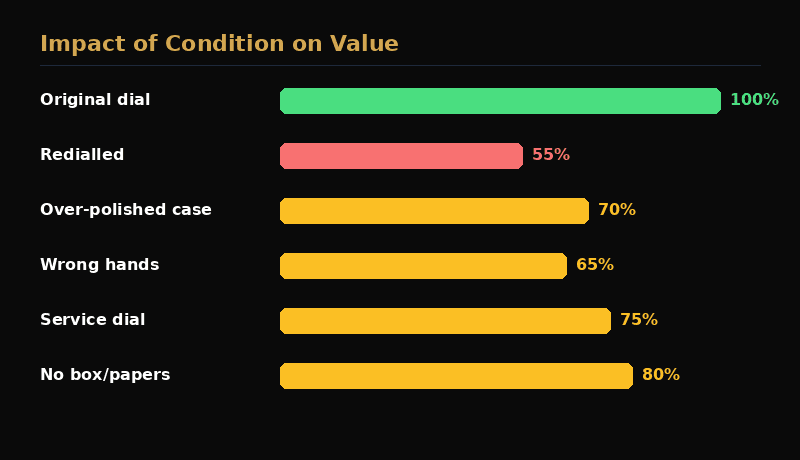
- Condition is king: a redial, aftermarket hands or a polished case can cut a vintage watch’s value by 30–50%
- Budget $200–$400 for a service on top of the purchase price — most vintage watches need one immediately
Why Buy Vintage
A vintage watch is a finished object in a way that a modern watch rarely is. The cases are thinner, the movements are hand-assembled and individually adjusted, and the designs reflect an era when watches were tools, not lifestyle accessories. A 1960s Omega Seamaster at 34mm sits on the wrist with a presence that no current 41mm watch can replicate, because the proportions — short lugs, domed crystal, slim bezel — were designed for function, not marketing photographs.
The other reason is value. At the budget and mid-range tiers, vintage watches offer Swiss mechanical movements, solid gold or gold-filled cases, and hand-applied indices for prices that buy a quartz fashion watch today. A 1960s Universal Genève Polerouter with a micro-rotor automatic movement can be found for $1,200–$1,800 — try finding a current-production micro-rotor watch under $5,000.
The trade-off is risk. Vintage watches come without warranties, they may need expensive service, and the market is full of redials, frankenwatches and outright fakes. This guide tells you what to buy at every budget and, more importantly, what to avoid.
What Counts as Vintage
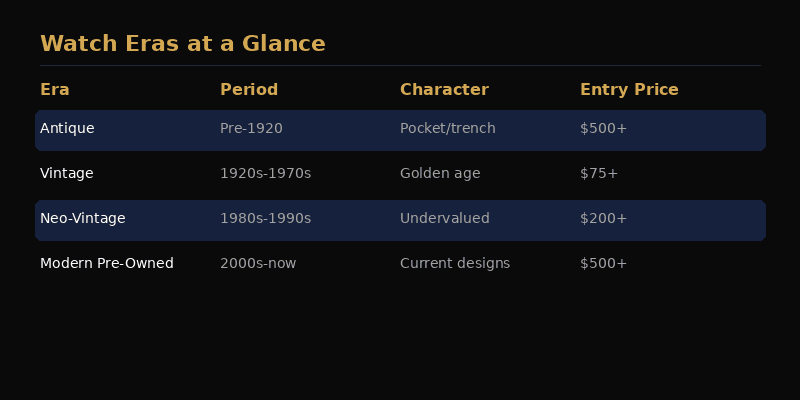
There is no industry-wide definition, but the conventions are well established. Antique watches are pre-1920, typically pocket watches or early wristwatches. Vintage covers roughly the 1920s through the 1970s — the golden age of mechanical watchmaking. Neo-vintage refers to the 1980s and 1990s, a period that produced some of the most undervalued pieces on the market today. And modern pre-owned is anything from 2000 onward.
This guide focuses on vintage and neo-vintage pieces — roughly 1950s to 1990s — because that is where the best combination of quality, availability and value sits. Antique watches require specialist knowledge, and modern pre-owned pieces are covered in our other buying guides.
Best Vintage Watches Under $500
Timex Marlin Manual-Wind ($75–$250)
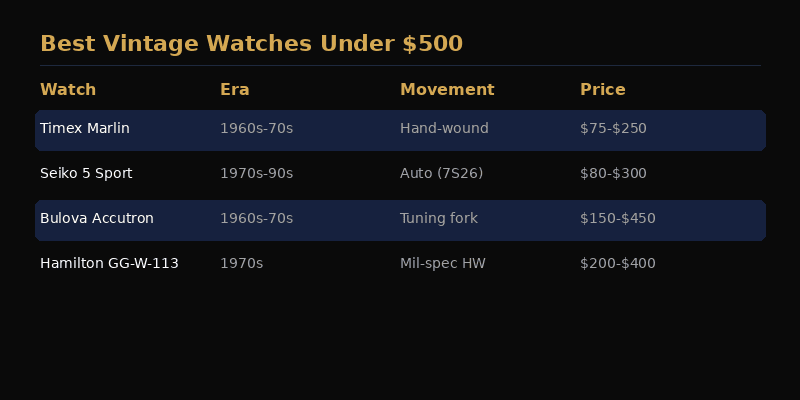
The Timex Marlin from the 1960s–1970s is the cheapest entry into vintage mechanical watches. The 34mm chrome-plated case houses a simple hand-wound movement that ticks audibly — part of the charm. Dials range from plain silver to textured sunburst, and condition varies wildly at this price point. Buy one that runs and keeps reasonable time; don’t spend $200+ on a service for a $100 watch. The Marlin is a gateway drug, not a grail.
Seiko 5 Sport (1970s–1990s, $80–$300)
Vintage Seiko 5 models are practically indestructible and come in hundreds of dial and case combinations. The 7S26 automatic movement is bomb-proof — independent watchmakers can service it in their sleep, and parts are abundant. Look for the cushion-case “turtle” shapes from the 1970s: they have a character that modern Seikos don’t replicate. Day-date complications, coloured dials, and occasional linen or faceted dial textures make each one slightly unique. At $80–$300, you can own several and rotate.
Bulova Accutron (1960s–1970s, $150–$450)
The Accutron is a piece of horological history. It uses a tuning-fork movement — not mechanical, not quartz — that produces a distinctive hum instead of a tick. The Spaceview model, with its exposed movement, is an icon of 1960s industrial design. Prices range from $150 for a standard date model to $300–$450 for a clean Spaceview. The catch: the tuning fork needs periodic battery replacement ($20–$40), and a full service costs $200–$350 because few watchmakers still work on them.
Hamilton Khaki (1970s military, $200–$400)
Hamilton’s military-issue watches from the 1970s are rugged, legible and historically significant. The Khaki Field lineage traces directly to these pieces. Look for the GG-W-113 specification models — mil-spec hacking movements, matte black dials with radium or tritium lume, and 34mm cases that sit close to the wrist. At $200–$400, these are genuine military watches at fashion-watch prices.
Mid-Range Classics: $500–$5,000
Omega Seamaster De Ville (1960s, $600–$1,500)
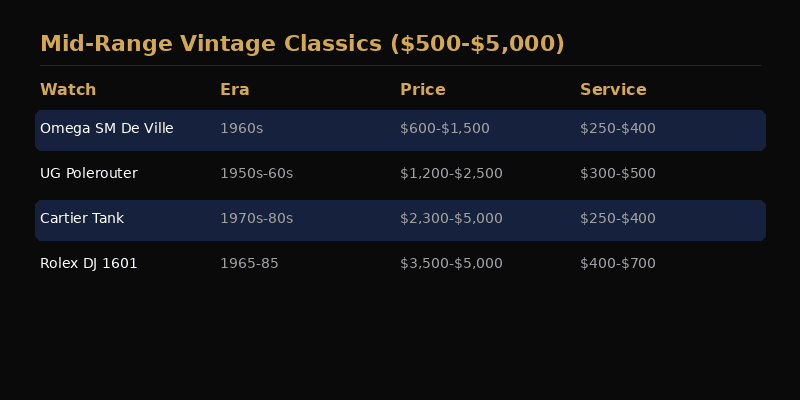
The 1960s Seamaster De Ville is the single best value in vintage Swiss watches. The 34mm steel case houses Omega’s Calibre 552 or 565 automatic — movements that are beautifully finished, accurate, and serviceable by any competent watchmaker. Dials come in silver, champagne, grey and crosshair variants, with some rare pie-pan dials commanding premiums. A clean example with original dial and hands sells for $600–$1,500 depending on condition and variant. Budget $250–$400 for a service. This is a dress watch that competes with modern pieces costing ten times as much.
Universal Genève Polerouter (1950s–1960s, $1,200–$2,500)
Designed by Gérald Genta (who later created the Audemars Piguet Royal Oak and Patek Philippe Nautilus), the Polerouter is a design icon available at a fraction of what Genta’s later work costs. The micro-rotor Calibre 215 was one of the first automatic movements thin enough for a dress watch. The 35mm case with cross-hair dial and dauphine hands has a timelessness that transcends trends. At $1,200–$2,500 for a clean example, this is arguably the most undervalued Swiss vintage watch.
Cartier Tank (1970s–1980s, $2,300–$5,000)
The Cartier Tank is one of the most recognisable watch designs ever made, and vintage examples offer the same DNA as current-production models at a lower price. The 1970s–1980s Tank Manual in vermeil (gold over silver) sells for $2,300–$3,500 and wears beautifully. The gold Tank Louis, the purest expression of the design, commands $3,500–$5,000+ for clean examples. The trade-off with vintage Cartier is that the movements are typically basic (ETA or Jaeger-LeCoultre hand-wound) — you are buying the case and dial, not the movement.
Rolex Datejust (1965–1985, $3,500–$5,000)
A vintage Datejust ref. 1601 or 16014 is the quintessential vintage luxury watch. The 36mm Oyster case with Jubilee bracelet, fluted bezel and Cyclops date window is the template that Rolex still uses today. Cal. 1570 (1601) and Cal. 3035 (16014) are robust, proven movements. Stainless steel examples in good condition with original dial sell for $3,500–$5,000. Two-tone and gold-dial variants climb higher. The Datejust holds value well in the vintage market because the design is recognisable and demand stays consistent.
Trophy Pieces: $5,000+
Omega Speedmaster Professional (pre-Moon, $6,000–$12,000)
Pre-Moon Speedmasters (ref. 105.012 and 145.012) with Calibre 321 are the most historically significant chronographs in watchmaking. These are the references that NASA qualified for spaceflight in 1965. The hand-wound Calibre 321 is a column-wheel chronograph of extraordinary beauty — it was so good that Omega reissued it in the modern Ed White Speedmaster at $14,100. Original 1960s examples in wearable condition sell for $6,000–$12,000. The later 145.022 with Calibre 861, produced from 1969 onward, is more affordable at $4,000–$7,000 and still carries genuine Moon heritage.
Rolex Submariner 5513 (1960s–1980s, $8,000–$15,000)
The no-date Submariner ref. 5513 is the purest expression of the dive-watch concept. The 40mm case without a date window, Cyclops lens or ceramic bezel has a cleanliness that modern Submariner owners envy. Early-production “meters first” dials and gilt dials command premiums, but a standard matte-dial example from the 1970s–1980s sells for $8,000–$12,000 in good condition with an original bracelet. The Cal. 1520 is simple, reliable and inexpensive to service.
Heuer Autavia (1960s–1970s, $5,000–$15,000)
Before TAG Heuer, there was Heuer, and the Autavia is its finest hour. The rotating bezel, legible chronograph layout and 39mm–42mm case make it a genuine tool watch. Valjoux 72-powered models from the 1960s command the highest prices ($8,000–$15,000), while the later Calibre 12 automatics from the 1970s sell for $5,000–$8,000. The Autavia is one of the most collectible chronographs outside Rolex and Omega, and clean examples are increasingly difficult to find.
Five Red Flags to Watch For
1. Redialled or Repainted Dials
A redialled vintage watch loses 30–50% of its value. Warning signs: text that looks too sharp or crisp for the watch’s age, paint that sits on top of the dial rather than being printed into it, lume plots that are too white and uniform (original vintage lume oxidises to cream or brown), and fonts that don’t match known examples. Compare against photographs of confirmed-original dials before buying.
2. Over-Polished Cases
Aggressive polishing removes metal and softens the case’s original lines. On a Rolex, check the edges of the lugs — they should be crisp, not rounded. On an Omega, the bezel edge should be sharp. A watch with sharp, well-defined case edges has been gently treated; one with soft, rounded edges has been polished repeatedly. Some wear is fine and expected; erasure of the case geometry is not.
3. Wrong or Aftermarket Parts
Hands, crowns, bezels and crystals are commonly replaced with incorrect or aftermarket parts. The hands should match the exact reference — a Rolex 5513 from 1972 should have specific hand styles that differ from a 1982 example. An aftermarket bezel insert on a vintage dive watch is common and costs $200–$400 to spot if you know what the original looks like. When in doubt, request a photograph of the movement and compare the serial-number range against the stated production year.
4. “Service Dial” Mismatch
When a brand services a vintage watch, it sometimes replaces the original dial with a current-production “service dial.” These are genuine parts from the manufacturer, but they look wrong on the vintage watch — modern fonts, modern lume, modern printing. A service dial depresses value by 15–30% compared to an original. The solution: specify “preserve original dial” when sending a vintage watch for service, and use an independent watchmaker who respects original parts.
5. Too-Good-to-Be-True Pricing
If a vintage Rolex Submariner is listed for 40% below comparable examples, something is wrong. The most common explanations: it’s a frankenwatch, the dial is a repaint, the serial numbers are altered, or it’s an outright counterfeit. Use Grailr’s scanner for a quick reference check and indicative pricing — then verify the result and any seller claims independently before committing.
Price Comparison
| Watch | Era | Movement | Price Range | Service Cost |
|---|---|---|---|---|
| Timex Marlin | 1960s–70s | Hand-wound | $75–$250 | $50–$100 |
| Seiko 5 Sport | 1970s–90s | Auto (7S26) | $80–$300 | $80–$150 |
| Bulova Accutron | 1960s–70s | Tuning fork | $150–$450 | $200–$350 |
| Hamilton GG-W-113 | 1970s | Hand-wound mil | $200–$400 | $150–$250 |
| Omega Seamaster DV | 1960s | Auto (Cal. 565) | $600–$1,500 | $250–$400 |
| UG Polerouter | 1950s–60s | Auto (Cal. 215) | $1,200–$2,500 | $300–$500 |
| Cartier Tank Manual | 1970s–80s | Hand-wound | $2,300–$5,000 | $250–$400 |
| Rolex Datejust 1601 | 1965–85 | Auto (Cal. 1570) | $3,500–$5,000 | $400–$700 |
| Heuer Autavia | 1960s–70s | Chrono (V.72) | $5,000–$15,000 | $500–$1,200 |
| Omega Speedmaster Pre-Moon | 1960s | Chrono (Cal. 321) | $6,000–$12,000 | $600–$1,500 |
| Rolex Sub 5513 | 1960s–80s | Auto (Cal. 1520) | $8,000–$15,000 | $400–$700 |
Check Any Vintage Watch Price
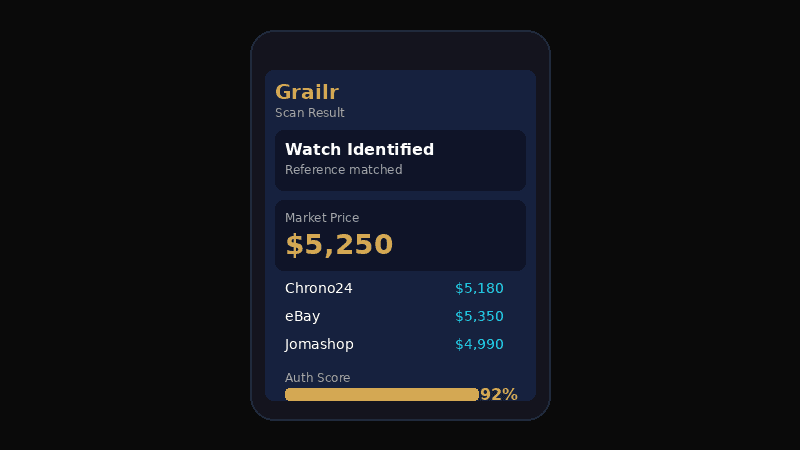
Grailr scans your watch photo and pulls live pricing from Chrono24, eBay, and Jomashop.
- AI identifies brand, model & reference number
- Live market prices from 3+ sources
- Authentication confidence score
Where to Buy Vintage Watches
| Channel | Pros | Cons | Best For |
|---|---|---|---|
| Specialist Dealers | Curated, serviced, warranty | 20–40% premium | First-time buyers |
| Auction Houses | Authentication, wide selection | Buyer’s premium (20–25%) | Rare pieces $5,000+ |
| Online Marketplaces | Lowest prices, huge selection | No vetting, higher risk | Budget pieces under $1,000 |
| Watch Forums | Community vetting, fair prices | Limited buyer protection | Experienced buyers |
Frequently Asked Questions
How old does a watch have to be to count as vintage?
There is no universal standard. The watch industry generally treats pieces from the 1970s or earlier as vintage, watches from the 1980s-1990s as neo-vintage, and anything from the 2000s onward as modern pre-owned. Some dealers use 25 years as a cutoff. The distinction matters less than the watch's condition, provenance and desirability.
Are vintage watches a good investment?
A handful of vintage watches have appreciated dramatically — the Rolex Daytona 'Paul Newman' being the most extreme example. But most vintage watches are not investments. Budget and mid-range vintage pieces often sell for less than their inflation-adjusted original retail price. Buy vintage because you love wearing them, not as a financial strategy.
Is it safe to buy a vintage watch online?
It can be, with precautions. Buy from established dealers with return policies rather than anonymous social-media sellers. Request detailed photographs of the dial, caseback, movement and serial numbers. Use escrow for private sales over $1,000. Get any vintage watch you buy independently inspected within 14 days.
How much does it cost to service a vintage watch?
A basic service for a simple vintage hand-wound or automatic movement costs $200-$400 through an independent watchmaker. Complex calibres, chronographs and watches that need parts sourced separately can run $500-$1,500+. The brand's own service centre is usually the most expensive option and may replace original parts that a specialist would preserve.
What is a 'frankenwatch' and how do I spot one?
A frankenwatch is a watch assembled from parts of different watches, often mixing genuine and aftermarket components. Red flags include mismatched serial numbers between case and movement, a dial that looks too clean for its stated age, wrong-font printing on the dial, and hands that don't match the watch's reference. Request movement photographs and compare them against known examples of that exact calibre.
Should I buy a vintage watch with or without original box and papers?
Original box and papers add 10-30% to a vintage watch's value depending on the model. For common watches under $2,000 the premium is smaller. For collectible references like the Rolex Submariner 5513 or Omega Speedmaster 145.022, the original papers can add $1,000-$3,000 to the price. If you plan to sell eventually, the papers matter. If you are buying to wear, a well-documented watch without the original box is often the better value.
Related Articles
The Bottom Line
Vintage watches offer something that no modern watch can: history, hand-finished craftsmanship and a connection to an era when watches were engineered to last a lifetime. At the budget end, a $150 Timex Marlin or Seiko 5 delivers mechanical charm that no quartz fashion watch can match. In the mid-range, the Omega Seamaster De Ville and Universal Genève Polerouter are genuine bargains with movements that rival modern pieces costing ten times as much. At the trophy level, pre-Moon Speedmasters and vintage Submariners are wearable pieces of horological history. Buy carefully, service promptly, and wear with confidence — a well-chosen vintage watch improves with age, just like its owner.
Found a Vintage Watch You Like?
Grailr uses a photo to suggest a watch identity and an indicative price estimate, with active eBay listings where available. Check the exact reference and condition independently; a photo scan cannot authenticate a watch.
Scan a Watch NowSources and price context
- Cartier Tank collection — Official Tank design heritage, current models and case specifications.
- Omega Speedmaster history — Official Speedmaster timeline including NASA qualification and moon-landing references.
These primary sources support the specific specification points noted above. Prices and resale percentages elsewhere in this guide are indicative editorial figures, not a verified transaction dataset or guaranteed returns. Confirm the exact reference, region, condition and current quote before buying; asking prices are not completed-sale prices.