Tissot PR 516: Every Model, Spec and Price
Tissot’s motorsport chronograph line from the $575 quartz to the $2,150 automatic — with real pricing, movement specs, and buying advice for 2026.
Price context: this guide includes indicative prices from its original publication period. They have not all been refreshed to current quotes. Use the linked primary sources for specifications and policies, and verify prices independently.

- The PR 516 quartz chronograph at $575 is one of the cheapest Swiss-made chronographs you can buy new
- The automatic chronograph ($2,150) uses a Valjoux A05.231 with a 68-hour power reserve
- The older PRS 516 is discontinued but trades for $250–$400 pre-owned — a motorsport bargain
- All models offer 100 m water resistance and sapphire crystals at every price tier
What Is the Tissot PR 516?
The PR 516 name goes back to 1965, when Tissot released a motorsport-inspired chronograph built to survive the kind of vibration and g-forces a racing driver would encounter. “PR” stood for “Particularly Robust,” and 516 was the internal model designation. The original became a cult piece among vintage collectors, and Tissot has revived the name several times since.
The most recent revival came in 2024, when Tissot replaced the larger, sportier PRS 516 line with a slimmer, more refined PR 516 collection. The new models trim the cases to 40–41 mm, clean up the dials, and pair upgraded Valjoux-based movements with Tissot’s signature affordability. The result is a Swiss-made chronograph family that starts at $575 and tops out at $2,150 — a price range where very few competitors offer comparable specifications.
As part of the Swatch Group’s stable, Tissot benefits from access to ETA and Valjoux movements at prices that independent brands cannot match. The PR 516 is the brand’s clearest expression of that advantage: a motorsport chronograph with Swiss pedigree, sapphire crystal, and 100 m water resistance at the price of a fashion-brand quartz watch.
The Current PR 516 Lineup
Quartz Chronograph ($575)
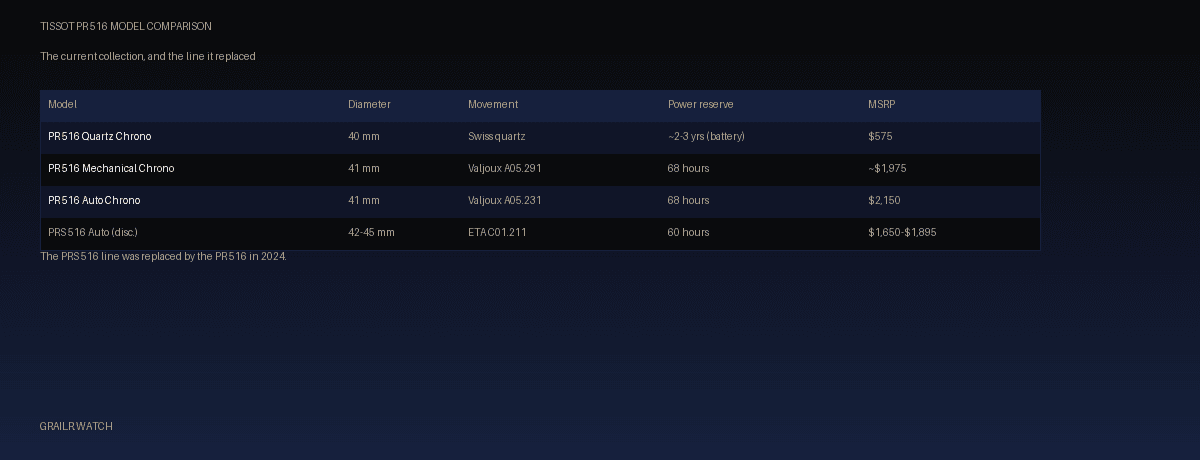
The entry point. At 40 mm in stainless steel, the quartz PR 516 chronograph is thin enough to slide under a cuff and tough enough for weekend wear. It runs a Swiss quartz movement with a standard battery life of approximately two to three years. The dial layout follows the traditional three-register chronograph format with a tachymeter scale on the bezel or dial edge, depending on the reference.
Available in black, white, and blue dial variants on either a stainless steel bracelet or a leather strap. The bracelet versions include a folding clasp with a safety catch. For $575, the spec sheet reads like it should cost twice as much: sapphire crystal, screw-down caseback, 100 m water resistance, and Swiss assembly.
Mechanical Hand-Wind Chronograph (~$1,975)
The middle child that most buyers overlook. This 41 mm model uses the Valjoux A05.291, a hand-wound chronograph calibre with a 68-hour power reserve. Without a rotor, the movement sits thinner, and the caseback view is cleaner. It’s the purist’s choice — a manual-wind chronograph from a Swiss manufacture for under $2,000.
Automatic Chronograph ($2,150)
The flagship. Same 41 mm case, but powered by the Valjoux A05.231 — an automatic chronograph calibre running at 28,800 vph with a 68-hour power reserve. That reserve means you can take it off on Friday evening and strap it back on Monday morning without resetting the time. The A05.231 is based on the proven ETA 7753 architecture, which has been in production for decades and is well understood by independent watchmakers.
PRS 516 vs PR 516: What Changed
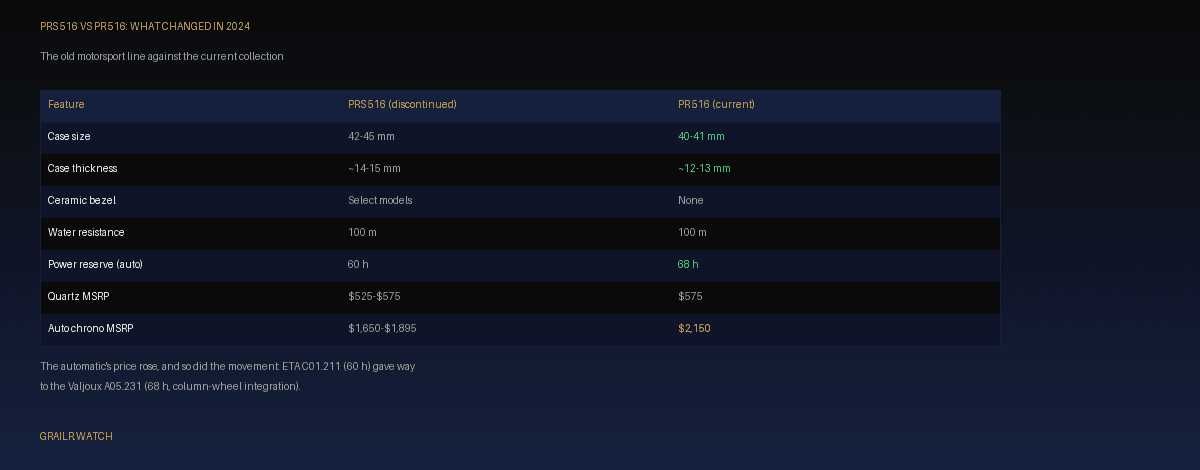
The name change isn’t just cosmetic. Tissot made several meaningful changes when it transitioned from the PRS 516 to the PR 516 in 2024. The older PRS line leaned into an aggressive motorsport aesthetic: 45 mm cases, ceramic bezel inserts, rubber straps with tyre-tread patterns, and exposed caseback screws. It looked fast, but it also looked large on most wrists.
The new PR 516 dials things back. Cases shrink to 40–41 mm. Bezels are cleaner. The motorsport DNA survives in the tachymeter, the racing-stripe subdial accents, and the “PR 516” engraving on the caseback, but the overall package is dressier and more versatile. If the PRS was a race car, the PR is a grand tourer.
| Feature | PRS 516 (Discontinued) | PR 516 (Current) |
|---|---|---|
| Case Size | 42–45 mm | 40–41 mm |
| Case Thickness | ~14–15 mm | ~12–13 mm |
| Ceramic Bezel | Select models | None |
| Water Resistance | 100 m | 100 m |
| Power Reserve (Auto) | 60 h | 68 h |
| Quartz MSRP | $525–$575 | $575 |
| Auto Chrono MSRP | $1,650–$1,895 | $2,150 |
The automatic’s price went up, but the movement improved. The older PRS 516 automatic used the ETA C01.211 (60-hour reserve). The current PR 516 automatic uses the Valjoux A05.231 (68-hour reserve, column-wheel integration). Whether that’s worth the premium depends on whether you value the extra power reserve and the Valjoux name on the movement.
Full Specifications Comparison
| Spec | Quartz Chrono | Mechanical Chrono | Automatic Chrono |
|---|---|---|---|
| Reference | T149.417.xx.xxx.xx | T149.459.xx.xxx.xx | T149.462.xx.xxx.xx |
| Diameter | 40 mm | 41 mm | 41 mm |
| Movement | Swiss quartz | Valjoux A05.291 | Valjoux A05.231 |
| Power Reserve | ~2–3 years (battery) | 68 hours | 68 hours |
| Frequency | 32,768 Hz | 28,800 vph | 28,800 vph |
| Water Resistance | 100 m | 100 m | 100 m |
| Crystal | Sapphire | Sapphire | Sapphire |
| Case Material | 316L steel | 316L steel | 316L steel |
| MSRP | $575 | ~$1,975 | $2,150 |
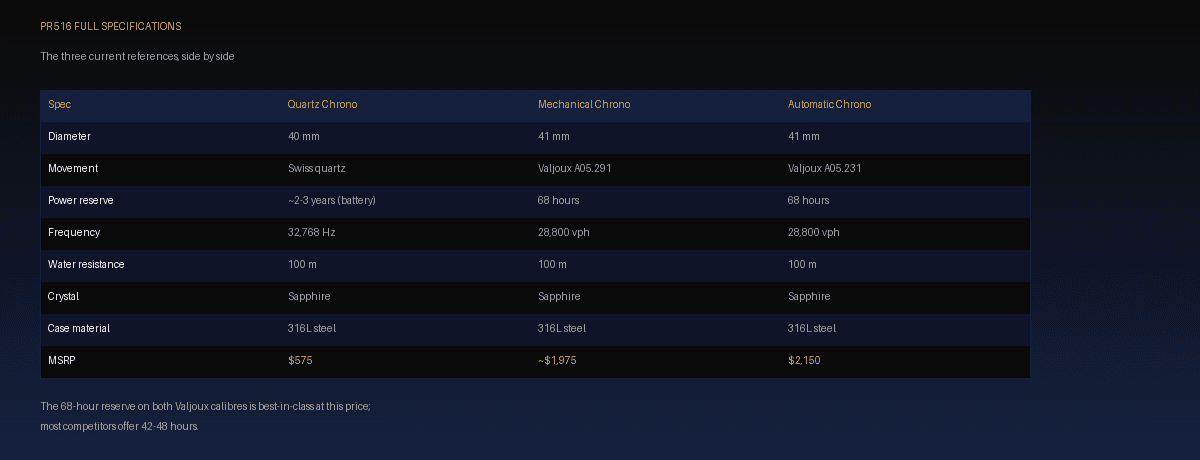
All three share the same 100 m water resistance, sapphire crystal, and 316L stainless steel case. The key differentiator is the movement. The quartz gives you accuracy within ±15 seconds per month. The mechanical movements give you a sweeping seconds hand, a transparent caseback, and the tactile satisfaction of winding or wearing a living machine. The 68-hour power reserve on both Valjoux calibres is best-in-class at this price — most competitors offer 42–48 hours.
Pricing and Value Retention
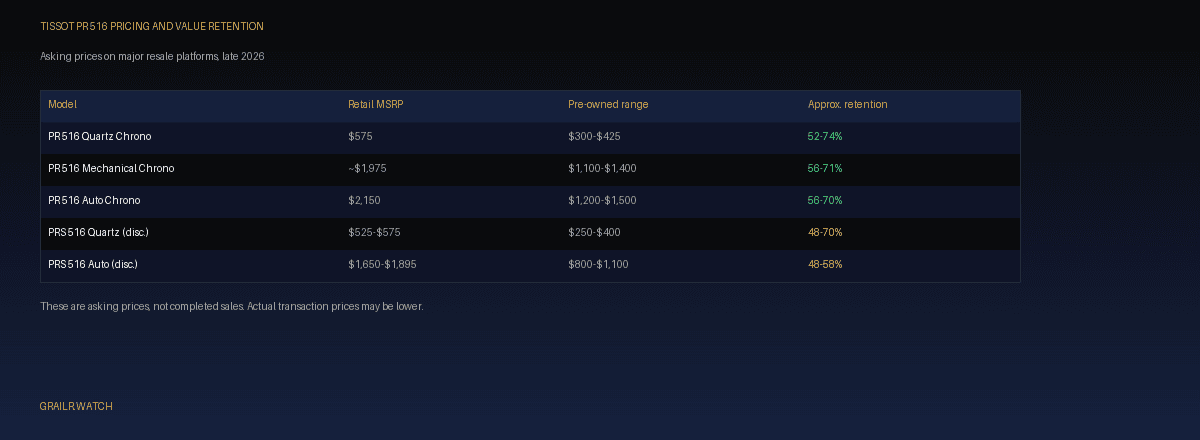
Tissot watches depreciate on the secondary market, and the PR 516 is no exception. That said, it depreciates less aggressively than most sub-$1,000 Swiss watches because Tissot’s brand recognition holds up well internationally. Here’s what the numbers look like in late 2026 based on asking prices from major resale platforms. These are asking prices, not completed sales — actual transaction prices may be lower.
| Model | Retail MSRP | Pre-Owned Range | Approx. Retention |
|---|---|---|---|
| PR 516 Quartz Chrono | $575 | $300–$425 | 52–74% |
| PR 516 Mechanical Chrono | ~$1,975 | $1,100–$1,400 | 56–71% |
| PR 516 Auto Chrono | $2,150 | $1,200–$1,500 | 56–70% |
| PRS 516 Quartz (Discontinued) | $525–$575 | $250–$400 | 48–70% |
| PRS 516 Auto (Discontinued) | $1,650–$1,895 | $800–$1,100 | 48–58% |
The takeaway: if value retention matters, the quartz at $575 delivers the least dollar loss in absolute terms. At roughly $175–$275 of depreciation, it’s cheap entertainment for a Swiss chronograph. The automatic loses more in raw dollars but holds a slightly higher percentage, and the Valjoux movement gives it a longer functional life — a quartz movement eventually needs a full replacement; a mechanical movement can be serviced indefinitely.
How the PR 516 Compares to Rivals
The PR 516 sits in a competitive bracket. At $575 for the quartz, it goes head-to-head with Seiko’s SSB and Presage chronographs, the Hamilton Khaki Field quartz variants, and Citizen’s Eco-Drive chronographs. At $2,150 for the automatic, it competes with the Hamilton Intra-Matic auto chrono (~$2,695), Certina DS-2 Chronograph (~$1,275), and the Tissot PRX Powermatic 80 at $695.
PR 516 Quartz vs Seiko SSB Series
Seiko’s quartz chronographs cost $275–$400 and use Seiko’s own calibres. They’re cheaper, but they ship with Hardlex mineral crystals instead of sapphire, and water resistance is typically 100 m but with push-pull crowns. The Tissot trades the lower price for a sapphire crystal, a screw-down caseback, and the “Swiss Made” label. If the brand origin matters to you, the Tissot wins. If raw value-per-dollar is the metric, Seiko is hard to beat.
PR 516 Auto vs Hamilton Intra-Matic Chrono
The Hamilton uses the H-31 (ETA/Valjoux-based) with a 60-hour reserve and costs ~$2,695. The Tissot automatic uses the A05.231 with a 68-hour reserve and costs $2,150. The Hamilton wins on vintage-inspired design and brand cachet in North America. The Tissot wins on power reserve and price. Both are excellent movements from the same Swatch Group stable.
PR 516 Auto vs Certina DS-2 Chronograph
Certina’s DS-2 automatic chronograph comes in around $1,275 with a similar ETA-based movement and 200 m water resistance. It’s cheaper and more water-resistant, but Certina lacks Tissot’s brand recognition outside of Switzerland. If you plan to resell the watch later, Tissot’s name carries further.
Buying Tips for the Tissot PR 516
1. Know Which Line You Want
Sellers often list “PRS 516” and “PR 516” interchangeably. The PRS is the older, discontinued line with 42–45 mm cases. The PR is the current 40–41 mm collection. Check the reference number: T149.xxx is the new PR 516; T100.xxx and T131.xxx are older PRS 516 models.
2. Try the Bracelet Before Buying a Strap
The steel bracelet adds versatility and resale appeal. Tissot’s bracelets use a folding clasp with micro-adjustment, which is rare at this price. If you buy on leather or rubber, switching to the OEM bracelet later costs nearly as much as the price difference at purchase.
3. Consider the Discontinued PRS 516
If you want wrist presence and don’t mind the larger case, pre-owned PRS 516 models offer outstanding value at $250–$400 for quartz and $800–$1,100 for automatic. The movements are reliable, parts are still available, and any Swatch Group service centre can handle them.
4. Scan Before You Buy Pre-Owned
Use Grailr’s scanner to photograph any listing and get a suggested identification and indicative price estimate. Verify the reference number on the caseback against Tissot’s records before paying.
5. Buy from Authorized Dealers for the Warranty
Tissot offers a two-year international warranty on new purchases from authorized dealers. Grey-market discounts on a $575 quartz are minimal — often under $50 — and you lose the warranty entirely. For the automatic, the AD warranty protects a $2,150 investment through the most failure-prone period.
Frequently Asked Questions
What is the difference between the Tissot PR 516 and PRS 516?
The PRS 516 was the older, sportier line with cases up to 45 mm and ceramic bezels. The PR 516, launched in 2024, is a slimmer motorsport-inspired collection at 40–41 mm with cleaner dials and updated Valjoux movements. The PRS 516 has been discontinued.
How much does a Tissot PR 516 cost?
The quartz chronograph starts at $575, the mechanical hand-wind chronograph is around $1,975, and the automatic chronograph costs $2,150. Pre-owned PRS 516 quartz models trade between $250 and $400.
Is the automatic worth the upgrade over quartz?
The automatic uses a Valjoux A05.231 with a 68-hour power reserve and a sweeping seconds hand. If you value mechanical movement and a weekend-proof power reserve, the upgrade is worth the $1,575 premium. If accuracy and low maintenance matter more, the quartz is the better buy.
What movement does the Tissot PR 516 use?
The quartz chronograph uses a Swiss quartz movement. The automatic chronograph uses the Valjoux A05.231 running at 28,800 vph with a 68-hour power reserve. The mechanical hand-wind model uses the Valjoux A05.291, also with a 68-hour reserve.
Does the Tissot PR 516 hold its value?
Like most sub-$2,500 Swiss watches, the PR 516 depreciates on the secondary market. Quartz models lose roughly 40–55% of retail value. The automatic chronograph holds better at around 55–65% retention, partly because the Valjoux movement appeals to collectors.
Is the Tissot PR 516 a good first Swiss watch?
Yes. The quartz chronograph at $575 is one of the most affordable Swiss-made chronographs on the market, with 100 m water resistance and solid build quality. The automatic at $2,150 competes directly with Hamilton and Certina alternatives that cost the same or more.
Related Articles
The Bottom Line
The Tissot PR 516 does what Tissot does best: deliver Swiss-made quality at a price that makes you double-check the spec sheet. The quartz chronograph at $575 is the smart buy for most people — a genuine Swiss chronograph with sapphire crystal and 100 m water resistance that costs less than many fashion-brand quartz watches. The automatic at $2,150 is for the enthusiast who wants a Valjoux-powered chronograph without spending Omega money. Either way, the PR 516 earns its place in any list of the best watches at their price.
Sources and price context
- Tissot PR 516 collection page — Official specifications, reference numbers and retail prices for the current PR 516 lineup.
- Caliber Corner: Valjoux A05.231 specifications — Movement architecture, beat rate, power reserve and service documentation for the automatic chronograph calibre.
These primary sources support the specific specification and pricing points noted above. Prices and resale percentages elsewhere in this guide are indicative editorial figures, not a verified transaction dataset or guaranteed returns. Confirm the exact reference, region, condition and current quote before buying; asking prices are not completed-sale prices.