What Is a Tool Watch? The Complete Buying Guide
Dive, pilot, field and chronograph — four categories of tool watch explained with 15 picks across every budget and the specs that separate real instruments from lifestyle pretenders.
Price context: this guide includes indicative prices from its original publication period. They have not all been refreshed to current quotes. Use the linked primary sources for specifications and policies, and verify prices independently.

- A tool watch is designed around a function — every element on the case, dial and bezel must serve a measurable purpose
- The four categories are dive watches, pilot watches, field watches and chronographs, each built to a different operational brief
- Genuine tool watches start under $100 — the Casio Duro at ~$50 offers 200m water resistance and a unidirectional bezel on a quartz movement
- ISO 6425 certification for divers, anti-magnetic ratings for pilot watches and shock resistance for field watches are the specs that separate instruments from fashion
- The GADA concept — Go Anywhere, Do Anything — has become the modern case for owning one versatile tool watch rather than several specialists
What Is a Tool Watch?
A tool watch is a watch designed around a function, where every element on the case, dial and bezel exists to serve a measurable purpose. The term emerged in the mid-twentieth century to distinguish purpose-built instruments from dress watches, which prioritize aesthetics and thinness over utility. Where a dress watch asks how it looks under a cuff, a tool watch asks whether it can survive the environment it was built for.
The concept is deliberately broad. A dive watch rated to 200m with a unidirectional timing bezel is a tool watch. A pilot’s watch with an oversized crown, high-contrast dial and anti-magnetic case is a tool watch. A field watch built to survive rough handling, low light and moderate water exposure qualifies too. What connects them is not a single function but a shared philosophy: if a design element does not serve a practical purpose, it does not belong on the watch.
That philosophy shows up in spec sheets as concrete, testable numbers — water resistance ratings certified to ISO 6425 for divers, anti-magnetic resistance measured in gauss for pilot watches, shock resistance tested to ISO 1413 for field watches. It also shows up in less measurable ways: the size and shape of luminous indices, the legibility of a bezel in low light, the tactile grip of a crown with wet or gloved hands. Tool watches are not simply “rugged” watches — they are watches whose ruggedness is pointed at a specific task.
The market has blurred the line. Many watches sold as tool watches today are thinner, more polished and less extreme than their mid-century ancestors. A modern Rolex Submariner, polished and precious-metal-optional, sits at a different point on the spectrum than the 1953 original that went underwater on professional wrists. Both are tool watches by heritage and spec sheet, but the modern version also works as a luxury daily driver in a way the original never pretended to.
The Four Categories of Tool Watch
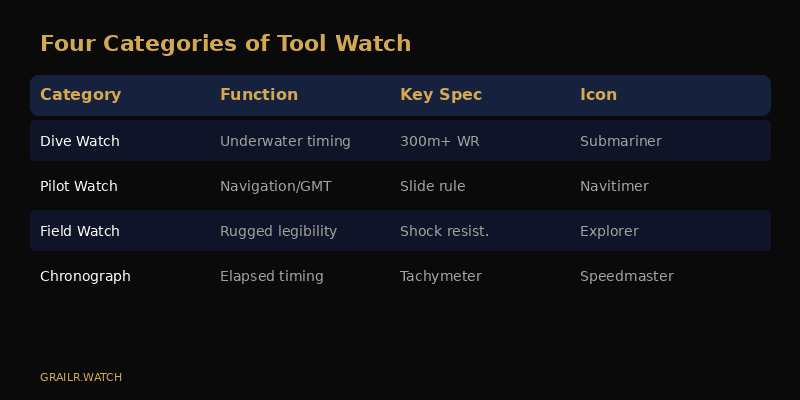
Tool watches divide into four broad families, each engineered around a different operational environment. The boundaries are not rigid — a dive chronograph straddles two categories, and a GMT pilot watch borrows from the field watch’s emphasis on versatility — but the core design brief for each category is distinct enough to shape case construction, dial layout and complication set.
Dive watches are built for underwater legibility and pressure resistance. The defining features are a unidirectional rotating bezel for timing decompression stops, at least 200m of water resistance, luminous markers readable in total darkness and a screw-down crown. Genuine divers carry ISO 6425 certification, which tests for pressure, shock, salt-water corrosion and magnetic resistance beyond a simple depth rating. For a deeper look at specific models, our best scuba diving watches guide covers the current field.
Pilot watches descend from cockpit instruments built for legibility and anti-magnetic protection. Oversized crowns allow operation with flight gloves, high-contrast dials prioritize reading time at a glance, and historically a soft-iron inner case shields the movement from the magnetic fields generated by cockpit electronics. Many modern references add a GMT complication or slide-rule bezel. Our pilot watches guide compares the full current range.
Field watches prioritize all-round durability. They evolved from military watches issued to ground troops, where shock resistance, legibility in low light and moderate water resistance mattered more than deep-dive pressure ratings or cockpit-grade anti-magnetism. Typical case sizes run 38–42mm, smaller and lighter than most dive watches, with a simple time-and-date dial that can be read quickly by torchlight or moonlight. The Hamilton Khaki Field guide is a good place to start for this category.
Chronographs are built around elapsed-time measurement. The classic tool chronograph adds two or three subdials and pushers to start, stop and reset a timer, with a tachymeter scale on the bezel or dial for calculating speed over a known distance. Racing, aviation and medical timing drove early development, and the Omega Speedmaster’s selection for every NASA crewed mission from 1965 remains the category’s defining credential.
| Category | Key Feature | Typical WR | Case Size | Classic Example |
|---|---|---|---|---|
| Dive | Unidirectional bezel, ISO 6425 | 200m+ | 40–44mm | Rolex Submariner |
| Pilot | Oversized crown, anti-magnetic | 50–100m | 39–43mm | IWC Mark XX |
| Field | Shock-resistant, high legibility | 50–100m | 38–42mm | Hamilton Khaki Field |
| Chronograph | Elapsed-time pushers, tachymeter | 50–100m | 39–44mm | Omega Speedmaster |
A Brief History of Tool Watches
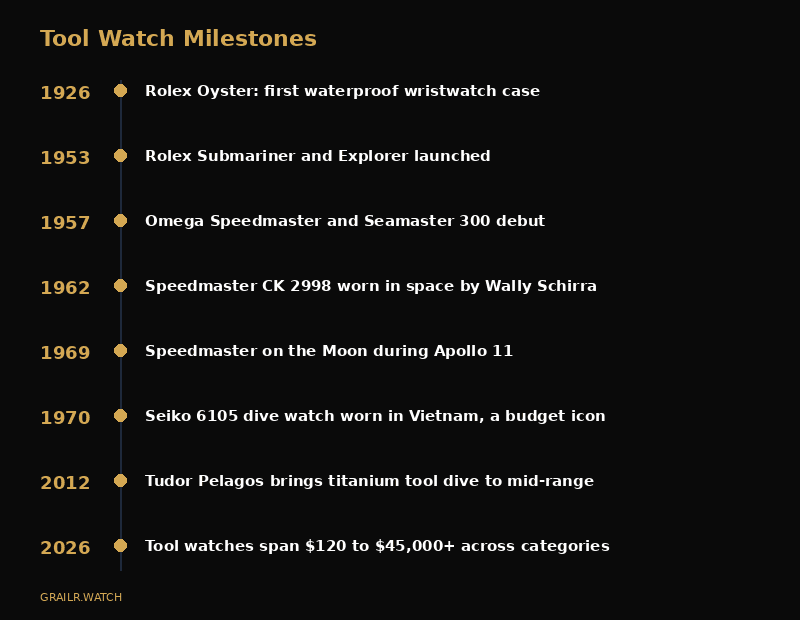
The tool watch as a category traces to a handful of engineering breakthroughs in the first half of the twentieth century. In 1926, Rolex patented the Oyster case — the first commercially successful waterproof wristwatch case — which solved the fundamental problem that had kept mechanical watches out of hostile environments: moisture ingress. Before the Oyster, a wristwatch was a fair-weather instrument; after it, the race to build purpose-specific tool watches could begin.
The pivotal decade was the 1950s. In 1953, Rolex launched both the Submariner — the template every modern dive watch still follows — and the Explorer, conceived for the Everest expeditions and effectively the first purpose-built field watch from a major Swiss house. In 1957, Omega answered with the Speedmaster, designed as a racing and scientific chronograph, and the Seamaster 300, a dive watch built to compete with the Submariner head-on.
The space race gave tool watches their most famous credential. Astronaut Wally Schirra wore an Omega Speedmaster during his Mercury-Atlas 8 flight in 1962, making it the first Omega in space. After NASA tested chronographs from multiple brands to destruction — extreme temperature swings, high g-forces, vacuum exposure and vibration — the Speedmaster was the only one still running, and in 1965 it was certified as flight-qualified for all NASA crewed missions.
On July 20, 1969, Buzz Aldrin wore a Speedmaster on the surface of the Moon during the Apollo 11 mission, cementing the watch’s “Moonwatch” identity and establishing the Speedmaster Professional as the most storied tool chronograph ever made. That pedigree still anchors Omega’s marketing today and commands a premium on the secondary market that has outlasted every fashion cycle since.
Parallel developments shaped the other categories. Military-issue field watches, supplied by Hamilton, Elgin, Bulova and others to ground troops in World War II and Korea, established the rugged, legible, easy-to-service template that civilian field watches still follow. Pilot watches from IWC, Breitling and Laco were originally issued to Luftwaffe and RAF navigators and set the standard for oversized crowns, anti-magnetic shielding and high-contrast dials. By the early 1970s, every major Swiss manufacturer had at least one purpose-built tool watch in its catalog, and the category had moved from military procurement to consumer retail.
Best Tool Watches by Price Tier
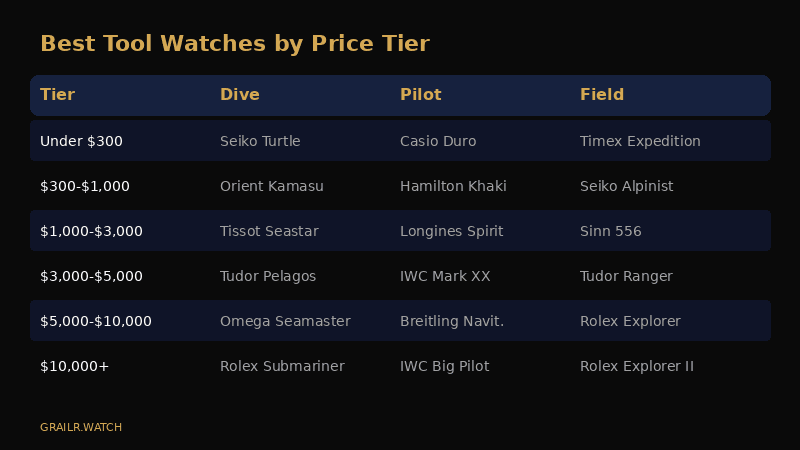
Fifteen picks across four price tiers, from a $50 quartz diver to a $10,250 Rolex Submariner. Each earns its place by meeting the functional requirements of its category rather than by brand cachet alone. Prices are indicative retail figures from the publication date; verify current quotes independently.
| Watch | Category | Movement | Water Resist. | Price |
|---|---|---|---|---|
| Budget ($50–$500) | ||||
| Casio Duro MDV106 | Dive | Quartz | 200m | ~$50 |
| Timex Expedition Scout | Field | Quartz | 50m | ~$60 |
| Orient Kamasu | Dive | F6922 auto | 200m | ~$280 |
| Seiko Prospex Turtle | Dive | 4R36 auto | 200m | ~$375 |
| Mid-Range ($500–$3,000) | ||||
| Hamilton Khaki Field Auto | Field | H-10 auto | 100m | ~$595 |
| Tissot Seastar 1000 | Dive | Powermatic 80 | 300m | ~$775 |
| Sinn 556 A | Field/GADA | SW200-1 | 200m | ~$1,630 |
| Longines Spirit | Field/Pilot | L888.4 (COSC) | 100m | ~$2,400 |
| Luxury ($3,000–$10,000) | ||||
| Tudor Pelagos 39 | Dive | MT5400 | 200m | ~$4,575 |
| IWC Mark XX | Pilot | Cal. 32111 | 100m | ~$5,050 |
| Omega Seamaster 300M | Dive | Cal. 8800 | 300m | ~$5,700 |
| Ultra-Luxury ($7,000+) | ||||
| Omega Speedmaster Professional | Chronograph | Cal. 3861 | 50m | ~$7,000 |
| Breitling Navitimer B01 | Pilot/Chrono | B01 in-house | 30m | ~$9,900 |
| Rolex Submariner Date | Dive | Cal. 3235 | 300m | ~$10,250 |
A few patterns stand out. First, genuine 200m water resistance is available at every price point — the $50 Casio Duro matches the Tudor Pelagos 39 on depth rating alone, though the quality of the case, crystal, movement and finishing are incomparable. Second, in-house movements only appear consistently above $1,500, where the Sinn 556 still uses a third-party Sellita caliber while the Longines Spirit runs a COSC-certified proprietary movement. Third, the jump from $5,700 (Omega Seamaster 300M) to $10,250 (Rolex Submariner) buys brand cachet and secondary-market liquidity more than additional engineering — both are excellent dive watches, and the Omega actually offers METAS Master Chronometer certification that the Rolex does not carry.
For a detailed look at the Tudor and Omega picks in this table, our Tudor Pelagos buying guide and Omega Seamaster buying guide cover the full lineups.
Specs That Actually Matter
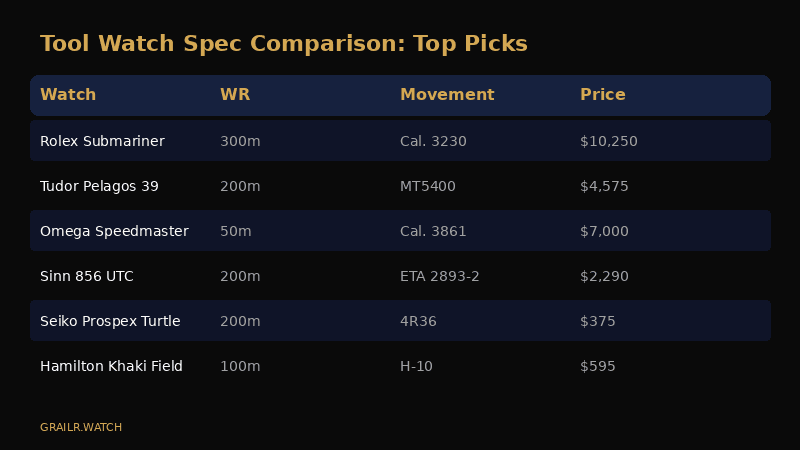
Not every number on a spec sheet matters equally. Water resistance, for instance, is the headline figure for dive watches, but for a field watch that will never go deeper than a rain shower it is largely irrelevant beyond a baseline 50m for splash protection. The specifications that actually distinguish a real tool watch from a fashion piece depend on the category.
Water resistance is tested statically in a pressure chamber, not dynamically at depth, so a 200m rating does not mean the watch is safe for diving at 200 metres with arm movement and temperature changes. ISO 6425 certification goes further: it tests each individual watch to 125% of its rated depth, adds shock, magnetic and salt-water corrosion tests, and requires the crown and crystal to survive impact. A bare “200m WR” rating without ISO 6425 is a pressure rating, not a diving guarantee.
Movement type matters for long-term serviceability. An in-house caliber from Rolex, Omega or Tudor means the manufacturer controls parts supply and can service the watch decades from now. A third-party ETA or Sellita movement is proven and reliable but depends on that supplier’s continued production. A Japanese Miyota or Seiko movement, meanwhile, is typically the most affordable to service but may lack the finishing and regulation of Swiss equivalents. None of these is universally “better” — the question is whether the movement matches the price you are paying and the use you intend.
Anti-magnetism is increasingly relevant in daily life. Modern electronics, phone speakers and laptop clasps expose a watch to magnetic fields far stronger than a mid-century wristwatch ever encountered, and a magnetized hairspring throws accuracy off by minutes per day until the movement is demagnetized. Watches with silicon hairsprings or dedicated anti-magnetic shielding — the Omega Master Chronometer standard requires resistance to 15,000 gauss — are effectively immune, while unshielded movements from brands like Sinn use specialized alloys for partial protection.
Crystal material is the last spec that matters at the point of purchase. Mineral glass, used on budget tool watches like the Casio Duro and Orient Kamasu, is harder than acrylic and adequate for daily wear, but scratches more easily than sapphire and shatters rather than cracks under impact. Sapphire crystal, standard on watches above roughly $500, is effectively scratch-proof in normal use but can chip on a hard edge strike. A few heritage-focused models still use hesalite acrylic — notably the Omega Speedmaster Professional “Moonwatch” in its standard reference — which scratches readily but resists shattering better than either alternative and can be polished smooth at home with a tube of Polywatch.
The GADA Watch: Go Anywhere, Do Anything
The collector community has coined a term for the tool watch that does not specialize: GADA, short for Go Anywhere, Do Anything. A GADA watch is versatile enough to handle a desk job, a weekend hike, a pool swim and a casual dinner without looking out of place at any of them. It does not dive to 500m or time a 1/10-second lap split, but it handles the environments most people actually encounter, every day, without complaint.
The ideal GADA profile is specific: moderate case size (38–42mm, comfortable under a dress-shirt cuff and on a smaller wrist), at least 100m of water resistance (enough for swimming and rain, not just hand-washing), a legible dial with enough lume for a dark room, and enough shock resistance that you are not nervous wearing it during yard work or a bike ride. The Sinn 556 A at $1,630 and the Hamilton Khaki Field Auto at $595 are two of the most commonly cited GADA watches, though both lean toward the field-watch end of the spectrum.
The GADA concept has reshaped how many buyers think about tool watches. Rather than building a collection of specialists — a diver, a field watch, a chronograph — more buyers now look for a single watch that covers 90% of real-world scenarios. That thinking favours moderate proportions and clean dial design over extreme depth ratings or niche complications, and it is one reason mid-size field watches and versatile divers like the Tudor Pelagos 39 have gained market share against larger, more specialized references.
Use Grailr’s appraisal tool to check indicative pricing on any GADA candidate before you commit. It is a starting point for due diligence, not proof of value or authenticity — pair it with an independent inspection.
Check Any Watch Price in Seconds
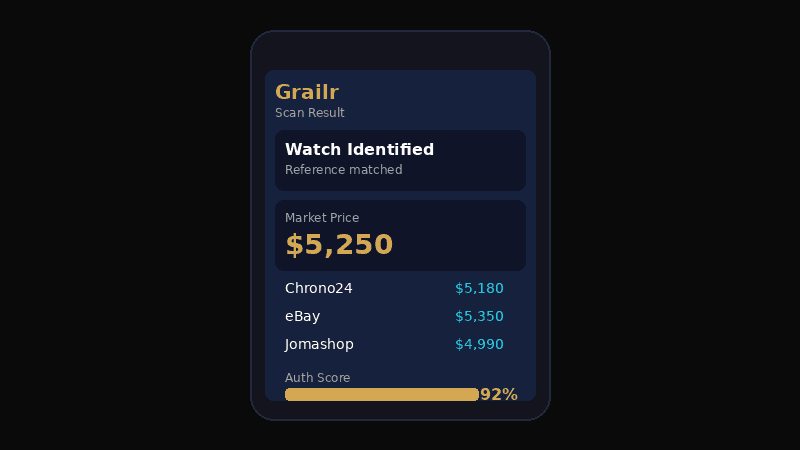
Grailr scans your watch photo and pulls live pricing from Chrono24, eBay, and Jomashop.
- AI identifies brand, model & reference number
- Live market prices from 3+ sources
- Authentication confidence score
5 Tips Before You Buy a Tool Watch
1. Decide Your Primary Environment
A dive watch, a field watch and a chronograph solve fundamentally different problems. If you spend weekends underwater, prioritize a unidirectional bezel and ISO 6425 certification. If you need a daily beater for mixed terrain and casual settings, a field watch or GADA piece with 100m water resistance and moderate proportions will serve better than a 44mm dive watch under a dress shirt.
2. Try It on Your Wrist First
Tool watches vary enormously in wrist presence. A 42mm dive watch with a thick case and wide bezel wears far larger than a 42mm field watch with slim lugs. Crown guards, bezel height and bracelet taper all affect how the watch sits on different wrist sizes. Visit a boutique or authorised dealer and wear the candidate watch for at least fifteen minutes before committing, especially above $1,000.
3. Verify the Actual Water Resistance
A watch rated to 50m should not go swimming. A watch rated to 100m can handle a pool. Only 200m-rated watches with screw-down crowns are reliably safe for snorkelling and recreational diving, and ISO 6425 certification is the only standard that actually tests diving performance. Do not assume the number printed on the caseback is a diving guarantee.
4. Photograph Before You Pay
Use Grailr’s free identification tool to photograph a listing and get a suggested model identification alongside an indicative price estimate. It is a starting point for due diligence, not proof of authenticity — pair it with an independent inspection before you send payment.
5. Budget for the Bracelet
A steel bracelet with a proper micro-adjust clasp can add $200–$800 to the price of a tool watch compared with the strap-only version. It also changes the wearing experience dramatically. If the budget is tight, a good aftermarket rubber or NATO strap lets you defer the bracelet cost without compromising the watch itself, and many collectors prefer fabric or rubber on a tool watch anyway for weight and comfort.
Frequently Asked Questions
What is a tool watch?
A tool watch is a timepiece designed around a specific function, where every element on the case, dial and bezel serves a measurable purpose. The four main categories are dive watches, pilot watches, field watches and chronographs. The defining trait is that design follows function rather than aesthetics.
What is the best tool watch under $500?
The Seiko Prospex Turtle at around $375 offers a genuine ISO 6425-certified dive watch with an automatic movement, 200m water resistance and a day-date complication. For even less, the Casio Duro MDV106 at around $50 delivers 200m water resistance and a unidirectional bezel on a quartz movement, making it arguably the best value tool watch ever made.
Is a dive watch a tool watch?
Yes, a dive watch is one of the four main categories of tool watch. Genuine dive watches are built to ISO 6425 standards with a unidirectional timing bezel, at least 200m of water resistance, luminous markers readable in darkness and a case designed to withstand underwater pressure. Not every water-resistant watch qualifies; only those engineered specifically for diving meet the standard.
What does GADA mean in watches?
GADA stands for Go Anywhere, Do Anything. It describes a tool watch versatile enough to handle everyday situations without specializing in one environment. A true GADA watch typically combines moderate water resistance (100m or more), legible dial design, moderate case size (38 to 42mm) and enough shock resistance for outdoor wear. The Hamilton Khaki Field and Sinn 556 are popular examples.
Do I need ISO 6425 certification for recreational diving?
Strictly speaking, no. Most recreational divers rely on a dive computer for timing and depth rather than a bezel, and any watch rated to 200m will handle typical recreational depths. However, ISO 6425 certification means the watch has been tested to specific shock, pressure and legibility standards beyond a simple pressure rating, so it provides a meaningful guarantee of reliability underwater that a bare water-resistance number alone does not.
What is the difference between a tool watch and a dress watch?
A tool watch prioritizes function: thick cases, robust crowns, high water resistance, luminous markers and bezels designed for measurement. A dress watch prioritizes aesthetics and slim profile: thin cases, minimal dials, precious metals and the ability to slide under a shirt cuff. Some modern watches blur the line, but the core distinction is whether design serves a task or an appearance.
Which tool watch holds its value best?
Among production tool watches, the Rolex Submariner has the strongest resale track record, frequently trading at or above retail price. The Omega Speedmaster Professional and Tudor Pelagos also retain value well, indicatively in the 85 to 95 percent range. Budget tool watches like the Seiko Turtle and Hamilton Khaki Field depreciate more steeply, typically to 55 to 70 percent of retail, but their lower entry prices mean the absolute dollar loss is smaller.
Related Articles
The Bottom Line
A tool watch is not defined by price, brand or material — it is defined by whether every element on the watch serves a function. A $50 Casio Duro with 200m water resistance and a unidirectional bezel is as much a tool watch as a $10,250 Rolex Submariner; the difference is in finishing, movement quality and secondary-market liquidity, not in functional category.
For most buyers, the right entry point is the mid-range tier: the Hamilton Khaki Field Auto at $595 for a field/GADA watch, the Tissot Seastar 1000 at $775 for a dive watch, or the Sinn 556 A at $1,630 for a do-everything daily wearer. Each meets the functional requirements of its category without demanding a luxury-tier budget. Whichever you choose, verify the exact reference, current market price and condition before you commit; a listing description and a photograph are a starting point, not a guarantee.
Found a Tool Watch You Like?
Grailr uses a photo to suggest a watch identity and an indicative price estimate, with active listings where available. Check the exact reference and condition independently; a photo scan cannot authenticate a watch.
Scan a Watch NowSources and price context
- Rolex Submariner collection — Official specifications, case materials and water resistance for the current Submariner lineup.
- Omega Speedmaster collection — Movement specifications, NASA flight qualification history and current Moonwatch reference details.
These primary sources support the specifications and history noted above. Prices and resale percentages elsewhere in this guide are indicative editorial figures, not a verified transaction dataset or guaranteed returns. Confirm the exact reference, region, condition and current quote before buying; asking prices are not completed-sale prices.