Tudor GMT Buying Guide: Every Model, Price & Resale
Four GMT watches, one movement family, a wide spread in price and purpose — here is how the Black Bay GMT, Black Bay Pro, BB 58 GMT, and Pelagos FXD GMT actually stack up.
Price context: this guide includes indicative prices from its original publication period. They have not all been refreshed to current quotes. Use the linked primary sources for specifications and policies, and verify prices independently.
- Tudor offers four distinct GMT watches ranging from ~$3,300 pre-owned to ~$5,650 retail, all powered by in-house Kenissi movements
- The Black Bay GMT (M79830RB) is the most affordable on the secondary market at ~$3,400, while the BB 58 GMT trades near retail
- The new Black Bay 58 GMT is Tudor’s first GMT with METAS Master Chronometer certification via the MT5450-U caliber
- The Pelagos FXD GMT is the only titanium option, designed for French Navy divers with fixed strap bars — no bracelet
- Tudor GMT watches deliver comparable dual-time-zone functionality to the Rolex GMT-Master II at roughly half the retail price
Tudor’s Four GMT Watches
Tudor’s GMT collection has grown quietly from a single model into a four-watch family, each built around a variant of the same in-house Kenissi movement architecture. What separates them is not the complication itself — all four track two time zones — but how the case, bezel, and strap configuration shape the wearing experience and the price.
The Black Bay GMT (M79830RB) launched in 2018 as Tudor’s first modern GMT. At 41mm in steel with a burgundy-and-blue “Pepsi” ceramic bezel, it uses the MT5652 caliber — a “caller” GMT where only the 24-hour hand jumps independently. Retail runs $4,925 on fabric or $5,275 on the rivet bracelet, and pre-owned examples settle around $3,400, making it the value entry point for the range.
The Black Bay Pro (M79470) takes a different approach: a fixed 24-hour bezel, a yellow GMT hand, and a 39mm case that draws obvious inspiration from the Rolex Explorer II. It shares the same MT5652 movement but sits at ~$4,610 retail, with pre-owned prices around $3,300. The fixed bezel means you read a second time zone directly off its markings rather than rotating an insert.
The Black Bay 58 GMT is Tudor’s newest GMT addition and the most technically advanced. It pairs a 39mm case with the MT5450-U — the first Tudor GMT movement to earn METAS Master Chronometer certification, the same standard Omega uses. Retail sits between $5,275 and $5,650 on the new five-link bracelet with T-Fit rapid adjustment, and the secondary market has not yet discounted it meaningfully.
The Pelagos FXD GMT is the outlier: a 42mm titanium case with fixed strap bars welded to the lugs, developed alongside French Navy combat swimmers. There is no bracelet option and no plan for one — you wear it on fabric or rubber. At ~$5,475 retail, it is the most expensive Tudor GMT after the BB 58 GMT on bracelet, but the titanium construction makes it noticeably lighter on the wrist than any steel option in the lineup. For a deeper look at the full Pelagos family, see our Tudor Pelagos buying guide.
Full Specifications and Pricing
| Model | Case | Movement | Bezel | Retail | Pre-Owned |
|---|---|---|---|---|---|
| Black Bay GMT | 41mm steel | MT5652 | Rotating, Pepsi ceramic | $4,925–$5,275 | ~$3,400 |
| Black Bay Pro | 39mm steel | MT5652 | Fixed 24-hour | ~$4,610 | ~$3,300 |
| Black Bay 58 GMT | 39mm steel | MT5450-U | Rotating, burgundy/blue | $5,275–$5,650 | Near retail |
| Pelagos FXD GMT | 42mm titanium | COSC, 70hr | Fixed, fabric only | ~$5,475 | Near retail |
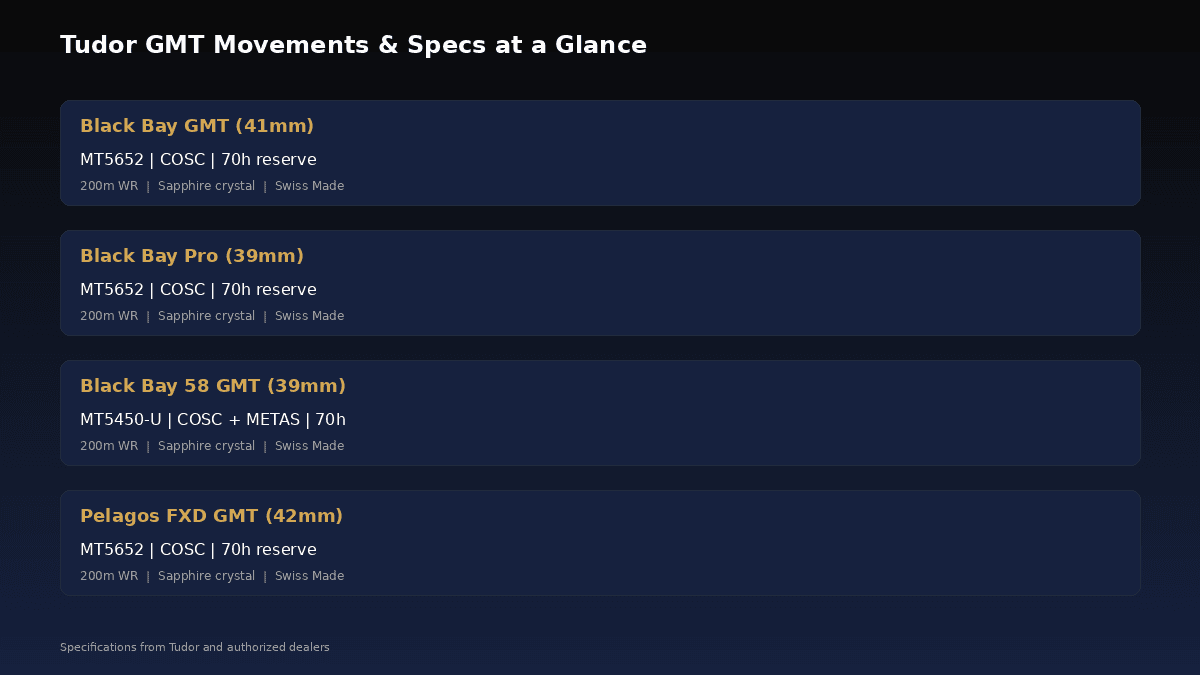
Every movement in the lineup carries a 70-hour power reserve, which means a Tudor GMT left on the nightstand over a long weekend is still running when you pick it up on Monday. The certification split matters more: the BB 58 GMT’s MT5450-U adds METAS testing for magnetic resistance and accuracy on top of COSC, while the other three rely on COSC alone. All four are rated to 200m water resistance. The biggest practical difference is the bezel — the Black Bay GMT and BB 58 GMT rotate bidirectionally, the Pro’s is fixed, and the FXD GMT’s is fixed by design for its military application.
How Each Tudor GMT Compares
Black Bay GMT vs Black Bay Pro. These two share the MT5652 caliber and 200m of water resistance, but the wearing experience is different. The BB GMT at 41mm with a rotating Pepsi bezel looks and acts like a classic travel watch — set the bezel to a third time zone reference, read the second on the 24-hour hand. The Pro at 39mm with a fixed yellow-accented bezel is more of a field/GMT hybrid in the Explorer II mould: you read both zones from the dial without touching the bezel. On the wrist, that 2mm difference is significant. The Pro wears smaller and flatter, while the BB GMT has more wrist presence. If you cross-shop these two, the Pro’s smaller footprint and lower retail price make it the easier everyday watch, but the BB GMT’s rotating bezel adds a layer of functionality the Pro simply cannot match.
BB 58 GMT vs Pelagos FXD GMT. These are the two newer, more expensive options, and they could hardly be more different in philosophy. The BB 58 GMT is Tudor’s most refined GMT — a 39mm steel case on a five-link bracelet with T-Fit micro-adjustment and the lineup’s only METAS-certified movement. It is built for the buyer who wants the best technical specification Tudor offers in a versatile, wearable size. The Pelagos FXD GMT is the opposite: a 42mm titanium tool watch with welded strap bars that eliminate bracelet wear entirely. It was developed for French Navy combat divers and prioritizes light weight, corrosion resistance, and strap security over versatility. If you want one watch that can dress up slightly, the BB 58 GMT wins. If you want a purpose-built travel instrument and do not mind committing to fabric or rubber, the FXD GMT delivers something no steel Tudor can.
All four models run the same “caller” GMT complication, where the independently adjustable hand is the 24-hour hand rather than the local hour hand. This is the same approach Rolex uses on its GMT-Master II and the format most travelers will find intuitive once they adjust: leave the main hands on home time, jump the GMT hand to your destination zone.
Check Any Watch Price in Seconds
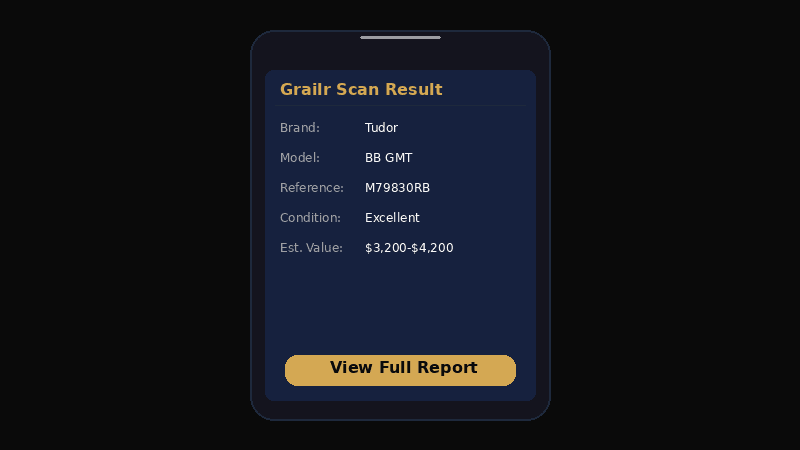
Grailr scans your watch photo and pulls live pricing from Chrono24, eBay, and Jomashop.
- AI identifies brand, model & reference number
- Live market prices from 3+ sources
- Authentication confidence score
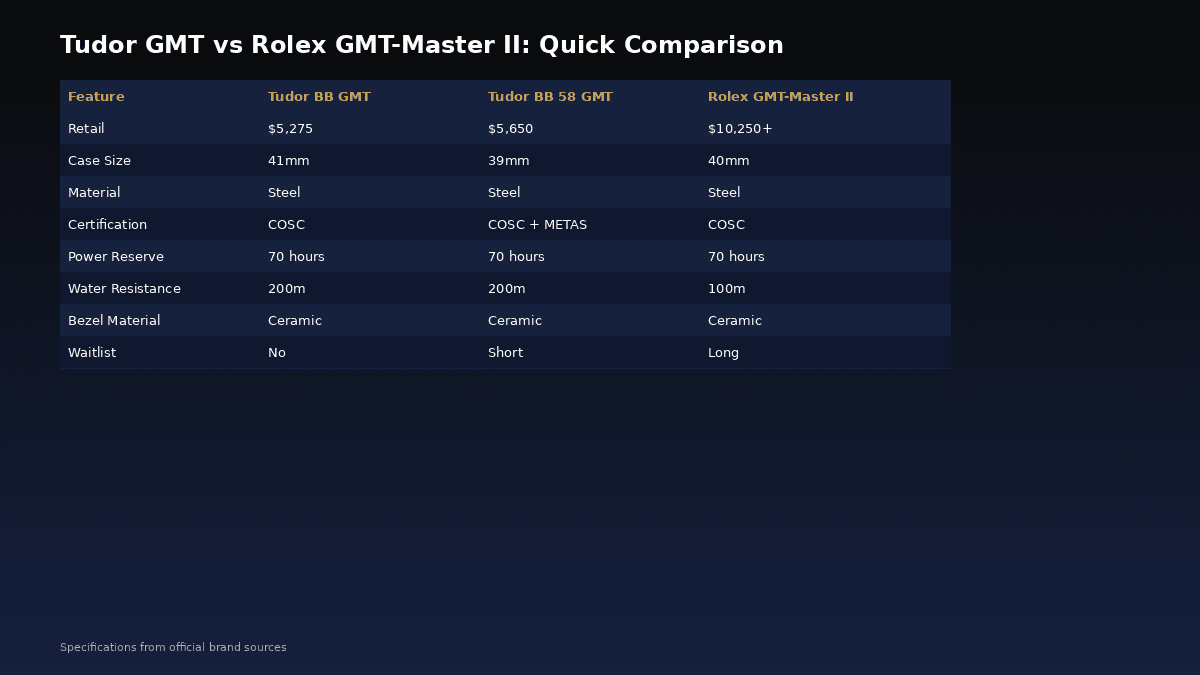
Tudor GMT vs Rolex GMT-Master II
The comparison is unavoidable: Tudor is owned by the same parent company as Rolex, uses Rolex’s distribution network, and the Black Bay GMT’s Pepsi bezel is an obvious nod to the GMT-Master lineage. But the ownership experience could not be more different. The Rolex GMT-Master II starts at roughly $10,250 retail and carries significant waitlists at most authorized dealers, while every Tudor GMT is available at or near retail without a relationship. For a thorough look at the Rolex side, see our Rolex GMT-Master II guide and our breakdown of the Pepsi, Batman & Sprite references.
| Attribute | Tudor BB GMT | Tudor BB 58 GMT | Rolex GMT-Master II |
|---|---|---|---|
| Retail price | $4,925–$5,275 | $5,275–$5,650 | ~$10,250+ |
| Case size | 41mm | 39mm | 40mm |
| Movement | MT5652 (COSC) | MT5450-U (METAS) | 3285 (COSC, Superlative) |
| Power reserve | 70 hours | 70 hours | 70 hours |
| Water resistance | 200m | 200m | 100m |
| Availability | In stock at most ADs | Available | Waitlist |
| Bezel insert | Ceramic, bidir. | Ceramic, bidir. | Ceramic, bidir. |
On paper the movements are remarkably close: 70-hour power reserves on both sides, COSC certification standard, and the BB 58 GMT actually adds METAS on top. Tudor also offers 200m of water resistance versus Rolex’s 100m on the GMT-Master II. Where Rolex wins decisively is in brand cachet, finishing quality at the macro level, and resale history — a used GMT-Master II routinely trades above retail, which no Tudor GMT does. The question is whether that premium is worth roughly double the money and a waitlist. For many buyers it is not, and Tudor offers genuine in-house watchmaking at a price that makes the complication accessible rather than aspirational.
Resale Value Across the Range
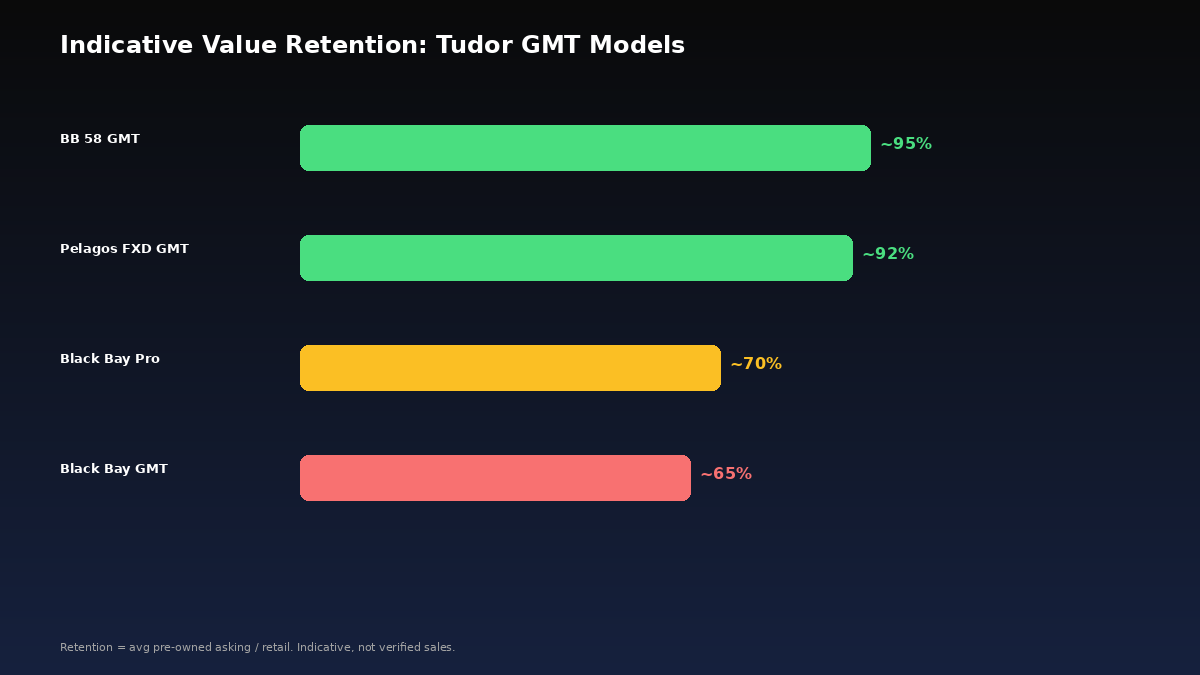
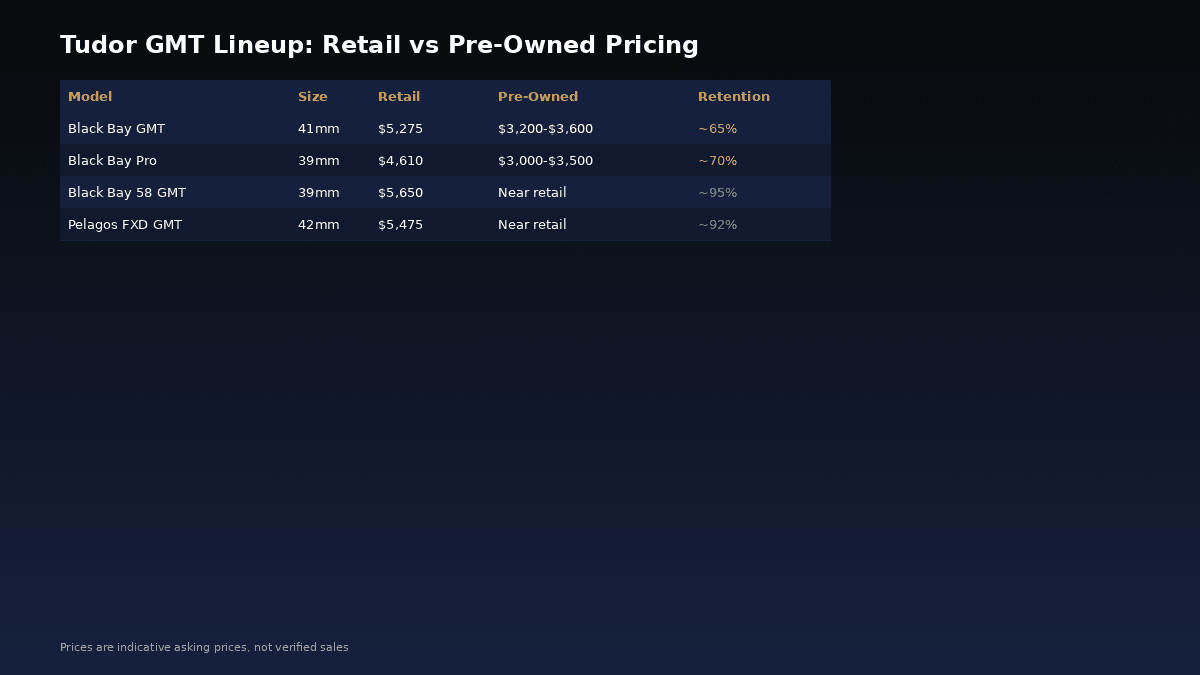
Resale performance across the Tudor GMT range follows a clear pattern: newer models with tighter supply hold value best, while the original Black Bay GMT — now several years into production — shows the widest gap between retail and secondary pricing. The BB GMT trades around $3,400 pre-owned against a $5,275 bracelet retail, which works out to roughly 65% retention. That is not catastrophic for a mid-range Swiss sport watch, but it means a buyer who purchases at retail should expect meaningful depreciation if they sell within the first few years.
The Black Bay Pro sits in similar territory at ~$3,300 against ~$4,610 retail, roughly 72% retention. The two newer models — the BB 58 GMT and Pelagos FXD GMT — both trade near their retail prices on the secondary market, helped by limited initial supply and strong collector interest. Whether that holds as production ramps up remains to be seen, but for now they are the strongest performers in the family.
None of these figures represent guaranteed returns or completed-sale prices. They are indicative asking prices drawn from major marketplaces and intended as a directional reference. Condition, box-and-papers status, and seller reputation shift real transaction prices by several hundred dollars in either direction. If resale matters to your purchase decision, verify current listings independently and recognize that asking prices are not the same as sold prices. For broader context, our Tudor Black Bay guide covers the steel side of the catalog where many of these buyers cross-shop.
How to Choose the Right Tudor GMT
1. Set Your Budget Range First
If you are buying pre-owned and want to spend under $3,500, the Black Bay GMT and Black Bay Pro are your only realistic options. If you are buying at retail and can stretch to $5,500+, the BB 58 GMT offers the best specification for the money. The FXD GMT sits between them but requires commitment to fabric or rubber straps.
2. Decide Between Bracelet and Strap
The Pelagos FXD GMT’s fixed strap bars are non-negotiable — there is no aftermarket bracelet conversion. If you want the option of a metal bracelet on any given day, you must choose one of the three Black Bay models. The BB 58 GMT’s T-Fit bracelet with rapid micro-adjustment is the most comfortable in the lineup.
3. Consider Case Size on Your Wrist
The range spans 39mm to 42mm, which is a meaningful spread on the wrist. The Pro and BB 58 GMT at 39mm suit wrists under 7 inches comfortably. The BB GMT at 41mm and FXD GMT at 42mm carry more presence but can overwhelm a smaller wrist. Try before you buy, or measure your wrist against lug-to-lug distances if buying online.
4. Scan Before You Commit
Use Grailr’s free scanner to photograph a listing and get a suggested model identification alongside live pricing pulled from multiple marketplaces. It is a starting point for due diligence, not proof of authenticity — pair it with an independent inspection before you send payment.
5. Weigh METAS Certification
If having the most stringent accuracy and magnetic-resistance certification matters to you, the BB 58 GMT is the only Tudor GMT that delivers it. The other three are COSC-certified only, which is still excellent but does not include the additional magnetic and accuracy testing METAS requires. For most daily wearers the difference is academic, but for collectors who value specs it is a clear tiebreaker.
Frequently Asked Questions
What Tudor GMT watches are currently available?
Tudor currently offers four GMT watches: the Black Bay GMT (41mm, M79830RB), the Black Bay Pro (39mm, M79470), the Black Bay 58 GMT (39mm, new for 2025/2026), and the Pelagos FXD GMT (42mm titanium). All use in-house Kenissi movements with 70-hour power reserves.
How much does a Tudor Black Bay GMT cost?
The Black Bay GMT retails for $4,925 on a fabric strap or $5,275 on the rivet bracelet in 2026. Pre-owned examples trade around $3,400, making it the most affordable Tudor GMT on the secondary market.
Is the Tudor Black Bay GMT a true GMT watch?
The Black Bay GMT is a caller GMT, meaning the 24-hour hand jumps independently in one-hour increments while the local hour and minute hands remain set to your home time. It tracks two time zones, but you set the travel zone on the 24-hour hand rather than the main dial.
What is the difference between the Tudor FXD GMT and the Black Bay GMT?
The Pelagos FXD GMT uses a 42mm titanium case with fixed strap bars that accept only fabric or rubber straps, never a bracelet. The Black Bay GMT uses a 41mm steel case compatible with both a rivet bracelet and fabric strap. The FXD GMT was designed for French Navy divers; the Black Bay GMT targets everyday travelers.
How does the Tudor GMT compare to the Rolex GMT-Master II?
Tudor GMT watches start at roughly $4,600 retail, while the Rolex GMT-Master II begins at about $10,250 with significant waitlists. Both brands use COSC-certified in-house movements with 70-hour power reserves. Tudor offers similar dual-time-zone functionality at roughly 50-55% of the Rolex price.
Which Tudor GMT has the best resale value?
The Black Bay 58 GMT and Pelagos FXD GMT both trade near their retail prices on the secondary market because they are newer releases with limited supply. The Black Bay GMT, being the oldest and most widely available, shows the largest gap between retail and pre-owned pricing at roughly 65-70% retention.
Related Articles
The Bottom Line
Tudor’s GMT lineup is one of the strongest value propositions in Swiss watchmaking: four genuinely different watches sharing a proven in-house movement architecture, priced between roughly $4,600 and $5,650 at retail — less than half of what Rolex charges for comparable GMT functionality. The Black Bay GMT remains the most accessible on the secondary market, the Pro is the most wearable daily option at 39mm, the BB 58 GMT is the technical flagship with METAS certification, and the Pelagos FXD GMT is the lightweight titanium tool watch for buyers who prize function over versatility. Whichever you choose, verify the exact reference, serial, and condition before committing; a listing photo is a starting point, not a guarantee.
Found a Tudor GMT You Like?
Grailr uses a photo to suggest a watch identity and an indicative price estimate, with active eBay listings where available. Check the exact reference and condition independently; a photo scan cannot authenticate a watch.
Get an Indicative EstimateSources and price context
- Tudor Black Bay GMT collection — Official specifications for the Black Bay GMT, including case dimensions, movement details, and water resistance ratings.
- WatchTime: Tudor Black Bay 58 GMT review — Independent review of the BB 58 GMT covering the MT5450-U movement, METAS certification, and T-Fit bracelet.
These primary sources support the specifications and history noted above. Prices and resale percentages elsewhere in this guide are indicative editorial figures, not a verified transaction dataset or guaranteed returns. Confirm the exact reference, region, condition and current quote before buying; asking prices are not completed-sale prices.