Vintage Rolex Guide: References Worth Chasing
From the no-date Submariner 5513 to the six-figure Daytona 6263 — the definitive references, real market prices, and hard-won buying advice for 2026 collectors.
Price context: this guide includes indicative prices from its original publication period. They have not all been refreshed to current quotes. Use the linked primary sources for specifications and policies, and verify prices independently.
- “Vintage Rolex” generally means pre-2000 references — watches built with acrylic crystals, tritium lume, and older-generation movements
- Collectible references range from $3,000 (Datejust 1601) to well into seven figures (Paul Newman Daytona 6239)
- Dial originality is the single biggest value driver — a refinished dial can cut a watch’s worth by 30–50%
- Box and papers add 10–30% to the price, but service history and provenance matter more than the box alone
What Counts as Vintage Rolex
There is no official cutoff, but most specialist dealers and auction houses draw the line at the year 2000. Some purists push it back to 1990. The distinction is not arbitrary — it tracks real changes in how Rolex built its watches. Pre-2000 references share a set of characteristics that modern production has moved past entirely: acrylic (Plexiglas) crystals instead of sapphire, tritium-based luminous material on dials and hands, older-calibre movements without Parachrom hairsprings or Paraflex shock absorbers, and thinner cases that sit closer to the wrist.
These are not deficiencies. Acrylic crystals can be polished out on a workbench — try that with a scratched sapphire. Tritium dials age in ways that create the patina collectors spend decades hunting for. And the slimmer proportions of a 1960s Submariner or Explorer feel nothing like the 40–41mm tool watches Rolex produces today. That gap between old and new is exactly what drives the vintage market.
Before 1963, Rolex used radium-based luminous paint. Radium dials are highly collectible — they produce a distinctive creamy patina and, in some cases, a warm orange glow under UV light — but they are regulated material in many jurisdictions. If you are buying a radium-dial piece, check your country’s import and ownership rules before bidding at an international auction.
One more distinction worth understanding: “tropical” dials. When certain lacquer formulations age under prolonged UV exposure, black dials shift to rich chocolate, tobacco, or caramel tones. These colour-changed dials — nicknamed “tropical” by collectors — command enormous premiums. A tropical-dial Submariner 5513 can sell for three to five times the price of an identical reference with a standard black dial. The effect cannot be replicated artificially, which is why the market rewards it.
The Most Collectible Vintage References
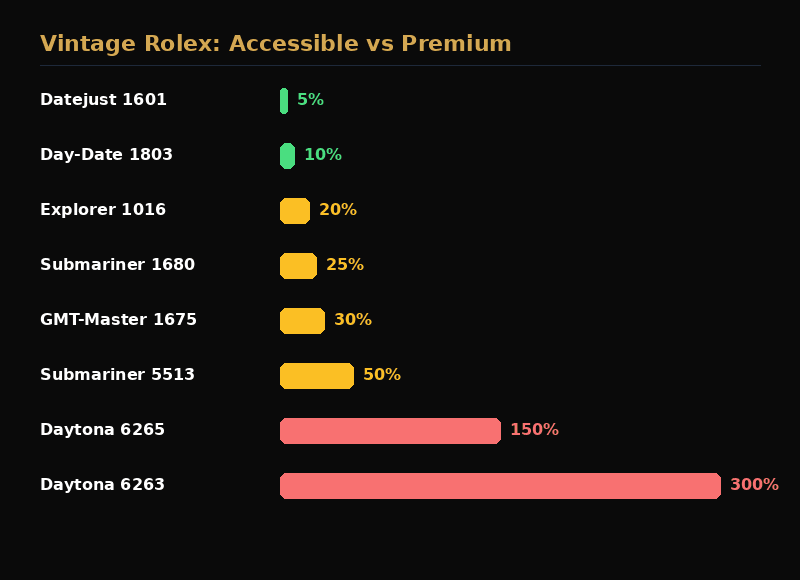
Vintage Rolex prices span an enormous range. A clean-dial Datejust 1601 trades for the price of a new Apple Watch Ultra, while the rarest Paul Newman Daytonas have cleared eight figures at auction. The table below covers the references that appear most frequently in dealer inventories and auction catalogues in 2026, with indicative market ranges for examples in honest, original condition.
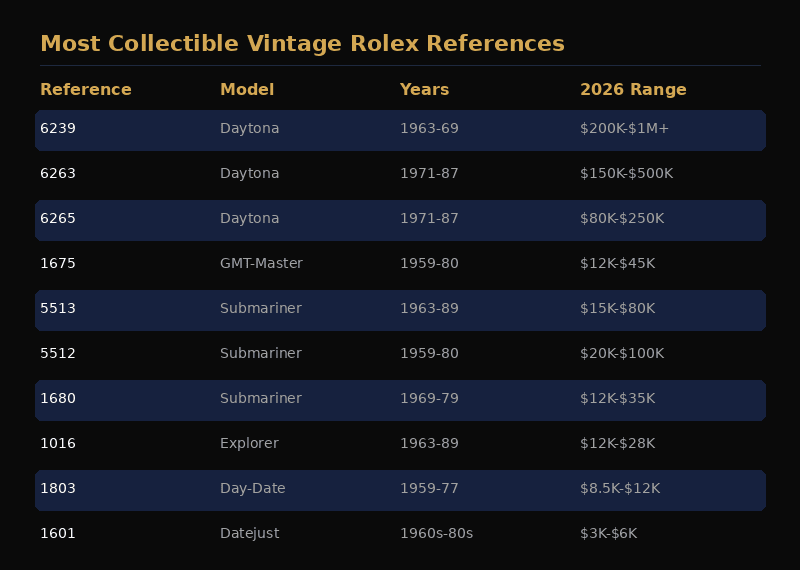
| Reference | Model | Years | Original MSRP | 2026 Range |
|---|---|---|---|---|
| 5513 | Submariner (no date) | 1963–1989 | $160–$175 | $15,000–$80,000 |
| 5512 | Submariner (COSC) | 1959–1980 | ~$165 | $18,000–$90,000 |
| 1680 | Submariner Date | 1969–1979 | ~$250 | $14,000–$65,000 |
| 1016 | Explorer | 1963–1989 | $205–$220 | $12,000–$28,000 |
| 1675 | GMT-Master (“Pepsi”) | 1959–1980 | $245–$275 | $12,000–$45,000 |
| 6263 | Daytona (pump pushers) | 1971–1988 | ~$600 | $150,000+ |
| 6239 | Daytona (“Paul Newman”) | 1963–1969 | ~$200 | $500,000–$5,000,000+ |
| 1601/1603 | Datejust | 1960s–1970s | ~$200 | $3,000–$6,000 |
| 1803 | Day-Date (“President”) | 1960s–1970s | ~$1,500 | $8,500–$12,000 |
Ranges reflect examples with original dials in honest condition. Tropical dials, military provenance, celebrity ownership, and other exceptional factors push prices well above these bands. Original MSRPs are approximate period retail prices in USD.
Submariner 5513 — The Collector’s Entry Point
The 5513 ran for 26 years — the longest production span of any Submariner reference. It was a no-date, no-COSC tool watch: Rolex at its most utilitarian. Early examples with “gilt” dials (gold text on a glossy black lacquer background) from the 1960s are the most valuable, often trading above $50,000. Later “matte” dial versions from the 1970s are more accessible, typically in the $15,000–$25,000 range for clean examples with matching tritium lume on hands and indices.
What made the 5513 special was its honesty. No chronometer certification, no date complication, no cyclops lens. Just 200 metres of water resistance and a rotating bezel. The market rewarded that simplicity: adjusted for inflation, a 5513 purchased for $175 in 1966 and kept in original condition has appreciated by roughly 14,000%.
GMT-Master 1675 — The Rising Star
The 1675 is the vintage reference that has moved most aggressively in 2026. Median asking prices are up 48% year over year, driven partly by the modern GMT-Master II’s continued waitlist scarcity and partly by a generational shift in collector taste toward sport watches with genuine tool-watch heritage. Originally priced at $245–$275, clean-dial examples with faded “Pepsi” bezels now trade between $12,000 and $45,000 depending on era, dial variant, and condition.
The 1675 was Pan Am’s cockpit companion for two decades. That aviation provenance, combined with the visual pop of the red-and-blue bezel insert, makes it one of the most recognisable vintage Rolex references on the market. If you can find a “Mark I” long-E dial from the late 1960s with a faded “ghost” bezel, you are looking at a watch that could reasonably double in value over the next decade — though no return is ever guaranteed.
Daytona 6263 and 6239 — The Grail Tier
The manual-wind Daytonas are the watches that put vintage Rolex on the front page. The 6263 (screw-down pushers, acrylic crystal) is the reference most serious collectors target as a “forever” hold, with standard dials beginning around $150,000 and exotic “Paul Newman” dial variants pushing well past $500,000. The 6239 — the original cosmograph Daytona, and the specific reference Paul Newman himself wore daily — is a seven-figure watch in any configuration with a Newman dial.
Newman’s personal 6239 sold at Phillips in 2017 for $17.75 million. That sale did not create the Daytona market — it already existed — but it crystallised a price floor beneath every exotic-dial Cosmograph that has held firm through multiple corrections since. These are not watches you buy casually. They demand deep expertise, trusted sourcing, and a willingness to spend more on authentication than most people spend on a car.
What Drives Vintage Rolex Prices
Dial Originality
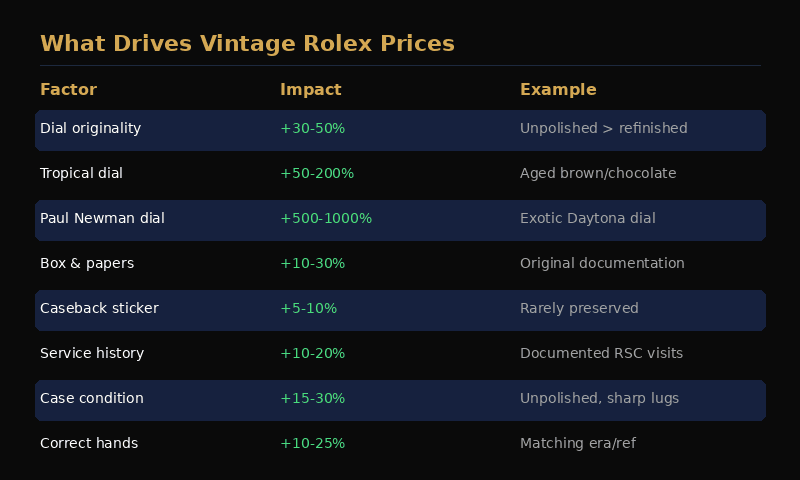
Nothing affects value more than the dial. A refinished dial — one that has been repainted, re-lumed, or had its text retouched — can reduce a vintage Rolex’s price by 30–50% compared to an identical reference with an untouched original dial. The market is ruthless on this point because the dial is the face of the watch, and once it has been refinished it can never be un-refinished.
How do you tell? Original dials show consistent ageing across the entire surface. The lume plots (the luminous dots on the indices) should match the colour of the lume on the hands. Font spacing and printing quality should be consistent with the known production standards for that reference and era. A refinished dial often has unnaturally crisp text, overly uniform colour, or visible paint buildup around the lettering. When in doubt, ask the seller for macro photographs and compare them to known originals in reference books or trusted online databases. Learning to spot fakes and refinished parts is an essential skill for any vintage buyer.
Tritium vs Luminova
Rolex switched from tritium to Luminova (and later Super-LumiNova) around 1998–2000. Tritium has a half-life of roughly 12.3 years, which means dials from the 1960s and 1970s have long since stopped glowing in the dark. That dead lume is part of the charm: it produces a warm, creamy patina that Luminova cannot replicate. A watch with matching tritium patina on both dial and hands is described as having “matching plots” — and that consistency can add thousands to the price.
Case Condition and Polishing History
Vintage Rolex cases were thinner than modern ones, and aggressive polishing wears through the metal. A case that has been heavily polished loses its original brushed-and-polished surface finishing, and the lugs become noticeably thinner. Collectors call these “over-polished” cases, and they trade at a meaningful discount. The ideal is a case with original surface texture and sharp lug geometry — what the market calls “thick” or “fat” lugs.
Box, Papers, and Provenance
Original box and papers add 10–30% to a vintage Rolex’s value, depending on the reference and era. For truly rare pieces — early Daytonas, military-issue Submariners, watches with documented celebrity ownership — provenance documentation can multiply the price many times over. Even a simple purchase receipt from the original authorised dealer is worth preserving.
Service History
A double-edged sword. Regular servicing keeps the movement healthy, but Rolex Service Centres have historically replaced dial, hands, and bezel inserts with current-production parts during overhaul. A 1970s Submariner that went through Rolex service in 2015 may have come back with a modern SuperLuminova dial and new handset — technically correct, but stripped of every detail that made it collectible. The best-case scenario is a watch serviced by an independent vintage specialist who maintained the movement without touching the cosmetics. Ask for service records and, critically, ask whether any parts were replaced during each service.
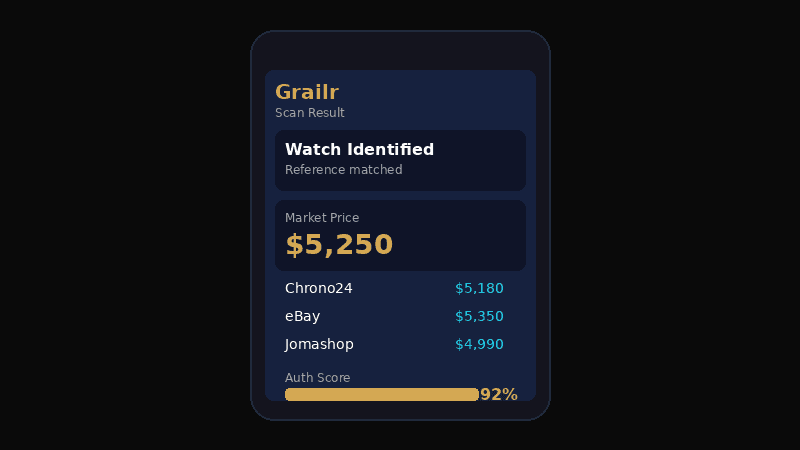
Check Any Watch Price in Seconds
Grailr scans your watch photo and pulls live pricing from Chrono24, eBay, and Jomashop.
- AI identifies brand, model & reference number
- Live market prices from 3+ sources
- Authentication confidence score
How to Spot Problems Before You Buy
Vintage Rolex fakes have become extraordinarily sophisticated. The counterfeit market now produces “super-fakes” with genuine Rolex movements sourced from damaged watches, period-correct dials, and cases machined to tolerances that fool casual inspection. Even experienced collectors have been caught. Here is what to examine before you commit.
1. Dial Printing Under Magnification
Examine the text under 10x magnification. Original Rolex printing uses a pad-printing process that leaves slightly rounded letter edges. Refinished dials often show sharper, screen-printed text. Compare the font, spacing, and coronet logo against documented originals for that specific reference and production year.
2. Lume Consistency
The luminous material on the hands should match the indices in colour and texture. Mismatched lume — for example, creamy-yellow plots with bright white handset lume — signals that the hands have been replaced. Under UV light, tritium and Luminova fluoresce differently; mixing the two on a single watch is a red flag.
3. Case Serial and Reference Numbers
Between the lugs at 12 o’clock you will find the reference number; between the lugs at 6 o’clock, the serial number. Both should be deeply and cleanly engraved — not shallow, wavy, or double-struck. Cross-reference the serial number against known production date ranges to confirm it matches the watch’s claimed year.
4. Caseback and Movement
Ask for a caseback photo or, better, an in-person movement inspection. The calibre number should match the reference: a 5513 should contain a calibre 1520 or 1530, not a later 3035 or 3135. The movement serial should fall within the correct date range. Aftermarket or replaced parts inside the movement diminish value even if they are technically functional.
5. Bracelet and Clasp
Vintage bracelets stretch over decades of wear. Some stretch is normal and expected; severe stretch (links pulling apart visibly) suggests heavy use or poor-quality replacement links. The clasp code should date to the same era as the watch. A 1970s Submariner on a 1990s bracelet is not a deal-breaker, but it should be priced accordingly. For thorough authentication guidance, check our full walkthrough.
Where to Buy Vintage Rolex Safely
The sourcing channel matters as much as the watch itself. Each option comes with its own trade-offs between price, protection, and selection.
Specialist Vintage Dealers
Firms like Hodinkee Shop, Bob’s Watches, and Eric Wind Vintage curate inventory, authenticate in-house, and offer return policies. Prices tend to run 5–15% above auction results, but the buyer protection is worth it — especially for first-time vintage buyers who do not yet trust their own eye.
Auction Houses
Christie’s, Phillips, and Sotheby’s vet every lot before cataloguing. Buyer’s premiums (typically 20–26%) add to the hammer price, but provenance documentation is usually excellent. Online-only auctions at lower price points offer a more accessible entry.
Online Marketplaces
Chrono24 and eBay list thousands of vintage Rolex references. Prices can be 10–20% lower than dealer retail, but due diligence falls entirely on you. Use escrow services where available, demand detailed photographs, and have the watch independently inspected before finalising payment.
Private Sales and Forums
Forums like Rolex Forums (TRF), Omega Forums, and Reddit’s r/Watchexchange host peer-to-peer sales. Prices can be favourable, but there is no institutional guarantee. Check seller history, request references, and never wire funds without an escrow arrangement or face-to-face exchange.
Whichever channel you choose, always get an independent assessment before committing significant money. A qualified watchmaker’s inspection — checking dial originality, movement condition, and case integrity — typically costs $75–$200 and can save you from a five-figure mistake. You can also read our Daytona-specific buying guide for additional sourcing advice on higher-value references.
Accessible Vintage: References Under $10,000
Not every vintage Rolex purchase requires a second mortgage. Several references offer genuine vintage character — acrylic crystals, tritium lume, period movements — at prices that compete with a new steel sport watch.
Datejust 1601/1603 — $3,000–$6,000
The gateway vintage Rolex. The 1601 (fluted bezel) and 1603 (smooth bezel) were produced in enormous quantities from the early 1960s through the late 1970s, which keeps supply healthy and prices accessible. Stainless steel examples with original “pie-pan” or “wide boy” dials and intact tritium lume sit comfortably in the $4,000–$6,000 range. Grey or silver dials are most common; blue, champagne, and “buckley” (printed Roman numeral) dials fetch a slight premium.
Day-Date 1803 — $8,500–$12,000
The vintage “President” in 18k gold. The 1803 features a 36mm case, acrylic crystal, calibre 1555, and the iconic day-and-date display. Prices for clean examples have stabilised in the $8,500–$12,000 range — remarkable value for a solid-gold Rolex with genuine 1960s provenance. Champagne and silver dials are most available; “Stella” (lacquered colour) dials in turquoise, coral, or green command significant premiums.
Air-King 5500 — $3,000–$5,000
Produced from 1957 to 1990, the Air-King 5500 is one of the longest-running Rolex references and one of the most affordable vintage options. The 34mm case wears small by modern standards, but the simple dial and 1520-series movement make it a reliable daily wearer. Silver and grey dials are the most common; the rare “double red” Air-King with red text trades closer to $8,000.
Oyster Perpetual Date 1500 — $2,500–$4,500
Often overlooked, the 1500 is a 34mm Oyster Perpetual with a date window and calibre 1570. It lacks the name recognition of the Datejust or Explorer, which is exactly why it remains affordable. For a buyer who wants a genuine pre-1980 Rolex with an original dial and tritium lume as a daily-wear piece, the 1500 is hard to beat on value. Pair it with a leather strap for a dressy look that costs less than most new quartz watches from fashion brands.
Frequently Asked Questions
What counts as a vintage Rolex?
Most dealers and collectors define vintage Rolex as any reference produced before 2000, though some draw the line at 1990. The key markers are acrylic crystals, tritium lume, and older calibre movements without Parachrom hairsprings or Paraflex shock absorbers.
Are vintage Rolex watches a good investment?
Certain references have appreciated significantly — the GMT-Master 1675 rose 48% in median price during 2026 alone. However, values depend heavily on dial originality, service history, and provenance. A refinished dial can cut a watch's worth by 30–50%. Past performance is not a guarantee of future returns.
How can I tell if a vintage Rolex dial is original?
Look for consistent ageing across the entire dial surface, matching lume colour between hands and indices, correct font spacing for the production year, and no paint buildup around text. A refinished dial often shows unnaturally even colour and sharper text edges than the original printing. When in doubt, consult a specialist or compare with documented originals.
Should I service my vintage Rolex?
Service it, but choose your watchmaker carefully. A full Rolex Service Centre overhaul may replace original parts — dial, hands, bezel insert — that collectors prize. Independent vintage specialists can service the movement while preserving original cosmetic components. Always request that replaced parts be returned to you.
Where is the safest place to buy a vintage Rolex?
Specialist vintage dealers with return policies, major auction houses (Christie's, Phillips, Sotheby's), and established platforms like Hodinkee Shop offer the strongest buyer protections. Always request service history, provenance documentation, and high-resolution photographs of the dial, caseback, and movement before purchasing.
How much does a vintage Rolex cost?
Accessible vintage references like the Datejust 1601 start around $3,000–$6,000. Mid-range collectibles such as the Explorer 1016 and GMT-Master 1675 run $12,000–$45,000. Top-tier pieces like the Daytona 6263 begin at $150,000, and Paul Newman dials can reach seven figures.
Related Articles
The Bottom Line
Vintage Rolex collecting rewards patience, knowledge, and a willingness to walk away. The references worth chasing have not changed much in the last decade — the Submariner 5513, Explorer 1016, GMT-Master 1675, and the manual-wind Daytonas remain the core of the market — but the price of entry keeps climbing. If you are starting out, the Datejust 1601 and Day-Date 1803 offer genuine vintage character at prices that will not keep you up at night.
Whatever you buy, buy the dial first and the reference second. A 5513 with a flawless original gilt dial is worth more than a 5512 with a refinished one. Learn to read lume, check serial ranges, and inspect case geometry before you spend a cent. The best vintage Rolex is the one that is exactly what the seller says it is — and the only way to know that is to do the work before you buy.
Considering a Vintage Rolex?
Grailr uses a photo to suggest a watch identity and an indicative price estimate, with active eBay listings where available. Check the exact reference and condition independently; a photo scan cannot authenticate a watch.
Scan a Watch NowSources and price context
- Rolex Submariner collection — Current specifications and design heritage for the Submariner line.
- Phillips Watches auction results — Historical auction records including the Paul Newman Daytona 6239 sale in 2017.
- Rolex GMT-Master II collection — Current GMT-Master II specifications and the model’s aviation heritage.
These primary sources support the specific history, specification or policy points noted above. Prices and value percentages elsewhere in this guide are indicative editorial figures, not a verified transaction dataset or guaranteed returns. Confirm the exact reference, region, condition and current quote before buying; asking prices are not completed-sale prices.