Vintage Tudor Watches: References, Prices and Tips
From the gilt-dial Submariner 7928 to the Snowflake 7021 and the Monte Carlo chronograph — every collectible vintage Tudor reference with real market prices and buying advice.
Price context: this guide includes indicative asking prices from dealer listings and auction records near its publication date. They have not all been refreshed to current quotes. Use the linked primary sources for specifications and policies, and verify prices independently before buying.

- Vintage Tudor Submariners range from about $4,000 (1990s ref. 79090) to $18,000+ (1960s gilt-dial 7928)
- The Snowflake 7021/0 and Monte Carlo 7149/0 are the two fastest-appreciating Tudor references
- Dial condition, originality and lume integrity drive the largest price differences
- Tudor Oyster Prince dress watches remain undervalued, starting around $1,200
Why Vintage Tudor Watches Are Worth Collecting
Tudor was founded in 1926 by Hans Wilsdorf — the same man who created Rolex — with a specific mission: build watches with the reliability of Rolex cases and bracelets but at a more accessible price. For decades, Tudor sourced its cases and crowns from Rolex while fitting third-party movements from manufacturers like ETA and Fleurier. The result was a watch that shared Rolex’s build quality and Oyster water resistance without the Rolex price tag.
That history matters today because vintage Tudor watches occupy a rare sweet spot in the collector market. They carry genuine Rolex-grade construction — the same 904L-precursor Oystersteel cases, the same Oyster crowns, the same bracelet endlinks — but at a fraction of what their Rolex-signed equivalents command. A vintage Tudor Submariner 7928 in good condition sells for $8,000 to $18,000. The equivalent Rolex Submariner 5512 from the same era starts around $25,000 and reaches six figures for desirable dial variants.
The gap is closing, though. As Rolex vintage prices have climbed beyond what many collectors can justify, attention has shifted to Tudor. Auction houses like Bonhams and Phillips now dedicate catalogue sections to vintage Tudor, and certain references — the Snowflake Submariner and Monte Carlo chronograph in particular — have seen strong year-over-year appreciation. If you’re interested in buying vintage watches, Tudor is one of the best places to start.
Key Vintage Tudor References
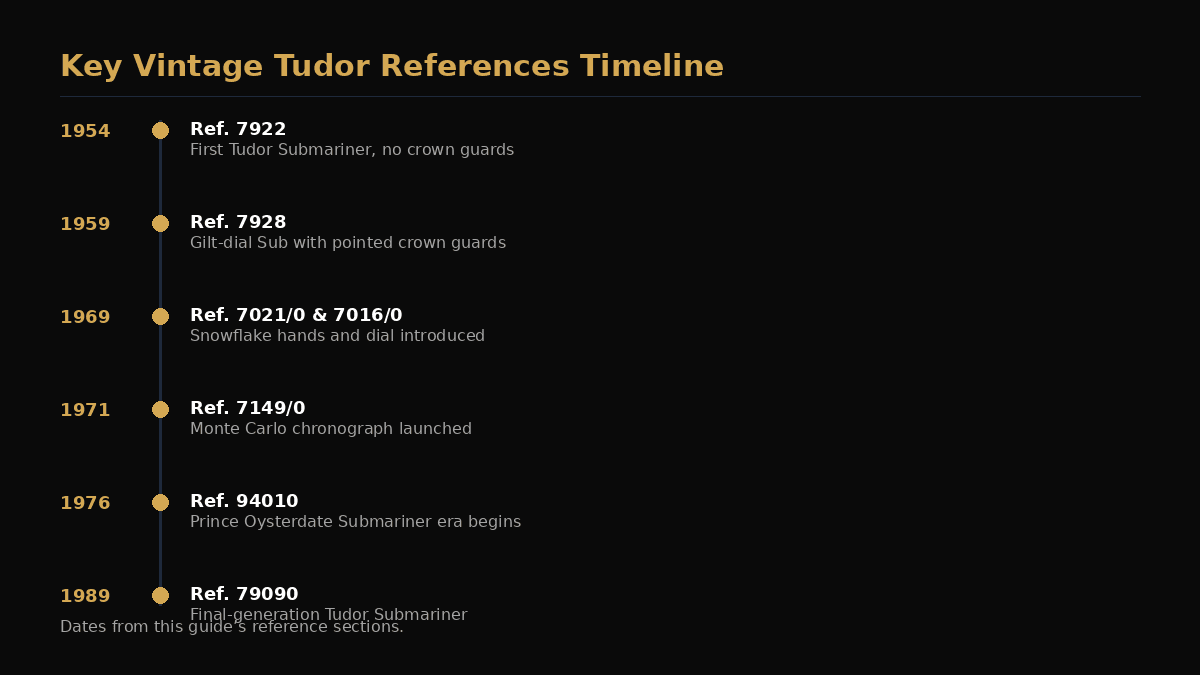
Tudor Submariner 7922 (1954–1958)
The first Tudor Submariner. The ref. 7922 introduced a 37mm Oyster case rated to 100 metres, a black gilt dial with radium lume, and a manually-wound movement. It lacks crown guards, which makes it easy to identify at a glance. Production numbers were small, and surviving examples in original condition are genuinely rare. Expect to pay $15,000 to $30,000 for a clean example, though exceptional specimens have crossed $40,000 at auction. For most collectors, the 7928 offers a more practical entry point into the early Tudor Submariner world.
Tudor Submariner 7928 (1959–1967)
The 7928 is where vintage Tudor collecting truly begins for most buyers. It was the first Tudor Submariner with protective crown guards — a design borrowed from the Rolex Submariner 5512. The 39mm case, 200-metre depth rating and automatic Fleurier movement made it a serious tool watch. What drives collector demand today is the dial. Early 7928s feature gilt (gold-lettered) dials that have aged into rich chocolate “tropical” tones. These tropical gilt dials command the highest premiums, with asking prices reaching $15,000 to $18,000 for unpolished examples with matching hands.
Later 7928 production switched to matte dials with white printing, which are more common and trade in the $8,000 to $12,000 range. Regardless of dial variant, check whether the case has been polished — sharp lug edges and intact chamfers add real value, while an over-polished case can reduce the price by 20–30%.
Tudor Snowflake Submariner 7021/0 and 7016/0 (1969–1981)
The “Snowflake” is arguably the most iconic vintage Tudor design. Named for the distinctive square-tipped lume plots on the hands — which resemble a snowflake when viewed straight on — these Submariners represent Tudor at its most visually distinct from Rolex. The ref. 7021/0 includes a date window; the 7016/0 is the no-date version.
Blue-dial Snowflakes are rarer than their black counterparts and carry a meaningful premium. A blue-dial 7021/0 in good condition trades for $12,000 to $15,000 or more, while black dials settle in the $8,000 to $11,000 range. As with the 7928, originality is everything: service replacement dials and hands dramatically reduce value. The Snowflake design has been directly referenced by Tudor’s modern Black Bay lineup, which uses snowflake-style hands across the entire collection.
Tudor Monte Carlo Chronograph 7149/0 (1971–1977)
Tudor’s first chronograph, the Monte Carlo is named for its colourful, multi-register dial layout that evokes a roulette wheel. Available with grey/blue or grey/orange sub-dial rings, it runs a Valjoux 234 hand-wound chronograph movement inside a 39mm Oyster case. Production was limited, and surviving examples in original condition are highly sought. Prices range from $6,000 for a well-used example to $20,000 or more for an unpolished watch with a crisp dial. The grey-and-orange “Home Plate” variant tends to command the strongest prices.
Tudor Prince Oysterdate Submariner 94010 (1976–1989)
The 94010 bridged the gap between the Snowflake era and Tudor’s later quartz-equipped models. It carries a 40mm case, a date window with Cyclops lens, and a more modern ETA 2784 automatic movement. Production spanned over a decade, making it relatively available on the secondary market. Asking prices typically fall between $8,500 and $12,000. The matte black dial and Mercedes-style hands give it a look closer to the Rolex Submariner 16800 than to earlier Tudor Subs. For collectors who want a vintage Tudor Submariner they can actually wear daily, the 94010 offers the best balance of age, size and durability.
Tudor Submariner 79090 (1989–1999)
The final generation of the Tudor Submariner before the line was discontinued. The 79090 runs an ETA 2824-2 automatic — a reliable workhorse movement still used in countless Swiss watches today — inside a 40mm case rated to 200 metres. Aesthetically, it’s the closest a vintage Tudor Submariner gets to a modern dive watch, with sapphire crystal options and solid endlinks. Prices are the most accessible of any Tudor Sub reference, ranging from about $4,000 to $6,000. It won’t appreciate like a Snowflake or a gilt 7928, but it’s an honest, wearable vintage diver at a fraction of what a comparable Rolex 16610 costs.
Tudor Oyster Prince Dress Watches (1950s–1960s)
Outside the Submariner family, Tudor produced a range of Oyster Prince dress watches with small cases (typically 34–36mm), elegant dial designs and reliable automatic movements. The “Big Rose” models — named for the large Tudor rose emblem on the dial — are the most recognisable. These watches are significantly undervalued compared to their tool-watch siblings, trading for $1,200 to $3,300 depending on condition and dial rarity. For buyers who want a vintage Tudor with character and history at a genuinely affordable price, the Oyster Prince dress range is the place to look. The “Tuxedo” two-tone dial variants are particularly attractive and still widely available under $2,000.
Vintage Tudor Prices in 2026
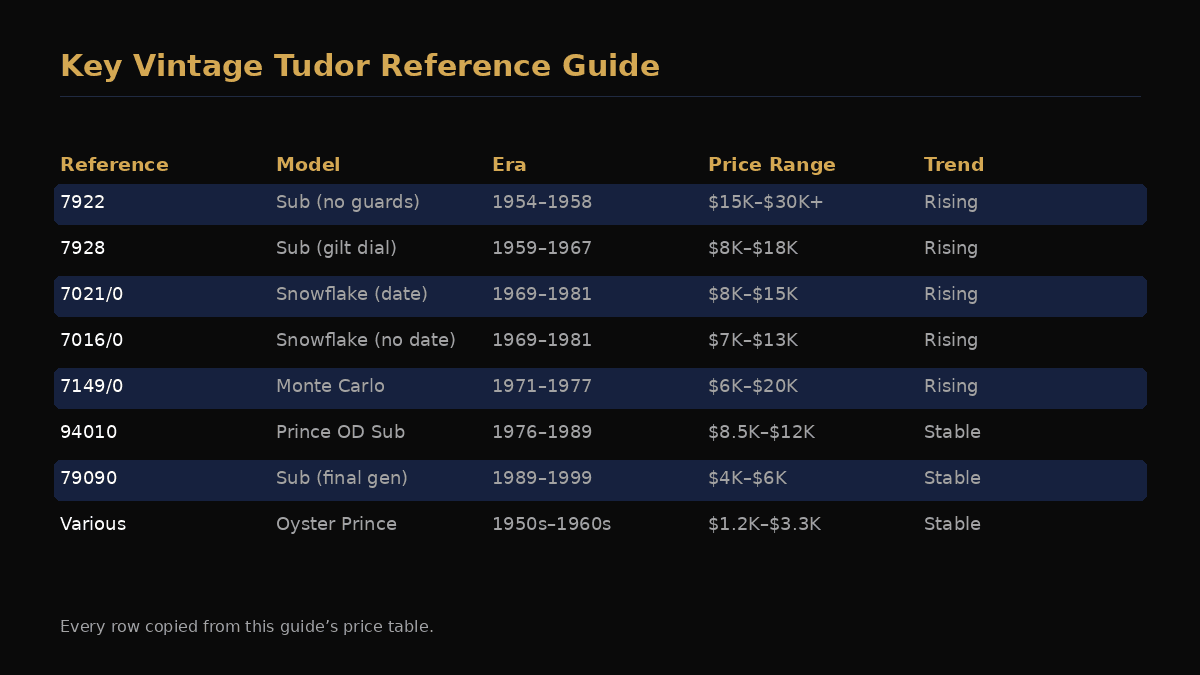
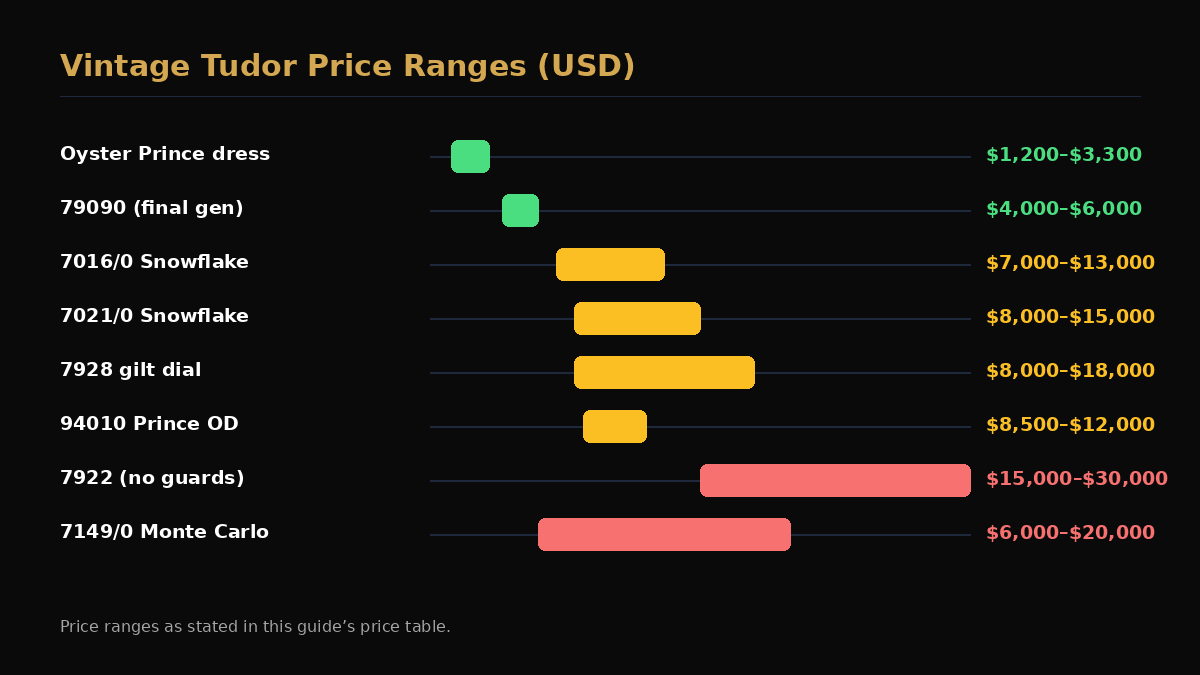
The table below summarises indicative asking-price ranges drawn from dealer listings, auction records and marketplace data near publication. Actual transaction prices depend on condition, originality, provenance, and whether box and papers are included. All figures are in USD and represent the range for examples in “good” to “excellent” condition.
| Reference | Model | Era | Price Range | Trend |
|---|---|---|---|---|
| 7922 | Submariner (no guards) | 1954–1958 | $15,000–$30,000+ | Rising |
| 7928 | Submariner (gilt dial) | 1959–1967 | $8,000–$18,000 | Rising |
| 7021/0 | Snowflake Sub (date) | 1969–1981 | $8,000–$15,000 | Rising |
| 7016/0 | Snowflake Sub (no date) | 1969–1981 | $7,000–$13,000 | Rising |
| 7149/0 | Monte Carlo chrono | 1971–1977 | $6,000–$20,000 | Rising |
| 94010 | Prince Oysterdate Sub | 1976–1989 | $8,500–$12,000 | Stable |
| 79090 | Submariner (final gen) | 1989–1999 | $4,000–$6,000 | Stable |
| Various | Oyster Prince dress | 1950s–1960s | $1,200–$3,300 | Stable |
Check Any Watch Price in Seconds
Grailr scans your watch photo and pulls live pricing from Chrono24, eBay, and Jomashop.
- AI identifies brand, model & reference number
- Live market prices from 3+ sources
- Authentication confidence score
How to Authenticate a Vintage Tudor
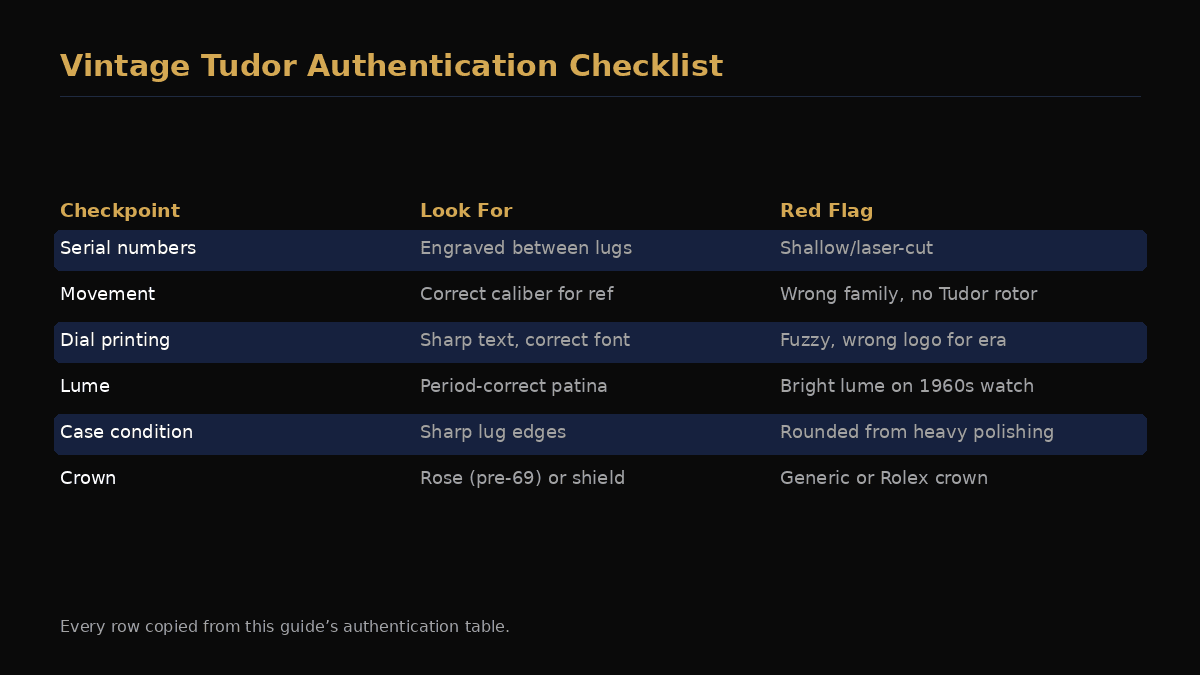
Vintage Tudor watches present unique authentication challenges. Unlike modern pieces with laser-etched serial numbers and holograms, older Tudors rely on physical markers that require experience to read correctly. Here are the critical checkpoints.
| Checkpoint | What to Look For | Red Flag |
|---|---|---|
| Serial & model numbers | Engraved between the lugs at 6 and 12 o’clock; serial should match the production year range for that reference | Shallow or laser-cut engravings, serial/reference mismatch |
| Movement caliber | Should match the reference (e.g., 7928 uses Fleurier 390; 79090 uses ETA 2824-2) | Wrong movement family, no Tudor rotor markings |
| Dial printing | Sharp, consistent print quality; correct font for the era; proper Tudor rose or shield logo | Fuzzy text, wrong logo style for the reference year, repainted indices |
| Lume condition | Period-correct radium (pre-1963) or tritium (1963–1998) with consistent patina across dial and hands | Bright white lume on a claimed 1960s watch, mismatched hand and dial aging |
| Case condition | Sharp lug edges, correct crown guard profile, proper caseback engravings | Rounded lugs from heavy polishing, aftermarket crown, missing caseback markings |
| Crown | Tudor rose (pre-1969) or shield logo (1969 onwards), with correct thread pitch | Generic crown, Rolex crown on a Tudor case, wrong logo for the era |
Even experienced collectors miss details that a professional watchmaker would catch. Before committing to a purchase over $5,000, have the watch inspected by a watchmaker who specialises in vintage Tudor and Rolex. You can start the identification process with Grailr’s watch identification tool to confirm the reference number and get an indicative value estimate, but a hands-on inspection remains the definitive step for authentication.
Where to Buy Vintage Tudor Watches
The right buying channel depends on your budget, risk tolerance and how much verification you want built into the transaction. Here are the main options for sourcing vintage Tudor watches in 2026.
Specialist Vintage Dealers
Dealers like European Watch Company, Analog/Shift and Oliver & Clarke focus on authenticated vintage pieces with documented provenance. You’ll pay a 15–25% premium over private sale prices, but you get professional inspection, accurate descriptions and a return window. This is the safest channel for first-time vintage buyers.
Auction Houses
Phillips, Christie’s and Bonhams all sell vintage Tudor pieces. Catalogue descriptions are detailed, condition reports are available on request, and provenance is verified. Factor in the buyer’s premium (typically 20–26%) on top of the hammer price. Auction is where the rarest dial variants and earliest references tend to surface.
Chrono24 and eBay
Both platforms host a wide range of vintage Tudor listings, from dealer stock to private sellers. Chrono24’s Trusted Checkout and eBay’s Authenticity Guarantee (for watches over $2,000) add a layer of buyer protection. Still, you’re relying on seller photos and descriptions, so request additional images and ask pointed questions about dial and hand originality before committing.
Watch Forums and Reddit
Communities like r/WatchExchange and WatchUSeek’s sales forum offer competitive pricing with no platform fees. Buyer protection is limited, so check seller history, insist on timestamped photos, and use PayPal Goods & Services. For more on forum buying, see our vintage watches buying guide.
Modern Tudor Heritage vs Vintage Originals
Tudor’s modern lineup draws heavily from its vintage catalogue. The Black Bay 58 borrows its 39mm case size and gilt-style dial from the Submariner 7924. The Black Bay Chrono echoes the Monte Carlo’s multi-register layout. Even the snowflake hands — once a period-specific detail — are now Tudor’s brand-wide signature.
In 2026, Tudor adopted METAS Master Chronometer certification across the Black Bay range, adding a level of movement testing that no vintage Tudor ever had. A modern Black Bay 58 starts around $4,300 with an in-house MT5402 movement, 200-metre water resistance, and a five-year warranty. That’s less than most vintage Submariner references, and it comes with none of the authentication risk.
So why buy vintage? Three reasons. First, originality: a Snowflake 7021/0 with 50 years of wrist patina has character that no modern watch can replicate. Second, scarcity: production numbers on these references were small, and the surviving pool shrinks every year as pieces enter permanent collections. Third, appreciation potential: while no watch is a guaranteed investment, the rarest vintage Tudor references have shown stronger price growth over the past decade than most modern Tudor models.
The modern alternative is genuinely excellent. If you want the vintage look without the risk, a Black Bay 58 or Pelagos is the practical choice. But if you want the real thing — with all the quirks, patina and history that come with it — the vintage market has never had more options or better documentation to help you buy wisely. You can compare modern Tudor models in our Tudor watches for men guide.
Five Tips for Buying Your First Vintage Tudor
1. Prioritise Dial Originality
The dial is the single biggest driver of value in any vintage Tudor. A service replacement dial — even an official Tudor one — can reduce a watch’s value by 30–50%. Learn to spot relumed indices, repainted text and replacement hands before you start shopping.
2. Start with a Later Reference
The ref. 79090 and 94010 offer genuine vintage Submariner ownership at $4,000–$12,000. They’re more common, easier to authenticate, and more forgiving of daily wear than earlier gilt-dial references. Build your knowledge on a later model before committing to a $15,000 7928.
3. Budget for a Service
Most vintage Tudor watches need or will soon need a movement service, which costs $400–$800 for a standard clean and lubrication. Factor this into your total cost and make sure the watchmaker is experienced with vintage Tudor calibers, since some parts are no longer available from Tudor.
4. Scan Before You Buy
Use Grailr’s free scanner to photograph any listing and get a suggested identification, reference number match and indicative market price. It’s not a substitute for a hands-on authentication, but it catches obvious misidentifications before you spend money on a professional inspection.
5. Keep Records
Photograph the watch from every angle at purchase, save the receipt, and keep all service records. If you ever resell, documented provenance significantly increases the price a buyer will pay — especially for rarer references where authentication is a live concern.
Frequently Asked Questions
What is the most collectible vintage Tudor watch?
The Tudor Submariner 7928 with a gilt or tropical dial is widely considered the most collectible. Asking prices range from $8,000 to $18,000 depending on dial variant, case condition and provenance. The Snowflake 7021/0 with a blue dial is a close second.
How much does a vintage Tudor Submariner cost?
Prices range from about $4,000 for a 1990s ref. 79090 to $18,000 or more for a mint 1960s ref. 7928 with a gilt dial. The Snowflake 7021/0 typically sells for $8,000 to $15,000, with blue dials at the top of that range.
Are vintage Tudor watches a good investment?
Certain references have appreciated steadily, particularly the 7928, 7021/0 and Monte Carlo 7149/0. But the vintage market carries condition risk, authentication challenges and no guaranteed returns. Buy what you enjoy wearing and treat any appreciation as a bonus.
How can I tell if a vintage Tudor watch is authentic?
Check serial and model numbers between the lugs, verify the movement caliber matches the reference, inspect lume for period-correct aging, and confirm the crown is a genuine Tudor rose or shield. A professional watchmaker experienced with vintage Tudor pieces is the most reliable step.
What is a Tudor Snowflake watch?
The Snowflake refers to Submariner models from the late 1960s through the 1970s — primarily refs. 7016/0 and 7021/0 — distinguished by square-shaped lume plots on the hands and dial. The nickname comes from the snowflake-like shape of the hour hand marker.
Should I buy a vintage Tudor or a modern Black Bay?
A modern Black Bay 58 offers vintage Submariner aesthetics with a METAS-certified in-house movement, 200m water resistance and a full warranty from about $4,300. A vintage original offers genuine patina and collector appeal but higher prices, no warranty and condition risk. Budget and risk tolerance should guide the decision.
Related Articles
The Bottom Line
Vintage Tudor watches offer genuine Rolex-grade construction and decades of horological history at prices that still undercut their Rolex equivalents by 50% or more. Whether you start with a $1,500 Oyster Prince dress watch or go straight for a $15,000 Snowflake Submariner, the key is originality: buy the best dial and case condition you can afford, verify authenticity through a specialist, and document everything. The vintage Tudor market rewards knowledge and patience — and the watches themselves reward daily wear. See Tudor’s official history for the full story behind the brand that started it all.
Spotted a Vintage Tudor?
Grailr uses a photo to suggest a watch identity and an indicative price estimate, with active eBay listings where available. Check the exact reference and condition independently; a photo scan cannot authenticate a watch.
Scan a Watch NowSources and price context
- Tudor official history — Brand founding, heritage and current collection details from the manufacturer.
- Bonhams watch department — Auction house with regular vintage Tudor Submariner and chronograph lots.
These primary sources support the specific history and market points noted above. Prices throughout this guide are indicative asking prices drawn from dealer listings and auction estimates, not verified completed-sale data. Condition, dial originality, provenance and current market demand drive large variations within each range. Confirm the exact reference, condition and current asking price independently before buying or selling.