Best Watch Winders for Automatic Watches in 2026: 12 Picks from $40 to $5,000
Every watch winder for automatic watches worth buying in 2026 — from a $45 Amazon pick to a $4,800 German-engineered masterpiece, with real pricing, TPD settings by brand, and honest recommendations for every budget.

- A watch winder for automatic watches keeps your timepiece running and accurately set when you’re not wearing it — essential if you own 3+ automatics and rotate daily
- Most watches need 650–1,800 turns per day (TPD); Rolex needs 650 clockwise, Omega needs 800 bidirectional, Patek Philippe needs 800 clockwise
- Quality winders will not damage your watch — modern automatic movements have a slipping clutch that prevents overwinding entirely
- The Barrington Single ($199) is the best value pick; the Wolf Cub ($250) is the best entry into premium quality; Buben & Zorweg ($4,800) is the pinnacle
What Is a Watch Winder & Do You Really Need One?
An automatic watch — also called a self-winding watch — generates energy from the motion of your wrist. Inside every automatic movement is a semicircular rotor that swings with gravity as you move your arm throughout the day. That rotor transfers energy through a series of gears to wind the mainspring, which stores mechanical energy and releases it in a controlled manner to drive the hands and complications.
Most automatic watches have a power reserve of 38 to 72 hours. When the watch sits unworn, the mainspring gradually unwinds and the watch eventually stops. This is perfectly normal and causes no harm to the movement. But it does mean you’ll need to reset the time, date, and any other complications the next time you pick it up.
A watch winder for automatic watches solves this problem by gently rotating your watch on a motorised cushion, simulating the natural movement of your wrist. The rotor inside the watch spins just as it would on your arm, keeping the mainspring wound and the watch running accurately — even if it sits in the winder for weeks or months.
So do you actually need one? If you own a single automatic watch and wear it every day, no. Your wrist does the job. But if you own three or more automatic watches and rotate between them, a winder becomes genuinely useful. Instead of spending five minutes resetting the time, date, day, and moon phase every time you switch watches, you simply lift the watch from the winder and strap it on.
The strongest case for a watch winder? Watches with perpetual calendars or annual calendars. Resetting a stopped perpetual calendar requires advancing through every day of every month you missed, one push of the corrector at a time. If your Patek Philippe or Audemars Piguet has a perpetual calendar, a winder isn’t a luxury — it’s a safeguard against a tedious and potentially costly resetting procedure.
How Watch Winders Work: TPD, Direction & Programming
Every watch winder for automatic watches operates on the same fundamental principle: a small electric motor turns a cushion that holds your watch, causing the internal rotor to swing and wind the mainspring. But the details of how it turns matter significantly. Three settings determine whether your winder works properly with your specific watch.
Turns per day (TPD) is the total number of rotations the winder completes in a 24-hour cycle. Different movements require different TPD counts, typically ranging from 650 to 1,800. Too few turns and your watch will stop; too many won’t damage the watch (thanks to the clutch mechanism), but will cause unnecessary wear on the winder’s motor.
Rotation direction refers to whether the winder spins clockwise (CW), counter-clockwise (CCW), or bidirectional (alternating). This matters because some automatic movements wind in only one direction. A Rolex with a Perpetual movement, for example, winds most efficiently clockwise. An Omega Co-Axial movement winds bidirectionally. Setting the wrong direction won’t harm anything, but it may mean the winder needs more turns to keep the watch fully wound.
Rotation schedule determines whether the winder spins continuously or intermittently. The best modern winders use intermittent programs — spinning for a set period, resting, then spinning again. Wolf’s patented program runs 10 seconds on, 3 minutes off, which closely mimics the patterns of natural wrist movement. This approach is gentler on both the watch and the winder motor.
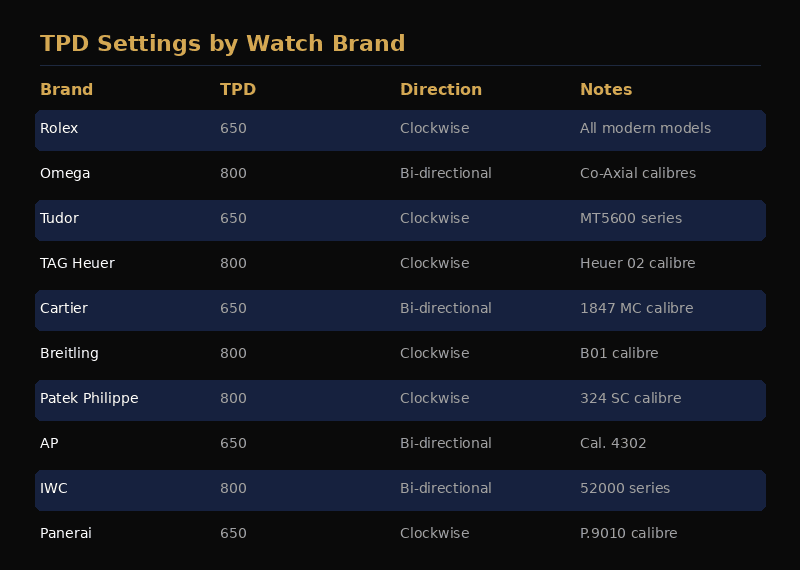
Quality winders from brands like Wolf, Orbita, and Rapport use brushless DC motors that are virtually silent (under 10 dB) and rated for over 10 years of continuous use. Budget winders typically use cheaper geared motors that may produce a faint hum or click — audible if the winder sits on a nightstand in a quiet room.
Can a Watch Winder Damage Your Watch?
This is the single most debated question in watch forums, and the short answer is: no, a quality watch winder for automatic watches will not damage your timepiece. Here’s why.
Every modern automatic movement — from a $200 Seiko 4R35 to a $200,000 Patek Philippe calibre 240 — includes a slipping clutch (also called a bridle or Breguet spring). When the mainspring reaches full wind, this clutch mechanism disengages the winding rotor from the mainspring barrel. The rotor continues to spin freely, but no additional energy is transferred. You cannot overwind a modern automatic watch. Period.
The legitimate concern is about magnetisation. Very cheap watch winders may use poorly shielded motors that generate a magnetic field strong enough to magnetise the hairspring in your watch. A magnetised hairspring causes the watch to run fast — sometimes by several minutes per day. This is easily remedied with a demagnetiser, but it’s an annoyance that a quality winder avoids entirely. Wolf, Orbita, and other reputable brands use motors with proper magnetic shielding.
What about wear on the rotor bearings? In theory, a winder keeps the rotor spinning longer than necessary. In practice, the incremental wear is negligible. Your watch experiences far more mechanical stress from a day on your wrist — including impacts, vibration, and temperature changes — than from years of gentle rotation in a quality winder. Watchmakers we’ve spoken with universally confirm that winder-related damage is exceedingly rare and almost always attributable to defective or extremely cheap units.
The bottom line: stick with established winder brands, set the correct TPD and direction for your watch, and use intermittent rotation mode. Your watch will be perfectly safe. If you want to be extra cautious, have your watch serviced at the manufacturer’s recommended intervals regardless of whether you use a winder.
12 Best Watch Winders for Automatic Watches Compared
We’ve researched and compared the most popular watch winders for automatic watches across every price point. Here are our 12 picks for 2026, from the most affordable to the finest money can buy.
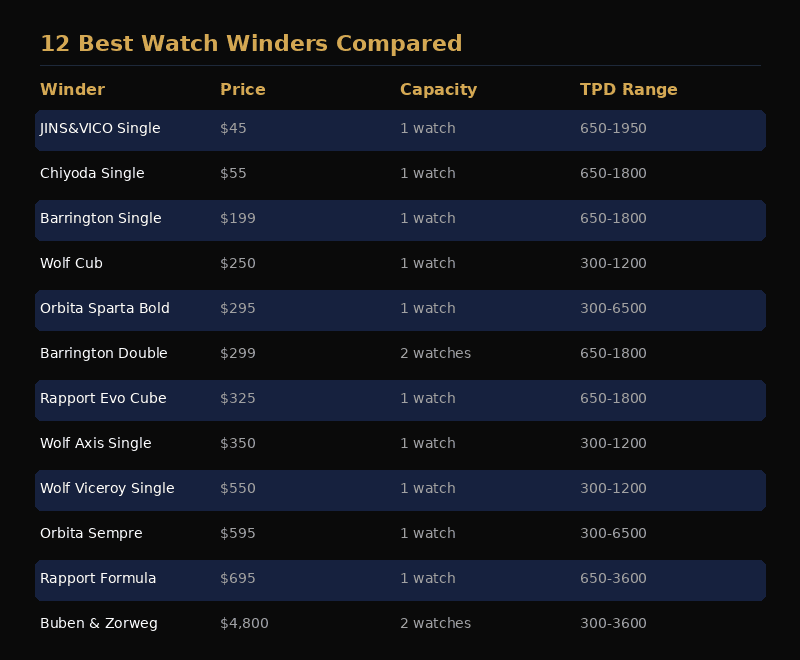
1. JINS&VICO Budget Single — $45
The cheapest functional watch winder for automatic watches you can buy. The JINS&VICO offers four rotation modes (clockwise, counter-clockwise, bidirectional, and continuous), a PU leather exterior, and AC power via USB adapter. Build quality is predictably modest — expect a faint motor hum and a synthetic leather smell that fades after a week. The cushion is not spring-loaded, so watches under 36mm may sit loosely. But at $45, it does the fundamental job of keeping your automatic watch wound. Best suited for entry-level pieces like Seiko, Orient, or Invicta automatics rather than luxury timepieces.
2. Chiyoda Single Watch Winder — $55
A step above the JINS&VICO in fit and finish. The Chiyoda wraps a quiet Mabuchi motor inside a piano-black lacquer shell with a transparent viewing lid. It offers adjustable TPD settings (via rotation mode presets) and three direction options. The flexible cushion accommodates watches from 28mm to 50mm. At $55, it’s the most refined sub-$100 option and has maintained a strong rating across thousands of Amazon reviews. The main limitation is AC-only power — no battery backup.
3. Barrington Single Watch Winder — $199
The best value watch winder for automatic watches on this list. Barrington is a UK-based specialist that focuses exclusively on winders, and it shows. The Single offers fully adjustable TPD (from 650 to 1,800), three rotation directions, and a clean modern design in matte black, bamboo, or walnut finish. It runs on AC power or 2× C batteries, giving you placement flexibility.
The motor is whisper-quiet — suitable for a bedroom nightstand — and the spring-loaded cushion fits watches from 32mm to 50mm. It comes with a 2-year warranty and a detailed TPD guide for popular watch brands. If you own a single automatic watch and want it ready to wear every morning, this is the winder to buy.
4. Wolf Cub Single — $250
Your entry point to Wolf, the most trusted name in watch winders. The Cub is compact (5.5“ x 4.75”) but packs Wolf’s patented rotation technology: a 10-seconds-on, 3.5-minutes-off cycle that closely mimics natural wrist movement. It offers preset TPD of approximately 900 bidirectional, a brushless motor that’s effectively silent, and Wolf’s lock-in cuff that holds watches securely without stretching bracelets. Available in orange, navy, green, and black. No dust cover, which is the main trade-off at this price. Backed by Wolf’s 10-year warranty.
5. Orbita Sparta Bold — $295
Made in the USA by a company that has been engineering watch winders since 1996. The Sparta Bold uses Orbita’s signature suspended-rotation technology, where the watch rotates on a tilted axis for a more natural winding motion. It runs on a single C battery that lasts 3–5 years thanks to a remarkably efficient motor cycle (approximately 4 minutes of rotation per hour). The minimalist open design makes it a handsome desktop display. TPD and direction are fixed at roughly 780 bidirectional — well-suited for most watches but not adjustable per brand.
6. Barrington Double Watch Winder — $299
Everything that makes the Barrington Single excellent, doubled. Two independently programmable modules let you set different TPD and direction for each watch — 650 clockwise for your Rolex and 800 bidirectional for your Omega, for example. The cabinet has a hinged glass lid that doubles as a dust cover, and the dual-power option (AC + battery) gives placement freedom. At $299 for two modules, it undercuts competitors like Wolf and Rapport significantly while delivering comparable performance.
7. Rapport Evo Cube — $325
British-designed with a striking cube form factor that looks as much like sculpture as storage. The Evo Cube holds a single watch in a high-gloss lacquer shell with a transparent door, offers multiple TPD programs, three rotation directions, and runs on a near-silent Japanese motor. The cube shape means it takes up minimal desk space while making a design statement. Available in black, white, and crimson. Rapport’s build quality sits neatly between Barrington and Wolf.
8. Wolf Axis Single — $350
The Axis is Wolf’s most contemporary design — a powder-coated aluminium shell with a transparent cover and backlit interior. It features the same patented rotation program as all Wolf winders, adjustable TPD, and the lock-in cuff. What sets the Axis apart is its storage compartment beneath the winding module, sized for a second watch or small accessories. If you want Wolf quality with a modern industrial aesthetic rather than traditional leather-and-wood, the Axis delivers.
9. Wolf 1834 Viceroy Single — $550
The Viceroy line is Wolf’s flagship. The single module sits inside a handcrafted wooden case with a chrome lock closure, faux suede lining, and tempered glass lid. The brushless motor is rated for over a decade of continuous use, and the patented rotation program cycles through multiple TPD and direction settings throughout the day for the most thorough winding available.
If you own a watch worth over $5,000 — a properly authenticated Rolex Submariner, for example — the Viceroy is the winder that matches the quality of what it protects. The 10-year warranty provides genuine peace of mind.
10. Orbita Sempre — $595
Orbita’s programmable single-watch winder. Unlike the fixed-setting Sparta Bold, the Sempre offers fully adjustable TPD (from 300 to 7,200 in 25 pre-programmed cycles) and three direction options. The case is handcrafted in the USA from solid hardwood with a piano lacquer finish. A lithium battery lasts roughly 5 years. For collectors who want American-made quality with the flexibility to tune settings for any watch, the Sempre is the premium choice in the $500–$600 range.
11. Rapport Formula — $695
Rapport’s most refined single-watch offering. The Formula features an automotive-inspired design with a carbon-fibre textured exterior and chrome accents. Inside, the watch sits on a spring-loaded cushion with adjustable TPD, three direction settings, and Rapport’s ultra-quiet Japanese motor. The flip-top lid provides easy access and doubles as a display stand. At $695, it’s positioned as a premium single winder for collectors who appreciate design as much as function.
12. Buben & Zorweg Time Mover — $4,800
The absolute pinnacle of watch winder engineering. Buben & Zorweg is a German manufacturer whose winders are used by watch brands themselves in their own boutiques. The Time Mover holds 2–4 watches (depending on configuration) in a precision-machined case with Swiss motors, individual programmable watch profiles stored in memory, built-in LED lighting, and optional climate control. Each module is independently adjustable from 300 to 3,600 TPD in all directions. Starting at $4,800, this is a winder for collectors whose watches are worth six figures — a fitting companion for a Patek Philippe Nautilus or AP Royal Oak.
Check Any Watch Price in Seconds
Grailr uses your photo to suggest a watch identification and an indicative price estimate. Active eBay listings, when available, offer asking-price comparisons.
- Grailr suggests brand, model & reference number
- Active eBay asking-price comparisons
- Identification confidence score

Head-to-Head: All 12 Watch Winders Compared
| Winder | Price | Capacity | TPD Adjust | Power | Warranty |
|---|---|---|---|---|---|
| JINS&VICO Budget | $45 | 1 | Basic | AC (USB) | 1 year |
| Chiyoda | $55 | 1 | Preset | AC | 1 year |
| Barrington Single | $199 | 1 | Yes | AC/Battery | 2 years |
| Wolf Cub | $250 | 1 | Preset | AC | 10 years |
| Orbita Sparta Bold | $295 | 1 | Fixed | Battery | 5 years |
| Barrington Double | $299 | 2 | Yes | AC/Battery | 2 years |
| Rapport Evo Cube | $325 | 1 | Yes | AC | 2 years |
| Wolf Axis | $350 | 1 + storage | Yes | AC | 10 years |
| Wolf 1834 Viceroy | $550 | 1 | Yes | AC/Battery | 10 years |
| Orbita Sempre | $595 | 1 | Yes | Battery | 5 years |
| Rapport Formula | $695 | 1 | Yes | AC | 2 years |
| Buben & Zorweg | $4,800+ | 2–4 | Yes | AC | 5 years |
Best Watch Winder Picks by Budget
Under $100
Chiyoda — $55
Quiet Mabuchi motor, piano-black finish, transparent lid. The best sub-$100 watch winder for automatic watches by a clear margin.
$100–$300
Barrington Single — $199
Adjustable TPD, dual power, 2-year warranty. The value sweet spot for most collectors.
$300–$700
Wolf 1834 Viceroy — $550
Patented rotation, 10-year warranty, brushless motor. The gold standard for a single luxury watch.
$700+
Buben & Zorweg Time Mover — $4,800
German engineering, Swiss motors, programmable memory profiles. For six-figure watch collections.
TPD Settings by Watch Brand
Every automatic movement has an optimal turns per day and direction setting for a watch winder. Using the wrong TPD won’t damage your watch (the clutch prevents overwinding), but the correct setting ensures your watch stays fully wound with minimal unnecessary rotation. Here are the recommended settings for the most popular brands:
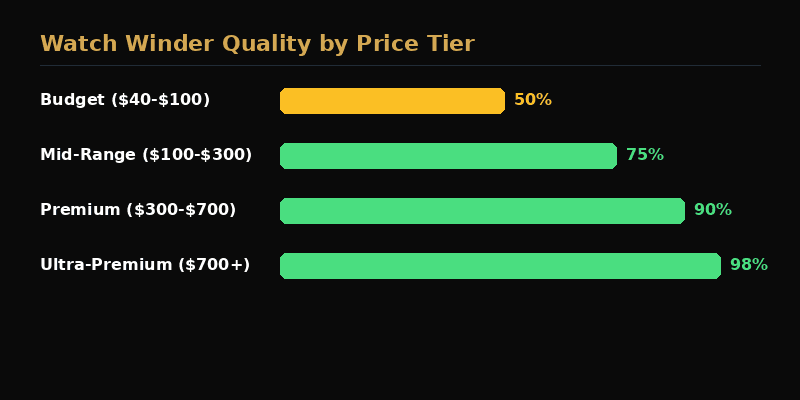
| Brand | TPD | Direction | Notes |
|---|---|---|---|
| Rolex | 650 | Clockwise | All modern Perpetual calibres |
| Omega | 800 | Bidirectional | Co-Axial movements |
| TAG Heuer | 800 | Clockwise | Calibre 5 & TH20-series |
| Breitling | 800 | Clockwise | B01 & SW200 calibres |
| Tudor | 650 | Clockwise | MT5-series in-house movements |
| Cartier | 650 | Bidirectional | 1847 MC & in-house calibres |
| Patek Philippe | 800 | Clockwise | Varies by calibre; check ref. |
| Audemars Piguet | 650 | Bidirectional | Royal Oak calibres |
| IWC | 800 | Bidirectional | Pellaton winding system |
| Panerai | 650 | Clockwise | P.9000 & P.4000 calibres |
Not sure which movement your watch uses? Upload a photo to Grailr and we’ll suggest a likely reference number and calibre, so you can look up the correct TPD.
How to Choose the Right Watch Winder for Automatic Watches
With a dozen strong options on the market, choosing the right watch winder for automatic watches comes down to five practical factors:
1. How Many Watches Do You Own?
If you have one or two automatics, a quality single winder like the Barrington ($199) or Wolf Cub ($250) is all you need. Three to five watches? Consider a multi-module unit like the Barrington Double ($299) or step up to a Wolf Viceroy Quad. Six or more? You’re in Rapport Paramount or Buben & Zorweg territory, or simply buy multiple singles.
2. Noise Level
If your winder will sit on a nightstand or in a quiet study, noise matters enormously. Budget winders with geared motors produce a noticeable hum. Wolf and Orbita use brushless motors rated below 10 dB — completely inaudible from across a room. The Barrington Single also performs well here, running nearly silently in practice.
3. Power Source
AC-only winders require proximity to a wall outlet. Battery-powered winders (like Orbita’s Sparta Bold, which runs 3–5 years on one C battery) go anywhere. Dual-power winders (AC + battery backup) offer the best flexibility — your watch keeps winding even during a power outage.
4. TPD Programmability
If you only ever use one watch brand, a fixed-TPD winder works fine. But if you rotate between a Rolex (650 CW) and an Omega (800 bidirectional), you need adjustable TPD and direction settings. This is the most important feature for anyone with a mixed-brand collection.
5. Build Quality & Warranty
A watch winder for automatic watches is protecting an expensive investment — the winder itself should be well-built. Wolf leads with a 10-year warranty. Orbita offers 5 years. Barrington offers 2 years. Budget brands typically provide 1 year or nothing. Consider the winder a long-term purchase; spending $200–$550 once is better than replacing a $50 winder every couple of years.
Frequently Asked Questions
Do automatic watches need a watch winder?
No, automatic watches don’t need a winder to stay healthy. However, a watch winder for automatic watches keeps your timepiece running and set to the correct time and date, which is especially convenient for watches with complex calendar complications. If you only own one watch and wear it daily, you don’t need a winder.
Can a watch winder damage my automatic watch?
A quality watch winder set to the correct TPD will not damage your watch. Modern automatic movements have a slipping clutch that disengages the winding system when the mainspring is fully wound — overwinding is physically impossible. The only concern is magnetisation from very cheap motors, which reputable brands like Wolf, Orbita, and Rapport avoid with proper shielding.
How many turns per day does my Rolex need?
All modern Rolex watches use a clockwise-winding Perpetual rotor and need approximately 650 turns per day in the clockwise direction. This applies to the Submariner, Daytona, GMT-Master II, Datejust, Day-Date, and all other current models. Set your winder to 650 TPD clockwise for any Rolex.
What is the best budget watch winder for automatic watches?
The Chiyoda at $55 is the best ultra-budget option with its quiet Mabuchi motor and transparent lid. For slightly more, the Barrington Single at $199 is the best value overall — it offers adjustable TPD, three rotation directions, dual power (AC + battery), and a 2-year warranty.
Is it bad to leave my watch in a winder all the time?
No. The slipping clutch in modern automatic movements prevents overwinding, and the wear on rotor bearings from a properly set winder is negligible compared to daily wrist wear. For optimal results, use intermittent rotation rather than continuous spinning.
Do I need a different winder for each watch brand?
No, but you do need a winder with adjustable TPD and direction settings if you own watches from different brands. A Rolex needs 650 TPD clockwise while an Omega needs 800 TPD bidirectional. A single winder with programmable settings handles any brand — just change the settings when you swap watches.
Related Articles
The Bottom Line
A watch winder for automatic watches is not a necessity — it’s a convenience that becomes increasingly valuable the more automatic watches you own. If you rotate between three or more pieces, especially any with date or calendar complications, a winder saves you minutes of fiddly resetting every time you switch.
For most collectors, the Barrington Single at $199 hits the value sweet spot — adjustable TPD, quiet motor, dual power, and a 2-year warranty. If you want the best single winder money can buy without reaching ultra-luxury territory, the Wolf 1834 Viceroy at $550 is the answer, backed by a 10-year warranty and Wolf’s patented rotation technology. And if your collection includes a Patek Philippe perpetual calendar or an AP Royal Oak, the Buben & Zorweg Time Mover at $4,800 is not an extravagance — it’s the smartest way to protect your investment. Before buying, check what your watches are worth to make sure you’re matching the right winder to the right collection.
Know What Your Watches Are Worth
Grailr can suggest a model and reference from a clear photo and provide an indicative price estimate. Active eBay listings, when available, show asking prices for comparison. Confirm the reference and condition with the seller; a photo scan does not authenticate a watch.
Scan a Watch NowSources and price context
- WOLF winding settings database — Model-specific turns per day and winding direction; follow the watch maker’s instructions.
- OMEGA Moonwatch user manual — Manual winding, calibre identification, care and warranty instructions for the named reference.
The links identify the specific manufacturer information and marketplace guidance used for this guide. Price ranges and resale percentages in this guide are illustrative, not live quotes or guaranteed returns; compare the exact reference, condition and sale date before relying on them.