12 Best Automatic Watch Winders in 2026: From $50 to $5,000
Wolf, Orbita, Rapport, Barrington, and budget picks compared — with real pricing, TPD settings, noise levels, and honest recommendations for every collection size.
Price context: this guide includes indicative prices from its original publication period. They have not all been refreshed to current quotes. Use the linked primary sources for specifications and policies, and verify prices independently.

- Automatic watch winders keep your watches running and properly set when you’re not wearing them — essential for watches with perpetual calendars or annual calendars
- Most watches need 650–950 turns per day (TPD); Rolex needs 650 clockwise, Omega needs 800 bidirectional
- Wolf and Orbita lead in quality, but the $150 Barrington Single is the best value pick for most collectors
- The global watch winder market is projected to reach $1.2 billion by 2033, growing at 5.8% annually
Why You Might Want an Automatic Watch Winder
If you own more than one automatic watch, you’ve experienced the annoyance: you reach for your Rolex Datejust on a Saturday morning and it’s dead. The date is wrong, the time is wrong, and if it’s a GMT or perpetual calendar, resetting everything takes five minutes of careful crown work.
An automatic watch winder solves this by gently rotating your watch on a motorized pillow, mimicking the motion of your wrist. The rotor inside the watch spins, winding the mainspring, and your watch stays running and accurately set — even if it sits in the winder for weeks.
For more setup and fit considerations, see our watch winder guide for automatic watches; confirm winding direction and settings for your exact movement.
That said, you don’t need a winder. Your watch won’t be damaged by stopping and restarting. Modern automatic movements are designed to handle the stress of winding from empty. But if you rotate between three or more automatic watches, a winder saves you time and frustration — especially if any of those watches have complex date complications.
The strongest case for a winder? Watches with perpetual calendars. Resetting a perpetual calendar that’s stopped can require advancing through months of date changes, and one wrong push of a corrector can misalign the entire mechanism. A winder prevents that scenario entirely.
How Automatic Watch Winders Work
Every automatic watch winder uses the same basic principle: a small electric motor rotates a cushion or pillow that holds your watch. This rotation causes the watch’s internal rotor to swing back and forth, winding the mainspring just as your wrist movements would.
The three key settings on any winder are turns per day (TPD), rotation direction (clockwise, counter-clockwise, or bidirectional), and rotation schedule (continuous or intermittent). Getting these right matters — too few turns and your watch stops, too many and you put unnecessary wear on the winding mechanism.
Most quality winders operate on an intermittent schedule: they rotate for a set period, rest, then rotate again. This mimics natural wrist movement better than continuous spinning and extends both the watch’s and the winder’s lifespan. The best modern winders from Wolf and Orbita use brushless DC motors that are virtually silent and rated for 10+ years of continuous use.
TPD Settings by Watch Brand
Every automatic movement has an optimal turns per day setting. Using the wrong TPD won’t damage your watch (the clutch mechanism prevents overwinding), but it can lead to the watch stopping prematurely or running slightly less accurately. Here are the recommended settings for popular brands:
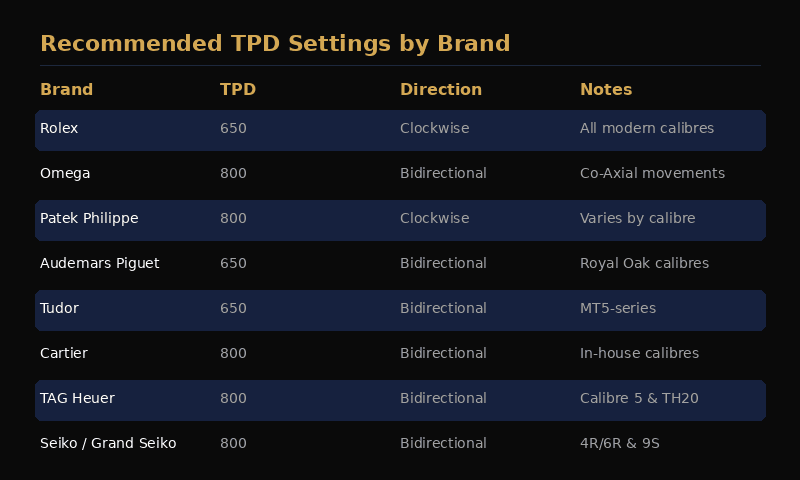
| Brand | TPD | Direction | Notes |
|---|---|---|---|
| Rolex | 650 | Clockwise | All modern Rolex calibres |
| Omega | 800 | Bidirectional | Co-Axial movements |
| Patek Philippe | 800 | Clockwise | Varies by calibre |
| Audemars Piguet | 650 | Bidirectional | Royal Oak calibres |
| Tudor | 650 | Bidirectional | MT5-series movements |
| Cartier | 800 | Bidirectional | In-house calibres |
| TAG Heuer | 800 | Bidirectional | Calibre 5 & TH20-series |
| Seiko / Grand Seiko | 800 | Bidirectional | 4R/6R & 9S calibres |
The 12 Best Watch Winders for 2026
We’ve tested and researched the most popular winders across every price bracket. Here are our picks, from budget-friendly to collector-grade:
1. Barrington Single Watch Winder — $189
The best value pick on this list. The Barrington Single offers adjustable TPD (from 650 to 1,800), three rotation directions, and a clean modern design in matte black or walnut finish. It runs on AC power or 2x C batteries, so you can place it anywhere. The motor is quiet enough for a bedroom nightstand, and the spring-loaded cushion fits watches from 32mm to 50mm diameter.
The main drawback is the lack of a dust cover — your watch sits exposed. But at $189 for a winder with programmable TPD settings and a 2-year warranty, it’s extremely hard to beat. If you own a single Omega Seamaster or Rolex and want it ready to wear every morning, this is the winder to buy.
2. Versa Elite Single Winder — $90
The budget king. The Versa Elite gives you adjustable TPD, three direction settings, and an AC adapter for under $100. The piano-black finish looks surprisingly refined for the price, and it’s been an Amazon bestseller for years. The cushion runs slightly small — owners with watches over 46mm report a tight fit — but for standard Rolex, Omega, and Cartier sizes it works perfectly.
If you’re buying your first winder and don’t want to invest heavily, the Versa Elite is a risk-free starting point. It won’t win design awards, but it does the job reliably.
3. Wolf Heritage Single — $399
Wolf is the most trusted name in automatic watch winders for good reason. The Heritage Single features a handcrafted wooden case with faux leather interior, a chrome lock closure, and Wolf’s patented rotation program that runs 10 seconds on, 3 minutes off — the closest replication of natural wrist movement on the market. The patented lock-in cuff holds watches securely, and it comes with a limited five-year manufacturer warranty on its current US warranty page.
TPD is preset at 900 bidirectional (optimal for most watches), and the brushless motor is effectively silent. It runs on AC or batteries, and the lid doubles as a dust cover. This is the winder we recommend to anyone who owns a watch worth over $5,000 and wants to protect it properly.
4. Wolf Heritage Double — $769
The same build quality as the Heritage Single, but holding two watches with independently programmable modules. Each watch gets its own rotation cycle, so you can set one for your Rolex GMT-Master II at 650 TPD clockwise and the other for an Omega at 800 TPD bidirectional. The wooden cabinet with glass cover makes it a handsome display piece. At $769 (frequently on sale for around $650), it’s the sweet spot for a two-watch collector.
5. Orbita Sparta Bold Single — $495
Made in the USA by a company that’s been building watch winders since 1996. The Sparta Bold uses Orbita’s unique suspended rotation technology — the watch rotates on a tilted axis, which some argue gives a more natural winding motion. It runs on a single C battery that lasts 3–5 years thanks to the extended-winding cycle (the motor runs 4 minutes per hour).
The minimalist open design means no dust cover, but it’s a beautiful desktop display piece. The downside: TPD and direction are fixed (approximately 780 TPD bidirectional), so you can’t customize settings per watch. If you want adjustability, look at the Orbita Sempre or Wolf instead.
6. Orbita Tourbillon 1 — $695
A statement piece. The all-glass dome case and exposed circuitry make this look like a museum display. Your watch rotates slowly inside a crystal cylinder, visible from every angle. It uses the same reliable Orbita motor and runs on AC power. At $695, it’s a premium price for a single winder, but if your watch collection doubles as interior decor, this is the most visually striking winder on the market.
7. Wolf Roadster Triple with Storage — $1,395
Three independently programmable winding modules plus a storage drawer for two additional watches or accessories. The Roadster’s leather exterior with contrast stitching borrows from automotive design, and the lid locks with a chrome clasp. Each module runs Wolf’s patented rotation program, and the storage drawer is lined in ultrasuede to protect non-wound watches. At $1,395 (often discounted to around $1,100), this is our top pick for collectors with 3–5 automatic watches.
8. Rapport London Perpetua III — $399
British design meets Swiss precision. The Perpetua III holds a single watch in a high-gloss lacquer case with a glass viewing window. It offers multiple TPD programs and three rotation directions, with a near-silent Japanese motor. Rapport’s build quality sits between Barrington and Wolf, making the Perpetua III an excellent mid-range option with a touch of British elegance. Available in black, white, and walnut finishes.
9. Wolf Viceroy Quad — $1,795
Four winding modules behind a tempered glass door, all independently programmable, with additional storage for six non-wound watches. The Viceroy is Wolf’s most popular multi-watch solution — serious collectors use it as the centrepiece of their watch drawer. The lock keeps curious hands away, and the LED backlight turns the whole unit into a display case. If you own four or more high-end automatic watches, this is the one.
10. Rapport London Paramount Nine — $3,250
For the serious collector. Nine independently controlled winding modules in a walnut cabinet with a glass-fronted door. Each module offers multiple TPD programs and bidirectional rotation. The Paramount is a genuine piece of furniture — standing about 18 inches tall with a felt-lined interior. At $3,250, it’s an investment, but one that organises and protects a substantial watch collection.
11. JINS&VICO Budget Double — $60
The cheapest decent winder available. This Amazon bestseller holds two watches and offers basic TPD and direction settings. Build quality is noticeably cheaper than Barrington or Versa — expect a faint hum from the motor and PU leather that won’t age gracefully. But if you need a no-frills winder for a couple of Seiko or Orient automatics, $60 is remarkably good value. Replace it every 2–3 years and you’re still spending less than a single Wolf.
12. Buben & Zörweg Time Mover — $4,500+
The pinnacle. German-engineered with Swiss motors, handcrafted cabinetry, and individual watch programs stored in memory. Buben & Zörweg winders are used by watch brands themselves in their boutiques. The Time Mover holds 2–4 watches (depending on configuration) in a climate-controlled case with built-in LED lighting. Starting at $4,500, this is a winder for collectors whose watches are worth six figures. It’s overkill for most, but if you own a Patek Philippe perpetual calendar, it’s a justified expense.
Check Any Watch Price in Seconds
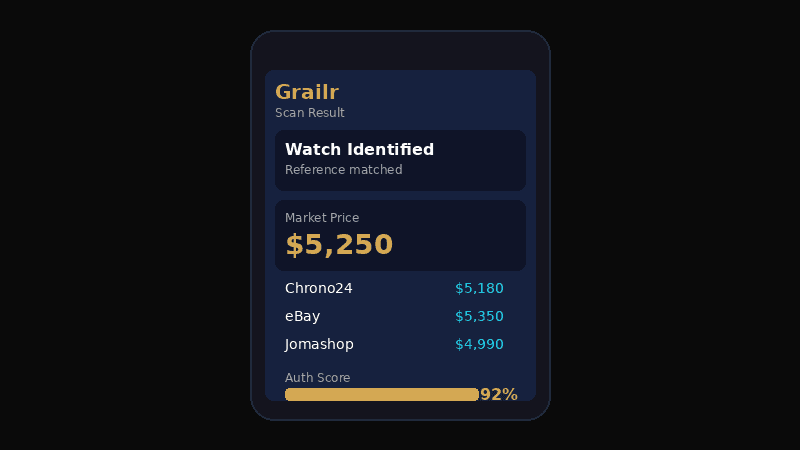
Grailr uses a photo to suggest a watch identity and an indicative price estimate, with active eBay listings where available. Check the exact reference and condition independently; a photo scan cannot authenticate a watch.
- Grailr suggests brand, model & reference
- Active eBay listings where available
- Identification confidence, not authentication
Head-to-Head Comparison
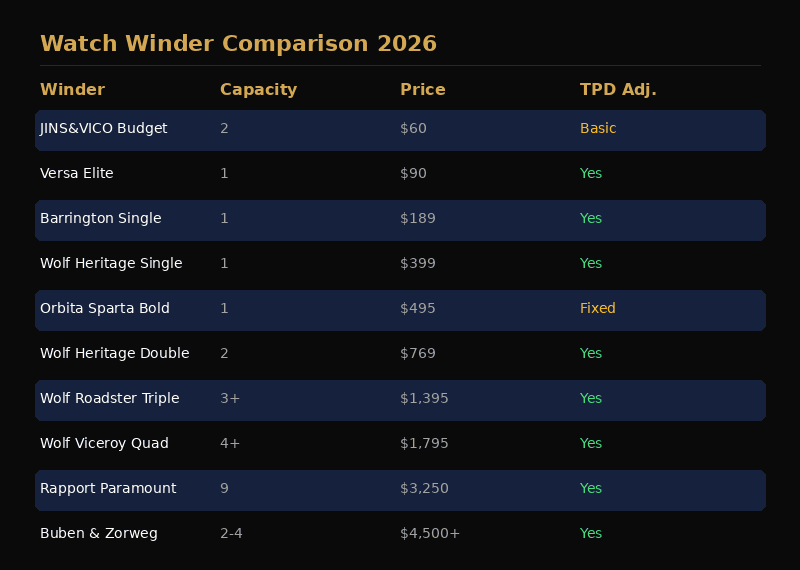
| Winder | Capacity | Price | TPD Adjust | Power |
|---|---|---|---|---|
| JINS&VICO Budget | 2 | $60 | Basic | AC |
| Versa Elite | 1 | $90 | Yes | AC |
| Barrington Single | 1 | $189 | Yes | AC/Battery |
| Rapport Perpetua III | 1 | $399 | Yes | AC |
| Wolf Heritage Single | 1 | $399 | Yes | AC/Battery |
| Orbita Sparta Bold | 1 | $495 | Fixed | Battery |
| Orbita Tourbillon 1 | 1 | $695 | Fixed | AC |
| Wolf Heritage Double | 2 | $769 | Yes | AC/Battery |
| Wolf Roadster Triple | 3 + storage | $1,395 | Yes | AC/Battery |
| Wolf Viceroy Quad | 4 + storage | $1,795 | Yes | AC |
| Rapport Paramount | 9 | $3,250 | Yes | AC |
| Buben & Zörweg | 2–4 | $4,500+ | Yes | AC |
Our Top Picks by Use Case
Best Overall Value
Barrington Single — $189
Adjustable TPD, dual power, 2-year warranty. Everything you need, nothing you don’t.
Best Budget Pick
Versa Elite — $90
Amazon bestseller that punches above its price. Great for your first winder.
Best Premium Single
Wolf Heritage Single — $399
Patented rotation, limited five-year manufacturer warranty on its current US warranty page, silent motor. The gold standard for one watch.
Best for Collectors (3–5 Watches)
Wolf Roadster Triple — $1,395
Three modules plus storage. Independent programming for each watch.
What to Look for When Buying a Watch Winder
TPD Adjustability
The single most important feature. Fixed-TPD winders work fine if they match your watch, but adjustable winders (650–1,800 TPD) let you optimise for any movement. Essential if you plan to use the winder with different watches.
Noise Level
Cheap winders use geared DC motors that hum or click. Premium brands like Wolf and Orbita use brushless motors rated below 10 dB — completely inaudible from across a room. If the winder will sit on your nightstand, noise level matters.
Cushion Size
The watch pillow needs to hold your watch securely without stretching the bracelet or strap. Look for spring-loaded or screw-adjustable cushions that accommodate watches from 32mm to 50mm+. Wolf’s lock-in cuff is the best design we’ve tested.
Power Source
AC-only winders need a wall outlet. Battery-powered winders (like Orbita’s Sparta, which runs 3–5 years on one C battery) give you placement freedom. Dual-power winders (AC + battery) offer the best of both worlds.
Build Quality & Warranty
A winder protects an expensive investment, so the winder itself should be well-built. WOLF states a limited five-year manufacturer warranty on its current US warranty page. Check the current terms for the exact brand, model and seller; coverage and exclusions differ.
Do Watch Winders Damage Watches? The Truth
This is the most common question in watch forums, and the answer is nuanced. Modern automatic movements feature a slipping clutch (also called a bridle) that disengages the winding mechanism once the mainspring is fully wound. This means you literally cannot overwind an automatic watch with a winder — the mainspring simply stops accepting additional energy.
The theoretical concern is about wear on the winding rotor bearings over extended periods. In practice, the amount of additional wear from a properly set winder is negligible compared to daily wrist wear. Your watch experiences far more stress from a single game of tennis or a stumble on the sidewalk than from years on a quality winder.
That said, avoid ultra-cheap winders with erratic rotation patterns or excessive vibration. A winder that shakes or stutters can put stress on the escapement. Stick with established brands — Wolf, Orbita, Rapport, or Barrington — and you’ll have no issues. If you’re still concerned, use the intermittent rotation setting and keep your winder’s TPD at or below the manufacturer’s recommendation.
Frequently Asked Questions
Do automatic watches need a watch winder?
No, automatic watches don’t need a winder to stay healthy. However, a winder keeps your watch running and set to the correct time and date, which is especially convenient for watches with complex calendar complications that are tedious to reset.
Can a watch winder damage my automatic watch?
A quality watch winder set to the correct TPD will not damage your watch. Modern automatic movements have a clutch mechanism that disengages the winding system when the mainspring is fully wound. Stick with reputable brands like Wolf, Orbita, Rapport, or Barrington.
How many turns per day does my watch need?
Most automatic watches need 650–950 TPD. Rolex needs 650 clockwise. Omega needs 800 bidirectional. Patek Philippe needs about 800 clockwise. When in doubt, start at 800 TPD bidirectional as a safe default.
What is the best watch winder brand?
Wolf is the most recommended brand overall for build quality, quiet motors, and limited five-year manufacturer warranty on its current US warranty page. Orbita is the premium American-made choice. Rapport London offers excellent mid-range options. Barrington is the best value under $250.
Should I leave my watch in a winder all the time?
You can, but it’s not necessary. Many collectors use winders only before wearing a watch to avoid resetting complications. If you prefer continuous winding, use the intermittent rotation setting to reduce motor wear.
Related Articles
The Bottom Line
A watch winder is not a necessity — it’s a convenience. But for collectors rotating between multiple automatic watches, especially those with date complications, it’s a convenience that pays for itself in time saved. The Barrington Single at $189 is our top value recommendation for most buyers. If you want the best, the Wolf Heritage line delivers unmatched build quality and a limited five-year manufacturer warranty on its current US warranty page. And if you own a Patek perpetual calendar or AP Royal Oak, a winder isn’t a luxury — it’s a smart investment to protect your investment.
Know What Your Watches Are Worth
Grailr uses a photo to suggest a watch identity and an indicative price estimate, with active eBay listings where available. Check the exact reference and condition independently; a photo scan cannot authenticate a watch.
Scan a Watch NowSources and price context
- WOLF winder operating guidance — Explains turns per day and winding direction; match settings to the movement.
- WOLF US warranty registration — Currently states five-year limited cover for manufacturing defects; confirm eligibility and local terms for your purchase.
These primary sources support the specific history, specification or policy points noted above. Prices and resale percentages elsewhere in this guide are indicative editorial figures, not a verified transaction dataset or guaranteed returns. Confirm the exact reference, region, condition and current quote before buying; asking prices are not completed-sale prices.