World Timer Watches: How They Work and What to Buy
The Cottier mechanism explained, every price tier from under $1,000 to six figures, and the best world timer watches for every budget in 2026.
Price context: this guide includes indicative prices from its original publication period. They have not all been refreshed to current quotes. Use the linked primary sources for specifications and policies, and verify prices independently.

- World timers display all 24 time zones at once — invented by Louis Cottier in the 1930s for Patek Philippe
- True world timers start at $995 (Alpina) and run to $112,000+ (Patek Philippe), with strong options at every tier
- Frederique Constant and Nomos offer the best value under $5,000 with in-house movements and manufacture finishing
- A world timer is different from a GMT (two zones) — it reads every zone without adjusting the watch
How a World Timer Watch Works
A world timer watch displays all 24 standard time zones simultaneously on a single dial. The mechanism was invented in the 1930s by Geneva watchmaker Louis Cottier, who built it initially for Patek Philippe. Nearly a century later, the Cottier system remains the standard design used by the vast majority of world timer watches on the market.
The mechanism uses three concentric rings on the dial. The outermost ring lists 24 cities, one representing each time zone. Inside that sits a rotating 24-hour ring, usually divided into day (light) and night (dark) halves. At the centre, the main hour and minute hands show your local time as usual. The 24-hour ring rotates once per day, synchronized with the main hands so that every city on the outer ring always aligns with the correct hour.
To set the watch, you advance the city ring until your home city sits at twelve o’clock, then set the main hands to your local time. The 24-hour ring moves automatically from there. To read any other time zone, find the city and check where it aligns with the 24-hour scale — no adjustments needed.
Some modern variations replace the city ring with a rotating disc beneath the dial, or use a bezel-operated system like the IWC Timezoner, which lets you set the zone by pressing and rotating the bezel rather than the crown. But the fundamental principle — a 24-hour indicator synchronized with a city reference — has not changed since Cottier’s original design.
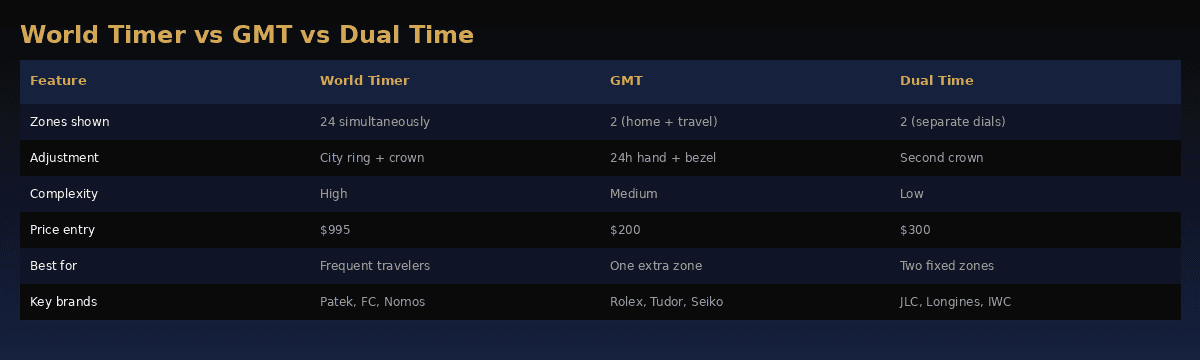
World Timer vs GMT vs Dual Time
All three complications help you track multiple time zones, but they work differently and suit different needs. If you travel across two or three zones regularly, a GMT watch is simpler and cheaper. If you need to reference many zones quickly — say you manage teams in London, Tokyo, and New York from Dubai — a world timer saves you from mental arithmetic.
| Feature | GMT | Dual Time | World Timer |
|---|---|---|---|
| Zones displayed | 2 | 2 | 24 |
| How it works | Extra hand + 24h bezel | Sub-dial or second hour hand | City ring + 24h ring |
| Adjust to read another zone? | Rotate bezel | Yes, set sub-dial | No — all visible |
| Typical price entry | $500 | $1,000 | $995 |
| Dial complexity | Low | Low | High |
| Best for | Two-zone travellers | Home + destination | Multi-zone monitoring |
Best Affordable World Timer Watches Under $5,000
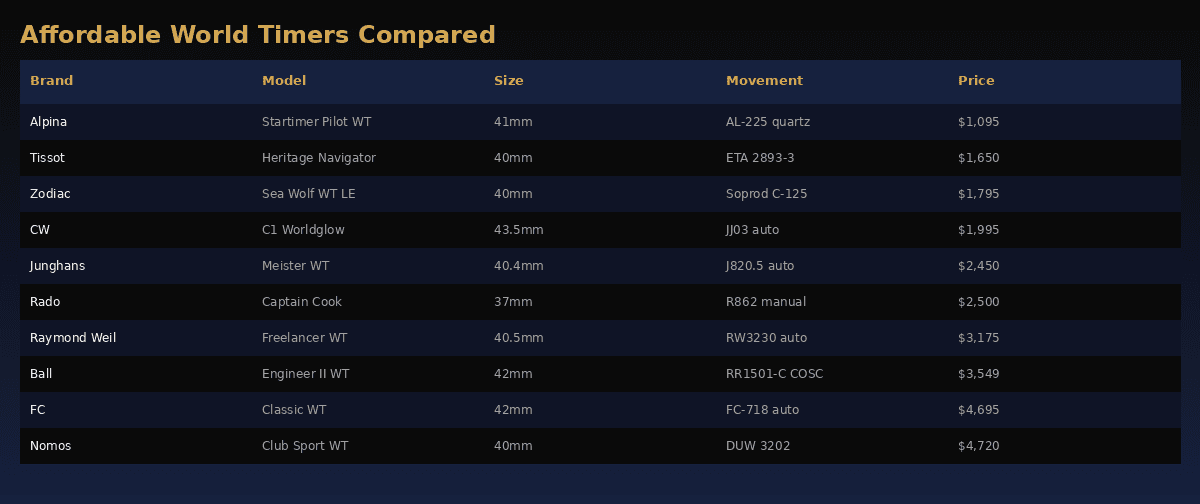
A decade ago, the cheapest world timer watch cost north of $3,000 and used a modified ETA base. Today, brands like Alpina, Nomos, and Frederique Constant offer genuine world-time complications with in-house or high-grade movements from under $1,000 to about $5,000. Here are the standout options.
Alpina Startimer Pilot Quartz World Timer — $995–$1,095
The most affordable true world timer on the market. The 41mm steel case houses the AL-225 quartz movement with a 45-month battery life and 100m water resistance. The 24-city rotating ring is operated by a pusher at two o’clock. It lacks the romance of a mechanical movement, but quartz accuracy means every zone reads exactly right — a genuine advantage for a travel watch. The pilot-style dial with oversized Arabic numerals is legible at a glance.
Tissot Heritage Navigator 160th Anniversary — $1,650
Tissot’s heritage piece uses the ETA 2893-3 automatic with COSC chronometer certification. At roughly 40mm, it’s the most classically sized affordable world timer. The city ring lists 24 cities in a vintage-inspired font, and the crosshair dial nods to mid-century navigation instruments. Water resistance is only 30m, so it’s a dress-and-travel piece rather than an everyday beater.
Zodiac Super Sea Wolf World Time LE — $1,795
Limited to 500 pieces, the Zodiac combines world-time functionality with serious dive credentials: 200m water resistance in a 40mm case powered by the Soprod C-125 automatic. The fixed city bezel gives it a sportier look than most world timers, and the colourful dial options keep the vintage Zodiac character alive.
Christopher Ward C1 Worldglow — $1,995
At 43.5mm, this is the biggest affordable option, but the standout feature is the glow-in-the-dark world map on the dial. The Sellita-based JJ03 automatic provides reliable timekeeping, and Christopher Ward’s direct-to-consumer pricing makes this a lot of watch for under $2,000. The sapphire caseback shows the decorated movement.
Junghans Meister Worldtimer — $2,450
Bauhaus-inspired design meets world-time functionality. The 40.4mm case is slim and elegant, with the J820.5 automatic providing a 42-hour power reserve. The city ring is printed on the chapter ring in a clean sans-serif font that keeps the dial restrained despite showing 24 zones. At 100m water resistance, it handles daily wear confidently.
Rado Captain Cook Over-Pole — $2,500
Rado’s compact 37mm case makes this the smallest world timer watch currently in production. The ceramic city bezel is virtually scratch-proof, and the R862 manual-wind movement (ETA 2804-2 base) delivers 80 hours of power reserve. The “Over-Pole” name references the great-circle flight paths that made world timers popular with pilots in the first place.
Frederique Constant Classic Worldtimer Manufacture — $4,695–$6,195
The best value world timer for anyone who wants an in-house movement. The FC-718 caliber is designed and produced in Frederique Constant’s own Plan-les-Ouates manufacture. The 42mm case hosts a beautifully finished dial with a rotating world map, and all functions are operated via the crown alone. At under $5,000 for the base steel version, it undercuts the next comparable manufacture world timer by several thousand dollars.
Nomos Club Sport Neomatik Worldtimer — $4,720
Nomos’s Glashütte-made DUW 3202 automatic is a genuinely in-house caliber with the brand’s signature slim profile — just 9.9mm case thickness for a world timer watch, which is remarkable. The 40mm case wears comfortably, and the city ring is advanced via a pusher. The minimalist Nomos design keeps the 24-zone display surprisingly legible. At under $5,000, it’s the best-dressed world timer in this bracket.
Best Luxury World Timer Watches
Once you cross the $5,000 mark, world timer watches begin to showcase haute horlogerie finishing, exotic materials, and complications-within-complications. These are the watches that define the category.
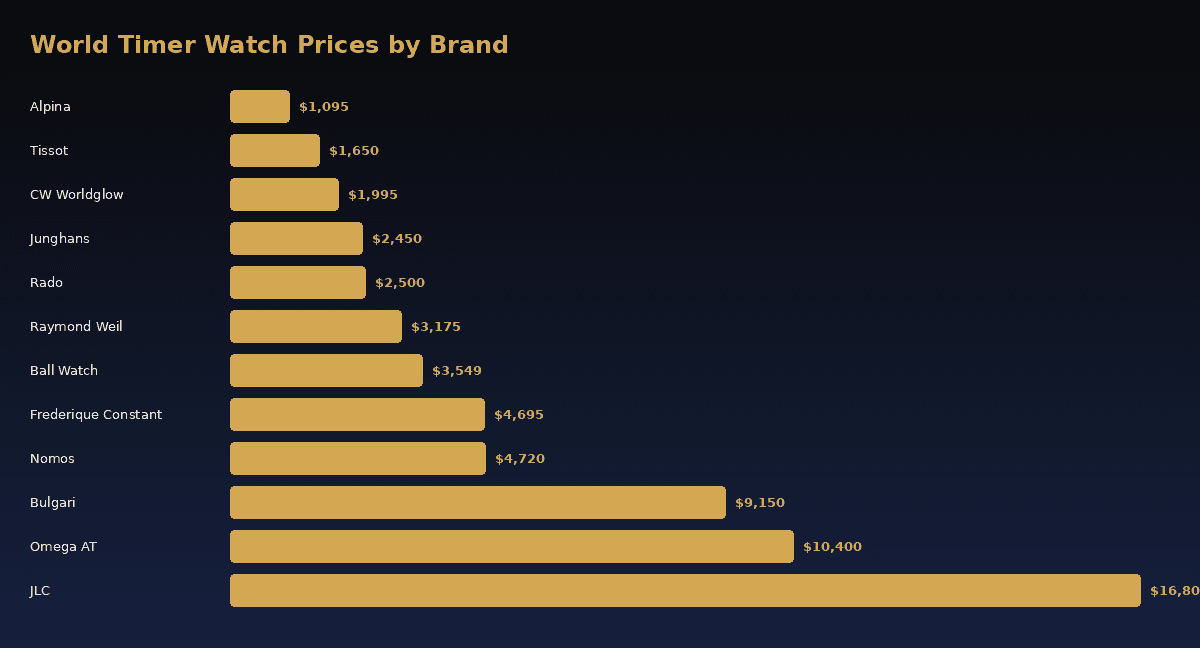
Bulgari Octo Roma Worldtimer — $9,150
The entry point to luxury world timers. The 41mm Octo Roma case is distinctive and angular, powered by the in-house BVL 257 automatic with a 42-hour reserve. A unique touch: the city ring includes locations of Bulgari hotels worldwide, giving it a branded but charming personality. At 100m water resistance, it handles travel wear without worry.
Omega Seamaster Aqua Terra Worldtimer — $10,400
The best world timer for daily wear. The 43mm case houses Omega’s Master Chronometer Caliber 8938 or 8939 automatic, which means it’s tested against METAS standards: 0/+5 sec/day, anti-magnetic to 15,000 gauss, and water resistant to 150m. The enamel world map dial is a genuine work of art, and the Seamaster-grade build quality means you can wear it diving, hiking, or at a business dinner without a second thought.
Jaeger-LeCoultre Geophysic Universal Time — $16,800
JLC’s Caliber 772 automatic features the brand’s Gyrolab balance wheel and a city disc operated entirely by the crown. At 41.6mm, it wears slightly more compact than most luxury world timers. The finishing is exceptional for the price point, and the lacquered world-map dial in blue is one of the most striking dials in the category. It’s the world timer that watchmakers buy for themselves.
IWC Pilot’s Watch Timezoner Top Gun Ceratanium — $18,400
The sportiest luxury world timer. The 46mm Ceratanium case (a ceramic-titanium composite exclusive to IWC) is virtually scratch-proof and featherweight. Caliber 82760 provides 60 hours of power reserve, and the unique bezel-operated zone selection means you press in and rotate to change cities — no crown fumbling. Limited to 500 pieces, it’s a modern classic for pilot watch enthusiasts.
Vacheron Constantin Overseas World Time — $37,000
The Overseas World Time packs 37 time zones into a 43.5mm case with 150m water resistance and the in-house Caliber 2460WT. The Geneva Seal guarantees the highest level of finishing, and the interchangeable bracelet/strap system (steel bracelet, leather strap, and rubber strap included) makes it the most versatile luxury world timer. The dial shows a Lambert azimuthal projection of the globe with separate day and night shading.
Patek Philippe World Time Flyback Chronograph — $112,484
The ultimate world timer watch. Patek’s Ref. 5930 combines the Cottier world-time mechanism with a flyback chronograph, all powered by the CH 28-520 HU automatic caliber. At 39.5mm, it’s remarkably wearable for the level of complication. One pusher at ten o’clock simultaneously advances the city ring and adjusts the hour hand, date, and 24-hour display. The brand that started the world-time revolution in the 1930s still makes the definitive version.
Full Specs Comparison
Side-by-side specifications for every world timer watch discussed in this guide. All prices are indicative retail figures; verify with the manufacturer or an authorized dealer before buying.
| Watch | Price | Size | Movement | WR |
|---|---|---|---|---|
| Alpina Startimer Pilot | $995 | 41mm | AL-225 quartz | 100m |
| Tissot Heritage Navigator | $1,650 | 40mm | ETA 2893-3 (COSC) | 30m |
| Zodiac Super Sea Wolf WT | $1,795 | 40mm | Soprod C-125 | 200m |
| Christopher Ward Worldglow | $1,995 | 43.5mm | JJ03 (Sellita) | 100m |
| Junghans Meister WT | $2,450 | 40.4mm | J820.5 | 100m |
| Rado Captain Cook OP | $2,500 | 37mm | R862 (manual) | 100m |
| Raymond Weil Freelancer | $3,175 | 40.5mm | RW3230 (Sellita) | 100m |
| Ball Engineer II Diver WT | $3,549 | 42mm | RR1501-C (COSC) | 200m |
| Frederique Constant WT | $4,695 | 42mm | FC-718 (in-house) | 100m |
| Nomos Club Sport WT | $4,720 | 40mm | DUW 3202 (in-house) | 100m |
| Bulgari Octo Roma WT | $9,150 | 41mm | BVL 257 (in-house) | 100m |
| Omega Aqua Terra WT | $10,400 | 43mm | Cal. 8938 (MC) | 150m |
| JLC Geophysic UT | $16,800 | 41.6mm | Cal. 772 | 50m |
| IWC Timezoner Top Gun | $18,400 | 46mm | Cal. 82760 | 60m |
| Vacheron Overseas WT | $37,000 | 43.5mm | Cal. 2460WT | 150m |
| Patek Philippe 5930 | $112,484 | 39.5mm | CH 28-520 HU | 30m |
What to Look For When Buying a World Timer
1. Dial Legibility
World timers are inherently complex dials. Try the watch on and confirm you can actually read all 24 cities and the 24-hour ring without squinting. Some designs sacrifice legibility for aesthetics. The Watches and Wonders show floor is a good place to compare dials in person.
2. Zone-Setting Mechanism
The traditional Cottier mechanism uses the crown, clicking the city ring forward one position at a time. More modern systems use a pusher (Nomos, Alpina) or the bezel (IWC Timezoner). The bezel system is fastest; the crown system is simplest and most common.
3. City Selection
Most world timers list 24 cities, but some omit zones you might care about. Check whether your home city or its UTC equivalent is represented. Some brands choose unusual city names for brand personality (Bulgari uses its hotel cities), which may or may not align with your travel patterns.
4. Case Size
World timers tend to run large because the dial needs room for all those rings. The Rado Captain Cook Over-Pole at 37mm is the exception; most fall in the 40–44mm range. If you have smaller wrists, try before you buy — the visual weight of a busy dial in a large case can overwhelm.
5. Water Resistance
World timers span the full range from 30m (Tissot, Patek) to 200m (Zodiac, Ball). If this will be your daily watch, 100m minimum is sensible. If it’s a dress-and-travel piece, 30m is adequate as long as you keep it dry.
6. Scan Before You Buy Pre-Owned
World timers are complex enough that pre-owned examples deserve extra scrutiny. Use Grailr’s scanner to verify the reference number and check fair market pricing against three or more sources before committing.
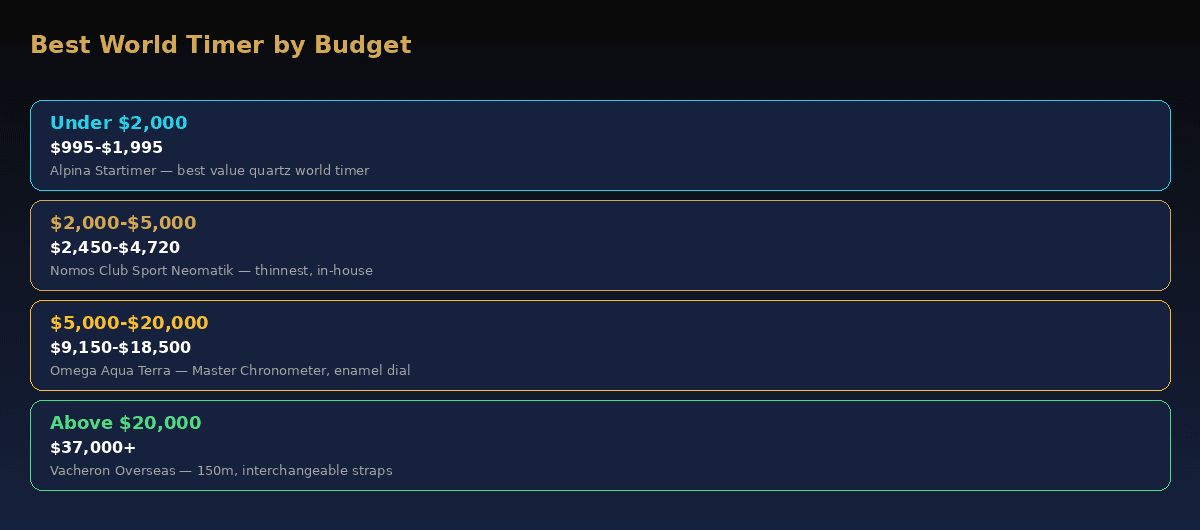
Our Top Picks by Budget
Best Under $2,000
Zodiac Super Sea Wolf World Time — $1,795
200m diver credentials, limited-edition character, and a true world-time complication at a price that beats most GMT automatics.
Best Under $5,000
Nomos Club Sport Neomatik Worldtimer — $4,720
In-house Glashütte movement, 9.9mm slim profile, minimalist legibility. The world timer that feels effortless on the wrist.
Best Daily Wearer
Omega Aqua Terra Worldtimer — $10,400
Master Chronometer accuracy, 150m water resistance, anti-magnetic to 15,000 gauss. The only world timer built like a tool watch.
Best Overall Luxury
Vacheron Constantin Overseas World Time — $37,000
Geneva Seal finishing, 37 time zones, three-strap system included. The world timer that does everything at the highest level.
Frequently Asked Questions
What is a world timer watch?
A world timer watch displays all 24 standard time zones simultaneously using a rotating 24-hour ring and a city ring around the dial. You read the local time for any city by finding it on the outer ring and checking where it aligns with the 24-hour scale.
What is the difference between a world timer and a GMT watch?
A GMT watch shows two time zones using an extra hand and a 24-hour bezel. A world timer shows all 24 zones at once via rotating rings. GMT is simpler and cheaper; world timers let you read any zone instantly without adjusting the watch.
What is the cheapest world timer watch?
The Alpina Startimer Pilot Quartz World Timer starts at about $995, making it the most affordable true world-time watch on the market. The Tissot Heritage Navigator at $1,650 and the Zodiac Super Sea Wolf World Time at $1,795 are the next most affordable options.
Who invented the world time watch?
Geneva watchmaker Louis Cottier invented the modern world-time wristwatch mechanism in the 1930s. He created it initially for Patek Philippe, and the basic Cottier system of a rotating 24-hour ring plus a city ring remains the standard design used by most world timers today.
Are world timer watches hard to set?
Modern world timers are easier to set than older designs. Most use the crown to advance the city ring one click at a time until your home city is at twelve. The 24-hour ring syncs automatically with the main hands. Some models like the IWC Timezoner let you set the zone by rotating the bezel directly.
Is a world timer a good investment?
World timers hold value reasonably well because the complication is desirable and production numbers are lower than basic time-and-date watches. Patek Philippe World Time references are among the strongest performers on the secondary market. At the affordable end, brands like Nomos and Frederique Constant retain 60-75% of retail.
Related Articles
The Bottom Line
A world timer watch is one of the most intellectually satisfying complications in horology — a mechanical solution to a genuinely useful problem. At the affordable end, the Nomos Club Sport Neomatik Worldtimer and Frederique Constant Classic Worldtimer Manufacture deliver in-house movements with real finishing at prices that would have been unthinkable a decade ago. For daily wear, the Omega Aqua Terra Worldtimer is built to handle anything. And for the collector, the Patek Philippe 5930 remains the pinnacle of what Louis Cottier started nearly a century ago. Whatever your budget, the world timer rewards you every time you glance at the dial and read a distant city’s time without lifting a finger.
Sources and price context
- Patek Philippe World Time collection — Official Patek Philippe page for the World Time complication, including the history of Louis Cottier’s mechanism.
- Frederique Constant Worldtimer collection — Official specifications and pricing for the Classic Worldtimer Manufacture with FC-718 caliber.
- Nomos Club collection — Official Nomos page for the Club Sport Neomatik Worldtimer with DUW 3202 caliber specifications.
These primary sources support the specific specification and pricing points noted above. Prices elsewhere in this guide are indicative editorial figures, not a verified transaction dataset or guaranteed returns. Confirm the exact reference, region, condition and current quote before buying; asking prices are not completed-sale prices.