Zenith El Primero: The Complete Buying Guide
Every Chronomaster model compared — history, specs, real pricing, and why the world’s fastest automatic chronograph still sets the standard.
Price context: this guide includes indicative prices from its original publication period. They have not all been refreshed to current quotes. Use the linked primary sources for specifications and policies, and verify prices independently.
- The El Primero is the highest-frequency integrated automatic chronograph in production, beating at 36,000 vph (5 Hz) with 1/10th-second precision
- Retail prices range from roughly $9,200 for the Chronomaster Original to $23,000 for the rose gold Chronomaster Sport
- Steel Chronomaster Sport models trade between $5,100 and $7,000 pre-owned — widely considered the best integrated chronograph value under $10,000
- El Primero references have appreciated roughly 7.2% over the past 12 months across tracked models
- The current El Primero 3600 caliber uses silicon escapement components for improved accuracy and durability
The History of the El Primero
On January 10, 1969, Zenith introduced the El Primero — Spanish for “the first” — as one of the world’s first automatic chronograph movements. It was not alone in the race: Seiko’s caliber 6139 and the Chrono-Matic consortium (Breitling, Heuer, Hamilton, Büren) were developing their own automatic chronographs simultaneously. What set the El Primero apart was its operating frequency: 36,000 vibrations per hour (5 Hz), double the 4 Hz standard used by virtually every other Swiss chronograph at the time.
That higher frequency gave the El Primero a decisive technical advantage. While a 4 Hz chronograph measures elapsed time to the nearest 1/4 or 1/8 of a second, the 5 Hz El Primero resolves to 1/10th of a second — genuine stopwatch precision from a wristwatch. The movement also packed a date complication, automatic winding, and a column-wheel chronograph mechanism into a single integrated caliber just 6.5mm thick. It was, and remains, one of the most technically dense movements ever produced.
Then the quartz crisis hit. By the mid-1970s, Japanese quartz watches were threatening the entire Swiss industry, and Zenith’s management ordered the destruction of all tooling for mechanical movements. But a watchmaker named Charles Vermot saw the El Primero as irreplaceable. He secretly gathered the tools, presses, and technical drawings and hid them behind a false wall in the Le Locle manufacture. When the mechanical watch market revived in the 1980s, Vermot’s cache allowed Zenith to restart El Primero production almost immediately — giving the brand a decade-long head start over competitors who had genuinely destroyed their tooling.
The movement’s reputation grew further in 1988 when Rolex chose a modified El Primero (the cal. 4030 base) to power the Daytona — a partnership that lasted until 2000. That single endorsement cemented the El Primero as the benchmark automatic chronograph movement, a status it continues to hold in the Chronomaster collection today. Founded in Le Locle, Switzerland in 1865, Zenith is one of the few remaining manufactures that produces its own movements from start to finish.
The Complete Chronomaster Lineup
Chronomaster Sport ($11,300)
Zenith’s flagship chronograph and the model that brought the El Primero back into mainstream conversation. At 41mm in stainless steel with a black ceramic tachymeter bezel, the Sport was launched in 2021 as the first non-limited-edition watch to carry the new El Primero 3600 caliber. The tricolor sub-dials — light grey at 3, dark grey at 6, and blue at 9 — are a direct callback to the 1969 A386 original. Available on a steel bracelet or a rubber strap, the Sport is designed as a daily-wear chronograph that can handle anything from the office to a track day.
At its $11,300 MSRP, the Chronomaster Sport competes directly with the Omega Speedmaster ’57 and sits well below the Rolex Daytona’s $15,100 retail. On the secondary market, steel examples trade between $5,100 and $7,000 — making it arguably the best value in the integrated chronograph category. A rose gold version is available at approximately $23,000 retail, with pre-owned examples around $16,000.
Chronomaster Original ($9,200)
The spiritual successor to the 1969 original. At 38mm, the Chronomaster Original is noticeably smaller and dressier than the Sport, with a domed sapphire crystal that gives the dial a warm, vintage-inflected distortion at the edges. It runs the same El Primero 3600 caliber but presents it in a more restrained package. Gradient dial options — including a reverse-panda white-on-black — have made certain references collector favourites. This is the Chronomaster for buyers who value heritage proportions over modern sport-watch sizing.
Chronomaster Open ($10,000)
First introduced in 2003 and relaunched at Watches & Wonders 2022, the Chronomaster Open cuts an aperture in the dial at 10 o’clock to expose the El Primero’s silicon escape wheel spinning at 36,000 vph. The current version uses the El Primero 3604 caliber — a modified 3600 — in a 39.5mm case. A hesalite crystal element at 9 o’clock preserves the tricolor sub-dial legibility while still revealing the escapement. It is the most visually dramatic Chronomaster in the current range.
Chronomaster Revival A386
A faithful 37mm re-edition of the original 1969 El Primero with pump pushers, a domed crystal, and the same tricolor dial layout that started it all. Limited and periodically reissued, the A386 Revival is aimed at collectors who want the closest possible approximation to the watch that Vermot saved. Pricing varies by edition and availability, typically starting around $9,500 on the secondary market for recent steel versions.
Full Specifications and Pricing
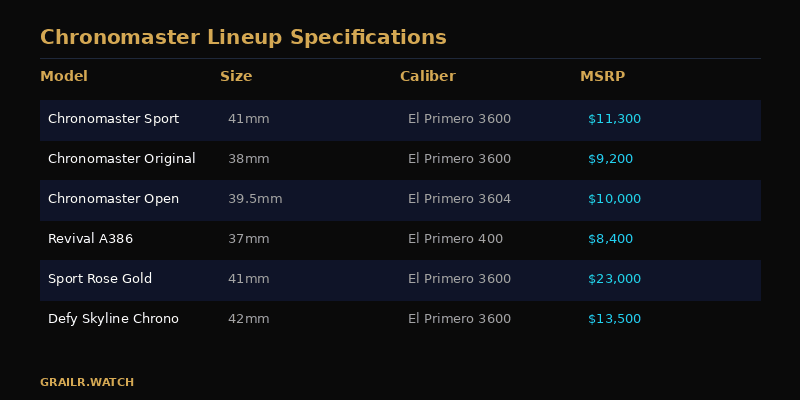
Every current Chronomaster reference uses a variant of the El Primero running at 36,000 vph. The differences come down to case size, materials, and how much of the movement you can see through the dial.
| Model | Size | Caliber | Retail | Pre-Owned |
|---|---|---|---|---|
| Chronomaster Sport (steel) | 41mm | El Primero 3600 | $11,300 | $5,100–$7,000 |
| Chronomaster Sport (rose gold) | 41mm | El Primero 3600 | $23,000 | ~$16,000 |
| Chronomaster Original | 38mm | El Primero 3600 | $9,200 | $5,500–$7,500 |
| Chronomaster Open | 39.5mm | El Primero 3604 | $10,000 | $5,000–$7,000 |
| Chronomaster Revival A386 | 37mm | El Primero 400 | Varies | ~$9,500+ |
Retail prices are approximate 2026 MSRPs. Pre-owned figures are indicative asking prices from aggregated market data, not completed sale records. Verify independently before purchasing.
Inside the El Primero 3600
The El Primero 3600 is the latest generation of a movement family that has been in continuous production — thanks to Vermot’s intervention — since 1969. It retains the defining characteristic of every El Primero: a 36,000 vph (5 Hz) operating frequency that delivers 1/10th-of-a-second chronograph precision. Where it diverges from its predecessors is in materials, efficiency, and modern finishing.
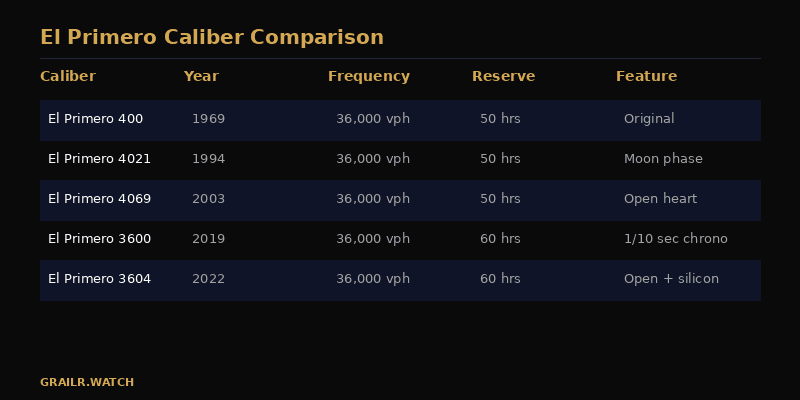
The 3600 uses a silicon escape wheel and pallet lever, replacing the traditional steel components found in earlier calibers. Silicon does not require lubrication, is unaffected by magnetic fields, and can be etched to tolerances impossible with conventional machining. The result is a measurable improvement in both long-term accuracy and service intervals. Zenith rates the 3600 at approximately 60 hours of power reserve — a significant increase over the roughly 50 hours offered by the previous El Primero 400 series.
The chronograph mechanism uses a column wheel and a star wheel for the tri-compax sub-dial display. Unlike modular chronographs that bolt an additional mechanism on top of a time-only base, the El Primero integrates the chronograph function into the base caliber itself. That integration keeps the movement thinner (6.6mm for the 3600) and more reliable than the stacked approach used by some competitors. The 3600 runs 31 jewels and is decorated with Côtes de Genève striping visible through the display caseback.
What does 1/10th-second precision mean in practice? The Chronomaster Sport includes a dedicated 1/10th-of-a-second display on the dial: the central chronograph seconds hand completes a full rotation in 10 seconds rather than 60, with each tick marking one-tenth of a second. Combined with the tachymeter bezel, this allows speeds to be measured with a precision no other production automatic chronograph can match. It is a genuine tool-watch feature, not a marketing exercise. If you use a chronograph to time things rather than admire it, the El Primero does it better than anything else on the market.
Check Any Watch Price in Seconds
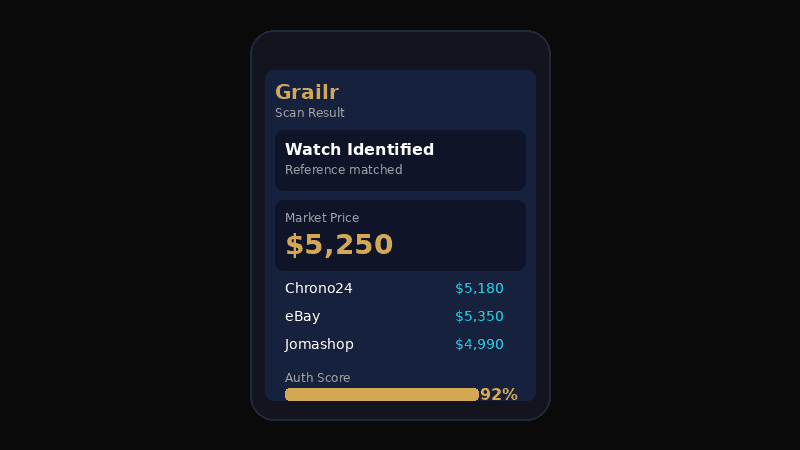
Grailr scans your watch photo and pulls live pricing from Chrono24, eBay, and Jomashop.
- AI identifies brand, model & reference number
- Live market prices from 3+ sources
- Authentication confidence score
El Primero vs Rolex Daytona vs Omega Speedmaster
The three most iconic chronograph movements in watchmaking all take different approaches. The El Primero prioritizes frequency and precision. The Daytona prioritizes prestige and value retention. The Speedmaster prioritizes heritage and versatility. Here is how they compare head to head.
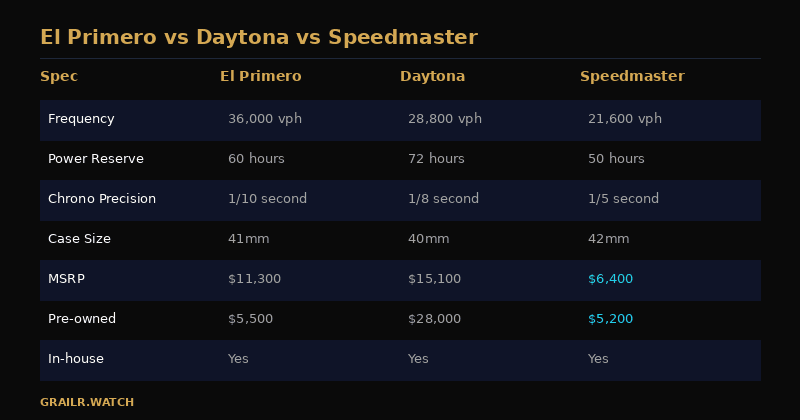
| Spec | Zenith Chronomaster Sport | Rolex Daytona | Omega Speedmaster ’57 |
|---|---|---|---|
| Caliber | El Primero 3600 | Cal. 4131 | Cal. 9906 |
| Frequency | 36,000 vph (5 Hz) | 28,800 vph (4 Hz) | 25,200 vph (3.5 Hz) |
| Chrono Precision | 1/10th second | 1/8th second | 1/4 second |
| Power Reserve | ~60 hours | 72 hours | 60 hours |
| Case Size | 41mm | 40mm | 40.5mm |
| Water Resistance | 100m | 100m | 100m |
| Retail (Steel) | $11,300 | $15,100 | $10,000 |
| Pre-Owned | $5,100–$7,000 | $25,000+ | $6,000–$8,000 |
| Value Retention | ~55% | 165%+ | ~70% |
The takeaway is clear: if you want a chronograph as a long-term store of value, the Daytona is in a league of its own. If you want the technically superior timing instrument at a fraction of the price, the Chronomaster Sport is the rational choice. The Speedmaster sits in between, offering stronger brand recognition than Zenith with better availability than Rolex. All three are exceptional luxury sport watches — the question is what you value most.
Resale Value and Market Trends
Zenith does not carry the secondary-market premium of Rolex, and the El Primero has never been a “flip” watch. But the numbers tell a more nuanced story than the conventional wisdom suggests. According to aggregated market data from Loupe, tracked El Primero references have appreciated roughly 7.2% over the past 12 months, outperforming many Omega and Breitling chronographs over the same period.
WatchCharts places the average El Primero market value near $7,000, with a range from roughly $2,000 for older quartz-era references to $25,000 for limited editions and precious-metal models. The steel Chronomaster Sport, with its sub-$7,000 pre-owned pricing against an $11,300 MSRP, represents a retention rate of approximately 50–62% depending on condition and dial variant. That is below Rolex and comparable to many Omega sport models, but the important context is the absolute dollar figure: a $5,500 Chronomaster Sport is an extraordinary amount of chronograph for the money.
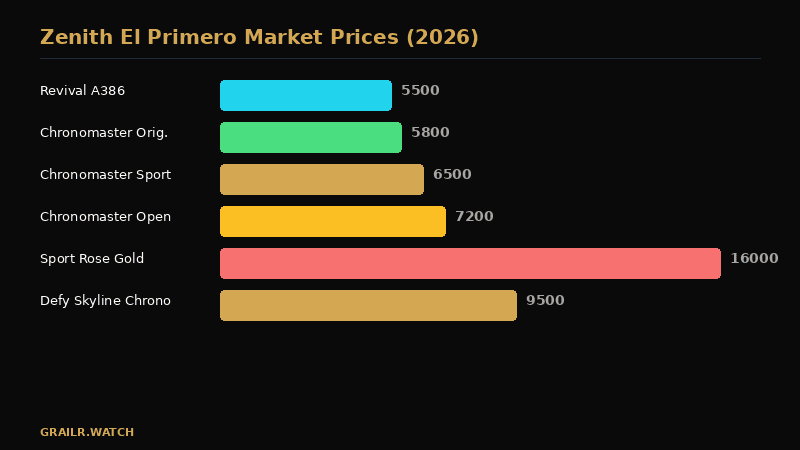
The references that hold value best tend to be limited editions (especially the A386 Revival), the tricolor-dial Chronomaster Sport on bracelet, and rose gold models where the entry cost is already high enough to discourage speculative buying. If you are buying for long-term appreciation, the A386 Revival in steel has the strongest historical trajectory. If you are buying to wear, the Chronomaster Sport on bracelet offers the best combination of utility and residual value.
5 Tips Before You Buy a Zenith El Primero
1. Buy Pre-Owned for Maximum Value
The Chronomaster Sport loses roughly 40–50% at retail but stabilizes quickly on the secondary market. A one- or two-year-old example with box and papers saves $4,000–$6,000 over retail with minimal wear. The movement is built for decades of service; there is no mechanical penalty for buying used.
2. Try Both Sizes On
The Chronomaster Sport (41mm) and the Chronomaster Original (38mm) wear very differently despite the modest 3mm gap. The Sport has a ceramic bezel and a thicker case profile that makes it feel larger on the wrist. If you have a wrist under 7 inches, the Original or the Open (39.5mm) may be the better daily wearer.
3. Understand the Dial Variants
Not all tricolor dials are the same. The Chronomaster Sport’s sub-dial colours are lighter and more muted than the Original’s deeper gradients. Some limited editions use a reverse-panda layout (black sub-dials on a white dial) that commands a premium on the secondary market. Check the exact reference number, not just “Chronomaster Sport,” when comparing prices.
4. Scan Before You Buy
Use Grailr’s free scanner to photograph any listing and confirm the reference, check indicative market pricing, and get a suggested identification. Verify the result against the seller’s documentation and an independent inspection — a photo scan is a starting point, not proof of authenticity.
5. Check the Service History
The El Primero runs at a higher frequency than most chronographs, which means the escapement components experience more wear per hour. Silicon parts in the 3600 reduce this significantly, but older El Primero 400-series movements benefit from regular service every four to five years. Ask for service records and factor the cost of a Zenith-certified service (typically $800–$1,200) into your pre-owned budget.
Frequently Asked Questions
What makes the El Primero movement special?
The El Primero beats at 36,000 vibrations per hour (5 Hz), the highest frequency of any integrated automatic chronograph. That rate lets it measure elapsed time to 1/10th of a second rather than the 1/4 or 1/8 second precision of most competitors.
How much does a Zenith Chronomaster Sport cost?
The steel Chronomaster Sport retails for approximately $11,300 in 2026. Pre-owned examples in good condition trade between $5,100 and $7,000 depending on dial variant and condition, making it one of the strongest values in the integrated chronograph category.
Is the Zenith El Primero a good investment?
The El Primero has shown roughly 7.2% appreciation over the past 12 months across tracked references. Steel Chronomaster models offer strong relative value compared to Rolex and Omega chronographs, though they do not carry the same waitlist-driven premiums.
What is the difference between the Chronomaster Sport and the Original?
The Chronomaster Sport is 41mm with a ceramic bezel and a sportier profile designed as Zenith's flagship everyday chronograph. The Chronomaster Original is 38mm with a domed sapphire crystal and gradient dial options, closer in spirit to the 1969 A386.
Who saved the El Primero tooling during the Quartz Crisis?
Charles Vermot, a watchmaker at Zenith, defied orders to destroy the El Primero tooling in the mid-1970s. He hid the tools, presses and technical drawings behind a false wall in the manufacture, preserving everything needed to restart production when the mechanical watch market recovered in the 1980s.
Should I buy a Zenith Chronomaster or a Rolex Daytona?
The Daytona is the more prestigious and investment-grade piece, trading above its $15,100 retail. The Chronomaster Sport offers a technically superior movement (higher frequency, 1/10th second measurement) at roughly half the cost new and a third of the cost pre-owned. If you want a chronograph to wear and use, the Zenith is the stronger value proposition.
Related Articles
The Bottom Line
The El Primero is the movement that rewrote the rules for automatic chronographs in 1969 and has been refined rather than reinvented ever since. No other production chronograph matches its 5 Hz frequency, its 1/10th-second precision, or its integrated architecture at this price point. The Chronomaster Sport is our top recommendation for most buyers — it offers the best combination of modern sizing, daily wearability, and secondary-market value. The Chronomaster Original suits smaller wrists and vintage tastes, while the Open and A386 Revival cater to collectors who want to see or own a piece of the movement’s history. Whichever reference you choose, you are buying what is arguably the single most important chronograph movement still in production.
Found a Zenith You Like?
Grailr uses a photo to suggest a watch identity and an indicative price estimate, with active eBay listings where available. Check the exact reference and condition independently; a photo scan cannot authenticate a watch.
Scan a Watch NowSources and price context
- Zenith Chronomaster collection page — Current models, specifications and official retail pricing from the manufacturer.
- Worn & Wound: El Primero 3600 caliber in the Chronomaster Open — Independent coverage of the 3600 caliber’s silicon escapement and updated specifications.
These primary sources support the specific specification and history points noted above. Prices and resale percentages elsewhere in this guide are indicative editorial figures, not a verified transaction dataset or guaranteed returns. Confirm the exact reference, region, condition and current quote before buying; asking prices are not completed-sale prices.