Alpina Watches: History, Collections and Prices
From the 1883 Swiss watchmakers’ cooperative to Citizen-owned manufacture — every Alpina collection compared with real pricing, movement specs and buying tips.
Price context: this guide includes indicative prices from its original publication period. They have not all been refreshed to current quotes. Use the linked primary sources for specifications and policies, and verify prices independently.

- Alpina dates to 1883 and invented the four-pillar sport watch concept with the Alpina 4 in 1938
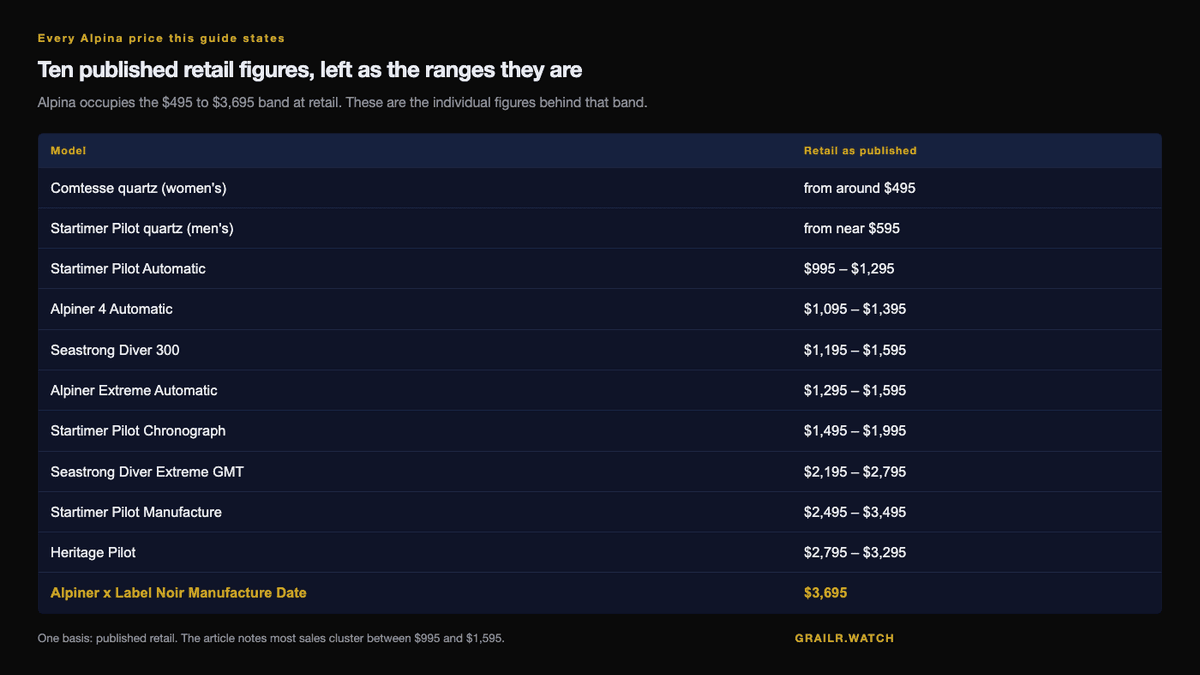
- Prices range from about $495 (Comtesse quartz) to $3,695 (limited Alpiner x Label Noir)
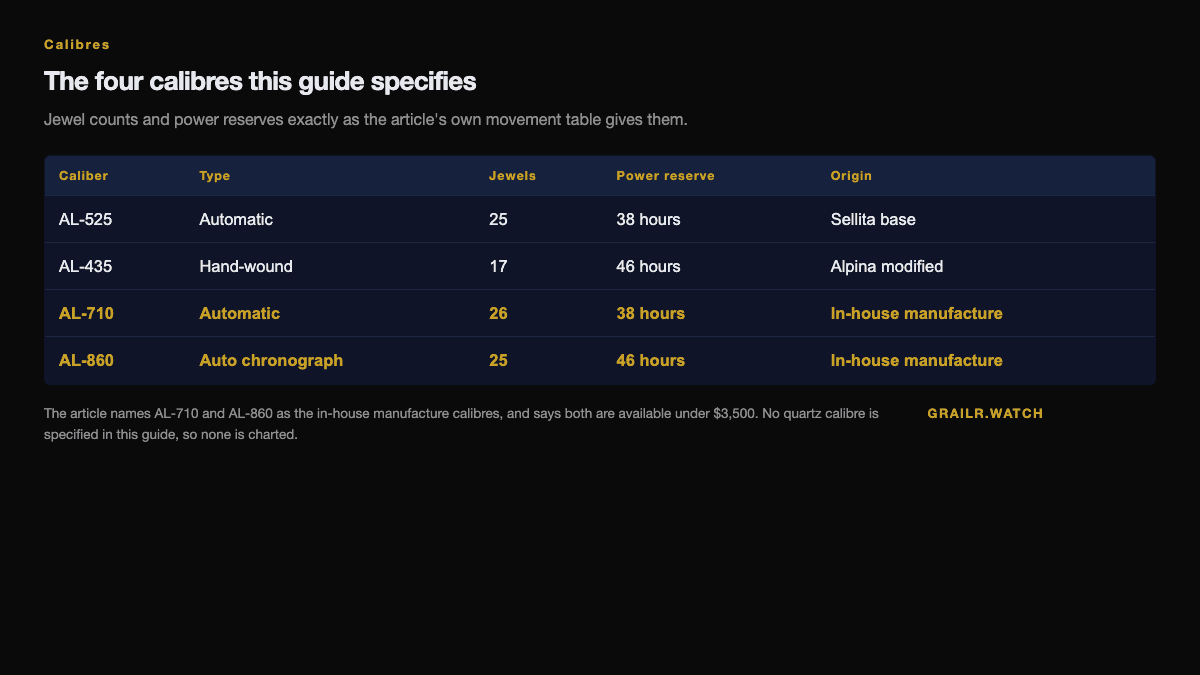
- In-house manufacture movements (AL-710, AL-860) are available under $3,500 — rare at this price point
- Owned by Citizen since 2016 but still designed and assembled in Geneva, Switzerland
The Alpina Story: 1883 to Today
In 1883, a Winterthur watchmaker named Gottlieb Hauser founded the Schweizerische Uhrmacher-Genossenschaft — the Swiss Watchmakers’ Cooperative — later known as the Union Horlogère. The idea was simple: pool the buying power of independent Swiss watchmakers to source components, share manufacturing knowledge, and compete against larger factories. At its peak the cooperative had hundreds of member workshops across Switzerland.
The name “Alpina” was reserved for the cooperative’s finest calibers. By 1901, the trademark was formally registered and began appearing on dials of watches that met the cooperative’s strictest quality standards. This is what makes Alpina different from most Swiss brands: it didn’t start as a single workshop with a famous founder. It started as a movement — dozens of independent watchmakers agreeing to hold each other to a higher standard.
The brand’s biggest contribution came in 1938 with the Alpina 4. This watch defined four attributes that every sport watch needed: antimagnetic protection, shock resistance, water resistance, and a stainless steel case. The concept sounds obvious today, but in 1938 most watches had none of these features. The Alpina 4 effectively wrote the blueprint that Rolex, Omega, and every other sport-watch maker would follow for decades. You can read more about how heritage shapes resale value in our watches that hold value guide.
After decades as a cooperative, Alpina became part of the Frédérique Constant Group, which was itself acquired by Citizen Watch Co. in 2016. Despite the Japanese parent company, Alpina still designs and assembles its watches at its headquarters in Plan-les-Ouates, Geneva. The Citizen acquisition brought manufacturing scale without diluting the Geneva address or the Swiss-made credentials.
Startimer Pilot Collection
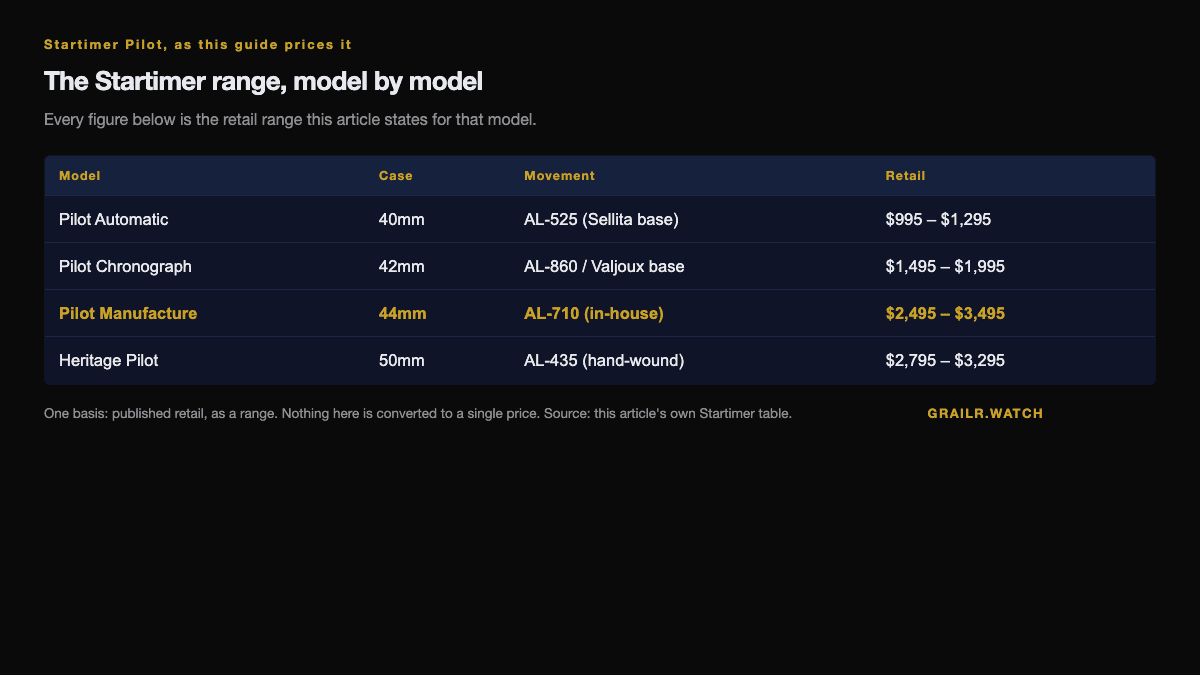
The Startimer Pilot is Alpina’s aviation line and its most recognizable collection. The name traces back to Alpina’s pilot watches of the 1920s, when the brand supplied cockpit instruments to early aviators. Today the range spans quartz entry points, automatic daily wearers, chronographs, and a manufacture-movement flagship.
Startimer Pilot Automatic ($995 – $1,295)
The core of the lineup. The 2026 refresh trimmed the case to 40mm (down from 44mm in earlier generations), making it far more wrist-friendly. It runs a Sellita-based automatic with a 38-hour power reserve, features a date window at 3 o’clock, and comes on either a leather NATO strap or a steel bracelet. Luminous Arabic numerals follow classic flieger conventions, and water resistance is rated at 100 meters.
Startimer Pilot Chronograph ($1,495 – $1,995)
A 42mm bi-compax or tri-compax chronograph with either the AL-860 in-house movement or a Valjoux 7750 base, depending on the reference. The AL-860 versions command a premium but offer a slimmer profile and a more refined finish. Power reserve is 46 hours. If you’re shopping for chronographs in this price range, see our Hamilton Khaki Field guide for a comparable option.
Startimer Pilot Manufacture ($2,495 – $3,495)
The top of the Startimer range uses Alpina’s in-house Caliber AL-710 — a 26-jewel automatic with a 38-hour power reserve that Alpina actually manufactures rather than outsources. At this price point, an in-house Swiss movement is genuinely rare. The case is typically 44mm in steel, with a sunburst dial, exhibition caseback, and either a leather strap or steel bracelet.
Heritage Pilot ($2,795 – $3,295)
A large 50mm reissue of Alpina’s original 1926 pilot watch. It uses the hand-wound Caliber AL-435, limited to 1,883 pieces (a nod to the founding year). The oversized case and onion crown are deliberately retro. This is a collector’s piece and a conversation starter, not a daily wearer — but it connects directly to Alpina’s genuine aviation heritage.
| Model | Case | Movement | Retail |
|---|---|---|---|
| Pilot Automatic | 40mm | AL-525 (Sellita base) | $995 – $1,295 |
| Pilot Chronograph | 42mm | AL-860 / Valjoux base | $1,495 – $1,995 |
| Pilot Manufacture | 44mm | AL-710 (in-house) | $2,495 – $3,495 |
| Heritage Pilot | 50mm | AL-435 (hand-wound) | $2,795 – $3,295 |
Alpiner Collection
The Alpiner is Alpina’s sport-outdoor line, inspired by the brand’s Alpine roots and the original Alpina 4. Where the Startimer looks to the cockpit, the Alpiner looks to the mountain. Cases tend to be slightly dressier, with applied indices instead of Arabic numerals, and the overall silhouette bridges sport and business casual.
Alpiner 4 Automatic ($1,095 – $1,395)
A direct homage to the 1938 original. The modern Alpiner 4 keeps the four-pillar concept — antimagnetic, shock-resistant, water-resistant to 100m, and stainless steel — in a wearable 40mm or 42mm case. It uses the AL-525 automatic (Sellita SW200 base) with a 38-hour power reserve. Available on a leather strap or steel bracelet.
Alpiner Extreme Automatic ($1,295 – $1,595)
Alpina’s answer to the integrated-bracelet trend. The Extreme features a more angular case with an integrated metal bracelet, a textured dial, and 100m water resistance. Launched to compete directly with the Tissot PRX and Frederique Constant Highlife, it punches above its price with a sapphire crystal, screw-down crown, and exhibition caseback.
Alpiner x Label Noir Manufacture Date ($3,695)
The top of the Alpiner range: a limited run of 130 pieces with the in-house AL-710 manufacture movement, an open-worked date disc, and a DLC-coated titanium case. At $3,695 it’s Alpina’s priciest current production model and the closest the brand gets to haute horlogerie territory.
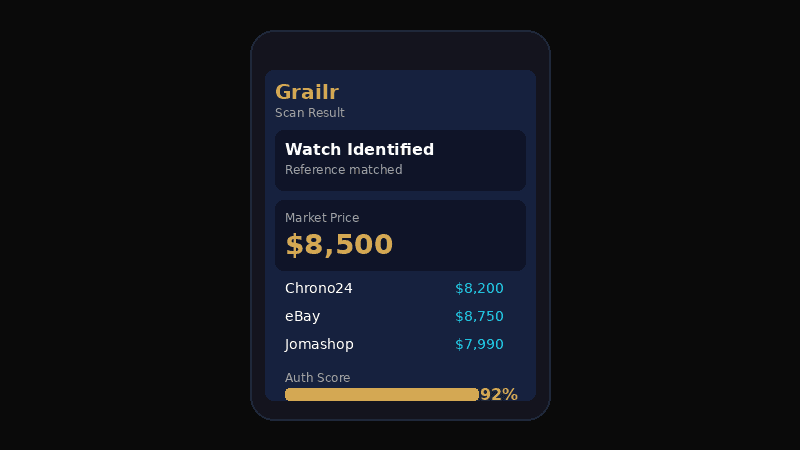
Check Any Watch Price in Seconds
Grailr scans your watch photo and pulls live pricing from Chrono24, eBay, and Jomashop.
- AI identifies brand, model & reference number
- Live market prices from 3+ sources
- Authentication confidence score
Seastrong Diver Collection
The Seastrong is Alpina’s dive-watch lineup and carries the brand’s most serious water-resistance ratings. The name combines “sea” and “strong” — straightforward, which is how the watches are built. Every Seastrong meets ISO 6425 diver certification, meaning each piece is individually pressure-tested.
Seastrong Diver 300 ($1,195 – $1,595)
The entry dive watch. A 42mm steel case with a unidirectional ceramic bezel, 300 meters of water resistance, Super-LumiNova, and the AL-525 automatic. It competes directly with the Certina DS Action Diver and the Tissot Seastar 2000. For a broader look at dive watches across price points, see our best scuba diving watches roundup.
Seastrong Diver Extreme GMT ($2,195 – $2,795)
Adds a GMT complication for tracking a second time zone, useful for dive-travel situations. The case grows to 43mm, and water resistance stays at 300 meters. It uses an automatic GMT caliber with a 38-hour power reserve. The ceramic bezel insert features a two-tone design for day/night distinction. Retail sits between $2,195 and $2,795 depending on the strap or bracelet configuration.
Movements and Specifications
Alpina uses a mix of outsourced and in-house calibers. The outsourced movements are typically based on the Sellita SW200 or SW500, which Alpina modifies, decorates, and brands with its own caliber numbers (AL-525, AL-530, etc.). These are reliable workhorse movements found across the Swiss mid-range.
The in-house calibers are the AL-710 (a 26-jewel automatic with 38-hour power reserve) and the AL-860 (an automatic chronograph). Both are manufactured at the Frédérique Constant Group’s facility in Plan-les-Ouates. Having manufacture movements at this price point is Alpina’s strongest competitive advantage — brands like Monochrome Watches notes that the Heritage Pilot’s hand-wound AL-435 offers genuine manufacture credentials at under $3,500.
Need to identify a specific Alpina caliber? Grailr’s watch identification tool can match a caseback photo to the movement reference.
| Caliber | Type | Jewels | Power Reserve | Origin |
|---|---|---|---|---|
| AL-525 | Automatic | 25 | 38 hours | Sellita base |
| AL-435 | Hand-wound | 17 | 46 hours | Alpina modified |
| AL-710 | Automatic | 26 | 38 hours | In-house manufacture |
| AL-860 | Auto chronograph | 25 | 46 hours | In-house manufacture |
Pricing and Resale Value
Alpina occupies the $495 – $3,695 price band at retail. The Comtesse quartz line for women starts at the bottom, while the limited-edition Alpiner x Label Noir Manufacture Date tops the current catalogue. The vast majority of sales cluster between $995 and $1,595, where the Startimer Pilot Automatic and Alpiner 4 live.
On the secondary market, expect to pay roughly 50–70% of retail for a standard production model in good condition. Pre-owned Seastrong divers trade between $662 and $2,179 depending on the reference and condition. Limited editions hold up better: the Heritage Pilot (1,883 pieces) and numbered Alpiner runs tend to retain 70–80% of their original price.
Compared to the broader Swiss market, this depreciation curve is typical of mid-range brands. You’re buying for the wearing experience and the engineering, not as an investment. If resale value is your primary concern, our watches that appreciate guide covers the brands and references that reliably gain value. For a quick check on any Alpina model, Grailr’s appraisal tool pulls live asking prices from multiple sources.
Alpina vs the Competition
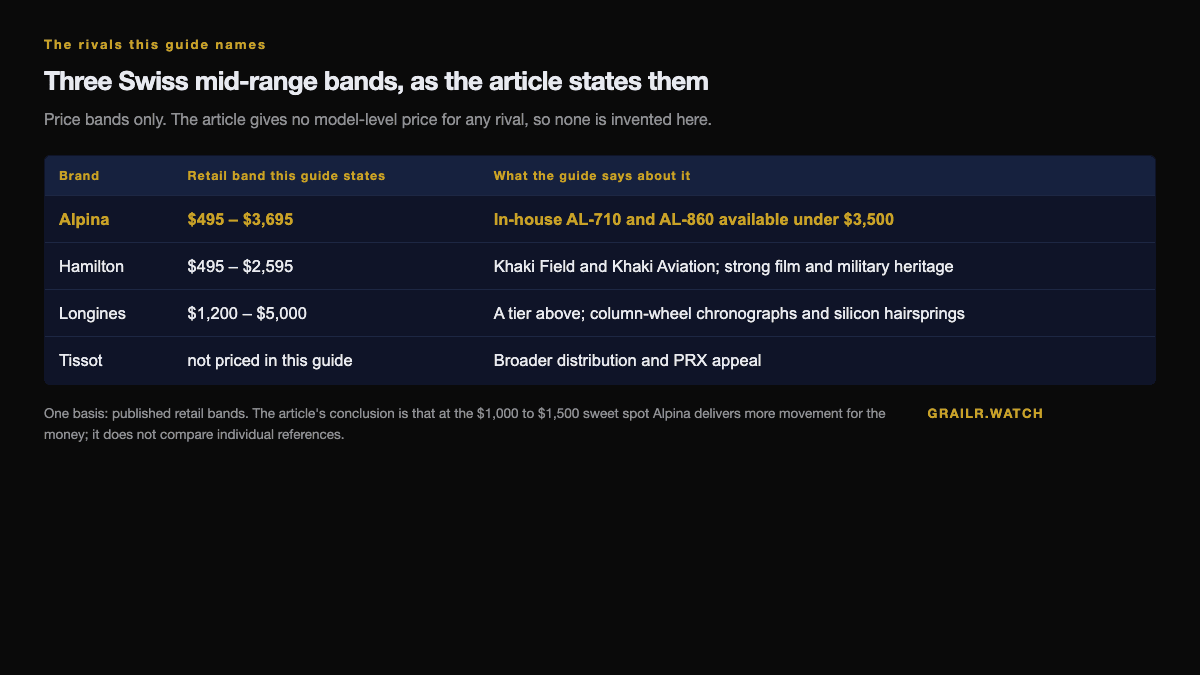
Alpina competes in the crowded Swiss mid-range alongside Hamilton, Tissot, Longines, Mido, and its corporate sibling Frédérique Constant. Here’s how the main rivals stack up:
Hamilton offers the Khaki Field and Khaki Aviation lines at similar prices ($495–$2,595) with strong film and military heritage. Hamilton uses ETA/Sellita movements throughout and does not offer an in-house caliber, which is Alpina’s clear advantage. Hamilton has broader brand recognition, especially in North America.
Tissot has the Swatch Group’s distribution muscle and the wildly popular PRX. Its Powermatic 80 movement delivers an 80-hour power reserve that beats Alpina’s 38 hours. Tissot wins on availability and power reserve; Alpina wins on sport-watch heritage and manufacture movements.
Longines sits a tier above at $1,200–$5,000 and offers column-wheel chronographs and silicon hairsprings. If your budget stretches to $2,500+, Longines is a strong alternative. But at the $1,000–$1,500 sweet spot, Alpina delivers comparable specs for less.
Mido competes most directly on price and offers the Baroncelli and Ocean Star lines. Mido’s Caliber 80 (Powermatic 80) matches Tissot’s 80-hour power reserve. Alpina’s advantage is its pilot and diver heritage, which feels more purposeful than Mido’s dress-watch positioning. Want to quickly verify any of these against live market prices? Use Grailr’s scan tool to compare.
Frequently Asked Questions
Is Alpina a good watch brand?
Yes. Alpina has been making Swiss watches since 1883 and offers COSC-grade accuracy, in-house movements in some lines, and genuine sport-watch heritage dating to the 1938 Alpina 4. It sits between fashion brands and high horology, offering serious specs at mid-range prices. Build quality, finishing, and water resistance are all competitive with Hamilton and Tissot at similar price points.
Who owns Alpina watches today?
Citizen Watch Co. of Japan owns Alpina through the Frédérique Constant Group, which it acquired in 2016. Despite the Japanese parent, Alpina still designs and assembles its watches in Plan-les-Ouates, Geneva, and retains its Swiss-made designation.
Does Alpina make its own movements?
Some models use Alpina manufacture calibers. The AL-710 is a 26-jewel in-house automatic, and the AL-860 is an in-house chronograph movement. Entry-level models typically use Sellita or ETA-based calibers (branded as AL-525, AL-530, etc.) that Alpina modifies and decorates. Having any in-house movement under $3,500 is rare in the Swiss market.
What is the cheapest Alpina watch?
The Comtesse quartz models for women start around $495. For men, the Startimer Pilot quartz begins near $595. The most affordable automatic is the Alpiner Automatic 4 at roughly $995–$1,095.
How does Alpina compare to Hamilton and Tissot?
All three are Swiss-made and occupy a similar $500–$3,500 price bracket. Alpina’s edge is its in-house manufacture movements at lower prices than most competitors, plus its 1938 sport-watch heritage. Hamilton wins on brand recognition and film ties. Tissot wins on distribution and the Powermatic 80’s 80-hour power reserve. The best choice depends on whether you prioritize heritage (Alpina), availability (Tissot), or design variety (Hamilton).
Do Alpina watches hold their value?
Like most mid-range Swiss brands, standard Alpina models lose roughly 30–50% on the secondary market. Limited editions such as the Heritage Pilot (1,883 pieces) and the Alpiner x Label Noir hold value better, typically retaining 70–80% of retail. Alpina is a buy-to-wear brand rather than an investment play. Use Grailr’s authentication tool to verify any pre-owned purchase before committing.
Related Guides
Hamilton Khaki Field Guide
The Swiss military field watch compared across every current reference.
Tissot PRX Buying Guide
Powermatic 80 vs quartz, sizing, and the resale reality.
Best Affordable Watches
The top Swiss and Japanese automatics under $1,500.
Best Scuba Diving Watches
ISO 6425 dive watches across every price point.
The Bottom Line
Alpina is one of the few Swiss watch brands that can claim genuine sport-watch heritage predating the Rolex Submariner by 15 years. The 1938 Alpina 4 invented the template every modern sport watch follows. Today’s lineup delivers on that legacy with in-house manufacture movements at prices that undercut most Swiss competitors.
If you’re cross-shopping in the $1,000–$2,000 range, Alpina deserves a spot on your shortlist alongside Hamilton and Tissot. The Startimer Pilot Automatic is the sweet spot for most buyers, while the Alpiner Extreme offers a modern integrated-bracelet design for less than a Longines Conquest. For pilots, heritage collectors, or anyone who values substance over marketing spend, Alpina punches well above its price.
Wondering What Your Alpina Is Worth?
Snap a photo and Grailr will identify the exact reference, pull live asking prices, and give you an indicative value estimate in seconds.
Scan Your Watch