Best Quartz Movements: Why Some Beat Automatics
A $15 Casio keeps better time than a $50,000 Patek Philippe. Here’s why quartz accuracy isn’t the whole story — and which quartz movements deserve the same respect as their mechanical rivals.
Price context: this guide includes indicative prices from its original publication period. They have not all been refreshed to current quotes. Use the linked primary sources for specifications and policies, and verify prices independently.

- Standard quartz is accurate to ±15 sec/month; the best high-accuracy quartz (HAQ) reaches ±1 sec/year
- The Citizen Caliber 0100 (±1 sec/year) is the most accurate non-atomic autonomous watch ever made
- Grand Seiko 9F quartz movements are hand-assembled and individually calibrated — rivalling mechanical finishing
- Quartz ownership costs are far lower: no $300–$1,000 service every 5–10 years, just a battery swap
- Excellent quartz watches exist at every price, from the $15 Casio F-91W to the $7,500 Citizen Caliber 0100
Why Quartz Matters
In December 1969, Seiko introduced the Astron — the world’s first quartz wristwatch. It cost the equivalent of a Toyota Corolla. Within a decade, quartz movements had nearly destroyed the entire Swiss watch industry in what collectors still call the quartz crisis. Hundreds of Swiss manufacturers went bankrupt. The survivors adapted, pivoted to luxury positioning, and eventually convinced the world that mechanical watches were more desirable. But they never argued that mechanical watches were more accurate. They couldn’t.
The physics are straightforward. A quartz crystal oscillates at 32,768 Hz — a tuning-fork-shaped sliver of silicon dioxide vibrating 32,768 times per second when voltage is applied. A mechanical balance wheel oscillates at 3–5 Hz. That’s a frequency advantage of roughly 8,000 to 1. More oscillations per second means smaller individual timing errors, which means far greater accuracy over time.
The result is that a $15 Casio F-91W — the watch strapped to the wrists of soldiers, students, and presidents — keeps time to about ±15 seconds per month. A $50,000 Patek Philippe mechanical chronometer, one of the finest timepieces ever made, is certified to ±2 seconds per day, or roughly ±60 seconds per month. The Casio is four times more accurate. It runs on a battery the size of a shirt button and costs less than lunch.
That accuracy gap is the reason quartz matters. But accuracy alone doesn’t explain why some quartz movements cost more than a mechanical Rolex. To understand that, you need to understand how quartz movements differ from one another — and what separates a commodity module from a genuine piece of horological engineering.
How Quartz Movements Differ
Not all quartz is created equal. The $2 module inside a promotional giveaway watch and the hand-assembled caliber inside a Grand Seiko both use quartz crystals, but the similarity ends there. Quartz movements fall into several distinct categories, each with different engineering goals and accuracy tiers.
Standard Quartz
The workhorses. Movements like the Miyota 2035, ETA 955.122, and Ronda 715 power the vast majority of quartz watches from $50 to $2,000. They use a single quartz crystal at 32,768 Hz, a basic integrated circuit, and a stepping motor to advance the hands once per second. Accuracy: ±10–15 seconds per month. Battery life: 2–3 years. They’re reliable, cheap to produce, and perfectly adequate for everyday timekeeping.
Thermocompensated Quartz (HAQ)
The biggest enemy of quartz accuracy is temperature. A standard quartz crystal’s frequency drifts as the temperature changes — warmer wrist in summer, cooler desk in winter. Thermocompensated movements solve this with a temperature sensor and a microprocessor that continuously adjusts the oscillation frequency to compensate for thermal drift. This is what the watch community calls HAQ — high-accuracy quartz. Accuracy leaps from ±15 seconds per month to ±5–10 seconds per year. The Breitling SuperQuartz and Longines VHP are prominent examples.
Solar Quartz
Solar movements like the Citizen Eco-Drive and Seiko Solar replace the disposable battery with a photovoltaic cell beneath the dial. Any light source — sunlight, office fluorescents, even a candle — charges a rechargeable cell that can power the watch for six months or more in complete darkness. The movement accuracy is typically standard quartz (±15 sec/month), but you never need a battery change. Citizen’s top-tier solar calibers push into HAQ territory: the Caliber A060 inside “The Citizen” line hits ±5 seconds per year while running entirely on light.
Twin Quartz and Multi-Mode
Some movements use two quartz crystals with different temperature characteristics. By comparing the two oscillation rates, the circuit can calculate the exact temperature and apply a more precise correction than a single-sensor thermocompensated system. Grand Seiko’s 9F caliber uses a form of this twin-regulation approach. Multi-mode quartz adds radio-wave time synchronization (like Casio’s Multi-Band 6) or GPS reception (Seiko Astron GPS Solar) to reset the time against an atomic reference, essentially eliminating drift entirely — though that’s external correction rather than intrinsic movement accuracy.
Kinetic and Spring Drive Hybrids
Seiko’s Spring Drive occupies a category of its own. It uses a mechanical mainspring for power but regulates the gear train with a quartz-controlled electromagnetic brake instead of a traditional escapement. The result: a smooth, gliding seconds hand (no tick, no stutter) with ±1 second per day accuracy — better than most mechanical watches, though not as precise as dedicated HAQ. Kinetic movements (Seiko Kinetic) generate electrical energy from a rotor, like an automatic, and store it in a capacitor to power a quartz circuit. Both blur the line between mechanical and electronic watchmaking.
The Elite Quartz Movements Ranked
These are the quartz movements that earn collector respect — not because they’re cheap and accurate (any quartz can claim that) but because they push accuracy, finishing, or engineering into territory that rivals or exceeds mechanical watchmaking. We’ve ranked them by accuracy, then weighted for build quality, innovation, and the overall watch they live inside.
| Movement | Maker | Accuracy | Power | Watch Price | Key Feature |
|---|---|---|---|---|---|
| Caliber 0100 | Citizen | ±1 sec/yr | Eco-Drive | ~$7,500 | Most accurate autonomous quartz ever |
| Caliber A060 | Citizen | ±5 sec/yr | Eco-Drive | $2,000–$3,000 | Solar HAQ in Super Titanium |
| Longines VHP | ETA (Swatch) | ±5 sec/yr | Battery | ~$1,200 | Flash setting, gear position detection |
| 9F series | Grand Seiko | ±10 sec/yr | Battery | $2,400–$3,000 | Twin-pulse stepping, instant date |
| SuperQuartz | Breitling | ±10 sec/yr | Battery | $3,000–$5,000 | COSC-certified quartz |
| Precisionist 262kHz | Bulova | ~10 sec/yr | Battery | $300–$900 | 262,144 Hz crystal, sweeping hand |
| V157 / V175 Solar | Seiko | ±15 sec/mo | Solar | $200–$400 | 6-month power reserve |
| ETA 955.122 / Ronda 715 | ETA / Ronda | ±10–15 sec/mo | Battery | $100–$2,000 | The Swiss industry standard |
Citizen Caliber 0100 — The Accuracy King
At ±1 second per year, the Caliber 0100 is the most accurate non-atomic autonomous quartz movement ever produced. Citizen achieved this by developing a proprietary AT-cut quartz crystal that oscillates at 8.4 MHz — roughly 256 times the frequency of a standard 32,768 Hz crystal. Higher frequency means smaller individual timing errors. Combined with advanced thermocompensation and Eco-Drive solar charging, the result is a watch that gains or loses no more than one second in an entire year, powered entirely by light. It sits inside a minimalist titanium case at around $7,500 — expensive for a Citizen, but cheaper than many mechanical chronometers that are orders of magnitude less accurate.
Grand Seiko 9F — The Collector’s Choice
Grand Seiko’s 9F caliber, introduced in 1993, is the movement that proved quartz could be taken seriously by watch enthusiasts. Rated to ±10 seconds per year, it uses a twin-pulse control stepping motor for precise hand movement, an instant date change that flips at midnight rather than slowly creeping over, and a sealed cabin that protects the movement from dust and moisture. Each 9F movement is hand-assembled in the Shinshu Watch Studio and individually adjusted to its own quartz crystal’s characteristics. The three-year battery includes an end-of-life indicator so the seconds hand advances in two-second jumps when power runs low. Watches using the 9F range from $2,400 to $3,000 — and hold value better than most quartz on the secondary market.
Citizen Caliber A060 — Solar HAQ
The A060 powers Citizen’s flagship “The Citizen” line and delivers ±5 seconds per year accuracy with Eco-Drive solar charging. That combination — HAQ precision with zero battery changes — makes it arguably the lowest-maintenance precision timepiece in existence. Housed in Citizen’s proprietary Super Titanium cases (titanium hardened to be five times more scratch-resistant than stainless steel), these watches range from $2,000 to $3,000 and are particularly popular with collectors who appreciate engineering over brand prestige.
Breitling SuperQuartz — COSC-Certified Precision
Breitling is the only major Swiss brand that submits quartz movements to COSC (Contrôle Officiel Suisse des Chronomètres) for chronometer certification — the same testing body that certifies Rolex and Omega mechanicals. The SuperQuartz achieves ±10 seconds per year and powers Breitling’s Aerospace, Endurance Pro, and Exospace lines. Prices range from $3,000 to $5,000, putting them squarely in mechanical-watch territory, but with ten to fifty times the accuracy.
Longines VHP — Swiss HAQ Value
VHP stands for “Very High Precision,” and Longines delivers: ±5 seconds per year from a thermocompensated ETA-based caliber. The clever party trick is GPD (Gear Position Detection) — if the watch is shocked or exposed to a magnetic field, the movement detects whether the hands have been displaced and snaps them back into correct position. Flash setting via smartphone camera (you point the watch at a flashing screen) rounds out a remarkably capable package at around $1,200. For Swiss HAQ on a budget, the VHP is hard to beat.
Bulova Precisionist 262kHz — The Sweeping Quartz
Bulova’s Precisionist uses a quartz crystal vibrating at 262,144 Hz — eight times the standard frequency. The higher frequency enables a continuously sweeping seconds hand, mimicking the smooth motion of a mechanical movement rather than the once-per-second tick of standard quartz. Accuracy is around ±10 seconds per year. At $300–$900, the Precisionist offers HAQ-level accuracy and a unique visual signature at a fraction of the price of Grand Seiko or Breitling. The trade-off is a larger case (the 262kHz crystal and three-prong mounting need space) and shorter battery life (about two years).
Seiko Solar V157/V175 — The Reliable Everyday Choice
Seiko’s V157 and V175 solar calibers won’t win accuracy competitions at ±15 seconds per month, but they excel where it matters for most buyers: reliability and zero maintenance. A full charge provides a six-month power reserve in complete darkness. No battery changes, no winding, no setting — just strap it on and forget it. At $200–$400, these movements power some of the best value propositions in watchmaking, particularly in Seiko’s solar dive watches and dress pieces.
ETA 955.122 and Ronda 715 — The Workhorses
These are the movements inside the majority of Swiss quartz watches from $100 to $2,000. The ETA 955.122 (with date) and Ronda 715 (three-hand) are thin, reliable, and accurate to ±10–15 seconds per month. They’re the Honda Civic of watch movements: nobody buys one to show off, but they start every time. When a brand like Tissot, Hamilton, or Victorinox puts “Swiss quartz” on the dial, this is almost certainly what’s inside. They’re also the movements most easily serviced by any watchmaker on earth — a battery change costs $10–$20 and takes five minutes.
Check Any Watch Price in Seconds
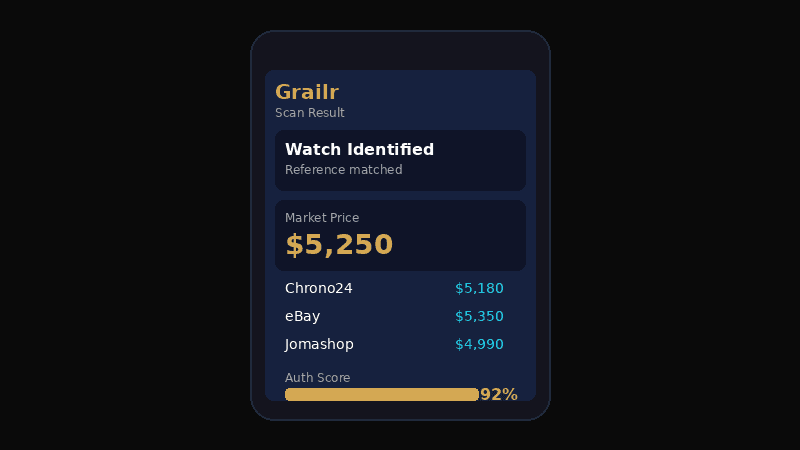
Grailr scans your watch photo and pulls live pricing from Chrono24, eBay, and Jomashop.
- AI identifies brand, model & reference number
- Live market prices from 3+ sources
- Authentication confidence score
Why Some Quartz Costs More Than Automatics
This is the question that baffles newcomers: how can a quartz watch cost $3,000 or $7,500 when quartz technology is supposed to be “cheap”? The answer has several layers, and none of them are simple brand tax.
Proprietary crystal technology. The Citizen Caliber 0100’s AT-cut crystal oscillating at 8.4 MHz is not a commodity component. It’s a proprietary cut developed specifically for this movement, manufactured to tolerances measured in fractions of a micron. Bulova’s 262kHz three-prong crystal mount is similarly bespoke. These are not the mass-produced tuning-fork crystals that cost pennies — they’re engineered components with limited production runs.
Hand assembly and individual calibration. Grand Seiko’s 9F movements are assembled by hand in the Shinshu Watch Studio — the same facility that produces Grand Seiko mechanicals. Each movement is individually adjusted to compensate for the unique frequency characteristics of its specific quartz crystal. A standard quartz movement is calibrated to a generic specification; a 9F is calibrated to itself. That individual attention is the difference between ±15 seconds per month and ±10 seconds per year.
COSC certification. Breitling’s decision to submit quartz movements to COSC testing is extraordinarily rare. The testing protocol for quartz chronometers requires the movement to maintain ±0.07 seconds per day across multiple temperature points over several days. Each movement that passes receives an individual certificate. The testing itself costs money, and the reject rate adds to the per-unit cost of those that pass.
Movement finishing. Open the caseback of a Grand Seiko 9F62 and you’ll see hand-polished bevels, blued screws, and surface finishing that rivals many mechanical movements costing twice as much. This is deliberate: Grand Seiko treats its quartz calibers as worthy of the same aesthetic care as its Spring Drive and mechanical lines. The finishing doesn’t improve accuracy, but it reflects a philosophy that precision timekeeping deserves beautiful engineering.
Case and bracelet quality. The watches housing these elite movements are themselves premium products. Citizen’s Super Titanium, Grand Seiko’s Zaratsu-polished cases, Breitling’s robust instrument-grade construction — these materials and finishing techniques cost the same whether the movement inside ticks or sweeps. When you buy a $3,000 Grand Seiko quartz, a significant portion of the price is in the case, bracelet, crystal, and dial. The movement just happens to be quartz rather than mechanical — and more accurate because of it.
Quartz vs Mechanical: The Accuracy Comparison
Numbers tell the story better than words. Here’s how every major accuracy standard compares, from a basic quartz module to the most stringent mechanical certification in the industry. If you’re weighing automatic vs quartz for your next purchase, this table is the definitive reference.
| Category | Example | Accuracy/Day | Accuracy/Year | Watch Cost |
|---|---|---|---|---|
| Elite HAQ | Citizen 0100 | ±0.003 sec | ±1 sec | $7,500 |
| HAQ | Longines VHP | ±0.014 sec | ±5 sec | $1,200 |
| Premium Quartz | Grand Seiko 9F | ±0.027 sec | ±10 sec | $2,400–$3,000 |
| Standard Quartz | Casio F-91W | ±0.5 sec | ±3 min | $15 |
| Rolex Superlative | Submariner | ±2 sec | ±12 min | $10,250+ |
| METAS Certified | Omega Seamaster | ±2 sec | ±12 min | $5,500+ |
| COSC Mechanical | Tudor Black Bay | ±4–6 sec | ±24–36 min | $3,975+ |
| Uncertified Mechanical | Seiko Presage | ±10–20 sec | ±1–2 hr | $300–$500 |
The pattern is stark. Even the cheapest quartz watch — the $15 Casio — is more accurate per day than a $10,250 Rolex Submariner. A $1,200 Longines VHP is roughly 140 times more accurate than a COSC-certified mechanical chronometer. And the Citizen Caliber 0100 at ±1 second per year occupies a different universe entirely: it would take a Rolex Superlative Chronometer six days to accumulate the drift the Citizen accrues in a full year.
Best Quartz Watches at Every Price
One of quartz’s great strengths is its range. No matter your budget, there’s a quartz watch that punches above its weight class. Here’s our pick at each tier.
$15–$100: The Essentials
The Casio F-91W ($15) is arguably the most successful watch ever made — water-resistant, accurate, and effectively indestructible. The Casio G-Shock DW5600 ($50–$70) adds 200m water resistance and shock protection in the iconic square case. The Timex Weekender ($30–$50) offers analog style with Indiglo backlight. At this price, quartz isn’t competing with mechanicals — there are no mechanical watches worth owning under $100. Quartz owns this tier completely.
$100–$500: The Sweet Spot
This is where quartz starts getting genuinely impressive. The Citizen Eco-Drive line ($150–$400) offers solar-powered quartz in dozens of styles — from dive watches to dress pieces — with no battery changes ever. The Seiko Solar ($200–$400) does the same with Seiko’s legendary build quality. And the Bulova Precisionist ($300–$500) gives you 262kHz accuracy and a sweeping seconds hand that mimics a mechanical — for less than the cost of a single mechanical service. If someone asked us for a single quartz watch recommendation for everyday wear, we’d point here.
$500–$1,500: Swiss HAQ Territory
The Longines VHP (~$1,200) is the standout — Swiss HAQ accuracy (±5 sec/year), gear position detection, and Longines’s heritage at a price that undercuts most Swiss mechanical chronometers. The Tissot PRX Quartz ($350–$425) offers the beloved integrated-bracelet design with Swiss quartz reliability. For those who want a capable tool watch without the servicing burden of a mechanical, this tier delivers exceptional value.
$1,500–$3,000: Collector-Grade Quartz
Grand Seiko 9F ($2,400–$3,000) is the crown jewel of this tier. Hand-assembled, individually calibrated, finished to a standard that rivals mechanical movements at twice the price. The Citizen “The Citizen” ($2,000–$3,000) pairs ±5 sec/year Eco-Drive accuracy with Super Titanium construction. These are watches that enthusiasts buy because they respect the engineering, not in spite of the quartz movement but because of it.
$3,000+: Elite Quartz
The Breitling Endurance Pro ($3,300) puts SuperQuartz in a lightweight Breitlight polymer case aimed at athletes. The Breitling Aerospace Evo ($4,000–$5,000) adds ana-digital display and multiple time zones. And at the summit, the Citizen Caliber 0100 ($7,500) is a pure statement of precision engineering — the most accurate autonomous watch on earth. Use Grailr to identify and price-check any of these models before you buy.
The Case for Quartz
The watch community’s bias toward mechanical movements is well documented. Forum posts, YouTube channels, and Instagram accounts overwhelmingly celebrate the sweep of a mechanical seconds hand, the ritual of winding, the romance of gears and springs. Quartz, by comparison, is often dismissed as “soulless.” But if you look at the actual ownership experience rather than the narrative, quartz makes a compelling case.
Servicing costs. A mechanical watch needs a full service every 5–10 years. For a standard Swiss movement, that runs $300–$500. For a Rolex, $800–$1,000. For a complicated piece, $1,500 or more. Over 20 years, a Rolex owner will spend $1,600–$4,000 on servicing alone. A quartz watch needs a battery change every 2–3 years at $10–$20 each, and a full service (if ever needed) runs $50–$100. Solar quartz eliminates even the battery cost. Over the same 20 years, total maintenance on a quartz watch is $100–$200.
Accuracy. We’ve covered this in detail. Even the cheapest quartz is more accurate than the most expensive mechanical. If telling the correct time is the fundamental purpose of a watch, quartz does it better by orders of magnitude.
Thinner cases. A quartz movement can be as thin as 1–2mm, enabling watches that slip under a shirt cuff without a bulge. The thinnest mechanical movements are 2–3mm, and most automatics are 4–6mm. For dress watches and slim sport watches, quartz enables designs that mechanical movements simply cannot achieve at the same price point.
Convenience. Pick up a quartz watch that’s been sitting in a drawer for three months. It’s still running, still showing the correct time (or within a few seconds of it). Do the same with a mechanical and you’ll need to wind it, set the time, set the date, possibly set the day — a two-minute ritual that enthusiasts love and everyone else tolerates. If you own multiple watches and rotate them, quartz eliminates the friction of switching.
Environmental resilience. Quartz movements are inherently more resistant to shocks and magnetic fields than mechanical movements. A mechanical watch exposed to a strong magnet will run fast until it’s demagnetized; most quartz movements are unaffected. Temperature extremes that cause a mechanical balance wheel to expand or contract (changing its rate) are compensated for automatically in HAQ movements. For active lifestyles, quartz is objectively more robust.
Frequently Asked Questions
What is the most accurate quartz movement?
The Citizen Caliber 0100, rated to ±1 second per year. It uses an 8.4 MHz AT-cut crystal — 256 times the frequency of a standard quartz movement — with thermocompensation and Eco-Drive solar charging. It costs around $7,500.
Is quartz more accurate than mechanical?
Yes, by a wide margin. A basic $15 quartz watch (±15 sec/month) is roughly four times more accurate than a COSC-certified mechanical chronometer (±4–6 sec/day). High-accuracy quartz reaches ±1–10 seconds per year — a hundred times more accurate.
Why are some quartz watches so expensive?
Premium quartz like the Grand Seiko 9F uses hand assembly, individual crystal calibration, and finishing that rivals mechanical movements. Citizen’s Caliber 0100 uses a proprietary 8.4 MHz crystal. Breitling’s SuperQuartz is COSC-tested. Case materials, engineering, and brand positioning all contribute.
How long does a quartz watch battery last?
Standard quartz batteries last 2–3 years. Grand Seiko 9F batteries last about 3 years with an end-of-life indicator. Solar-powered quartz (Citizen Eco-Drive, Seiko Solar) never needs a battery change and runs 6+ months in complete darkness on a full charge.
What is thermocompensated quartz?
Thermocompensated (HAQ) quartz uses a temperature sensor and microprocessor to compensate for the frequency drift caused by temperature changes. This improves accuracy from ±15 seconds per month to ±5–10 seconds per year. Examples include Longines VHP, Breitling SuperQuartz, and Citizen Caliber A060.
Do quartz watches hold their value?
Most quartz watches depreciate faster than mechanical equivalents. Exceptions include Grand Seiko 9F models and limited Citizen Caliber 0100 pieces, which hold value due to collector demand. Solar quartz watches have the lowest total cost of ownership thanks to zero servicing requirements.
Related Articles
The Bottom Line
Quartz isn’t the lesser technology. It’s the more accurate one, the more convenient one, and — movement for movement — often the more affordable one. The best quartz movements, from the Grand Seiko 9F to the Citizen Caliber 0100, represent some of the finest timekeeping engineering on earth. They deserve the same respect collectors give to a hand-finished mechanical movement.
Whether you’re spending $15 on a Casio F-91W or $7,500 on a Citizen Caliber 0100, you’re buying into a technology that does the one thing a watch is supposed to do — tell accurate time — better than any mechanical alternative. The rest is preference, and preference is perfectly valid. But don’t let anyone tell you quartz isn’t “real” watchmaking. The engineers at Grand Seiko, Citizen, and Breitling would disagree.
Spotted a Quartz Watch You Like?
Grailr uses a photo to suggest a watch identity and an indicative price estimate, with active listings where available. Check the exact reference and condition independently; a photo scan cannot authenticate a watch.
Identify a Watch NowSources and price context
- Grand Seiko 9F quartz movement — Details on twin-pulse stepping motor, instant date change, and calibration process.
- Citizen Caliber 0100 technology — Technical overview of the 8.4 MHz AT-cut crystal and Eco-Drive integration.
- Breitling Professional collection — SuperQuartz COSC-certified movement specifications and current pricing.
These primary sources support the specific technology, specification, and accuracy claims noted above. Prices elsewhere in this guide are indicative editorial figures, not a verified transaction dataset or guaranteed market values. Confirm the exact reference, region, condition, and current quote before buying; asking prices are not completed-sale prices.