Bust Down AP Watch: Prices, Risks and Value
What an aftermarket diamond-set Audemars Piguet actually costs, how it compares to factory gem-set models, and why the resale picture matters more than the look.
Price context: this guide includes indicative prices from its original publication period. They have not all been refreshed to current quotes. Use the linked primary sources for specifications and policies, and verify prices independently.

- A fully iced-out aftermarket AP Royal Oak typically sells for $25,000–$120,000+, depending on the base model, diamond quality and coverage.
- The bust-down process itself costs $5,000–$75,000 on top of the base watch price, driven mainly by stone grade and carat weight.
- Aftermarket diamond-set APs sell for 40–60% less than equivalent unmodified watches on resale — the modification is irreversible and voids the AP warranty.
- Factory gem-set Royal Oaks carry their own reference numbers, retain the manufacturer warranty and hold value far better than aftermarket pieces.
- Always verify stone quality, setting work and the base watch’s authenticity before buying any bust-down AP.
What “Bust Down” Actually Means
A “bust down” watch is a timepiece that has been sent to an aftermarket jeweler to have diamonds or other precious stones set into its surfaces — bezel, dial, case, bracelet links or any combination. The term comes from the jewelry trade and refers to the process of “busting down” the original metal to create seats for the stones.
In the context of Audemars Piguet, the bust-down treatment is most commonly applied to the Royal Oak and Royal Oak Offshore. The octagonal bezel, wide bracelet links and flat case surfaces make these models particularly well suited to diamond pavé work.
The process is permanent. A jeweler drills or engraves into the case and bracelet to create individual prong or channel settings for each stone. Metal is physically removed during this process, which means the watch can never be returned to its original factory condition — even if every diamond is later taken out.
This irreversibility is the single most important factor in understanding bust-down AP pricing. It draws a hard line between a factory gem-set piece, which Audemars Piguet designed and produced as a complete product, and an aftermarket modification, which a third party applies to a standard-reference watch.
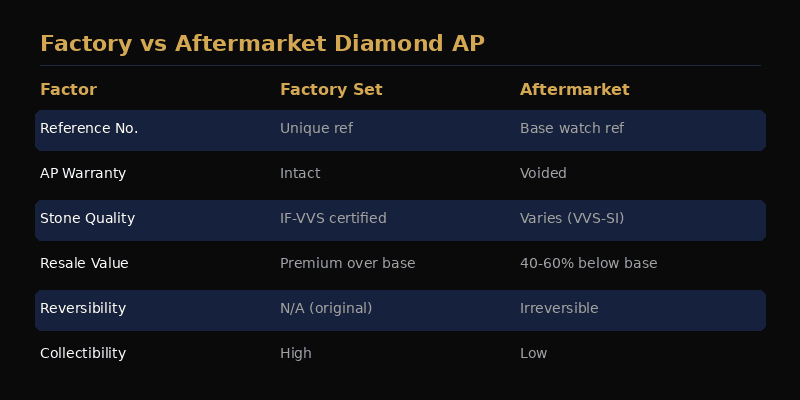
Factory vs Aftermarket Diamond AP Watches
The distinction between factory and aftermarket diamond work is the most consequential variable in bust-down AP pricing. It affects the purchase price, the resale value, the warranty status and the collector perception of the piece.
| Factor | Factory Gem-Set | Aftermarket Bust Down |
|---|---|---|
| Reference number | Unique factory ref (e.g., 15452BC.ZZ.1258BC.01) | Base watch ref unchanged (e.g., 15500ST.OO.1220ST.01) |
| Warranty | Full AP manufacturer warranty | Voided — AP will not service modified watches |
| Stone quality | AP-selected, documented in spec sheet | Varies by jeweler — independent certification needed |
| Reversibility | N/A — designed as-is | Irreversible — metal permanently removed |
| Price range (2026) | $80,000–$300,000+ | $25,000–$120,000+ |
| Resale retention | Comparable to non-diamond AP models | 40–60% below equivalent unmodified watch |
| Collector perception | Accepted as a distinct product | Niche audience — most collectors avoid |
A factory gem-set Royal Oak like the ref. 15452BC.ZZ.1258BC.01 in 18K white gold with over 1,000 factory-set diamonds retails above $150,000. That piece carries a unique reference, an AP certificate listing the stone specification and the full manufacturer warranty.
An aftermarket bust-down of a steel Royal Oak 15500ST, by contrast, starts with a base watch that trades around $25,000–$28,000 on the secondary market. The diamond work adds $5,000–$75,000 on top. The finished piece has no AP warranty, no factory stone documentation and carries the same reference number as the unmodified steel watch.
What a Bust-Down AP Costs in 2026
The total cost of an aftermarket bust-down AP is the sum of two components: the base watch and the diamond-setting work. Both vary widely, and neither is transparent.
Base Watch Prices
Most bust-down conversions start with a steel Royal Oak or Royal Oak Offshore, since precious-metal references are both more expensive to acquire and less likely to be modified. In late 2026, secondary-market prices for the most common base watches sit in these ranges:
- Royal Oak 15500ST (41mm steel): $25,000–$28,000 pre-owned
- Royal Oak Offshore 26470ST (chronograph): $25,000–$30,000 pre-owned
- Royal Oak 15510ST (current 41mm): approximately 36% above retail on the secondary market, putting it closer to $40,000+
Diamond-Setting Costs
The setting work itself ranges from $5,000 for a bezel-only treatment with modest stones to $75,000 or more for a full pavé job with VVS-grade diamonds covering the bezel, dial, case sides and bracelet. The main cost drivers are:
- Stone quality: VVS (very, very slightly included) diamonds cost roughly two to three times more per carat than VS (very slightly included) or SI (slightly included) stones of the same size.
- Coverage area: A bezel-only bust-down uses 2–5 carats. A full pavé of bezel, dial and bracelet can require 15–30+ carats.
- Setting technique: Micro-pavé with individually set stones takes more labor hours than channel or bezel setting.
- Jeweler reputation: Established specialists like Icebox in Atlanta or Avi & Co in New York charge premium rates but offer documented stone grades and warranties.
Total Price: Ready-to-Wear Examples
Most buyers purchase pre-made bust-down AP watches rather than commissioning custom work. Dealer listings in late 2026 show these indicative price ranges:
| Configuration | Base Model | Diamond Coverage | Asking Price |
|---|---|---|---|
| Bezel only, round stones | Royal Oak 15500ST | Bezel (~3 ct) | $30,000–$40,000 |
| Bezel + dial pavé | Royal Oak 15500ST | Bezel + dial (~8 ct) | $45,000–$65,000 |
| Full pavé (VVS) | Royal Oak 15500ST | Full case + bracelet (~20 ct) | $80,000–$120,000+ |
| Baguette bezel + pavé | Royal Oak Offshore 26470ST | Baguettes + pavé (~25 ct) | $60,000–$100,000 |
| Custom two-tone rose gold + diamonds | Royal Oak (custom plated) | Full pavé | $35,000–$55,000 |
These are asking prices from specialist dealers in late 2026. Actual transaction prices may differ, and you can track live market comparisons on platforms like Chrono24. Always confirm whether the listing is for factory or aftermarket stones before comparing prices.
Check Any Watch Price in Seconds
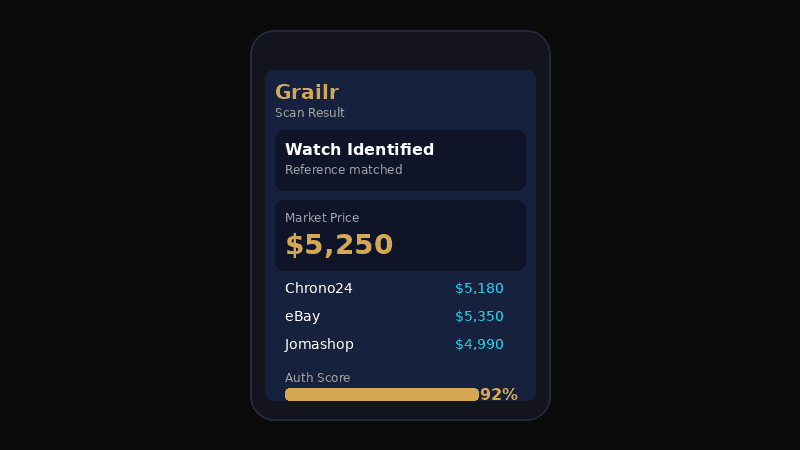
Grailr scans your watch photo and pulls live pricing from Chrono24, eBay, and Jomashop.
- AI identifies brand, model & reference number
- Live market prices from 3+ sources
- Authentication confidence score
Diamond Quality: VVS, VS and SI Explained
Diamond clarity grades are the single biggest price variable in bust-down work. The grading scale, standardized by the Gemological Institute of America (GIA), runs from Flawless (FL) down through Included (I). In the bust-down market, three tiers dominate:
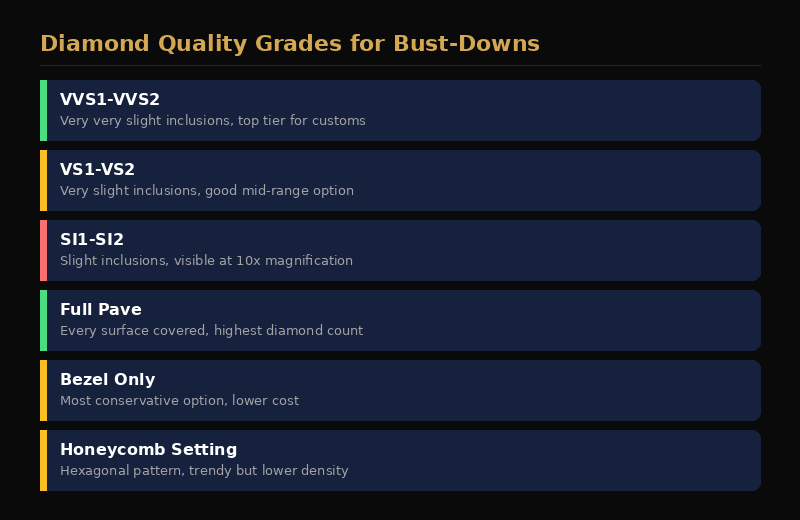
VVS (Very Very Slightly Included): Inclusions are extremely difficult to detect under 10x magnification. VVS1 and VVS2 diamonds are the standard in high-end bust-down work because they produce consistent brilliance across large pavé surfaces. They cost two to three times more per carat than VS stones. For a full Royal Oak pavé of roughly 20 carats, VVS diamonds alone can represent $40,000–$60,000 of the total cost.
VS (Very Slightly Included): Minor inclusions are visible under 10x magnification but difficult to see with the naked eye. VS diamonds are a common mid-range choice for bust-down work. They produce a visually similar result to VVS at a significantly lower cost per carat, making them the most popular grade for bezel-only and partial pavé jobs.
SI (Slightly Included): Inclusions are visible under 10x magnification and may be visible to the naked eye. SI diamonds are the budget option in bust-down work. They are noticeably less expensive per carat, but inconsistencies in clarity can be visible across a large pavé surface, particularly on the flat, well-lit bezel of a Royal Oak.
Reputable bust-down jewelers will provide a stone-quality specification or certificate. Some offer a lifetime diamond replacement warranty, while others provide a 12-month stone-setting guarantee. If the seller cannot or will not document the stone quality, that is a significant red flag. For more on diamond watches across brands, see our factory vs custom diamond watches guide.
Resale Value and the Financial Reality
This is where the bust-down market diverges sharply from the standard AP secondary market. An unmodified Royal Oak 15500ST in steel trades well above its original retail price in 2026 — roughly 36% above, according to WatchCharts data. It is one of the strongest-performing luxury steel sports watches on the secondary market.
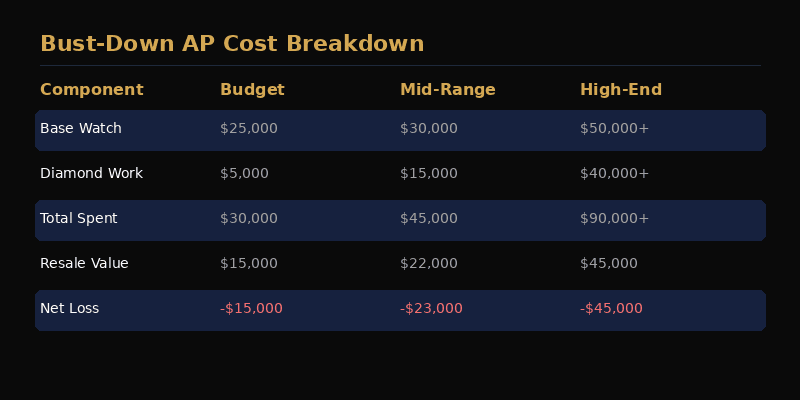
A bust-down version of the same watch does not benefit from that premium. Industry sources consistently report that aftermarket diamond-set pieces sell for 40–60% less than equivalent unmodified examples. In practice, this means:
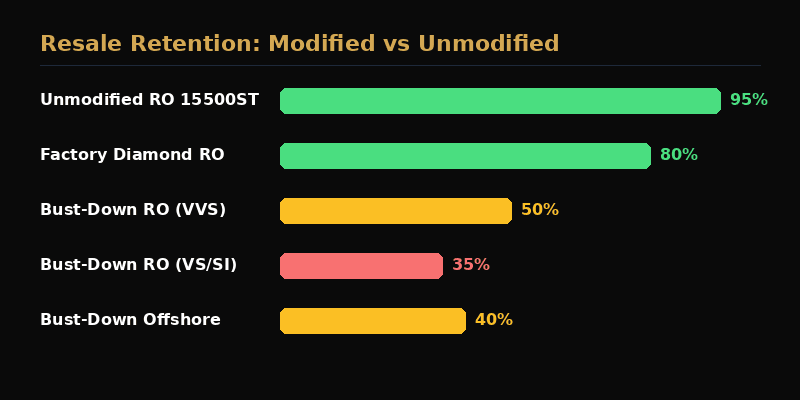
Example scenario:
- An unmodified Royal Oak 15500ST sells for approximately $26,000 pre-owned.
- A bust-down conversion adds $30,000 in diamond work (VS grade, full bezel and dial).
- Total investment: approximately $56,000.
- Resale value of the modified piece: approximately $15,000–$25,000 — a potential loss of $31,000–$41,000.
The math does not improve with higher stone quality. VVS diamonds cost more to install but do not proportionally increase the resale value, because the buyer pool for aftermarket iced-out watches is small and price-sensitive. Most serious AP collectors will not consider a modified piece, and the remaining buyers expect a discount.
Factory gem-set pieces tell a different story. Because they carry their own reference numbers and retain the AP warranty, factory diamond Royal Oaks trade in line with — or sometimes above — standard model pricing patterns. A factory-set 18K gold Royal Oak with diamonds is a production piece, not a modification, and the market treats it accordingly.
For broader context on how diamonds affect watch value across brands, our guide to factory and custom diamond watches covers the same dynamic with Rolex, Cartier and Patek Philippe examples.
What to Check Before Buying
If you decide to buy a bust-down AP, these checks can help you avoid overpaying or buying a problematic piece. The aftermarket diamond watch market has limited standardization, so due diligence matters more than in the conventional pre-owned watch market.
1. Verify the Base Watch
Confirm the base watch is a genuine Audemars Piguet with a valid serial number. The diamonds can mask signs of a fake or Frankenwatch. Request photos of the caseback, movement and serial number, and cross-reference the serial with AP’s records if possible. Grailr’s watch identification scan can help confirm the base model.
2. Get Stone Documentation
Ask for a stone-quality specification listing the clarity grade (VVS, VS or SI), color grade, carat weight and setting type. Reputable jewelers provide this. If the seller cannot document the stones, the price should reflect that uncertainty.
3. Inspect the Setting Quality
Look for consistent stone spacing, secure prong work and no visible metal damage around the settings. Poor setting work can cause stones to come loose, and the Royal Oak’s octagonal bezel has tight tolerances that expose sloppy craftsmanship.
4. Confirm Warranty Terms
Some aftermarket jewelers offer a stone-setting warranty (typically 12 months) or a lifetime diamond replacement guarantee. Get the terms in writing. Note that the AP manufacturer warranty is voided regardless.
5. Know the Market
Compare the asking price against equivalent listings on Chrono24, 1stDibs and specialist dealers. The range is wide, and a $20,000 spread between similar-looking pieces usually reflects differences in stone quality, coverage or the seller’s margin.
For a broader look at the AP lineup and what to check on any pre-owned piece, see our Royal Oak buying guide and the second-hand luxury watches guide.
Frequently Asked Questions
How much does it cost to bust down an AP Royal Oak?
The diamond-setting work alone costs $5,000–$75,000 on top of the base watch price. A bezel-only job with VS-grade stones starts around $5,000–$10,000. A full pavé of bezel, dial and bracelet with VVS diamonds can reach $50,000–$75,000. The total price of a ready-to-wear bust-down Royal Oak, including the base watch, typically ranges from $30,000 to $120,000+.
Does a bust-down AP hold its value?
No. Aftermarket diamond-set AP watches typically sell for 40–60% less than equivalent unmodified pieces on the secondary market. The modification voids the manufacturer warranty, is irreversible and limits the buyer pool. Buyers should treat a bust-down AP as a personal luxury purchase, not a financial asset.
What is the difference between factory and aftermarket diamonds on an AP?
Factory gem-set APs carry a unique reference number assigned by Audemars Piguet, retain the manufacturer warranty and are set by AP’s own gem-setters to documented quality standards. Aftermarket bust-down pieces start as a standard reference modified by a third-party jeweler. The base watch reference is unchanged, the warranty is voided and the stone quality depends entirely on the aftermarket jeweler’s work.
Can you undo a bust-down modification?
No. The process drills into the case and bracelet metal to create seats for the stones, permanently removing material. Even if the diamonds are taken out, the watch cannot be restored to factory condition. This irreversibility is a major factor in the resale discount.
Which AP model is best for a bust-down?
The Royal Oak 15500ST (41mm steel) and Royal Oak Offshore 26470ST (chronograph) are the most common bases because they are more accessible on the secondary market than precious-metal references. The octagonal bezel and wide bracelet links of both models lend themselves well to pavé work. The Code 11.59 is rarely used because it already trades 33% below retail in unmodified form.
Where can I buy a bust-down AP?
Specialist diamond watch dealers like Icebox (Atlanta), Avi & Co (New York) and WatchMyDiamonds sell ready-made bust-down APs. Listings also appear on 1stDibs and Chrono24. Always verify the base watch authenticity, stone quality documentation and the jeweler’s warranty terms before purchasing. See our high-end watches guide for broader context.
The Bottom Line
A bust-down AP is a statement piece, not a financial play. The aftermarket diamond-setting process permanently modifies the watch, voids the manufacturer warranty and reduces its resale value to 40–60% below what the same unmodified watch would command. Total cost for a ready-to-wear bust-down Royal Oak ranges from roughly $30,000 for a bezel-only job to $120,000+ for a full VVS pavé.
If the look is what you want and you are comfortable treating it as a depreciating personal asset, the market has options at every level. If long-term value matters, a factory gem-set Royal Oak — with its own reference number and full AP warranty — is the safer route, albeit at a significantly higher entry price.
Either way, verify the base watch, get stone documentation, compare prices across multiple dealers and understand what you are giving up on resale before you commit.
Know What Your Watch Is Worth
Upload a photo and get an instant identification and market price estimate from Grailr.
Scan Your Watch