Diamond Watches: Factory, Custom and Resale
Factory-set vs aftermarket diamond watches compared across Rolex, Cartier, Audemars Piguet, Patek Philippe and Omega — with real prices and what happens when you sell.
Price context: this guide includes indicative prices from its original publication period. They have not all been refreshed to current quotes. Use the linked primary sources for specifications and policies, and verify prices independently.

- Factory-set diamonds retain 85–100% of their premium on resale; aftermarket stones lose 30–60%
- Entry-level factory diamond watches start around $5,200 (Omega Constellation) and climb past $50,000 for full-pavé Rolex and Patek
- Rolex diamond Datejust and Day-Date models offer the broadest secondary market with consistent pricing
- Always confirm the reference number matches a factory diamond configuration before buying pre-owned
What Makes a Diamond Watch Worth Buying
Diamond-set watches sit at the intersection of horology and jewellery, and that overlap creates a market unlike any other category in luxury watches. A plain steel Rolex Datejust 36 retails for about $9,650. Add a factory diamond bezel and diamond hour markers, and the 126284RBR lists for approximately $21,100 — more than double the price for the same movement, the same case, and the same bracelet.
The question is whether those diamonds are worth the premium. The answer depends entirely on who set them. A factory diamond watch — one where the manufacturer sources, grades, and sets every stone in its own workshop — carries the brand’s quality guarantee and, crucially, a reference number that identifies it as a diamond model. That reference number is what holds value on the secondary market.
An aftermarket diamond watch is a standard model sent to a third-party jeweller for stone setting after purchase. The movement is the same, the case is the same, but the manufacturer’s warranty is voided, the caseback reference no longer matches what’s on the watch, and the resale market treats it as a modified piece. That distinction — factory vs aftermarket — is the single most important thing to understand before spending money on a diamond watch.
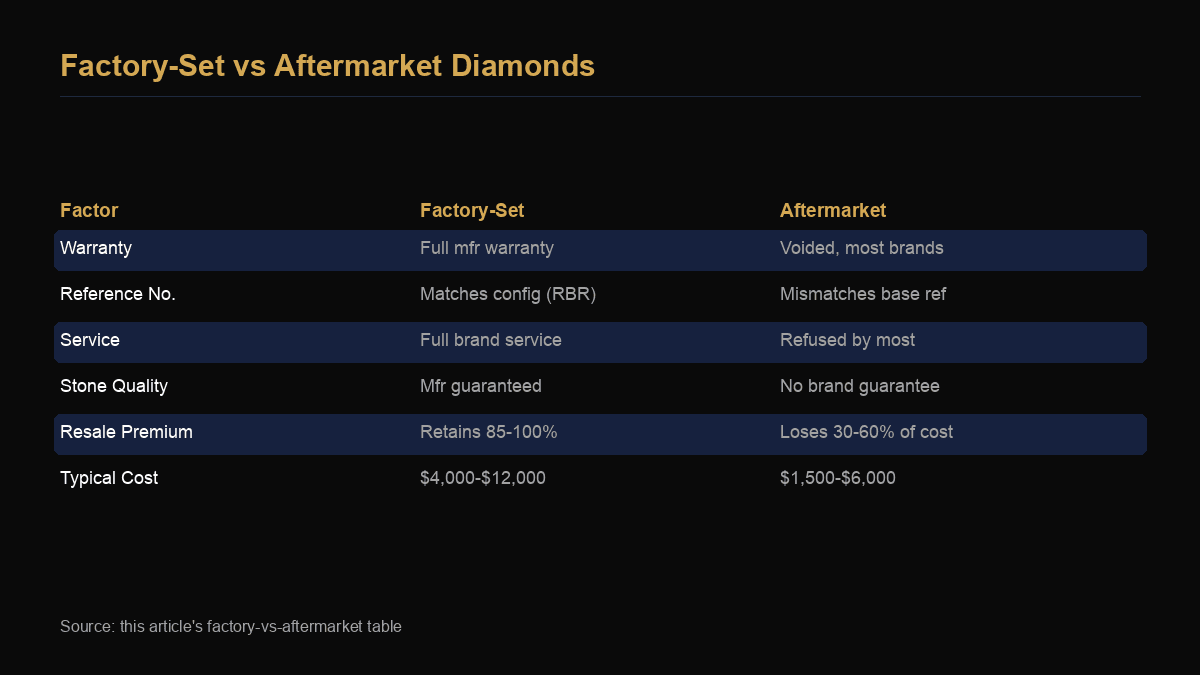
Factory-Set vs Aftermarket Diamonds
The difference between factory and aftermarket diamond watches is not cosmetic — it is structural, financial, and legal. Factory-set pieces are engineered with diamond setting as part of the original design. The case is machined with seats for each stone, the bezel is purpose-built to hold a specific cut and carat weight, and the finished watch ships with documentation that lists the diamond configuration. Rolex uses reference suffixes like RBR (round brilliant) and TBR (trapeze baguette) to identify these models.
Aftermarket setting, by contrast, modifies an existing watch. A jeweller drills into the bezel or dial to create stone seats that were never part of the original engineering. The result can look stunning, but it permanently alters the case, voids the manufacturer warranty, and — in the case of Rolex — makes the watch ineligible for official servicing. That servicing exclusion alone costs buyers thousands over the watch’s lifetime.
| Factor | Factory-Set | Aftermarket |
|---|---|---|
| Warranty | Full manufacturer warranty | Voided on most brands |
| Reference Number | Matches diamond config (e.g., RBR) | Mismatches — standard ref with added stones |
| Service Eligibility | Full brand service available | Refused by most manufacturers |
| Stone Quality | Guaranteed by manufacturer | Varies by jeweller, no brand guarantee |
| Resale Premium | Retains 85–100% of diamond premium | Loses 30–60% of setting cost |
| Typical Cost | $4,000–$12,000 over base model | $1,500–$6,000 for the setting |
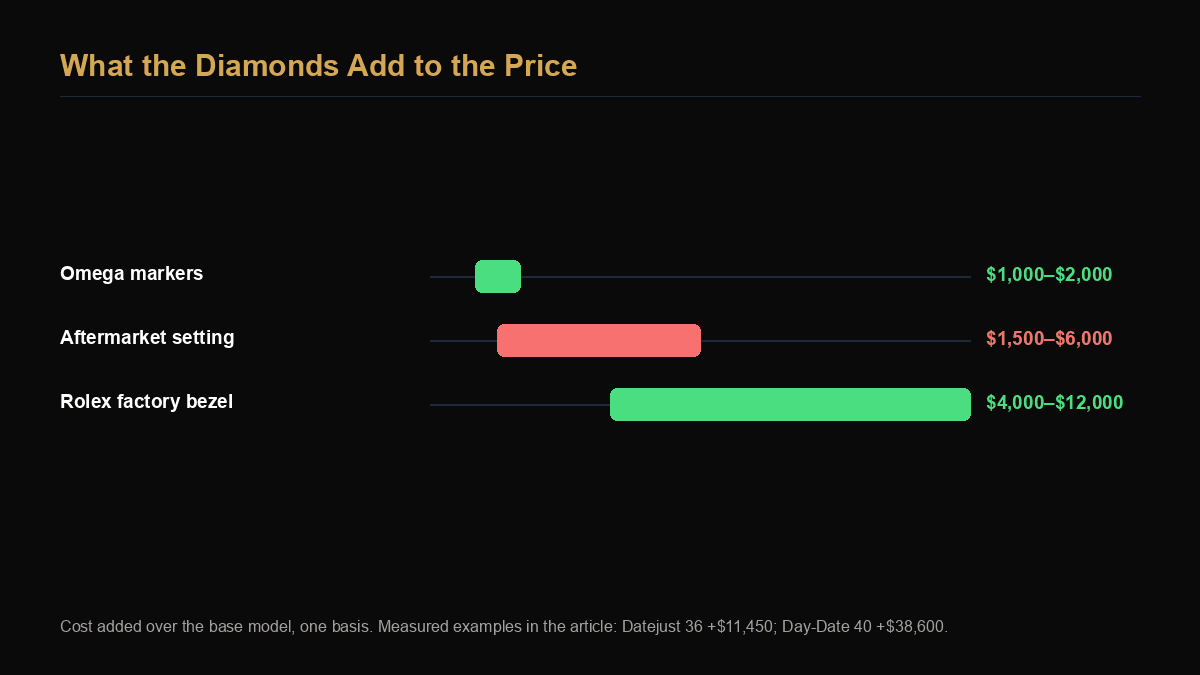
The price gap between factory and aftermarket is smaller than most people assume. A factory Rolex diamond bezel adds roughly $4,000–$12,000 to retail depending on the model and stone count. An aftermarket setting costs $1,500–$6,000 for labour and stones, but the moment you sell, buyers discount the watch by more than the setting cost because they cannot verify the stone quality and they inherit the voided warranty. The “savings” evaporate on resale.
The Best Diamond Watches by Brand
Rolex
Rolex offers the widest range of factory diamond configurations of any major brand. The Datejust 36 (126284RBR) with diamond bezel and markers lists for approximately $21,100, making it the most accessible factory diamond Rolex. The Lady-Datejust 31 (278384RBR) at around $18,800 targets smaller wrists with the same stone quality. For solid gold, the Day-Date 40 (228239) with baguette diamond dial starts near $78,600 in white gold. Rolex uses its Calibre 3235 across the Datejust range, delivering a 70-hour power reserve regardless of diamond configuration. Every factory diamond Rolex can be identified by its reference number to confirm authenticity.
Cartier
Cartier integrates diamonds into its most iconic shapes. The Ballon Bleu (WJBB0036) in 33mm 18K rose gold with factory diamond bezel is the brand’s most popular diamond entry. The Baignoire collection — covered in detail in our Cartier Baignoire buying guide — offers diamond-set bezels across its Mini and Small sizes, starting around $17,800 for the Mini in rose gold. The Tank Française and Panthère also come in diamond variants. Cartier’s current catalogue lists diamond configurations with specific reference numbers, and prices rose approximately 6% in May 2026.
Audemars Piguet
The Royal Oak 34mm (77351OR.ZZ.1261OR.01) in 18K rose gold with factory diamond bezel retails from approximately €25,000, with secondary market prices ranging from €28,000 to €40,000 depending on configuration. AP diamond Royal Oaks are among the most sought-after diamond watches on the market. The brand also offers diamond-set Royal Oak Offshore chronographs for buyers who want both complications and stones, though prices climb quickly past $60,000.
Patek Philippe
Patek Philippe’s Twenty~4 Automatic (7300/1200A-001) in stainless steel with factory diamond bezel and blue dial is the brand’s most accessible diamond piece. The quartz Aquanaut Luce (5067A-023) at 35.6mm offers a sportier diamond option. For collectors, the Annual Calendar Chronograph (5961P-001) in platinum with diamond bezel represents the pinnacle, with asking prices above $100,000. Patek diamond pieces consistently trade above retail due to scarcity — the Twenty~4 range has a waiting list at most authorised dealers.
Omega, Chopard and Bulgari
Omega’s Constellation 29mm with factory diamond hour markers starts around $5,200, making it the most affordable factory diamond watch from a top-tier Swiss brand. Chopard’s Happy Sport features the brand’s signature floating diamonds between two sapphire crystals, with prices starting near $8,000 in steel. Bulgari’s Serpenti Tubogas with diamond bezel and malachite dial lists at $23,100 for the steel-and-gold limited edition, blending Italian jewellery craft with Swiss movements.
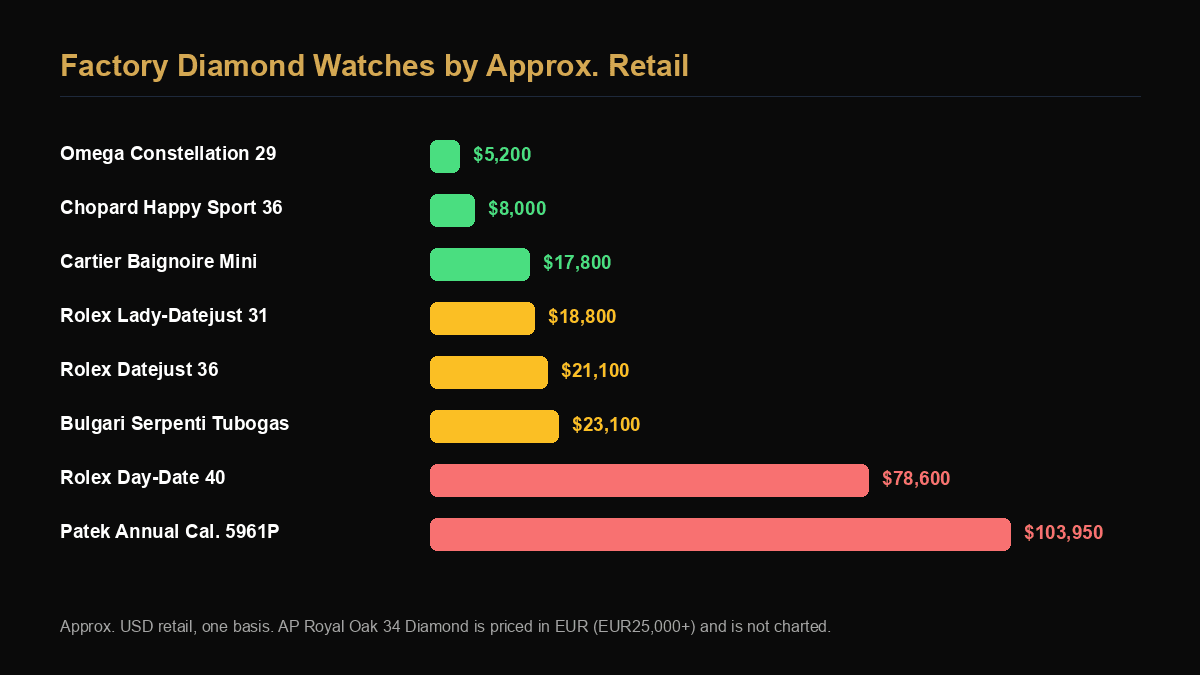
| Brand | Model | Case | Material | Approx. Price |
|---|---|---|---|---|
| Omega | Constellation Diamond | 29mm | Steel | $5,200 |
| Chopard | Happy Sport | 36mm | Steel | $8,000 |
| Cartier | Baignoire Mini Diamond | 24.6mm | 18K Rose Gold | $17,800 |
| Rolex | Lady-Datejust 31 | 31mm | Steel/WG | $18,800 |
| Rolex | Datejust 36 Diamond | 36mm | Steel/WG | $21,100 |
| Bulgari | Serpenti Tubogas Diamond | 35mm | Steel/YG | $23,100 |
| AP | Royal Oak 34 Diamond | 34mm | 18K Rose Gold | €25,000+ |
| Rolex | Day-Date 40 Diamond | 40mm | 18K White Gold | $78,600+ |
| Patek Philippe | Annual Calendar 5961P | 40.5mm | Platinum | $103,950+ |
Check Any Watch Price in Seconds
Grailr scans your watch photo and pulls live pricing from Chrono24, eBay, and Jomashop.
- AI identifies brand, model & reference number
- Live market prices from 3+ sources
- Authentication confidence score
Diamond Watch Pricing Explained
The retail premium for factory diamonds varies dramatically by brand and model. At the accessible end, Omega charges roughly $1,000–$2,000 to add diamond hour markers to a Constellation. Rolex’s premium is steeper: a standard Datejust 36 in steel lists for about $9,650, while the diamond-bezel 126284RBR lists for approximately $21,100 — a premium of about $11,450 for the diamond bezel and markers. That premium includes Rolex’s stone sourcing, quality guarantee, and the precision machining needed to set each stone into the bezel without compromising water resistance.
For precious-metal models, the diamond premium is proportionally smaller. A solid 18K white gold Day-Date 40 without diamonds starts at about $40,000, while the diamond-dial version (228239) lists near $78,600. The $38,600 gap covers baguette-cut diamonds across the entire dial — but as a percentage of the total, diamonds account for about 49% of the price versus 53% on the steel Datejust. This is because the gold itself already carries significant material value.
Cartier’s pricing reflects its position as a jeweller first. The Ballon Bleu 33mm in rose gold with factory diamond bezel is priced as a piece of fine jewellery, not as a watch with added stones. Patek Philippe’s approach is similar: the Twenty~4 diamond bezel is integral to the design, not an option. Both brands price their diamond configurations as complete products rather than as upgrades to a base model.
Aftermarket diamond setting follows a completely different economy. A competent jeweller charges $1,500–$6,000 for a full bezel setting depending on stone size and quality. The stones themselves are sourced independently, which means no brand quality guarantee and no traceability. The total cost is lower than factory, but the resale value drops more than the cost of the setting itself — a net loss for most owners.
Resale Value of Diamond Watches
Factory diamond watches follow the same secondary-market patterns as their non-diamond counterparts, with one important difference: the diamond premium is partially preserved. A standard Rolex Datejust 36 in steel retains roughly 89–97% of retail on the secondary market. The factory diamond version (126284RBR) retains a similar percentage of its higher retail price, which means the absolute dollar amount retained is larger — but the percentage works the same way.
Specific retention figures vary by brand. Rolex factory diamond Datejust models retain 85–97% of retail depending on configuration and demand. One trade source shows the 126281RBR (Everose steel, diamond) with a $21,700 MSRP trading at $21,000 on the secondary market — 97% retention. The 126283RBR at $20,350 MSRP trades at roughly $18,900 — 93% retention. Cartier diamond models retain 70–90% depending on the collection, with the Tank and Ballon Bleu performing best. AP Royal Oak diamond models regularly trade above retail due to production constraints.
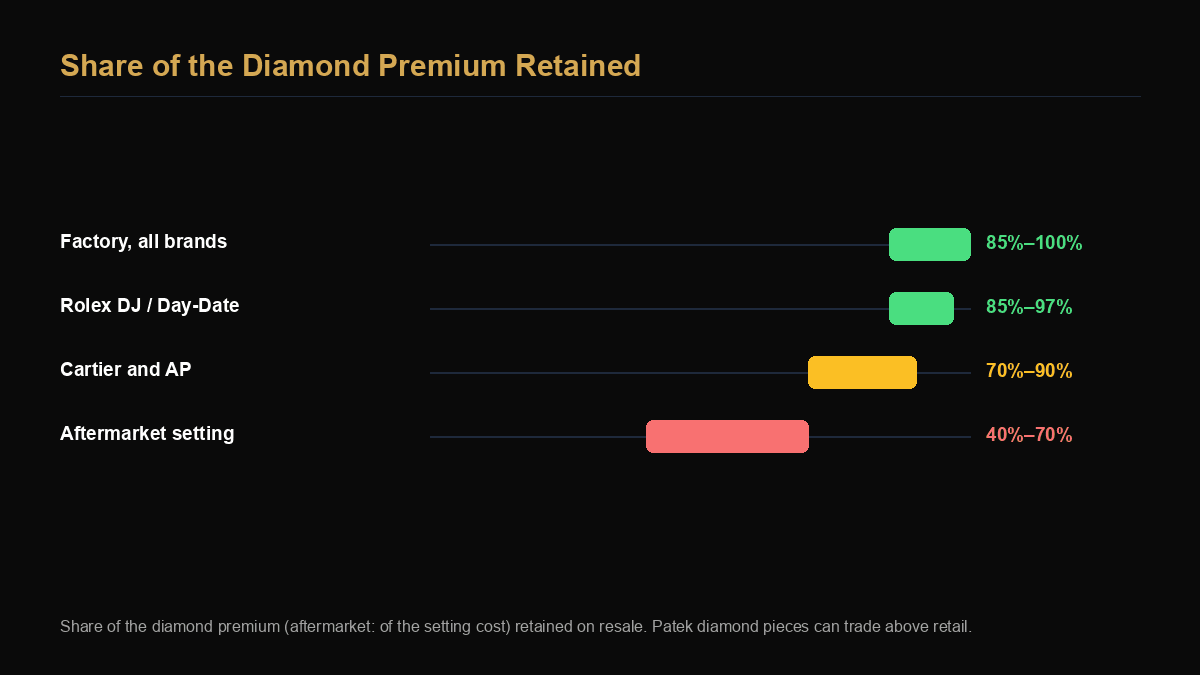
Aftermarket diamond watches tell a very different story. A $10,000 Rolex Submariner with $4,000 worth of aftermarket diamonds does not become a $14,000 watch. It often sells for less than the standard Submariner because buyers factor in the voided warranty, the inability to get Rolex service, and the unknown quality of the stones. The aftermarket diamond premium is effectively negative on resale — which is why experienced dealers and resale guides consistently recommend factory-only for diamond watches.
How to Buy a Diamond Watch Safely
1. Verify the Reference Number
The reference number is the single most reliable indicator of factory diamonds. Rolex uses RBR or TBR suffixes. Cartier lists diamond references separately in their catalogue. Patek Philippe provides a configuration code on the warranty certificate. If the reference does not indicate diamonds but the watch has them, they are aftermarket. Use Grailr’s identification tool to check the reference against known factory configurations.
2. Demand the Full Set
Box, papers, warranty card, and purchase receipt. For diamond watches, the warranty card is especially important because it lists the reference number and confirms the watch left the factory with diamonds installed. Without papers, you have no documentation that the stones are factory, and the resale market will price the watch accordingly.
3. Inspect Under Magnification
Factory diamond setting is precise and uniform. Every stone sits at the same depth, with consistent spacing and aligned prongs. Aftermarket setting often shows uneven depth, visible tool marks on the bezel edge, or slight misalignment. A qualified watchmaker with a loupe can usually spot the difference in minutes. Consider professional authentication for any diamond watch over $10,000.
4. Compare Prices Before Committing
Diamond watches have wider price ranges than standard models because stone quality, condition, and documentation all affect value. A factory diamond Datejust with full papers might sell for 15% less than retail, while the same watch without papers could be discounted 30%. Use Grailr’s scanner to get an indicative market price before negotiating.
5. Avoid “Custom” or “Iced Out” Listings
Listings that describe a diamond watch as “custom,” “iced out,” or “bustdown” are almost always aftermarket. These terms signal third-party modification and should be treated as a warning. The premium you pay for aftermarket icing is money you will never recover on resale.
Frequently Asked Questions
Are factory diamond watches worth more than aftermarket?
Yes. Factory-set diamonds from Rolex, Cartier, AP or Patek retain 85-100% of their premium on resale. Aftermarket stones lose 30-60% of the setting cost because buyers cannot verify stone quality and the modification voids the manufacturer warranty.
What is the cheapest factory diamond watch from a major brand?
The Omega Constellation 29mm with factory diamond markers starts around $5,200 at retail. Among the traditional Swiss brands, that is the lowest entry point for genuine factory-set stones on a luxury watch.
Does a diamond bezel add value to a Rolex?
A factory Rolex diamond bezel adds roughly $4,000-$12,000 to retail and retains most of that premium on the secondary market. An aftermarket diamond bezel can reduce the watch's resale value below a non-diamond version because it voids Rolex service eligibility.
How can I tell if diamonds on a watch are factory or aftermarket?
Check the reference number. Rolex uses RBR or TBR suffixes for diamond models. Cartier and Patek list specific diamond references in their catalogues. If the reference does not indicate diamonds but the watch has them, they are aftermarket. A loupe inspection by a qualified watchmaker can also reveal setting-quality differences.
Which diamond watches hold their value best?
Rolex factory diamond Datejust and Day-Date models retain 85-97% of retail. Patek Philippe diamond-set Nautilus and Aquanaut models can trade above retail due to scarcity. Cartier and AP factory diamond pieces retain 70-90% depending on the collection.
Should I buy a diamond watch new or pre-owned?
Pre-owned factory diamond watches offer savings of 10-25% below retail with the same resale stability, provided box, papers and warranty card confirm the factory origin. Always verify the reference number matches a factory diamond configuration before buying.
Related Articles
The Bottom Line
Diamond watches are a commitment — financially and aesthetically. The single most important rule is simple: buy factory or don’t buy diamonds at all. Factory-set stones from Rolex, Cartier, AP, Patek Philippe, or Omega come with a quality guarantee, a traceable reference number, and resale stability. Aftermarket diamonds look similar on the wrist but cost you thousands on resale and lock you out of manufacturer servicing. If budget is a concern, a pre-owned factory diamond watch from a reputable dealer offers 10–25% savings with no compromise on long-term value. Scan any listing with Grailr to check the reference and get an indicative market price before you commit.
Considering a Diamond Watch?
Grailr uses a photo to suggest a watch identity and an indicative price estimate, with active eBay listings where available. Check the exact reference and condition independently; a photo scan cannot authenticate a watch.
Scan a Watch NowSources and price context
- Rolex Datejust 36 diamond bezel (126284RBR) specifications — Official reference page listing calibre, case materials, and diamond configuration.
- Cartier current watch catalogue — Official collection page listing current Baignoire, Ballon Bleu and Tank diamond configurations.
These primary sources support the specific reference, specification and configuration points noted above. Prices and resale percentages elsewhere in this guide are indicative editorial figures, not a verified transaction dataset or guaranteed returns. Confirm the exact reference, region, condition and current quote before buying; asking prices are not completed-sale prices.