Buying Second Hand Luxury Watches: Cartier, Omega, Rolex
A complete reference to buying pre-owned watches from three of the most popular luxury brands — with real 2026 prices, savings versus retail, value retention data and a practical authentication checklist so you can buy with confidence on the secondary market.
Price context: this guide includes indicative asking prices from its original publication period. They have not all been refreshed to current quotes. Use the linked primary sources for specifications and policies, and verify prices independently. Asking prices are not completed-sale prices.
Key Takeaways
- Pre-owned Cartier watches trade 20–35% below retail, with the Santos retaining 70–80% of its value — Cartier’s strongest performer
- Second hand Omega Speedmaster Moonwatches hold 70–85% of retail, though new Seamasters are commonly discounted 10–15% at ADs
- Rolex entry models like the Submariner 124060 trade above retail at $12,300+, making pre-owned Rolex a different equation entirely
- The “second hand movement” on a Rolex refers to the smooth-sweeping seconds hand, not a used watch mechanism
- Always verify serial numbers, service history and box-and-papers status before committing to any pre-owned luxury watch purchase
Why Buy a Second Hand Luxury Watch?
The secondary market for luxury watches has matured dramatically over the past decade. What was once a niche corner of the jewellery trade — small dealers, auction houses and classified ads — has become a global marketplace with authentication standards, condition grading systems and buyer protections that rival those of new retail. For buyers considering a second hand Cartier watch, a pre-owned Omega or a used Rolex, the question is no longer whether to buy pre-owned but which brand and model offers the best combination of savings, quality and long-term value.
The financial case is straightforward. A new luxury watch loses a portion of its value the moment it leaves the boutique — unless it is a Rolex sport model with a waitlist, in which case it may actually gain value. For Cartier and Omega, the savings on a pre-owned purchase typically range from 15–35% below current retail. On a $7,000 watch, that is $1,000 to $2,400 in your pocket before you even strap it on. Those savings buy the watch itself, not the experience of opening a boutique box — the movement, the case, the bracelet and the design heritage are identical whether the watch has been worn for six months or is fresh from the factory.
Beyond price, the secondary market offers access to discontinued references that Cartier, Omega and Rolex no longer produce. The Cartier Santos Galbée, the Omega Speedmaster “First Omega in Space” and vintage Rolex Explorer references are available only through the pre-owned channel. For collectors and enthusiasts, these discontinued models often carry more character and historical significance than their current-production replacements.
This guide covers the three brands that dominate second hand luxury watch searches: Cartier, whose elegant designs and accessible entry prices make it one of the most popular choices for first-time pre-owned buyers; Omega, whose Speedmaster and Seamaster lines offer genuine mechanical depth at prices that undercut Rolex significantly; and Rolex, whose sport models defy normal depreciation curves and whose “second hand movement” is a search term that actually refers to the smooth sweep of its seconds hand, not to buying a used watch. We will break down each brand’s pre-owned pricing, explain value retention patterns and provide a practical checklist for authenticating any second hand luxury watch before you commit.
Second Hand Cartier Watches: Models and Prices
Cartier is one of the strongest value propositions in the second hand luxury watch market. Unlike Rolex, where pre-owned prices often exceed retail, 2nd hand Cartier watches typically trade 20–35% below current retail, giving buyers meaningful savings on some of the most recognisable watch designs in the world. The brand’s five core collections — Tank, Santos, Ballon Bleu, Panthère and Pasha — each have distinct pre-owned pricing patterns. For a full breakdown of every Cartier collection at current prices, see our Cartier watch prices 2026 guide.
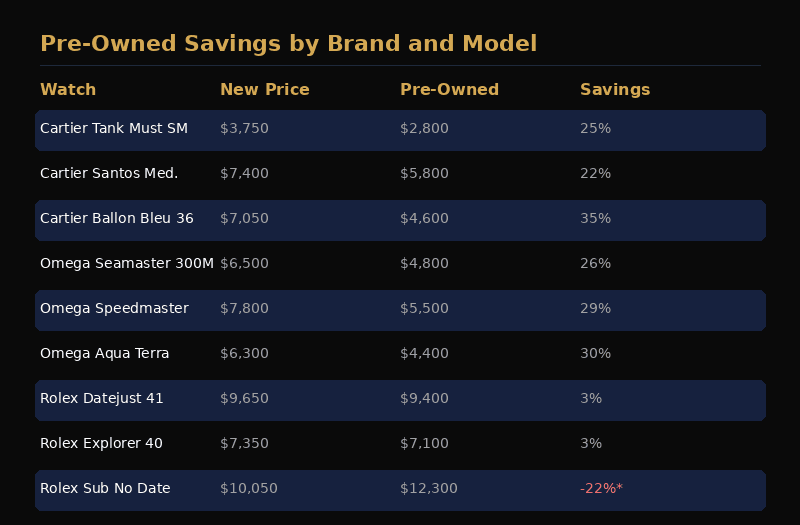
The Santos de Cartier is Cartier’s strongest secondary market performer. The steel Santos medium retails at approximately $7,400 new and trades pre-owned at $5,500–$6,200, a saving of roughly 16–26%. The large Santos at $9,200 retail trades pre-owned at $6,500–$7,400. That tighter spread compared with other Cartier collections reflects genuine demand: buyers want the Santos, and they are willing to pay close to retail for a pre-owned example because the QuickSwitch bracelet system, in-house-derived movement and design heritage make it competitive with watches costing considerably more new. The now-discontinued Santos Galbée has developed a collector following, with clean examples commanding premiums over equivalent current-production references.
Cartier Retention at a Glance
Overall: 60–80% of retail. Santos leads at 70–80%. Ballon Bleu trails at 55–65%. The May 2026 price increase (2.5–7%) widened the gap on models that had not yet adjusted on the secondary market.
The Tank Must small in steel starts at $3,750 new and trades pre-owned at roughly $2,600–$3,000, saving 20–30%. The Tank remains one of the lowest entry points to any luxury watch brand’s back catalogue, and on the secondary market it becomes even more accessible. The Ballon Bleu 36mm in steel at roughly $7,050 retail trades pre-owned at $4,200–$5,000, offering the deepest percentage savings of any Cartier collection — up to 40% below retail in some cases. The Panthère medium in steel retails at approximately $5,150 and trades pre-owned at $3,600–$4,200.
Note that Cartier implemented a price increase on 21 May 2026, raising most models by 2.5–7%. If you are comparing pre-owned listings against retail, make sure you are using post-May 2026 retail prices — older references to “retail price” may understate the current gap.
| Cartier Model | New Retail | Pre-Owned Range | Typical Saving |
|---|---|---|---|
| Tank Must Small (steel) | $3,750 | $2,600–$3,000 | 20–30% |
| Santos Medium (steel) | ~$7,400 | $5,500–$6,200 | 16–26% |
| Santos Large (steel) | $9,200 | $6,500–$7,400 | 20–29% |
| Ballon Bleu 36mm (steel) | ~$7,050 | $4,200–$5,000 | 29–40% |
| Panthère Medium (steel) | ~$5,150 | $3,600–$4,200 | 18–30% |
Retail prices reflect post-May 2026 US MSRP. Pre-owned ranges are indicative asking prices for watches in good to excellent condition, sourced from Chrono24, eBay and dealer listings as of October 2026. Asking prices are not completed-sale prices.
Second Hand Omega Watches: Models and Prices
Omega occupies a unique position in the pre-owned market. The brand produces genuinely impressive mechanical watches — the Co-Axial Master Chronometer movements are among the most advanced series-production calibres in the industry — but authorised dealers commonly discount new Omega watches by 10–15%, particularly on Seamaster models. That built-in discount compresses the pre-owned margin: if you can buy a new Seamaster at 12% off retail from an AD, the saving on a pre-owned example shrinks from a headline 25% to a more realistic 10–15%. Understanding that dynamic is essential for anyone shopping for second hand Omega watches. For a deeper look at the range, see our Omega watches for men guide.
The Speedmaster Moonwatch is Omega’s best second hand performer. The hesalite crystal reference retails at $6,800 new and trades pre-owned at $4,500–$5,800. The sapphire sandwich variant at $7,800 new trades pre-owned at $5,500–$6,800. The Moonwatch benefits from its NASA heritage, its status as the first watch worn on the Moon and a collector community that actively seeks out specific reference numbers, dial variations and limited editions. It is the one Omega model where AD discounts are rare, which means the pre-owned saving versus actual street price is genuine.
AD Discount Effect
New Seamasters are commonly discounted 10–15% at authorised dealers. Compare pre-owned prices against the best available new offer, not full retail, to gauge the real saving.
The Seamaster Diver 300M retails at $5,900–$6,500 new and trades pre-owned at $4,300–$5,200. On paper that is a 20–27% saving, but after typical AD discounts the real saving drops to 10–15%. The Seamaster remains an excellent second hand watch regardless — it is a robust, METAS-certified diver with a ceramic bezel and a helium escape valve — but buyers should compare pre-owned prices against the best new offer from an AD, not against full retail.
The Aqua Terra retails at $6,000–$6,500 new and trades pre-owned at $3,800–$5,000. The Aqua Terra offers the deepest percentage saving of the three core Omega lines, partly because it is less iconic than the Speedmaster or Seamaster and partly because its dressy-sports positioning puts it in direct competition with Tudor, Longines and even entry-level Rolex models on the secondary market. For buyers who want a high-quality Swiss movement in a versatile case design and are comfortable buying pre-owned, the Aqua Terra at $4,000 represents exceptional value.
| Omega Model | New Retail | Pre-Owned Range | Retention |
|---|---|---|---|
| Speedmaster Moonwatch (hesalite) | $6,800 | $4,500–$5,800 | 70–85% |
| Speedmaster Moonwatch (sapphire) | $7,800 | $5,500–$6,800 | 70–87% |
| Seamaster Diver 300M | $5,900–$6,500 | $4,300–$5,200 | 65–80% |
| Aqua Terra | $6,000–$6,500 | $3,800–$5,000 | 60–77% |
Retail prices are 2026 US MSRP. Pre-owned ranges are indicative asking prices for watches in good to excellent condition with box and papers, sourced from Chrono24, eBay and dealer listings as of October 2026. Retention is calculated against full retail, not discounted AD prices.
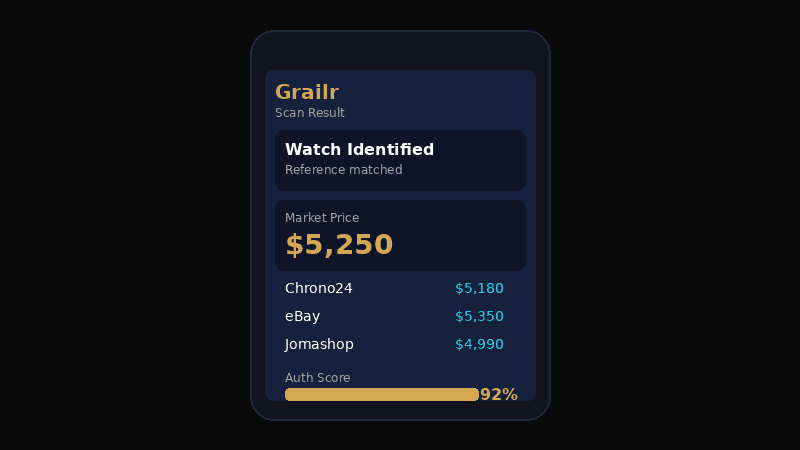
Check Any Watch Price in Seconds
Grailr scans your watch photo and pulls live pricing from Chrono24, eBay, and Jomashop.
- AI identifies brand, model & reference number
- Live market prices from 3+ sources
- Authentication confidence score
Rolex on the Pre-Owned Market — and the Second Hand Movement Explained
Rolex is the exception to nearly every rule in the second hand luxury watch market. While Cartier and Omega watches depreciate on the secondary market, many Rolex sport models trade at or above retail. The Submariner 124060 has a retail price of $10,050, yet pre-owned examples in good condition with box and papers routinely sell for $12,300 or more — a premium of over 20%. This anomaly is driven by scarcity: Rolex allocates popular sport models through authorised dealers with multi-year waitlists, which pushes demand to the secondary market where prices reflect actual availability rather than suggested retail. For a comprehensive treatment, see our buying a used Rolex guide.
Not every Rolex trades above retail. The Datejust 41 at $9,650 retail trades pre-owned at roughly $9,400 — a modest 2–3% discount. The Explorer 40 at $7,350 retail trades pre-owned at about $7,100. These entry-level models offer the closest thing to a “normal” pre-owned equation in the Rolex catalogue: a small saving versus new, with the trade-off of losing the manufacturer warranty. Across the board, Rolex retention sits at 89–106% on entry-level steel models, making it the strongest resale brand in the industry by a wide margin.
Terminology Note
“Second hand movement on a Rolex” refers to the sweep seconds hand on the dial — not to buying a used watch. The smooth gliding motion comes from the movement’s 28,800 vph beat rate (eight ticks per second), which the eye perceives as continuous.
If you have searched for “second hand movement on a Rolex,” the answer is mechanical, not commercial. Rolex mechanical movements beat at 28,800 vibrations per hour (eight beats per second), which makes the seconds hand appear to glide smoothly around the dial rather than ticking in discrete one-second jumps the way a quartz watch does. This smooth sweeping motion is one of the most visible hallmarks of a genuine Rolex mechanical watch and is often the first thing people notice when comparing a real Rolex to a quartz imitation. The seconds hand on a Rolex does make very small discrete steps — eight per second — but the effect to the naked eye is a continuous sweep. It is not related to whether the watch is new or used.
| Rolex Model | Retail Price | Pre-Owned Price | vs Retail |
|---|---|---|---|
| Submariner 124060 (no date) | $10,050 | $12,300+ | +22% |
| Datejust 41 | $9,650 | ~$9,400 | −3% |
| Explorer 40 | $7,350 | ~$7,100 | −3% |
Retail prices are 2026 US MSRP. Pre-owned prices are indicative asking prices for watches in good to excellent condition with box and papers as of October 2026. The Submariner premium reflects limited availability at authorised dealers.
Brand Value Retention: Cartier vs Omega vs Rolex
Value retention is the single most important factor for buyers who plan to wear a watch for several years and then sell or trade it. The differences between Cartier, Omega and Rolex are stark and worth understanding before you commit to any second hand luxury watch purchase. If resale value matters to your buying decision, see our watches that hold value guide for a broader comparison across brands.
Rolex leads the industry with 89–106% retention on entry-level steel sport models. The Submariner, GMT-Master II and Daytona routinely trade above retail. Even the Datejust and Explorer, which sit below retail, retain over 90% of their purchase price. No other brand matches this performance, and it is driven by a combination of limited production, controlled distribution and a brand reputation that transcends the watch industry.
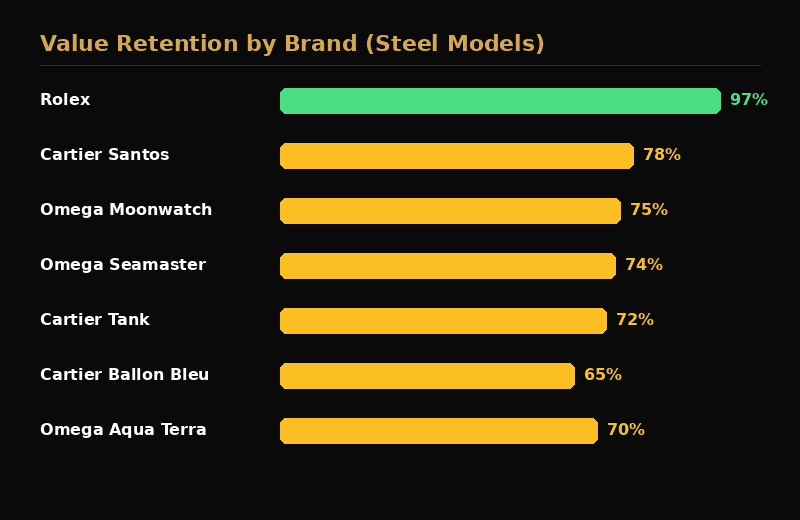
Cartier retains 60–80% overall, with the Santos leading at 70–80% and the Ballon Bleu trailing at 55–65%. Cartier’s retention is stronger than most buyers expect — the “fashion brand” perception depresses expectations, which actually creates buying opportunities on the secondary market. The Santos in particular performs at a level comparable to Tudor, IWC and some Omega references.
Omega generally retains 60–75%, with the Moonwatch at the top of that range and the Aqua Terra at the bottom. Omega’s retention is compressed by the availability of AD discounts on new watches: if buyers can get 10–15% off new, they expect an even larger discount pre-owned, which pushes secondary prices lower. The Moonwatch is the exception because it rarely receives AD discounts and carries cultural weight that supports its price floor.
| Brand | Overall Retention | Best Performer | Weakest Performer |
|---|---|---|---|
| Rolex | 89–106% | Submariner / Daytona | Datejust / Explorer |
| Cartier | 60–80% | Santos de Cartier | Ballon Bleu |
| Omega | 60–75% | Speedmaster Moonwatch | Aqua Terra |
Retention ranges are based on pre-owned asking prices as a percentage of current retail, as of October 2026. They are indicative editorial figures and do not represent a verified transaction dataset.
How to Authenticate a Pre-Owned Luxury Watch
Authentication is the single highest-stakes decision in any second hand luxury watch transaction. A convincing counterfeit can cost thousands of dollars, and the sophistication of replica watches has reached a point where visual inspection alone is no longer sufficient for high-value purchases. Whether you are buying a second hand Cartier watch, a pre-owned Omega or a used Rolex, the authentication process follows the same core steps. For a dedicated walkthrough, see our how to authenticate a luxury watch guide.
Case back engravings are the first checkpoint. Genuine luxury watches carry the manufacturer’s logo, reference number and serial number engraved or embossed on the case back. On Rolex models, the serial number is engraved between the lugs at the 6 o’clock side (post-2005 models also have it engraved on the inner rehaut at the 6 o’clock position). On Cartier watches, look for the Cartier logo, reference number and a four-digit serial number on the case back. On Omega, the case back typically carries the serial number, reference number and the Omega seahorse logo.
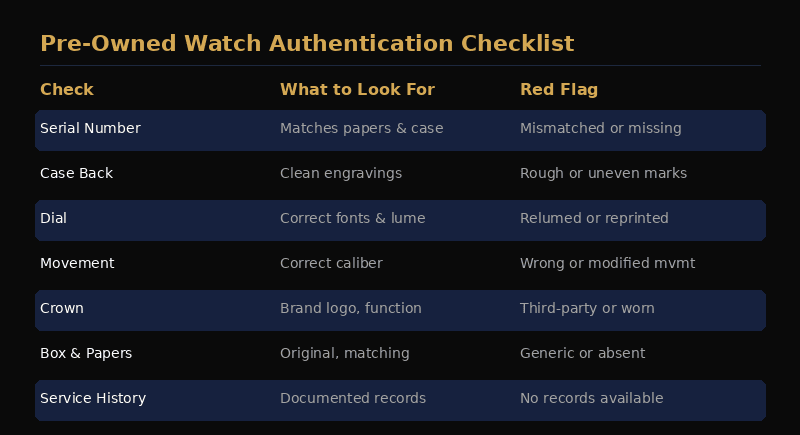
Serial number verification is the next step. Contact the manufacturer or an authorised service centre with the serial number to confirm the watch exists in their records and matches the reference number being sold. Rolex will verify a serial number through an authorised service centre. Cartier and Omega offer similar verification through their service networks. This step catches stolen watches and “Franken-watches” — watches assembled from parts of multiple genuine watches, which are technically authentic in every component but do not represent a single factory-original piece.
Service history matters more than most buyers realise. A luxury watch that has been regularly serviced by the manufacturer or an authorised service centre is likely to run accurately and maintain its water resistance. A watch with no service history may need a $500–$1,500 service immediately after purchase, which eats into the savings of buying pre-owned. Ask the seller for service records, and factor in the cost of an upcoming service if none are available. Grailr’s scanner can suggest an identity and indicative market value from a photo, but a photo scan is not an authentication — always get a professional inspection for high-value purchases. Use our guide to fair pre-owned pricing to cross-reference the asking price.
Finally, verify box and papers. The original box, warranty card (or guarantee card), instruction manual and any service receipts add 5–15% to a pre-owned watch’s value. For collectible references, a complete set can command 20–30% more. Counterfeit documentation exists, so check that the serial number on the warranty card matches the serial number on the watch itself. A mismatch is a red flag that should stop the transaction.
Where to Buy Second Hand Luxury Watches
The choice of where to buy is nearly as important as what to buy. Each channel has trade-offs in pricing, authentication rigour and buyer protection. Established online platforms like Chrono24, WatchBox and Crown & Caliber offer wide inventories, structured condition grading and buyer-protection programmes. Chrono24’s Trusted Checkout holds funds in escrow until the buyer confirms receipt. WatchBox and Crown & Caliber authenticate every watch in-house before listing and offer their own warranties.
Brand-certified pre-owned programmes are a newer option that offers the closest experience to buying new. Rolex launched its Certified Pre-Owned programme in late 2022 through select authorised dealers, offering a two-year Rolex warranty on authenticated pre-owned watches. The trade-off is price: Rolex CPO watches typically sell at a premium to the open secondary market because buyers are paying for the Rolex warranty and the certainty of factory authentication. Omega has a similar programme through its boutiques. Cartier does not currently offer a formal CPO programme, though Richemont-owned Watchfinder serves as an adjacent channel.
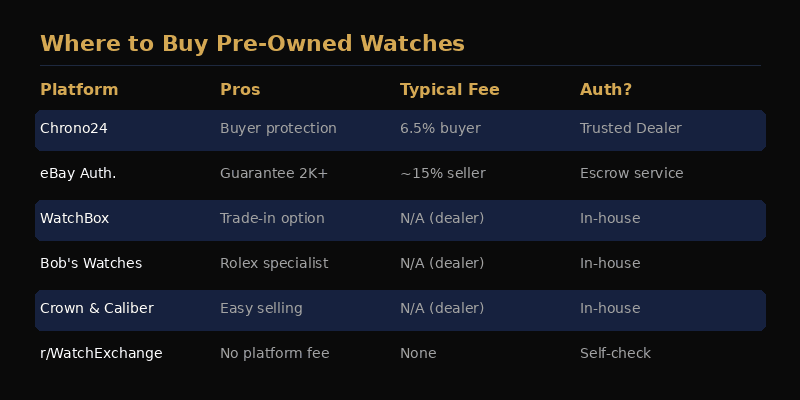
Auction houses like Christie’s, Sotheby’s and Phillips handle the top end of the market — rare, vintage and collectible references that command prices well above standard secondary-market levels. For everyday pre-owned purchases of current-production models, auctions are generally not the most efficient channel because buyer’s premiums of 20–28% add significant cost.
Peer-to-peer platforms like eBay and Reddit’s r/Watchexchange offer the lowest prices but also the least buyer protection. eBay’s Authenticity Guarantee programme covers watches over $2,000 with third-party authentication, which has improved trust considerably. Reddit transactions rely on community reputation and escrow services. For first-time buyers, a dealer or certified programme is the safer starting point; peer-to-peer markets are better suited to experienced buyers who can authenticate independently or are willing to pay for an independent appraisal before completing the sale.
Frequently Asked Questions
Is it safe to buy a second hand luxury watch?
Yes, provided you buy from a reputable dealer or platform with authentication guarantees. Established dealers like Watchfinder, Crown and Caliber, and Chrono24 Trusted Sellers offer authentication, condition grading and return policies. Always verify the seller's reputation, inspect documentation and confirm the serial number before purchasing.
How much can you save buying a second hand Cartier watch?
Pre-owned Cartier watches typically trade 20 to 35 percent below current retail. The savings are largest on the Ballon Bleu (30 to 40 percent below retail) and smallest on the Santos de Cartier (10 to 20 percent below retail), which holds its value better due to stronger secondary market demand.
What does ‘second hand movement’ mean on a Rolex?
The second hand movement on a Rolex refers to the sweep seconds hand on the dial, not to buying a used watch. Rolex mechanical movements beat at 28,800 vibrations per hour, which makes the seconds hand appear to glide smoothly rather than tick in one-second increments like a quartz watch. This smooth sweep is a hallmark of Rolex mechanical calibres.
Do second hand Omega watches hold their value?
Omega watches generally retain 60 to 75 percent of their retail price on the secondary market. The Speedmaster Moonwatch is the strongest performer, holding 70 to 85 percent depending on variant. Seamaster and Aqua Terra models retain less because authorised dealers commonly discount them 10 to 15 percent on new purchases, which compresses pre-owned margins.
Should I buy a second hand watch with or without box and papers?
Box and papers typically add 5 to 15 percent to a pre-owned watch's value. For common models the premium is modest, but for collectible references a complete set can command 20 to 30 percent more than a watch-only sale. If you plan to resell later, buying with full documentation protects your resale value.
What is the best second hand luxury watch to buy in 2026?
For value retention, the Rolex Submariner and Daytona trade at or above retail. For savings versus new, the Cartier Santos de Cartier and Omega Speedmaster Moonwatch offer strong combinations of heritage, mechanical quality and secondary market demand. The best choice depends on your budget, style preference and whether you prioritise savings now or resale value later.
Related Articles
The Bottom Line
The second hand luxury watch market in 2026 offers genuine opportunities across all three of the most searched brands. Cartier offers the deepest savings — 20–35% below retail on most models, with the Santos and Tank providing accessible entry points that retain their value well. Omega offers mechanical depth at lower prices than Rolex, though the common availability of AD discounts means the real pre-owned saving is smaller than headline figures suggest. Rolex inverts the equation entirely: its sport models cost more pre-owned than new, making it the one brand where buying from an AD (if you can get the allocation) is actually the better financial play.
Whatever brand you choose, the fundamentals are the same. Authenticate before you pay. Verify the serial number. Check for service history. Compare the asking price against at least two independent sources. Factor in the cost of a service if the watch has not been serviced recently. And remember that asking prices are not completed-sale prices — the figures in this guide and on any listing platform are starting points for negotiation, not guarantees of what you will pay or receive.
Check Any Watch Before You Buy
Grailr uses a photo to suggest a watch identity and an indicative price estimate, with active listings where available. Check the exact reference and condition independently; a photo scan cannot authenticate a watch.
Scan Your Watch NowSources and Price Context
- Cartier Official Watch Collections — Current retail pricing, specifications and available references for all Cartier watch families.
- Omega Official Watch Collections — Current retail pricing, specifications and Co-Axial Master Chronometer movement details for all Omega families.
These primary sources support the specific specification and pricing points noted above. Prices and resale percentages elsewhere in this guide are indicative editorial figures, not a verified transaction dataset or guaranteed returns. Confirm the exact reference, region, condition and current quote before buying; asking prices are not completed-sale prices.