Cartier Ballon Bleu: Every Size, Spec and Price
The complete guide to Cartier’s signature round watch — every size from 33mm to 42mm compared with real pricing, movement specs and honest buying advice.
Price context: this guide includes indicative prices from its original publication period. They have not all been refreshed to current quotes. Use the linked primary sources for specifications and policies, and verify prices independently.

- Steel Ballon Bleu starts at approximately $7,050 (33mm) and $7,500 (36mm) after the May 2026 price increase
- Current models use the in-house Caliber 1847 MC with a 42-hour power reserve
- Pre-owned steel examples trade at roughly $5,200–$6,000, or about 70–80% of retail
- The 33mm and 36mm sizes are genuinely unisex — size to your wrist, not to a marketing label
What Makes the Ballon Bleu a Ballon Bleu
The Ballon Bleu de Cartier debuted in 2007 and immediately set itself apart from every other round watch on the market. While most round watches treat the crown as an afterthought — a functional knob sticking out from the side of the case — Cartier’s design team, led by Carole Forestier-Kasapi, integrated the crown into a sculpted guard that flows seamlessly into the case contour. Housed inside that guard is a cabochon-cut blue synthetic spinel, the “blue balloon” that gives the collection its name.
That single detail changes the entire watch. The case reads as a continuous curve from every angle. The crown is protected from accidental impact. And the blue cabochon adds a flash of colour to an otherwise restrained design. It is a small thing done very well, which is what Cartier has always been best at.
The rest of the design is classically Cartier: a guilloché dial with Roman numeral indices, sword-shaped blued steel hands, and a finish level that starts high even in steel. The bracelet has polished and brushed links that flow into the lugs without visible endlinks — a trick that makes the watch sit closer to the wrist than you’d expect from its case diameter. Alongside the Panthère and the Tank, it has become one of Cartier’s three best-selling watch lines worldwide.
Every Size in the Current Lineup
Cartier has offered the Ballon Bleu in sizes ranging from 28mm to 46.5mm over the years, but the active 2026 catalogue has narrowed to a focused core. The 28mm quartz model appears to have been discontinued from the active lineup, and the larger chronograph and tourbillon models were phased out several years ago. What remains is a tighter range that covers most wrist sizes.
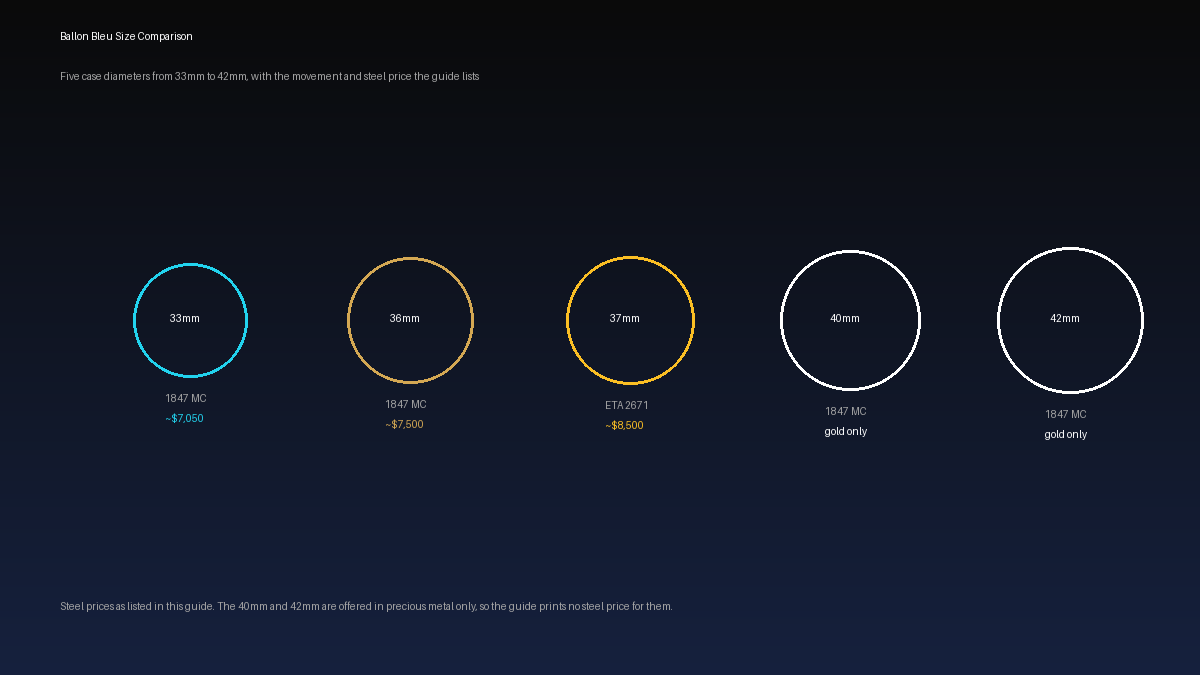
| Size | Movement | Materials | Steel Price | Best For |
|---|---|---|---|---|
| 33mm | Cal. 1847 MC (auto) | Steel, steel/gold, gold | ~$7,050 | Smaller wrists, dressier looks |
| 36mm | Cal. 1847 MC (auto) | Steel, steel/gold, gold | ~$7,500 | Most versatile; true unisex |
| 37mm | ETA 2671 (auto) | Steel, pink gold | ~$8,500 | Moon-phase complication |
| 40mm | Cal. 1847 MC (auto) | Gold, steel/gold | N/A (precious metal only) | Larger wrists wanting a mid-size |
| 42mm | Cal. 1847 MC (auto) | Gold, steel/gold | N/A (precious metal only) | Maximum wrist presence |
The 33mm and 36mm are the volume sellers and the only sizes available in full steel. If you want gold, every size is covered. If you want steel, you’re choosing between 33mm and 36mm — and for most people, the 36mm is the sweet spot. It wears more like a 34mm from other brands because of Cartier’s short lugs and integrated bracelet.
Movement History: ETA to In-House
When the Ballon Bleu launched in 2007, Cartier used ETA-based movements across the range. That was standard practice for most of the Swiss industry at the time, and it kept prices accessible while Cartier invested in developing its own calibers. The transition happened gradually: Cartier introduced the in-house Caliber 1847 MC and began rolling it into the Ballon Bleu line, replacing the ETA movements model by model.
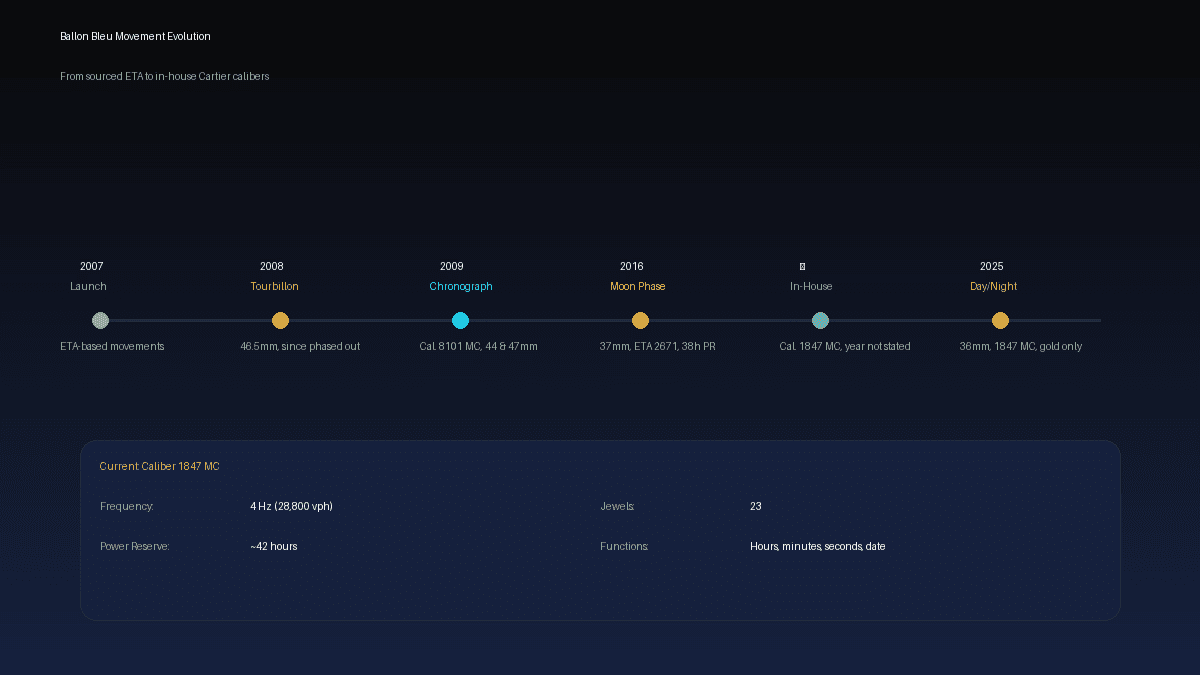
The Caliber 1847 MC runs at 4 Hz (28,800 vibrations per hour) with 23 jewels and delivers approximately 42 hours of power reserve. Those numbers are respectable but not class-leading — Rolex offers 70 hours in a Datejust and Omega delivers 60 hours in an Aqua Terra. But power reserve has never been Cartier’s selling point. What the in-house movement does establish is manufacturing credibility. When a brand makes its own movement, it controls finishing, service intervals and long-term parts availability. For a watch you plan to keep for decades, that matters.
The exception in the current lineup is the Moon-Phase model, which still uses an ETA 2671 base with a 38-hour power reserve. If movement provenance matters to you, the standard time-and-date Ballon Bleu on the 1847 MC is the better buy. If you want the complication, the ETA is a proven workhorse that any watchmaker can service.
2026 Pricing: Retail and Pre-Owned
Cartier applied a broad US price increase on 21 May 2026, averaging roughly 6% across the core collections. The Ballon Bleu was not exempt. Below are the approximate US retail prices after that adjustment, alongside typical pre-owned values for steel models in good condition. Gold and diamond-set models vary widely by configuration, so the table focuses on the most commonly traded references.
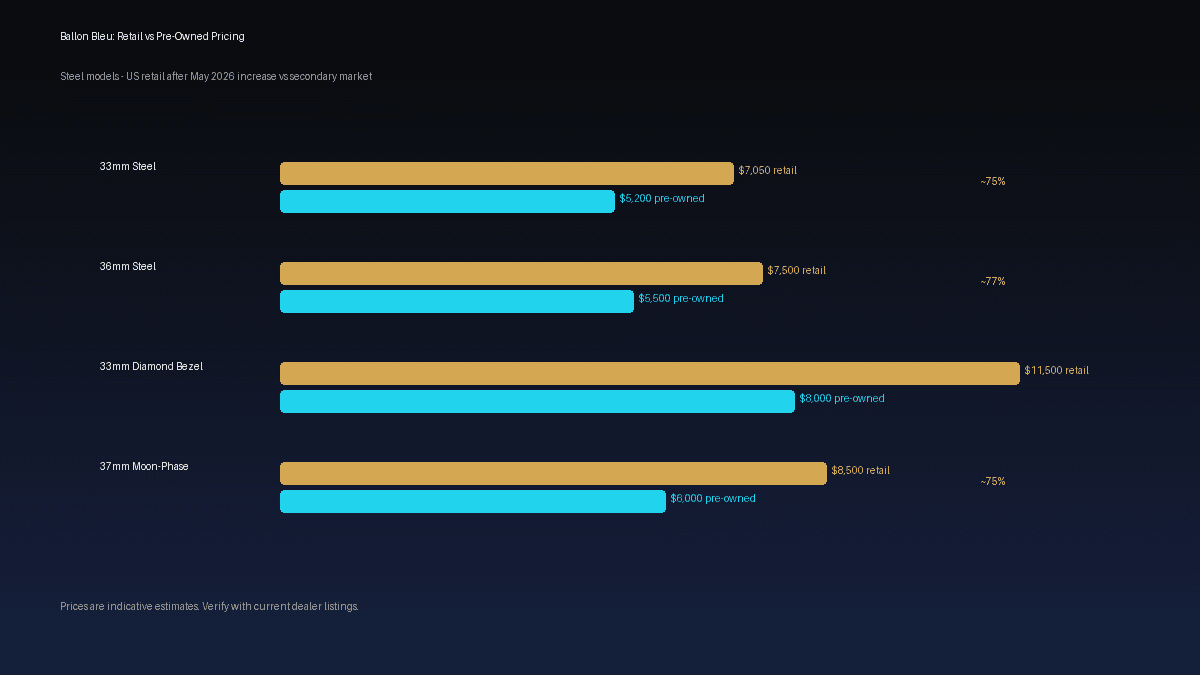
| Model | Material | Retail (Approx.) | Pre-Owned | Retention |
|---|---|---|---|---|
| 33mm Auto | Steel | ~$7,050 | $5,200–$5,800 | ~75% |
| 36mm Auto | Steel | ~$7,500 | $5,500–$6,000 | ~77% |
| 33mm Auto Diamond Bezel | Steel | ~$11,500 | $8,000–$9,000 | ~72% |
| 33mm Auto | Steel/Rose Gold | ~$12,500 | $8,500–$10,000 | ~73% |
| 37mm Moon-Phase | Steel | ~$8,500 | $6,000–$7,000 | ~75% |
| 40mm Auto | Rose Gold | ~$25,000 | $16,000–$19,000 | ~70% |
| 42mm Auto | Rose Gold | ~$30,000 | $18,000–$22,000 | ~67% |
The pattern is consistent: steel Ballon Bleu models hold about 70–80% of retail. That is in line with other Cartier collections and comparable to the Tank and Panthère in steel. Larger precious-metal models lose more in absolute dollar terms, but their percentage retention is similar. If you are buying for enjoyment rather than investment, the value proposition is fair — especially compared to fashion-brand watches that lose 80–90% at resale.
Complications: Moon-Phase and Day/Night
The Ballon Bleu is primarily a time-and-date watch, and that is what most people buy. But Cartier has added complications over the years — some that stuck and some that didn’t. The Tourbillon (2008, 46.5mm) and Chronograph (2009, 44mm and 47mm with the Caliber 8101 MC) were both impressive technically but have been phased out of the active catalogue. They turn up on the pre-owned market occasionally and command a premium from Cartier collectors.
What remains are two complications that suit the Ballon Bleu’s character. The Moon-Phase (37mm, introduced 2016) uses an ETA 2671 base with a 38-hour power reserve. It is available in steel or pink gold, with optional diamond bezels. The moon-phase aperture at six o’clock adds visual depth without cluttering the dial, and the 37mm case fits neatly between the 36mm and 40mm time-only models.
The newest addition is the Day/Night indicator, introduced in 2025. At 36mm with the Caliber 1847 MC, it comes only in red or white gold with a diamond-set bezel. The red-gold version has a mother-of-pearl dial; the white-gold version uses aventurine. Both are firmly in the jewellery-watch category — expect pricing well above $20,000. For most buyers, the standard time-and-date Ballon Bleu is the right call. The moon-phase is worth the premium only if the complication genuinely appeals to you.
Resale Value and What Holds Best
Cartier watches do not hold value the way a Rolex Submariner or Patek Philippe Nautilus does. That is worth stating plainly, because some guides tiptoe around it. The Ballon Bleu is a luxury purchase, not an investment vehicle. That said, it retains value better than most non-sports luxury watches, and certain configurations hold up better than others.
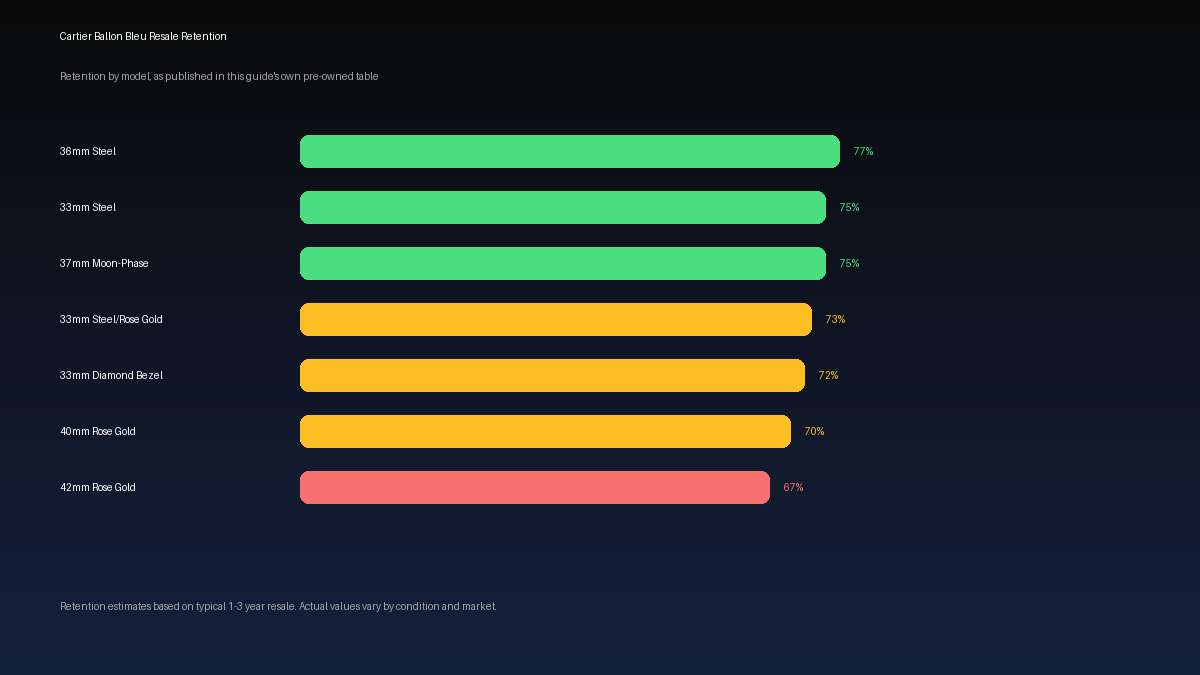
Steel models hold the highest percentage. A steel 36mm in good condition with box and papers typically resells for 75–80% of its original retail price. The 33mm is close behind. Diamond-set steel models lose more in percentage terms because the aftermarket discounts gems more aggressively than base metal. Gold models lose the most in absolute dollar terms, but their percentage retention is roughly similar.
Box and papers matter. A complete set with the original Cartier box, warranty card and receipt adds 10–15% to the resale price. This is true across all Cartier collections. If you plan to sell someday, keep everything.
Discontinued references can outperform. The larger 42mm steel models and certain limited-edition dial colours have held value better than current-production models on the secondary market. If you spot a discontinued reference in good condition, it may be a better buy than new. Use Grailr’s appraisal tool to check current market pricing before committing.
How to Buy a Ballon Bleu in 2026
Unlike Rolex sport models, the Ballon Bleu has no waitlist. Walk into any Cartier boutique or authorized dealer and you can try every size on your wrist and walk out wearing one the same day. That availability is actually an advantage for pre-owned buyers: it means the secondary market is well supplied, and prices are competitive.
1. Try Both Sizes
The 33mm and 36mm wear differently on the wrist than their numbers suggest. Cartier’s short lugs and integrated bracelet mean the 36mm wears more like a 34mm from most other brands. Try both before deciding — many people expecting to prefer the 33mm end up choosing the 36mm.
2. Consider Pre-Owned
Steel Ballon Bleu models trade 20–30% below retail on the secondary market. A one-year-old example in excellent condition saves you $1,500–$2,000 and may still have Cartier’s international warranty remaining. Use Grailr’s scanner to check the reference and market pricing on any listing.
3. Check the Movement
If buying pre-owned, verify whether the specific reference uses the older ETA movement or the current Caliber 1847 MC. The transition happened gradually, so two watches of the same size from different years may have different movements. The in-house caliber is preferable for long-term servicing.
4. Scan Before You Buy
Photograph any pre-owned listing and run it through Grailr’s identification tool. It will suggest the model, check market pricing, and give a confidence score. A photo scan cannot authenticate a watch, but it can flag a price that is suspiciously low or a reference that does not match the seller’s description.
5. Compare Before Committing
At the $7,000–$8,000 level, the Ballon Bleu competes with the Cartier Baignoire, the Omega Aqua Terra, and even the Rolex Oyster Perpetual. All three offer in-house movements, different aesthetics, and varying resale performance. The Ballon Bleu wins on design distinctiveness and Cartier’s jewellery heritage; it loses on power reserve and resale percentage.
Frequently Asked Questions
How much does a Cartier Ballon Bleu cost in 2026?
A steel 33mm automatic starts at approximately $7,050 and a steel 36mm at $7,500 after the May 2026 price adjustment. Gold models range from roughly $14,000 to over $30,000 depending on size and gem-setting. These are indicative retail figures; verify with Cartier or an authorized dealer.
What movement does the Cartier Ballon Bleu use?
Current automatic Ballon Bleu models use the in-house Caliber 1847 MC, a 23-jewel automatic beating at 4 Hz with approximately 42 hours of power reserve. Earlier models used ETA-based movements, and the Moon-Phase still uses an ETA 2671.
What sizes does the Ballon Bleu come in?
The current core lineup offers 33mm and 36mm automatic models in steel. Cartier also makes 40mm and 42mm versions in precious metals, and a 37mm Moon-Phase. The 28mm quartz model appears to have been discontinued from the active catalogue as of 2026.
Is the Ballon Bleu a good investment?
Steel Ballon Bleu models typically retain about 70-80% of retail on the pre-owned market. That is respectable for a non-sports luxury watch, though not in the same league as a Rolex Submariner or Patek Philippe Nautilus. Buy it because you love it, not for resale.
Is the Ballon Bleu a unisex watch?
Yes. The 33mm and 36mm sizes work well on most wrist sizes regardless of gender. Cartier markets the collection to everyone, and many buyers choose the 36mm as a versatile everyday piece.
What is the blue crown on the Ballon Bleu?
The protruding crown guard houses a cabochon-cut blue synthetic spinel. It is both functional — protecting the crown from impact — and the defining design detail that gives the collection its name: 'ballon bleu' means 'blue balloon' in French.
Related Articles
The Bottom Line
The Ballon Bleu is not trying to be a tool watch or an investment piece. It is a beautifully designed round watch from a house with 177 years of jewellery and watchmaking history, and that crown guard with its blue cabochon is one of the most distinctive details in modern horology. The steel 36mm automatic is the sweet spot for most buyers: large enough to read at a glance, refined enough for any occasion, and priced fairly for what you get. Try it on before you decide, consider pre-owned to save 20–30%, and keep the box and papers for the day you want to pass it on.
Sources and price context
- Cartier Ballon Bleu WSBB0062 product page — Official specifications and reference details for the 33mm steel automatic.
- Teddy Baldassarre Cartier Ballon Bleu review — Independent review covering sizes, movements, dial options and the design evolution from 2007 to present.
These primary sources support the specific specification and history points noted above. Prices and resale percentages elsewhere in this guide are indicative editorial figures, not a verified transaction dataset or guaranteed returns. Confirm the exact reference, region, condition and current quote before buying; asking prices are not completed-sale prices.