Citizen Tsuyosa Buying Guide: Specs, Prices and Value
Every Citizen Tsuyosa model compared — from the original 40mm automatic to the new Tsuyosa 60 with its 60-hour power reserve, guilloché dials and 37mm option.

- The Citizen Tsuyosa is an automatic watch line starting at roughly $350, offering sapphire crystal and a display caseback at a price most Swiss brands cannot match
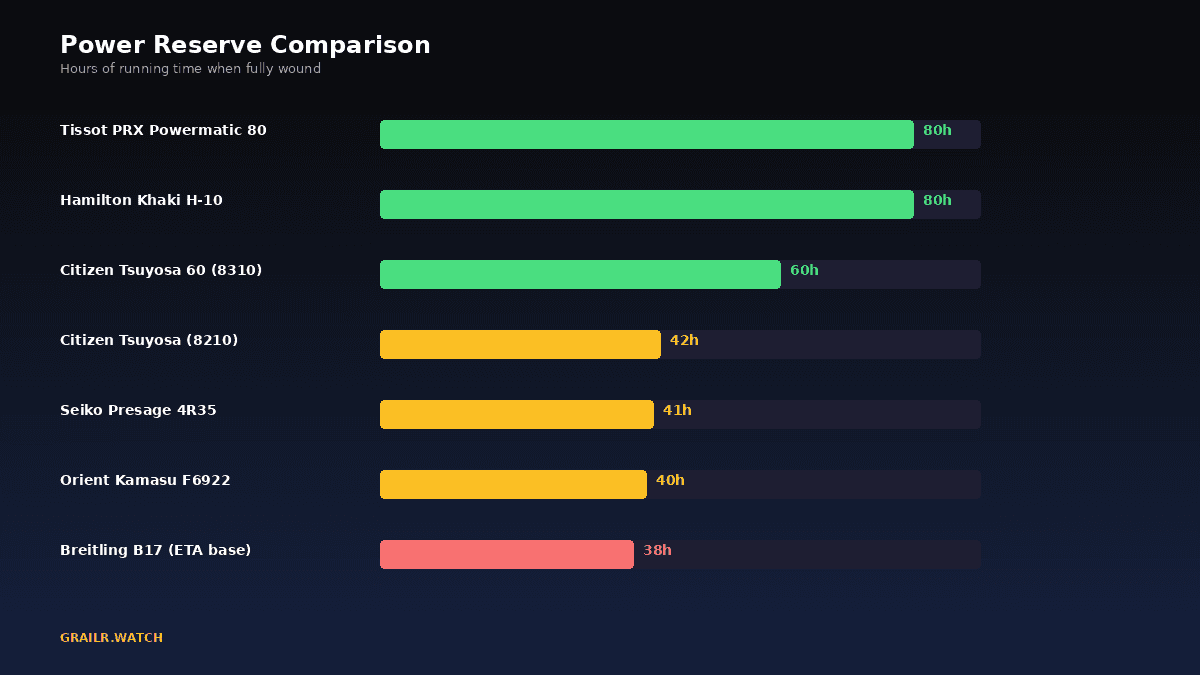
- The Tsuyosa 60 generation upgrades to Caliber 8310 with a 60-hour power reserve, up from 42 hours on the original Caliber 8210
- Available in 37mm and 40mm sizes with integrated stainless steel bracelets and a growing range of dial colours
- Directly competes with the Seiko Presage, Tissot PRX Powermatic 80 and Orient Star on specs and price
What Is the Citizen Tsuyosa?
The Tsuyosa is Citizen’s answer to a question the affordable watch market had been asking for years: where is the Japanese automatic with an integrated bracelet, sapphire crystal and display caseback for under $500? Launched in 2023, the name comes from the Japanese word tsuyosa (“strength”), and the watch has earned its reputation as one of the best-value mechanical watches you can buy today.
What makes the Tsuyosa notable is not any single headline feature but the combination of specs at the price. A sapphire crystal on front and back, a Citizen in-house automatic caliber, hacking seconds, a stainless steel integrated bracelet with push-button deployment clasp, and water resistance to 50 metres — all starting around $350 for the original generation. That package used to cost $800 or more from Swiss brands.
The line has since expanded into the Tsuyosa 60, which upgrades the movement to a 60-hour power reserve and introduces a 37mm case alongside the original 40mm. It is part of Citizen’s broader push back into mechanical watchmaking — the same company that pioneered Eco-Drive solar technology now wants to compete with Seiko and Orient on the automatic side too.
Every Tsuyosa Model Compared
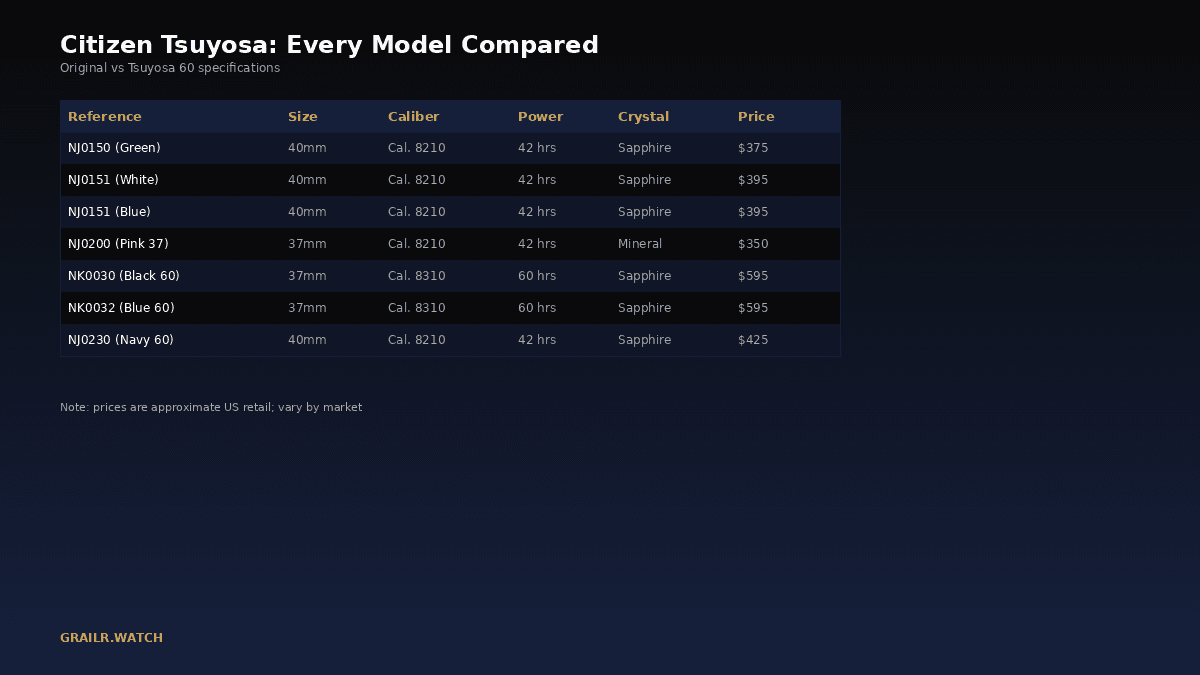
Citizen splits the Tsuyosa into two generations that share the same design language but differ in movement and, in the case of the 60, case size options. Here is how the three main configurations line up.
Original Tsuyosa 40mm (NJ0150/NJ0151 Series)
The first generation runs the Caliber 8210 with a 42-hour power reserve. The 40mm stainless steel case measures 11.7mm thick and sits on a five-link integrated bracelet. Dial options include black, white, green, blue and several limited-edition colours. Sapphire crystal front and back, with a display caseback showing the decorated automatic rotor. Water resistance is 50 metres — fine for a splash but not a pool.
Tsuyosa 60 — 37mm (NK0030 Series)
The smaller Tsuyosa 60 uses the upgraded Caliber 8310, pushing the power reserve to 60 hours. At 37mm wide and 11.5mm thick, it sits closer to vintage sport-watch proportions. The dial features a machine-cut guilloché pattern that catches light differently depending on angle — a detail usually found on watches costing several times more. Anti-reflective sapphire crystal keeps reflections down in direct sunlight.
Tsuyosa 60 — 40mm (NJ0230 Series)
Same Caliber 8310 and 60-hour reserve as the 37mm, but in the original 40mm case size for buyers who want the updated movement without sizing down. Guilloché dials carry over from the 37mm, and Citizen has introduced new colourways including navy blue and champagne that are exclusive to this generation. The bracelet remains the same five-link design with the push-button deployment clasp. Pricing sits between the original 40mm and the 37mm Tsuyosa 60, roughly in the $425 to $500 range depending on dial and market.
Movement and Specifications
The movement is where the generational split matters most. Both calibers are manufactured by Citizen’s Miyota division in Japan, but the 8310 represents a meaningful upgrade in power reserve and, according to WatchTime’s coverage, improved finishing on the rotor and bridges.
| Specification | Caliber 8210 | Caliber 8310 |
|---|---|---|
| Type | Automatic | Automatic |
| Frequency | 21,600 vph (6 bps) | 21,600 vph (6 bps) |
| Jewels | 21 | 21 |
| Power Reserve | ~42 hours | ~60 hours |
| Hacking Seconds | Yes | Yes |
| Hand-winding | No | No |
| Date | Yes, at 3 o’clock | Yes, at 3 o’clock |
| Accuracy | ±20 sec/day | ±20 sec/day |
| Display Caseback | Yes | Yes |
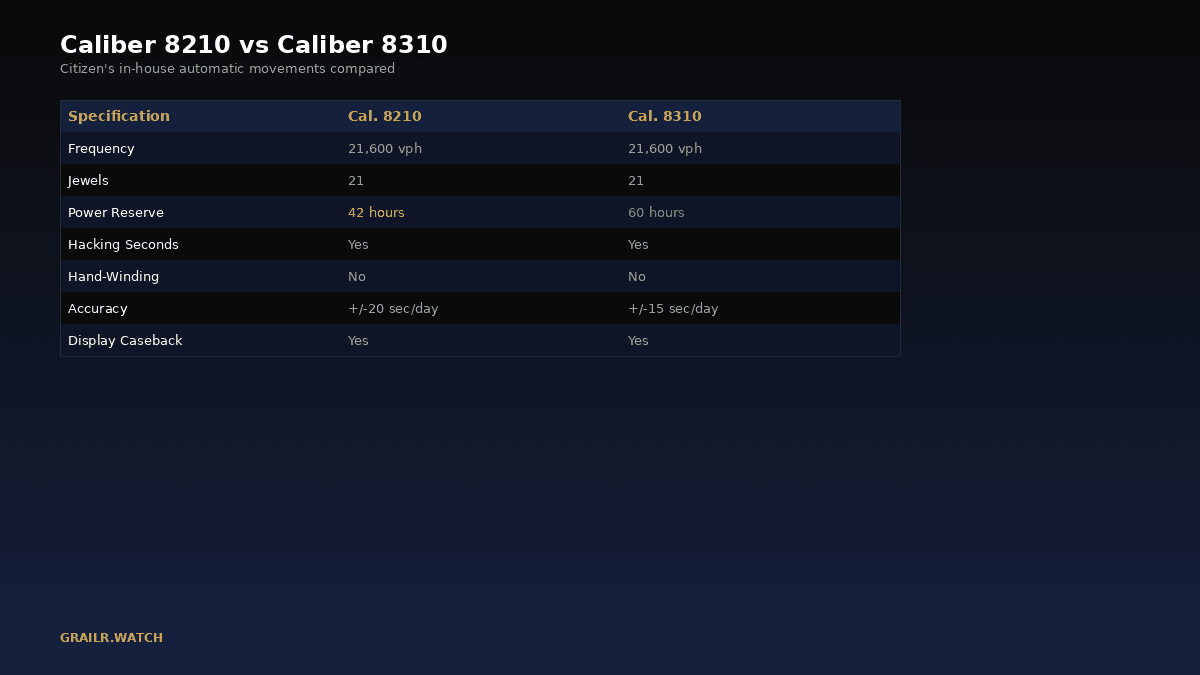
Neither caliber supports manual winding, which means you cannot wind the watch by crown alone — it needs wrist motion or a watch winder to stay running. The 60-hour reserve on the 8310 helps offset this: you can take the watch off Friday evening and pick it up Monday morning with time still on the mainspring. The 42-hour 8210 gives you about a day and three-quarters, so a full weekend off the wrist usually means resetting the time.
Pricing Across Markets
Citizen prices the Tsuyosa differently across regions, and dealer discounts are common since these are not allocation-restricted watches. The table below shows approximate retail prices as of late 2026. Street prices from authorized dealers can run 10–20% below these figures, especially on the original generation as Citizen shifts production toward the Tsuyosa 60.
| Model | Size | Caliber | US Retail | Street Price |
|---|---|---|---|---|
| NJ0150 (Black) | 40mm | 8210 | $475 | ~$350 |
| NJ0151 (White) | 40mm | 8210 | $475 | ~$365 |
| NJ0230 (Navy) | 40mm | 8310 | $525 | ~$425 |
| NK0030 (Black) | 37mm | 8310 | $595 | ~$500 |
| NK0030 (Green) | 37mm | 8310 | $595 | ~$500 |
| NJ0200 (Pink, 37mm) | 37mm | 8310 | $525 | ~$440 |
Price context: prices above are indicative and drawn from authorized dealer listings in October 2026. They may differ by region. Verify prices independently before purchasing.
Check Any Watch Price in Seconds
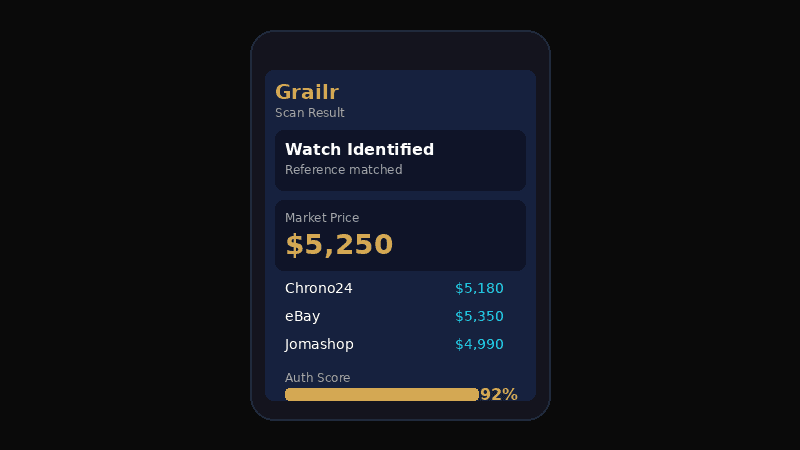
Grailr scans your watch photo and pulls live pricing from Chrono24, eBay, and Jomashop.
- AI identifies brand, model & reference number
- Live market prices from 3+ sources
- Authentication confidence score
Tsuyosa vs Seiko Presage vs Tissot PRX vs Orient
The Tsuyosa does not exist in a vacuum. Three other watches fight for the same wrist and the same budget. Here is how they compare on the specs that matter most.
The Seiko Presage is the closest rival in the Japanese market. Models running the 4R35 caliber offer 41 hours of power reserve, hacking and hand-winding, and Hardlex mineral crystal — not sapphire — for roughly $300 to $500. The Presage’s strength is dial finishing: enamel, textured and multi-layer dials that outclass the Tsuyosa’s cleaner aesthetic. Its weakness is the crystal downgrade and the bulkier lug-to-lug dimensions on many references.
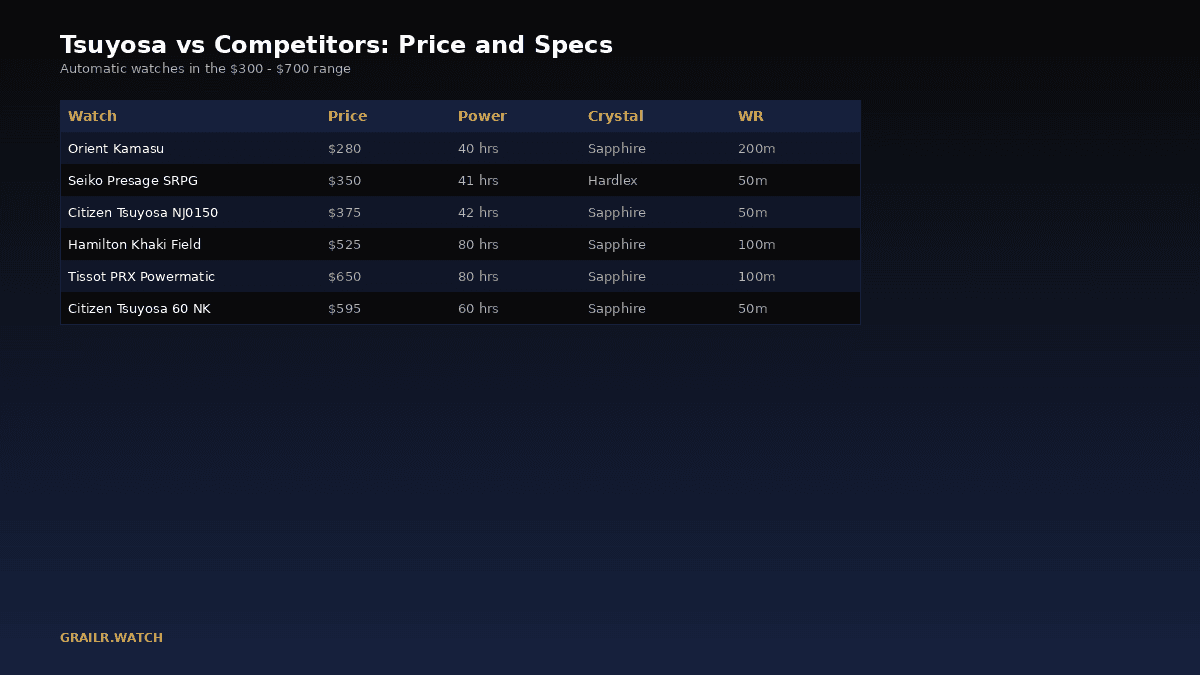
The Tissot PRX Powermatic 80 is the Swiss competitor. It delivers an 80-hour power reserve, sapphire crystal and a COSC-grade movement for around $650 to $700. The PRX wins on power reserve and brand cachet in European markets. The Tsuyosa 60 wins on price by $100 to $200 and offers a display caseback that the PRX does not.
The Orient Star sits between the two, with in-house calibers offering 40 to 50 hours of reserve, sapphire crystal and hand-winding at $350 to $600. Orient is also owned by Citizen Watch Group, making it a sibling brand. The Orient Star’s advantage is hand-winding and more classically styled designs; the Tsuyosa’s advantage is the modern integrated bracelet and, on the 60 generation, a longer power reserve.
Resale Value and Long-Term Ownership
Let’s be direct: no watch at the $350 to $600 price point is an investment. Japanese automatics in this range typically retain 50 to 70 percent of their retail price on the secondary market, with the first year seeing the steepest drop. The Tsuyosa is no exception.
That said, some factors work in the Tsuyosa’s favour. Limited-edition colourways tend to hold better than standard black or white dials. The Tsuyosa 60 generation is still relatively new, and early references are not flooding the used market yet. If you buy at street price rather than full retail, you’re already starting from a lower cost basis, which softens the depreciation in real-dollar terms.
Where the Tsuyosa genuinely shines is cost of ownership. Citizen’s Miyota movements are workhorses with published service intervals of five to seven years. A full service runs roughly $100 to $150 at an independent watchmaker, compared to $300 or more for a Swiss ETA movement. Parts availability is excellent — Miyota supplies movements to hundreds of brands, so any competent watchmaker can source what they need.
If you are buying a watch in this range for long-term daily wear rather than flipping, the Tsuyosa’s combination of low purchase price and low maintenance cost makes it one of the most economical mechanical watches to own over a decade.
Five Tips Before You Buy a Tsuyosa
1. Try Both Sizes On
The 37mm and 40mm look different on paper but feel dramatically different on smaller wrists. The integrated bracelet means the lug-to-lug is tight on both, so the 37mm wears larger than you would expect from a round 37mm watch. If you have a 6.5-inch wrist or smaller, the 37mm is likely the better fit. Above 7 inches, the 40mm fills the wrist without looking oversized.
2. Buy the Tsuyosa 60 if You Can
The 18-hour power reserve difference between the 8210 and 8310 is the single biggest practical upgrade. If you only wear the watch on weekdays, the 60-hour reserve means it survives the weekend on your nightstand. The price premium is $50 to $150 over the original — worth it for the convenience alone.
3. Shop Authorized Dealers for Discounts
Unlike Rolex or Patek Philippe, Citizen watches are readily available at authorized dealers who often discount 10–20% off retail, especially on the original Tsuyosa generation. Online ADs regularly run sales. There is no waitlist, no allocation game and no grey-market premium.
4. Consider the Bracelet Comfort
The Tsuyosa’s integrated bracelet cannot be swapped for a leather or NATO strap without an aftermarket adapter. If you like rotating straps, this is not the watch for that. The bracelet itself is well-finished for the price — solid end links, brushed centre links, polished outer links — but it is part of the package, not an option.
5. Check the Colour Before It Sells Out
Citizen rotates dial colours more frequently than most brands at this price point. Limited runs in pink, salmon, teal and champagne have sold through quickly at authorized dealers. If you see a colourway you like, do not wait — the standard black, white and blue will always be available, but the special editions may not come back.
Frequently Asked Questions
Is the Citizen Tsuyosa a good automatic watch for the price?
Yes. The Tsuyosa delivers sapphire crystal, a display caseback and a reliable in-house automatic movement for $350 to $595, undercutting most Swiss competitors with comparable specs. For a first automatic watch or a daily beater, it is one of the strongest values in 2026.
What is the difference between Tsuyosa and Tsuyosa 60?
The Tsuyosa 60 uses the newer Caliber 8310 with a 60-hour power reserve, up from the original Caliber 8210’s 42 hours. The 60 also adds guilloché dial textures and is available in a 37mm case size alongside the 40mm.
What movement does the Citizen Tsuyosa use?
The original runs the Citizen Caliber 8210, a 21-jewel automatic beating at 21,600 vph with a 42-hour power reserve and hacking seconds. The Tsuyosa 60 upgrades to the Caliber 8310, which extends the power reserve to 60 hours while keeping the same beat rate and jewel count.
Does the Citizen Tsuyosa have a sapphire crystal?
Yes. Both generations feature a sapphire crystal on the front. The Tsuyosa 60 models also have an anti-reflective coating for improved legibility in bright conditions.
How does the Tsuyosa compare to the Seiko Presage?
Both offer Japanese automatic movements in the $300 to $600 range. The Tsuyosa has a sportier integrated-bracelet design and sapphire crystal. The Presage leans dressier with more elaborate dial finishing but uses Hardlex mineral crystal on most models. The Tsuyosa 60’s 60-hour reserve beats the Presage 4R35’s 41 hours.
Does the Citizen Tsuyosa hold its value?
Japanese automatics in this price range typically retain 50 to 70 percent of retail on the secondary market. The Tsuyosa is relatively new, so long-term data is limited, but limited-colour runs and the Tsuyosa 60 generation tend to hold slightly better than standard references. Buy at street price to minimize depreciation in dollar terms.
Related Guides
The Bottom Line
The Citizen Tsuyosa is one of the best automatic watches you can buy under $600 in 2026. The original generation is an exceptional value at street prices around $350, and the Tsuyosa 60 raises the bar with a 60-hour power reserve that solves the biggest practical complaint about affordable automatics. Sapphire crystal, display caseback, integrated bracelet, hacking seconds — the spec sheet reads like a watch at twice the price.
It is not perfect. The lack of hand-winding is a real inconvenience if you do not wear the watch daily. The integrated bracelet limits strap options. And if you care about dial artistry, the Seiko Presage line still does it better at a similar price. But for a modern, daily-wear automatic that punches well above its weight on specifications, the Tsuyosa is hard to beat.
If you already own a Tsuyosa and want to know what it is worth today, Grailr’s appraisal tool can give you an indicative estimate in seconds. And if you are still deciding between models, scan any watch photo to pull up the reference number, specs and live market pricing.
Not Sure Which Tsuyosa to Buy?
Scan any Citizen watch to get the exact reference number, movement details and live market pricing.
Scan a Watch