Golden Watches: Types, Prices and What to Buy
Gold-plated, two-tone and solid 18k gold watches compared at every price point — from a $25 Casio to a $75,000 Audemars Piguet Royal Oak, with real pricing data and resale expectations.
Price context: this guide includes indicative prices from its original publication period. They have not all been refreshed to current quotes. Use the linked primary sources for specifications and policies, and verify prices independently.

- Gold-plated and PVD watches start at $25 and look the part, but plating wears and resale value is near zero
- Two-tone models deliver the warmth of gold at 50–60% of a full-gold price and sell faster pre-owned
- Solid 18k gold watches carry intrinsic metal value — a Rolex Day-Date trades roughly 4% above retail
- Rose gold is the fastest-appreciating colour — Rolex rose gold models reportedly gained 14% over the past year
- Pre-owned solid gold from $2,000 to $12,000 is the sweet spot for value from Rolex, Omega, Cartier and Tudor
Types of Gold in Watchmaking
Not every golden watch contains actual gold. The watch industry uses four distinct tiers of gold, and the differences between them determine price, durability and resale value. Understanding which tier you’re looking at is the single most important step before handing over any money.
Gold-plated and PVD-coated watches use a thin layer of gold — typically 1 to 5 microns — over a stainless steel or brass base. The coating looks identical to solid gold from across a room, but it wears over time. Daily-wear pieces usually show base metal at high-contact points within two to five years. These watches range from $25 for a Casio A168WG to around $1,000 for a Tissot or Bulova in gold PVD. The resale floor is effectively zero because the gold content itself is negligible.
Gold-capped and gold-filled watches carry a thicker layer of gold — typically 10 to 20 microns — bonded to the base metal. These were common in mid-century watches from brands like Omega and Longines. They last longer than plating but still lack the intrinsic value of solid gold. Vintage gold-filled Omegas trade in the $500 to $2,000 range, depending on movement condition and model rarity.
Two-tone watches combine a steel case and bracelet with 18k gold accents — typically the bezel, crown, centre bracelet links and sometimes the dial. This approach delivers the visual warmth of gold at roughly 50 to 60 percent of the price of an all-gold equivalent. The Rolex Datejust 41 in Oystersteel and yellow gold (ref. 126333) is the category’s most recognisable example, sitting around $14,500 retail versus over $37,000 for the full-gold Day-Date.
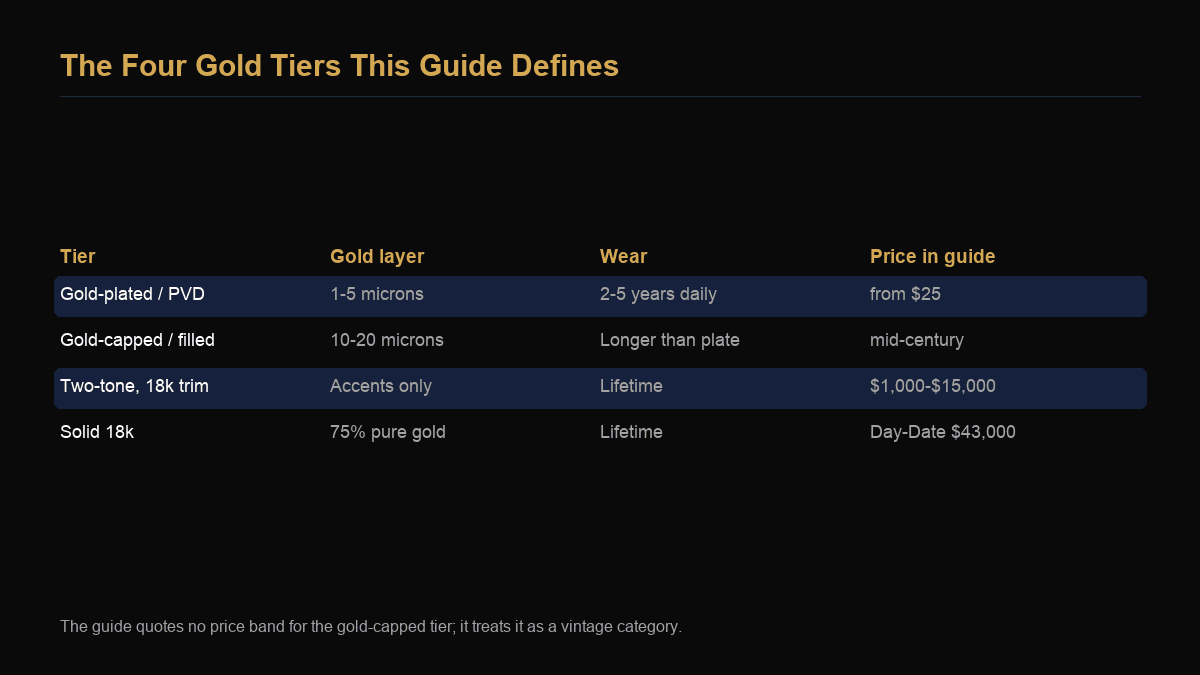
Solid gold watches use 18k gold (75% pure gold, 25% alloy metals) for the entire case, and often the bracelet as well. The gold content alone in a typical 40mm case weighs between 50 and 80 grams, which at current gold spot prices represents $3,000 to $5,000 in raw metal value. This intrinsic floor is what separates solid gold from every other tier: even if the brand collapsed tomorrow, the watch would be worth its melt weight. Prices start around $10,000 for a Cartier Tank Louis and climb past $75,000 for an Audemars Piguet Royal Oak in yellow gold.
Yellow, Rose and White Gold Compared
All 18k gold is 75% pure gold. The remaining 25% alloy determines the colour. Each has a distinct look, different wear characteristics and a different secondary-market trajectory.
Yellow gold is the classic choice. It carries the strongest cultural association with luxury watchmaking and historically commands the highest demand on the secondary market. The alloy typically combines gold with silver and copper in roughly equal measure. Rolex’s version, cast and refined at their Chêne-Bourg foundry, has been the benchmark since the Day-Date launched in 1956. A yellow gold Day-Date 40 (ref. 228238) retails for approximately $43,000, and secondary-market examples trade between $38,000 and $48,000 — roughly 4% above retail according to dealer data.
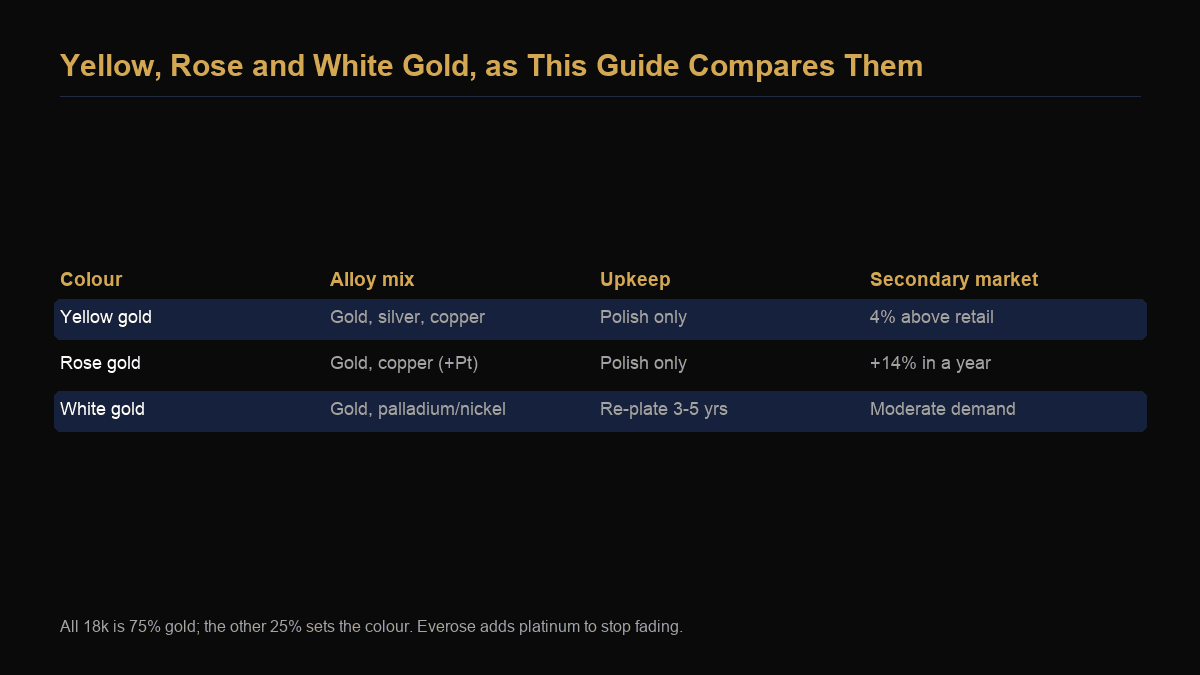
Rose gold has surged in popularity over the past decade. The alloy adds a higher proportion of copper, producing a warm pinkish hue. Several brands have developed proprietary formulations: Rolex’s Everose gold includes a small percentage of platinum to prevent fading over time, while Omega’s Sedna gold blends gold, copper and palladium. Rose gold Rolex models reportedly gained around 14% in value over the past year, making it the fastest-appreciating gold colour in the current market.
White gold combines gold with palladium or nickel and is rhodium-plated to achieve a bright silver appearance. On the wrist, it looks almost identical to stainless steel, which divides collectors. The practical downside is that rhodium plating wears off over three to five years and requires re-plating at $50 to $150 per service. If you want a precious-metal watch that doesn’t announce itself, white gold delivers subtlety. If you want the warmth of gold, yellow or rose is the better investment.
| Gold Colour | Alloy Mix | Maintenance | Secondary Market |
|---|---|---|---|
| Yellow Gold | Gold + silver + copper | Polish only | Highest demand, 4% above retail (Day-Date) |
| Rose Gold | Gold + copper (+ platinum in Everose) | Polish only | Fastest appreciating, +14% year-over-year |
| White Gold | Gold + palladium or nickel | Re-plate every 3–5 years ($50–$150) | Moderate demand, subtle appearance |
Best Golden Watches Under $1,000
You do not need thousands of dollars to wear a golden watch. The watches below use gold-plated, PVD-coated or gold-tone finishes rather than solid gold, but they deliver genuine style and reliable movements at accessible prices. None will hold significant resale value, so buy them for the pleasure of wearing gold on your wrist, not as an investment.
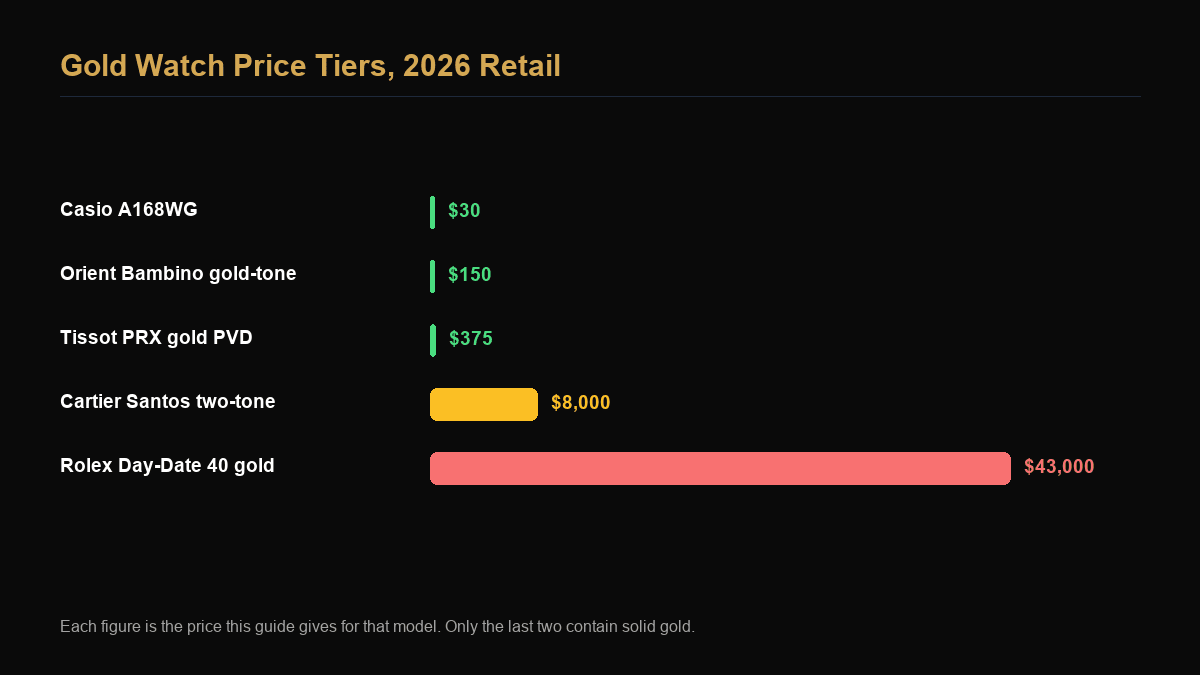
The Casio A168WG is the most affordable golden watch worth owning. At $25 to $30, it offers the iconic digital Casio design in a gold-tone stainless steel case with a resin backing. The module runs for seven years on a single battery, and the watch has survived everything from office desks to construction sites for decades. It will not fool anyone into thinking you’re wearing solid gold, but it has a charm that transcends its price.
Step up to $100 to $200 and the Orient Bambino in gold-tone offers a 40.5mm dress watch with an in-house Caliber F6722 automatic movement, a domed mineral crystal and a genuine leather strap. The gold-tone case and champagne dial pair beautifully at weddings and formal events. At roughly $150 new, it is the cheapest mechanical golden watch that delivers genuine watchmaking credibility.
The Seiko Presage gold-tone models occupy the $300 to $500 range. The Cocktail Time series in particular combines textured dials — inspired by Japanese cocktails — with gold PVD cases and the 4R35 automatic movement. At 40.5mm and 11.8mm thick, they wear well as dress watches while offering 41 hours of power reserve and 50 metres of water resistance.
At the top of this tier, the Tissot PRX in gold PVD (ref. T137.410.33.021.00) delivers a 40mm integrated-bracelet sports watch in gold-tone for around $375. The quartz version uses the ETA F06.115 for reliable timekeeping, while the Powermatic 80 automatic version in gold PVD climbs to approximately $650. Both offer the design language of luxury integrated-bracelet watches — a silhouette shared with the Audemars Piguet Royal Oak and Patek Philippe Nautilus — at a fraction of the cost.
Two-Tone and Mid-Range Gold ($1,000–$15,000)
The two-tone segment is where real gold enters the picture. These watches pair stainless steel with genuine 18k gold accents, delivering the warmth and prestige of gold without the full weight on your wallet. For many collectors, two-tone is the practical sweet spot: you get genuine precious metal, better resale retention than gold-plated alternatives, and a look that bridges sporty and dressy.
The Tudor Black Bay S&G (Steel and Gold) combines a stainless steel case with an 18k yellow gold bezel, crown and bracelet centre links. At approximately $4,750 retail, it’s one of the most affordable paths to wearing genuine Swiss gold on an everyday sport watch. The in-house MT5612 movement delivers 70 hours of power reserve, and the 41mm case wears well across wrist sizes.
Cartier’s Santos two-tone (ref. W2SA0016) takes a different approach. The 35mm medium case mixes 18k yellow gold with steel on the bracelet and bezel for approximately $8,000 retail. The QuickSwitch bracelet system lets you swap between the steel-and-gold bracelet and an included leather strap in seconds. For a deeper look at the full Santos lineup, see our Cartier buying guide.
At Cartier’s dressier end, the Tank Louis (ref. WGTA0343) is solid 18k yellow gold in a 25.5mm case for approximately $11,000 to $14,000 retail. It is one of the most affordable solid-gold watches from a tier-one maison and has been worn by everyone from Andy Warhol to Michelle Obama. The classic rectangular case is just 6.4mm thick, making it the gold dress watch against which all others are measured.
The Rolex Datejust 41 two-tone (ref. 126333) in Oystersteel and yellow gold is the most popular two-tone luxury watch in the world. Retail pricing sits at approximately $14,500, and pre-owned examples trade between $11,000 and $15,000 depending on dial and condition. For a full breakdown of two-tone Rolex references and prices, see our two-tone Rolex guide.
| Model | Gold Content | Size | Retail | Pre-Owned |
|---|---|---|---|---|
| Tudor Black Bay S&G | 18k bezel + crown + links | 41mm | ~$4,750 | ~$3,500–$4,200 |
| Cartier Santos Two-Tone | 18k bezel + bracelet links | 35mm | ~$8,000 | ~$6,500–$7,500 |
| Cartier Tank Louis | Solid 18k case | 25.5mm | ~$11,000–$14,000 | ~$8,000–$12,000 |
| Omega Aqua Terra Sedna Gold | Solid 18k Sedna (rose) | 41mm | ~$18,000–$22,000 | ~$14,000–$18,000 |
| Rolex Datejust 41 Two-Tone | 18k bezel + bracelet links | 41mm | ~$14,500 | ~$11,000–$15,000 |
Check Any Watch Price in Seconds
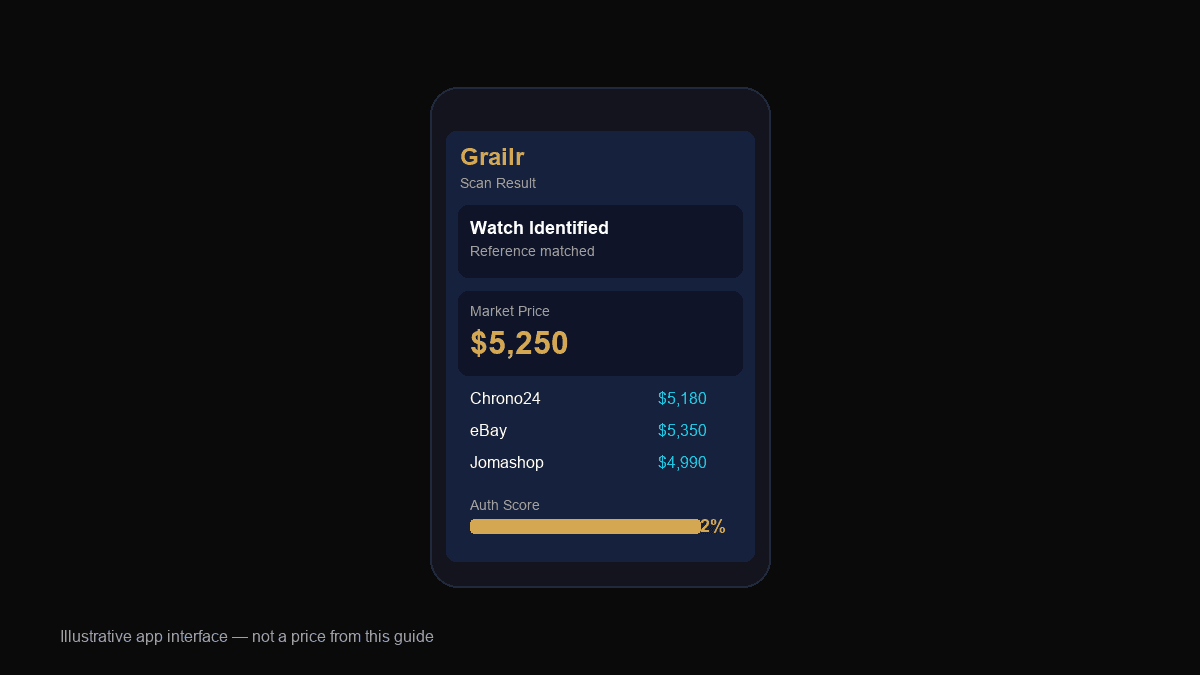
Grailr scans your watch photo and pulls live pricing from Chrono24, eBay, and Jomashop.
- AI identifies brand, model & reference number
- Live market prices from 3+ sources
- Authentication confidence score
Solid Gold Watches: The Flagship Tier
Solid 18k gold watches are where watchmaking meets fine jewellery. The entire case — and often the bracelet — is machined from solid gold, giving these watches a weight, warmth and lustre that no amount of plating can replicate. The intrinsic gold content provides a price floor that gold-plated watches simply do not have.
The Rolex Day-Date 40 (ref. 228238) is the definitive golden statement watch. The 40mm case in 18k yellow gold houses the Caliber 3255 with 70 hours of power reserve, and the President bracelet — with its distinctive semi-circular three-piece links — is a Rolex design that has been worn by world leaders since 1956. Retail pricing sits at approximately $43,000, while secondary-market examples trade between $38,000 and $48,000. For a reference-by-reference breakdown of every Day-Date, see our Rolex Day-Date guide.
The Patek Philippe Calatrava (ref. 6119R-001) represents the quieter end of solid gold luxury. The 39mm case in 18k rose gold houses the Caliber 30-255 PS with micro-rotor winding, keeping the profile slim at just 8.08mm. Pricing sits in the low-to-mid five figures retail, with pre-owned examples reflecting strong retention because Patek Philippe’s production volumes remain deliberately limited.
At the summit sits the Audemars Piguet Royal Oak Extra-Thin Jumbo (ref. 16202BA.OO.1240BA.02) in 18k yellow gold. The 39mm case is just 8.1mm thick, powered by Caliber 7121 with 55 hours of power reserve. Secondary-market examples start from approximately $75,000, reflecting both the brand’s prestige and the significant gold weight in the case and integrated bracelet.
The Vacheron Constantin Overseas Dual Time (ref. 7900V/000R-B336) in 18k rose gold offers a 41mm travel watch with two-time-zone functionality. The Caliber 5110 DT provides 60 hours of power reserve, and the interchangeable bracelet and strap system lets you switch between rose gold bracelet, leather and rubber without tools. Pricing sits in the mid five figures, positioning it between the Patek Calatrava and the AP Royal Oak.
Do Gold Watches Hold Value?
The resale story for gold watches splits sharply by tier. Gold-plated and PVD-coated watches retain almost no value because the gold content is negligible and the plating wears. Two-tone watches fare better, holding roughly 70 to 85% of retail depending on brand and condition. Solid gold watches from top brands carry a permanent metal-value floor and often outperform their steel counterparts on the secondary market.
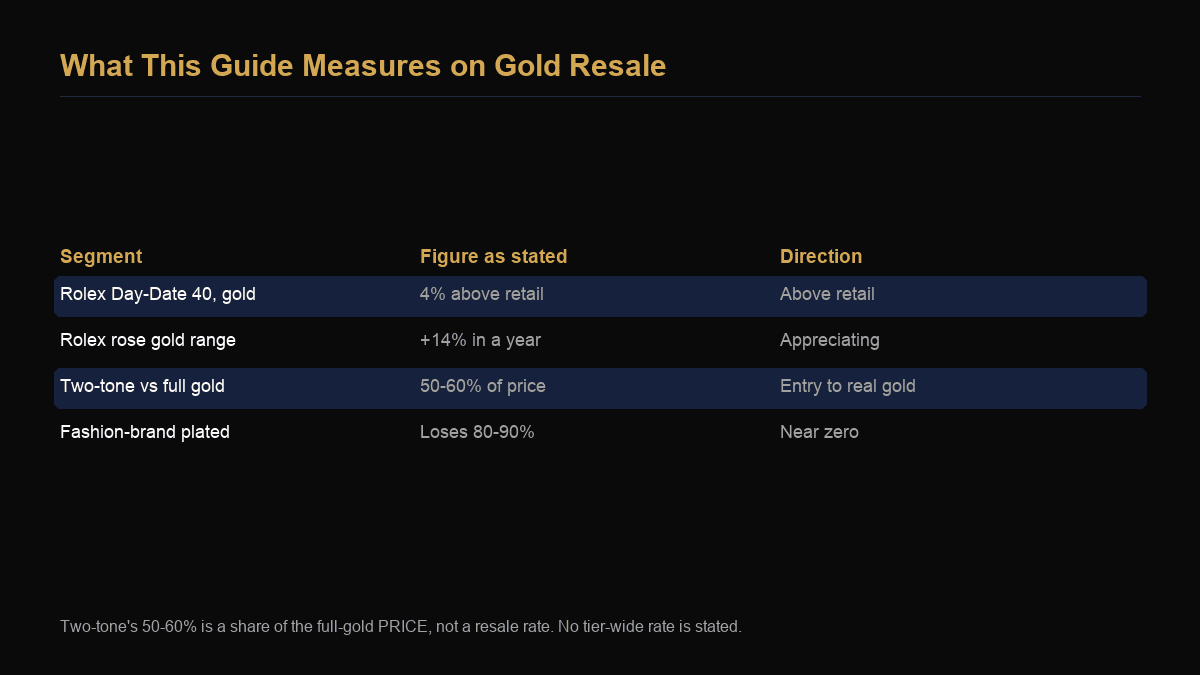
A yellow gold Rolex Day-Date 40 trades roughly 4% above retail on the secondary market, making it one of the few watches where you can potentially sell for more than you paid. Rose gold models across the Rolex range reportedly gained approximately 14% over the past year, driven partly by gold spot price increases and partly by shifting fashion preferences toward warmer metals.
The pre-owned solid gold market between $2,000 and $12,000 is a particularly compelling sweet spot. In this range you can find vintage solid gold Omega Seamasters, Rolex Date models, Cartier Tank references and Tudor Prince Date pieces. These watches have already taken their depreciation hit, carry meaningful gold content, and often appreciate as vintage collector interest grows. For more on pre-owned value dynamics across brands, see our gold watches for men guide.
One caveat: gold watches from fashion brands — Michael Kors, Fossil, MVMT — are typically gold-plated over base metal and lose 80 to 90% of their retail price at resale. The brand premium evaporates immediately, and the negligible gold content provides no floor. If resale matters to you, stick with horological brands that use real gold in meaningful quantities.
Buying Tips for Gold Watches
Verify the gold. The caseback should be stamped with a hallmark indicating gold purity: “750” or “18K” for 18-karat, “585” or “14K” for 14-karat. If you see “GP” (gold-plated), “GF” (gold-filled) or “PVD” anywhere, the watch is not solid gold. When buying pre-owned, ask for documentation and verify the hallmarks yourself.
Factor in weight. Solid gold watches are noticeably heavier than their steel equivalents. A gold Rolex Day-Date on a President bracelet weighs around 150 grams, compared to roughly 135 grams for a steel Datejust. Some wearers love the heft; others find it fatiguing over long days. Try the watch on before committing, or at minimum check the listed weight against watches you already own.
Consider scratching. Gold is softer than stainless steel, so solid gold cases and bracelets accumulate scratches faster. This is normal and expected — many collectors consider a lightly patinated gold watch more characterful than a pristine one — but it surprises first-time gold-watch buyers. Professional polishing can remove light scratches, though each polish removes a tiny amount of gold, so limit it to once every few years.
Buy pre-owned for the best value. The steepest depreciation on luxury gold watches happens in the first two to three years. A pre-owned Cartier Tank Louis or Omega Seamaster in gold can save you 20 to 35% versus retail while delivering the same gold content, movement and wearing experience. Authorised pre-owned programmes from Rolex, Cartier and Omega offer factory-serviced pieces with brand warranties, providing additional peace of mind. For dress-watch alternatives and deeper value analysis, see our best dress watches guide.
Match gold to skin tone. Yellow gold tends to complement warmer skin tones, while rose gold works across a wider range. White gold suits cooler undertones but, as noted earlier, requires periodic rhodium re-plating. Two-tone pieces are the most versatile because the steel component anchors the design in neutral territory.
Frequently Asked Questions
Is a gold-plated watch worth buying?
Gold-plated and PVD-coated watches deliver the look of gold from $25 to $1,000. The plating wears over time — typically two to five years with daily wear — and resale value is minimal. But for style on a budget, they are a practical and enjoyable choice. The Casio A168WG, Orient Bambino and Tissot PRX gold PVD are all excellent options that punch above their price.
How much does a solid gold watch cost?
Entry-level solid 18k gold watches start around $10,000 for a Cartier Tank Louis. Mid-range options like the Omega Seamaster in Sedna gold sit between $15,000 and $25,000. Flagship solid gold watches from Rolex, Audemars Piguet and Patek Philippe range from $30,000 to well over $100,000. The gold content alone in a typical 40mm case represents $3,000 to $5,000 in raw metal value.
What is the difference between yellow gold, rose gold and white gold?
All three are 18k (75% pure gold). Yellow gold is alloyed with silver and copper for the classic warm tone. Rose gold adds more copper for a pinkish hue. White gold mixes gold with palladium or nickel and is rhodium-plated to appear silver. Yellow gold has the strongest secondary-market demand, rose gold is appreciating fastest, and white gold offers precious-metal subtlety.
Do gold watches hold their value?
Solid gold watches from top brands hold value well because they carry intrinsic metal value plus brand demand. A Rolex Day-Date in yellow gold trades roughly 4% above retail. Rose gold Rolex models gained around 14% over the past year. Gold-plated watches, by contrast, retain almost no resale value because the gold content is negligible.
Is two-tone a good compromise?
Two-tone watches combine steel and gold for roughly 50 to 60 percent of the price of a full-gold equivalent. They deliver the visual warmth of gold with greater durability on the steel portions. The Rolex Datejust two-tone and Tudor Black Bay S&G are two of the most popular options, and two-tone pieces tend to sell faster on the pre-owned market because the entry price is lower.
What is the cheapest gold watch worth owning?
The Casio A168WG at $25 to $30 is the most affordable gold-tone watch that delivers reliable daily wear. For a mechanical option, the Orient Bambino in gold-tone starts near $150. Both use gold-coloured plating rather than solid gold, but they offer genuine style and build quality that punches well above their price.
Related Articles
The Bottom Line
A golden watch can cost $25 or $75,000. The question is not whether gold looks good on the wrist — it does — but which type of gold makes sense for your budget, your lifestyle and your expectations about resale. Gold-plated watches are disposable luxury: enjoy them, but do not expect to get your money back. Two-tone watches are the pragmatic sweet spot, combining real gold with steel durability at 50 to 60% of a full-gold price. And solid gold watches from established maisons carry intrinsic value that outlasts fashion trends, economic cycles and even the brands themselves.
If you’re buying your first golden watch, start with a two-tone model from Tudor, Cartier or Rolex. If you already own one and want to step up, the pre-owned solid gold market between $2,000 and $12,000 is where the best value lives today. And whatever you buy, verify the gold content, check the hallmarks, and confirm the price against live market data before you commit.
Know What Your Watch Is Worth
Upload a photo and Grailr pulls live pricing from multiple sources — including gold-specific models — so you know the real market value before you buy or sell.
Scan Your Watch