Rolex Day-Date Guide: Every Reference and Price
The definitive reference to every Day-Date generation — from the vintage 1803 to today’s 228238, with real pricing data and buying advice.
Price context: this guide includes indicative prices from its original publication period. They have not all been refreshed to current quotes. Use the linked primary sources for specifications and policies, and verify prices independently.
- The Day-Date has never been made in stainless steel — every reference is 18k gold or 950 platinum
- Current MSRP starts at ~$43,700 (36mm yellow gold) and reaches ~$73,550 (40mm platinum)
- Pre-owned vintage 1803 references trade from $8,500, making the Day-Date more accessible than many assume
- A fully-linked 18k gold Day-Date contains roughly 114 grams of gold, setting a natural price floor
What Makes the Day-Date Special
Introduced in 1956, the Rolex Day-Date was the first wristwatch to display both the day of the week spelled out in full and the date in a single window. That innovation alone would have earned it a place in horological history. But Rolex went further: the Day-Date was released exclusively in 18k gold or platinum, fitted with a new semi-circular three-piece link bracelet that would become known as the President bracelet after Rolex presented one to U.S. President Dwight D. Eisenhower.
More than six decades later, the formula has not changed. The Day-Date remains the only Rolex that has never been offered in stainless steel. Every single reference — from the original 6511 to the current 228238 — has been produced exclusively in precious metal. This is not a marketing decision that could be reversed next year; it is the defining characteristic of the model. When you see a Day-Date on someone’s wrist, you know without checking that it is solid gold or platinum.
The day display is another distinguishing feature. While the Datejust shows only the date, the Day-Date spells out the full day name — MONDAY, TUESDAY, and so on — through a window at 12 o’clock. Rolex offers the day wheel in 26 languages. Combined with the date at 3 o’clock and the signature Cyclops magnifying lens, the dial carries more information than any other Rolex dress watch.
The Day-Date’s reputation as “The President’s Watch” extends well beyond Eisenhower. It has been worn by Lyndon B. Johnson, Warren Buffett, and dozens of world leaders, entertainers and business figures. That association is not manufactured — it reflects the watch’s position at the top of the Rolex hierarchy, above even the Submariner and Daytona in terms of material value and dressy presence.
Current Day-Date References and Prices
Rolex currently produces the Day-Date in two case sizes — 36mm and 40mm — across three gold alloys and platinum. Every current reference runs the Caliber 3255, which delivers a 70-hour power reserve and Rolex’s Superlative Chronometer certification of ±2 seconds per day. The Chronergy escapement and Parachrom hairspring make it one of the most accurate mechanical movements in production.
The table below covers the core references with indicative 2026 retail pricing. Exotic dials, gem-set bezels, and special-order configurations can push prices significantly higher. Platinum is exclusive to the 40mm case.
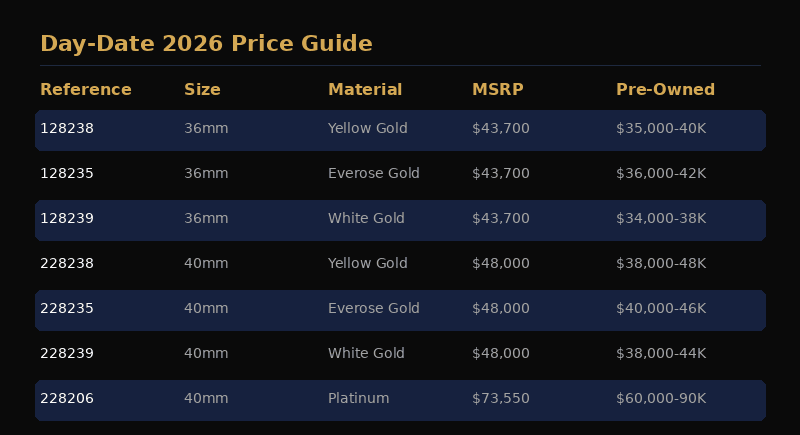
| Reference | Size | Metal | MSRP (approx.) | Pre-Owned Range |
|---|---|---|---|---|
| 128238 | 36mm | Yellow Gold | ~$43,700 | $34,000–$40,000 |
| 128235 | 36mm | Everose Gold | ~$43,700 | $35,000–$41,000 |
| 128239 | 36mm | White Gold | ~$46,500 | $36,000–$43,000 |
| 228238 | 40mm | Yellow Gold | ~$48,000 | $38,000–$48,000 |
| 228235 | 40mm | Everose Gold | ~$48,000 | $39,000–$48,000 |
| 228239 | 40mm | White Gold | ~$51,000 | $40,000–$50,000 |
| 228206 | 40mm | Platinum | ~$73,550 | $60,000–$90,000+ |
Prices are indicative editorial figures based on publicly visible listings in mid-2026. Asking prices are not completed-sale prices. Confirm the exact reference, dial, condition and current quote before buying.
Day-Date 36 vs Day-Date 40: Which Size to Choose
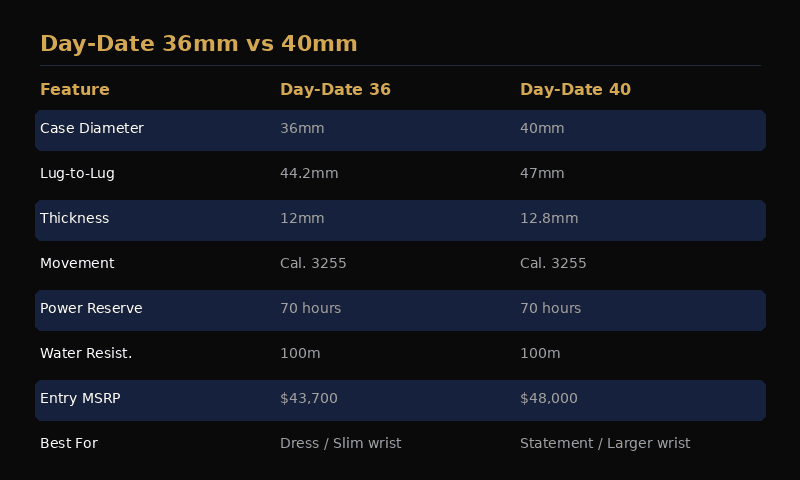
The Day-Date 36 is the traditional size — the one worn by Eisenhower, Johnson and every vintage reference from 1956 through 2008. For most of the watch’s history, 36mm was considered a standard men’s size, and on the wrist it still looks refined and proportionate. If you have a wrist circumference under 17cm (6.7 inches), the 36mm will sit more elegantly than the 40mm, and many collectors prefer its classic presence regardless of wrist size.
The Day-Date 40 (originally the Day-Date II at 41mm, downsized to 40mm in 2015) suits modern sizing preferences. It wears larger than a 40mm Oyster Perpetual because the gold case and President bracelet add visual weight. The 40mm also opens up the platinum option — the 228206 with its exclusive ice blue dial is only available in this size.
From a mechanical standpoint, both sizes are identical. The Caliber 3255 fits both cases, delivering the same 70-hour power reserve and ±2 sec/day accuracy. The price gap is meaningful, though: the 40mm yellow gold (228238) starts roughly $4,300 above the 36mm equivalent (128238). That premium reflects the additional gold content — a larger case and broader bracelet links mean more 18k material.
The practical advice: try both on. A Day-Date in solid gold sits differently from a steel sports watch of the same diameter. The weight of precious metal changes how the watch falls on the wrist, and the President bracelet’s slim profile gives a different drape than an Oyster or Jubilee. Most authorised dealers keep both sizes in stock for comparison.
Check Any Watch Price in Seconds
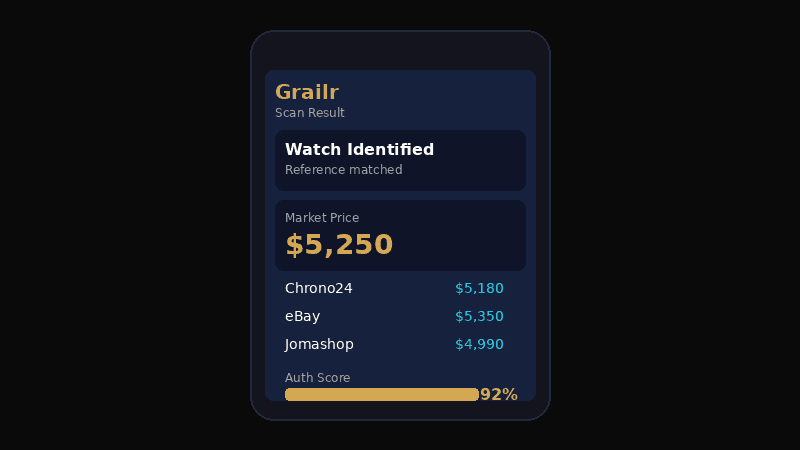
Grailr scans your watch photo and pulls live pricing from Chrono24, eBay, and Jomashop.
- AI identifies brand, model & reference number
- Live market prices from 3+ sources
- Authentication confidence score
Pre-Owned Day-Date Pricing by Era
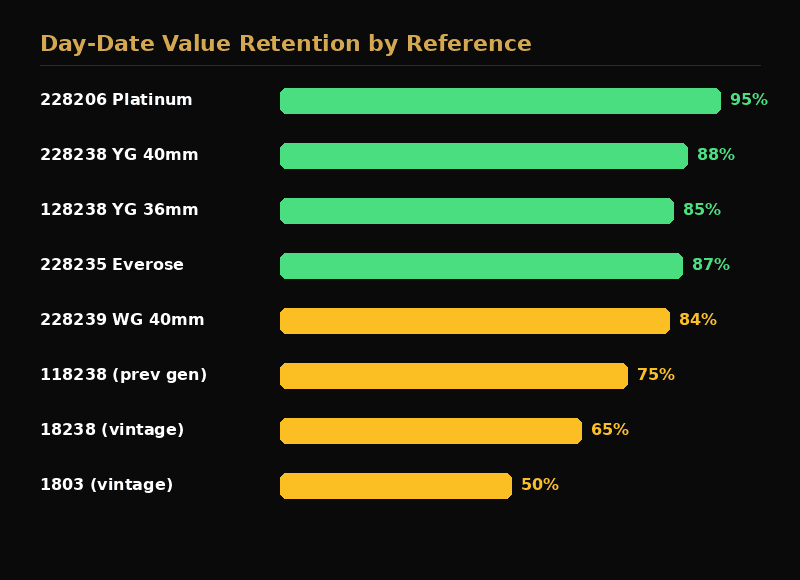
One of the Day-Date’s overlooked advantages is accessibility on the pre-owned market. While a new 228238 costs $48,000, a vintage Day-Date with genuine Rolex provenance can be had for well under $15,000. The gold content provides a natural price floor — roughly 114 grams of 18k gold in a fully-linked President bracelet model — but older references trade at surprisingly approachable levels given what you’re getting: a solid gold Rolex with the same day-and-date complication as a current model.
Ref. 1803 (1959–1977): $8,500–$12,000
The 1803 is the classic acrylic-crystal Day-Date with a pie-pan dial and Caliber 1555 or 1556 movement. It wears true to its 36mm size and sits remarkably thin on the wrist. The acrylic crystal and older-style President bracelet give it a warmth that modern references can’t replicate. Watch for stretched bracelet links and refinished dials — a clean, original-dial 1803 commands a premium. At $8,500–$12,000 for a yellow gold example, this is the most affordable route into Day-Date ownership and one of the best-value vintage Rolex purchases available.
Ref. 18238 (1988–2000): $16,000–$22,000
The double-quick-set era. The 18238 introduced a sapphire crystal and the Caliber 3155 with independent hour-hand adjustment, making time-zone changes practical. Build quality took a meaningful step forward with heavier case construction and improved bracelet tolerances. This generation also saw some of the most collectible Day-Date dials ever produced, including wood, stone and meteorite options. Expect to pay $16,000–$22,000 for a yellow gold 18238 in good condition with box and papers.
Ref. 118238 (2000–2015): $22,000–$28,000
Rolex’s “super case” generation. The 118238 retained the 36mm diameter but thickened the case and lugs, giving the watch a more substantial modern feel. It runs the Caliber 3155, the same movement as the outgoing 18238 but with a Paraflex shock absorber. The heavy solid end-links on the President bracelet eliminate any rattle. The 118238 hits a sweet spot for buyers who want modern build quality without paying current retail — at $22,000–$28,000, it’s a well-finished watch with plenty of life remaining before a major service is needed.
Ref. 228238 (2015–present): $38,000–$48,000
The current 40mm Day-Date with Caliber 3255. Pre-owned examples from 2015–2023 trade at $38,000–$48,000 depending on dial configuration, condition, and whether box and papers are included. The most popular configuration — champagne dial with fluted bezel on President bracelet — typically sits near the middle of that range. The platinum 228206 commands $60,000–$90,000 or more on the secondary market, with the ice blue dial versions reaching the upper end. If you can source a gently used 228238 for $38,000–$40,000, you’re getting current-generation build quality at a meaningful discount to the $48,000 retail price. Always authenticate before buying pre-owned.
The Most Iconic Day-Date Dials
No other Rolex model offers the dial variety of the Day-Date. Over six decades, Rolex has fitted the Day-Date with lacquer, sunburst, stone, wood, meteorite, mother-of-pearl, and gem-set dials in dozens of colour combinations. A handful have become genuinely iconic.
Ice Blue (Platinum Exclusive)
The ice blue dial is available only on platinum Day-Date references — Rolex has never offered it on gold or any other model. Its pale, glacial tone changes character in different light, ranging from silver-blue to almost white. The 228206 with smooth bezel, ice blue diagonal motif dial and day-date display in matching ice blue is arguably the most desirable non-gem-set Day-Date configuration in current production. Its exclusivity to platinum makes it an instant identifier: if the dial is ice blue, the case is platinum.
Wimbledon (Olive Green with Roman Numerals)
Named by collectors for its association with the tennis championships, the Wimbledon dial features an olive-green sunburst finish with oversized Roman numeral hour markers in contrasting metal. Originally offered on the Datejust, the Wimbledon dial found a natural home on the Day-Date 40 in Everose gold (228235). The olive-green-on-pink-gold combination is one of the most visually striking modern Rolex configurations. Pre-owned examples with the Wimbledon dial typically command a modest premium over standard champagne or silver dials.
Champagne with Fluted Bezel
The “classic” Day-Date. A champagne sunburst dial in yellow gold with stick indices and a fluted bezel on President bracelet is the configuration most people picture when they hear the words “Rolex President.” It has been in continuous production in some form since 1956. While not as headline-grabbing as the ice blue or Wimbledon, it remains the best-selling Day-Date configuration and offers the purest expression of the model’s heritage.
Exotic Stone and Wood Dials
Rolex has periodically offered the Day-Date with dials cut from lapis lazuli, malachite, bloodstone, rubellite, tiger’s eye, meteorite and various woods including burl walnut and mahogany. These limited-run dials — particularly from the 18038 and 18238 generations — have become highly collectible on the secondary market. A clean stone-dial 18238 can command $30,000–$50,000, well above the standard-dial range. Because each stone slab is unique, no two dials are identical.
Day-Date Alternatives: Tudor Prince Date-Day
If the Day-Date’s precious-metal pricing puts it out of reach, Tudor — Rolex’s sister brand — has historically offered a more affordable day-date complication. The Tudor Prince Date-Day (also sold as the Prince Oysterdate) featured a similar day-of-week window at 12 o’clock and a date window at 3, housed in a stainless steel case on a bracelet that echoed the President’s semi-circular link design.
Tudor discontinued the Prince Date-Day line, and current Tudor models do not include a day-date complication. However, vintage Tudor Prince Date-Day references trade between $800 and $2,500 on the secondary market, depending on condition and dial variant. They offer the day-date functionality in a robust package at a fraction of the Rolex Day-Date’s cost.
The trade-offs are clear: Tudor cases are stainless steel rather than precious metal, the movements lack Rolex’s in-house caliber refinement, and the finishing is a step below. But if you want the day-and-date complication with Rolex-family DNA and you’re working with a budget under $3,000, a vintage Tudor Prince Date-Day is worth considering.
Beyond Tudor, other alternatives in the day-date complication space include the Omega Day-Date (part of the Seamaster and De Ville lines), the Grand Seiko SBGT241, and the Longines Master Collection Day-Date. None carry the Day-Date’s precious-metal exclusivity or “President” cachet, but they offer the same functionality at accessible price points. For a broader view of watches that retain value over time, see our dedicated guide.
Frequently Asked Questions
Has the Rolex Day-Date ever been made in stainless steel?
No. In over sixty years of production the Day-Date has never been offered in stainless steel. Every reference uses 18k yellow gold, 18k white gold, 18k Everose gold, or 950 platinum. This precious-metal exclusivity is central to the model's identity.
Why is the Rolex Day-Date called 'The President'?
The semi-circular three-piece link bracelet fitted to the Day-Date became known as the President bracelet after Rolex presented an 18k gold Day-Date to U.S. President Dwight D. Eisenhower in 1956. The nickname stuck, and the watch has been associated with heads of state ever since.
What is the cheapest Rolex Day-Date you can buy?
New, the most affordable Day-Date is the 36mm in 18k yellow gold (ref. 128238) at around $43,700 MSRP. Pre-owned, vintage references like the 1803 from the 1960s-1970s can be found for $8,500-$12,000 depending on condition and dial.
Is the Rolex Day-Date a good investment?
The Day-Date holds value well relative to its retail price, partly because its gold content sets a price floor. A fully-linked 18k gold Day-Date contains roughly 114 grams of gold. Vintage references like the 18238 and 118238 have appreciated steadily. However, buying any watch purely as an investment carries risk — verify current market pricing before committing.
What is the difference between Day-Date 36 and Day-Date 40?
The Day-Date 36 (128238/128235/128239) uses a 36mm case, while the Day-Date 40 (228238/228235/228239/228206) uses a 40mm case. Both run the Caliber 3255 with a 70-hour power reserve. The 40mm is available in yellow gold, Everose gold, white gold, and platinum, while the 36mm skips platinum. The 40mm starts about $4,300 higher at retail.
What makes the ice blue dial special?
The ice blue dial is exclusive to platinum Day-Date references. Rolex does not offer this dial colour on any other metal or any other model. Its pale, glacial tone is instantly recognisable and has become one of the most sought-after configurations in the entire Rolex catalogue.
Related Articles
The Bottom Line
The Day-Date is not an entry-level Rolex — it never pretended to be. It sits at the summit of the Rolex catalogue, defined by six decades of precious-metal exclusivity and an association with power that no marketing campaign could manufacture. But “expensive” is relative: a vintage 1803 at $9,000 costs less than a new steel Submariner, and delivers something no steel Rolex can — a solid gold case, the President bracelet, and a day-of-week complication in a watch with genuine historical provenance. Whether you’re considering a new 228238 at retail or a thirty-year-old 18238 at half the price, the Day-Date rewards careful research. Know the references, understand the pricing tiers, authenticate before buying, and pick the configuration that speaks to you.
Considering a Day-Date?
Grailr uses a photo to suggest a watch identity and an indicative price estimate, with active eBay listings where available. Check the exact reference and condition independently; a photo scan cannot authenticate a watch.
Scan a Watch NowSources and price context
- Rolex Day-Date collection page — Official specifications, case dimensions, movement data and available configurations for all current Day-Date references.
- Rolex Day-Date 40 ref. 228238 specifications — Lists Caliber 3255, 70-hour power reserve, and 18k yellow gold case details for this specific reference.
- Rolex Certified Pre-Owned process — Explains physical authentication, servicing and the two-year programme guarantee for pre-owned Rolex purchases.
These primary sources support the specific specification and policy points noted above. Prices and pre-owned ranges elsewhere in this guide are indicative editorial figures, not a verified transaction dataset or guaranteed returns. Confirm the exact reference, region, condition and current quote before buying; asking prices are not completed-sale prices.