Grey Market vs Authorized Dealer: What You Give Up
Grey market watches are genuine, brand-new, and often 20–30% cheaper — but you trade away the manufacturer warranty, the AD relationship, and sometimes your resale upside. Here is what that trade-off actually costs.
Price context: this guide includes indicative prices from its original publication period. They have not all been refreshed to current quotes. Use the linked primary sources for specifications and policies, and verify prices independently.
- Grey market watches save 20–35% on Omega, Breitling and TAG Heuer, but high-demand Rolex and Patek models trade above retail
- You lose the manufacturer warranty; reputable grey dealers substitute a 2–5 year in-house guarantee
- Every major Swiss brand will still service a grey market watch for a standard fee
- Missing AD papers reduce resale value by roughly 5–15%, more for Patek Philippe
What Is the Grey Market, Exactly?
The grey market is any sale of a genuine, brand-new watch outside the brand’s official distribution network. An authorized dealer (AD) buys from the manufacturer, sells to you, and stamps your warranty card. A grey market dealer acquires that same watch through a parallel channel — unsold AD inventory, overstock, international redistribution — and passes it along, usually at a discount, without the brand’s warranty stamp.
Grey market is not the same as counterfeit. The watches are authentic, factory-sealed and mechanically identical to what the boutique sells. Chrono24, Jomashop, WatchMaxx, Prestigetime and dozens of other well-known platforms operate in this space. What you give up is the after-sale relationship with the brand — and depending on the brand and model, that trade-off ranges from a bargain to a mistake.
The term “grey” can also cover watches sold between regions — for example, a European-market watch sold to a US buyer. This practice is legal in most jurisdictions but may affect warranty portability and, in the US, now attracts a 15% tariff on Swiss imports that the buyer ultimately absorbs.
How Much You Actually Save (and Where You Don’t)
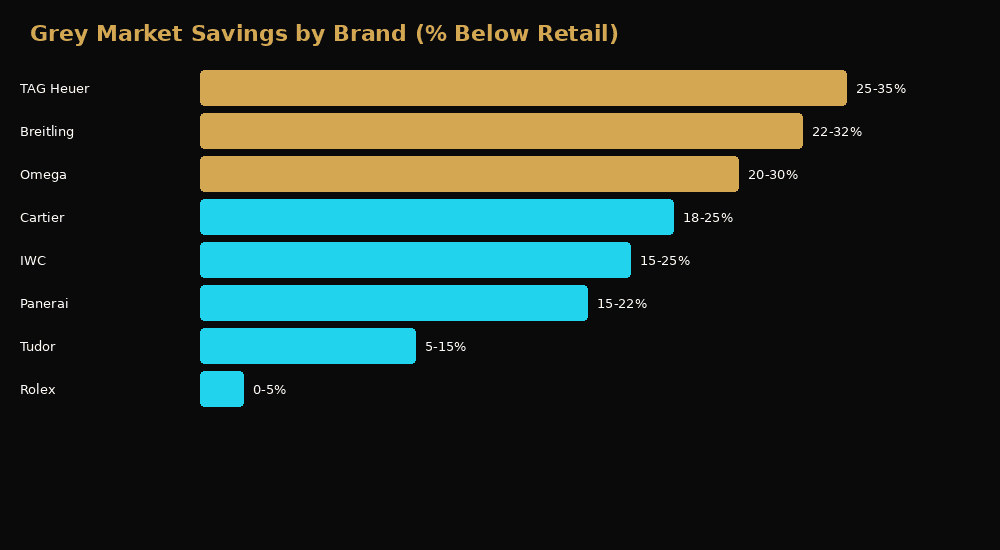
The common pitch is “20–30% off retail.” That is accurate for brands like Omega, Breitling and TAG Heuer, whose production comfortably outpaces demand. For Rolex, Patek Philippe and Audemars Piguet, the picture reverses entirely — you pay a premium on the grey market because the watches are allocation-restricted at ADs.
| Brand | Example Model | MSRP | Grey Market | Difference |
|---|---|---|---|---|
| Omega | Speedmaster Moonwatch | $7,000 | $4,800 | −31% |
| Breitling | AVI Ref. 765 Re-Edition | $9,800 | $6,900 | −30% |
| TAG Heuer | Carrera Chronograph | $6,870 | $5,450 | −21% |
| Cartier | Santos Medium Steel | $7,850 | $6,700 | −15% |
| Rolex | Submariner 126610LN | $11,350 | $15,700 | +38% |
| Rolex | GMT-Master II Batman | $11,800 | $19,000 | +61% |
Prices are indicative mid-2026 grey market asking prices, not completed transactions. Verify independently before buying.
The pattern is clear: if a brand makes more watches than its dealer network can sell, grey market dealers offer real savings. If demand outstrips supply, the grey market becomes a markup machine. Before you decide where to buy, check indicative pricing for the exact reference you want.
The Warranty Trade-Off
This is the single biggest difference. An authorized dealer activates the manufacturer’s warranty at point of sale — Rolex gives you five years, Omega five years, Patek Philippe two years. Under that warranty, mechanical defects are repaired at no charge, and the brand registers the serial number to you.
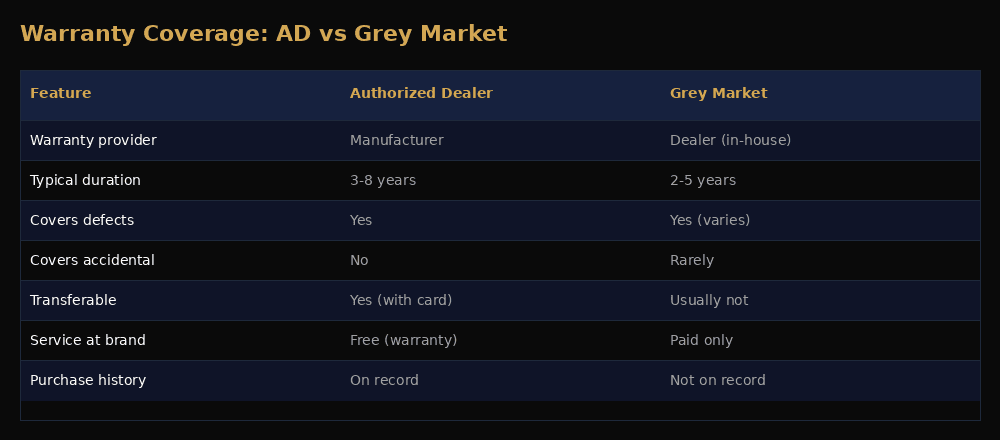
A grey market purchase skips that activation. The watch arrives with an unstamped (or foreign-stamped) warranty card, and the manufacturer will not honour free repairs. What you get instead depends on the grey market dealer:
| Feature | Authorized Dealer | Grey Market Dealer |
|---|---|---|
| Warranty type | Manufacturer (brand-backed) | In-house dealer warranty |
| Duration | 2–5 years (varies by brand) | 1–5 years (varies by dealer) |
| Global coverage | Yes — any brand service centre | Usually limited to the selling dealer |
| Serial registration | Registered to you with the brand | Not registered |
| Paid service after warranty | Available from brand or independent | Same — brands service any authentic watch |
| Resale documentation | Stamped card, receipt, full set | Box present; card usually blank or foreign |
The practical risk of losing the manufacturer warranty is modest for a brand-new watch. Modern Swiss movements rarely fail within the first two years, and when they do, the dealer’s in-house warranty covers the repair. The real cost shows up later — at resale, when a missing warranty card lowers the value by 5–15%.
Brand-by-Brand: Where the Grey Market Makes Sense
Omega, Breitling, TAG Heuer
These brands produce at scale and distribute generously. Grey market savings of 20–35% are routine and stable. An Omega Speedmaster Professional at $4,800 instead of $7,000 is a legitimate saving of $2,200 — more than enough to cover a future paid service. For these brands, buying grey market is the most common advice in collector communities, and for good reason.
Cartier
Cartier occupies a middle ground. Steel models like the Santos and Tank trade 10–20% below retail on the grey market. However, Cartier’s brand cachet means the resale penalty for missing papers is steeper than for Omega or TAG — particularly on precious-metal models. For steel Cartier, the grey market is a decent bet. For gold, think twice.
Rolex
Rolex is the outlier. Almost every steel professional model trades above retail on the grey market in 2026. A Submariner that lists for $11,350 at the AD costs $15,700 from a grey dealer. A GMT-Master II “Batman” trades at a 61% premium. Rolex also implemented a 7% MSRP increase in January 2026 and may raise prices again.
For Rolex, the grey market is not a discount channel — it is a premium channel for people who cannot get the watch at an AD. The only way to buy a popular Rolex at retail is through an authorized dealer relationship, which comes with its own costs in time and purchase history.
Patek Philippe & Audemars Piguet
Similar to Rolex. The Nautilus 5811 and Royal Oak Jumbo trade at multiples of retail. Even less hyped references like the Patek Calatrava trade at a modest premium or at par. For these brands, the only “discount” on the grey market is a pre-owned watch — which is a different conversation entirely. If you want a new Patek or AP at list price, the AD is the only path.
Check Any Watch Price in Seconds
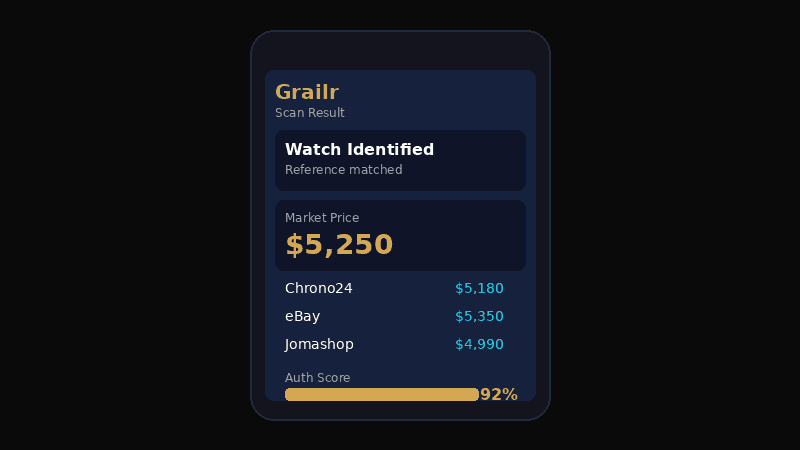
Grailr scans your watch photo and pulls live pricing from Chrono24, eBay, and Jomashop.
- AI identifies brand, model & reference number
- Live market prices from 3+ sources
- Authentication confidence score
The Service Question: Will the Brand Still Work on It?
Yes. Every major Swiss manufacturer — Rolex, Omega, Patek Philippe, Cartier, Breitling, TAG Heuer — will perform paid servicing on any authentic watch regardless of where it was purchased. You bring it in, they quote a service price, and they do the work. The watch’s provenance does not matter for paid service.
The distinction is free service. Under the manufacturer warranty, a defect is repaired at no charge. Without that warranty, you pay. A basic Rolex service runs $800–$1,000. An Omega service is $500–$800. Over a five-year ownership period, you might need one service — so the question becomes whether your grey market discount exceeds the cost of one paid service. For Omega (saving $2,200, service $600), the maths are clear. For a TAG Heuer Carrera (saving $1,400, service $500), still positive. For Rolex (paying a $4,000 premium), there is nothing to recoup.
Independent watchmakers offer another option. A qualified independent will service most standard Swiss movements for 30–50% less than the brand’s official service centre. Many collectors prefer this route regardless of whether the watch came from an AD, as the turnaround is usually faster and the cost lower.
The Resale Impact
A watch with full AD documentation — stamped warranty card, original receipt, box, and any tags — commands a measurable premium on the secondary market. The premium depends on the brand:
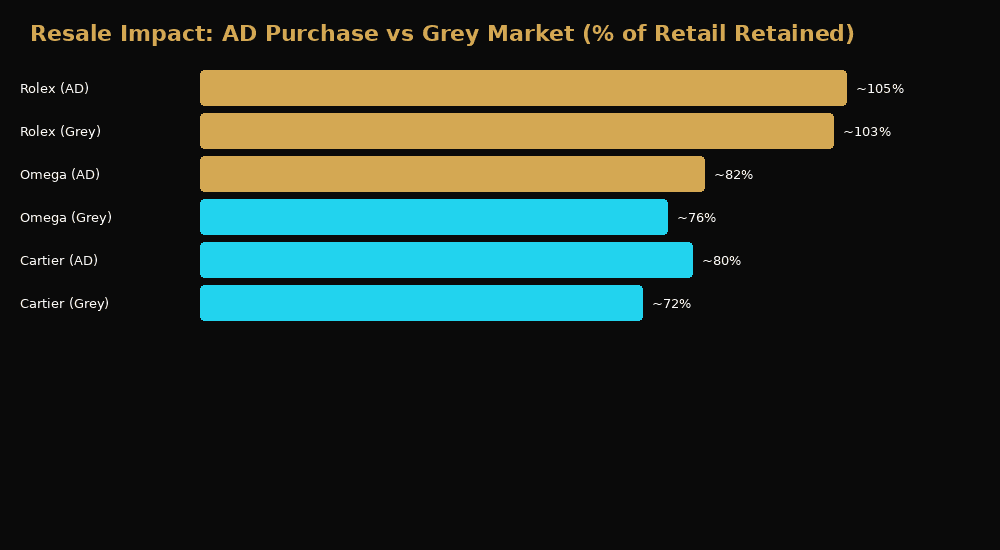
- Rolex: 5–10% premium for full set over “watch only”
- Omega: 5–8% — less pronounced because Omega is more available
- Patek Philippe: 10–15% or more — Patek documentation is the single largest resale multiplier
- Cartier: 8–12% for precious-metal models; less for steel
For watches you plan to own long-term, the resale penalty is academic — you bought it to wear, not to flip. But if you treat a watch purchase as partially recoverable, factor the missing-papers discount into your total cost of ownership. A grey market Omega Speedmaster at $4,800 without full papers might resell at $3,800 instead of $4,100 — a $300 haircut on top of the savings you already captured.
The AD Relationship: What You’re Really Paying For
For Rolex, Patek Philippe and Audemars Piguet, the AD is not just a store — it is a gatekeeper. These brands allocate limited steel sport watches to their best customers, and “best” usually means a documented purchase history. Buying a Datejust or Calatrava at full retail is, in part, an investment in future access to a Submariner, Nautilus or Royal Oak.
That dynamic makes the “grey vs AD” question about more than a single transaction. If you buy an Omega Seamaster on the grey market and save $2,000, nobody cares — Omega does not restrict allocation the same way. But if you buy a Rolex Datejust on the grey market instead of from your local AD, you may lose your place in line for a GMT-Master or Submariner.
This is a real cost with a real dollar value — a Rolex waiting-list strategy can take years and multiple purchases before an allocation arrives. Whether that cost is worth it depends entirely on whether you want the allocated model. If you just want a Datejust and nothing else, the grey market is fine.
How to Buy Safely on the Grey Market
1. Choose an established dealer
Look for dealers with years of transaction history, verified reviews, and a physical address. Jomashop, Prestigetime, AuthenticWatches, Chrono24’s Trusted Dealer programme, and WatchMaxx all have established track records.
2. Confirm the in-house warranty terms
Read the warranty document before purchasing. Understand what is covered, what is excluded, and how to file a claim. A five-year in-house warranty with clear terms is a good sign; a vague “satisfaction guarantee” is not.
3. Get the watch authenticated
Even from a reputable source, have the watch inspected. Grailr’s authentication tool can help you check visual consistency. For watches over $5,000, a physical inspection by a qualified watchmaker is worth the $50–$150 fee.
4. Pay by credit card
Credit card chargebacks are your last line of defence. Wire transfers and cryptocurrency are irreversible. If a dealer insists on wire-only payment, walk away.
5. Document everything
Photograph the watch and all included materials on arrival. Keep the shipping label, invoice, and warranty card. This documentation matters for insurance, resale, and any future dispute.
When to Buy Grey — and When to Walk into an AD
Buy Grey Market When…
- The brand has no allocation restrictions (Omega, Breitling, TAG Heuer)
- The saving exceeds one future paid service
- You plan to wear the watch long-term, not flip it
- You have no interest in the AD allocation system
Buy From an AD When…
- You want a Rolex, Patek or AP at retail price
- Building purchase history for a future allocation
- You want full documentation for maximum resale
- The watch is a gift and presentation matters
Frequently Asked Questions
Is buying a grey market watch safe?
Yes, if you buy from a reputable dealer. Grey market watches are genuine, brand-new timepieces sold outside the authorized distribution network. The watch itself is identical to what an AD sells; the difference is the warranty and purchase experience.
Do grey market watches come with a warranty?
Not a manufacturer warranty. Most reputable grey market dealers offer their own in-house warranty, typically 2–5 years, covering mechanical defects. The manufacturer will still service the watch for a fee, but you lose free warranty repairs.
How much cheaper are grey market watches?
Savings vary wildly by brand and model. Omega, Breitling and TAG Heuer regularly trade 20–35% below retail. Cartier saves 10–20%. However, high-demand Rolex and Patek Philippe models trade above retail on the grey market, so there is no discount at all.
Will Rolex service a grey market watch?
Yes. Rolex, Omega, and most Swiss manufacturers will perform paid servicing on any authentic watch regardless of where it was purchased. You simply will not receive free warranty service.
Does buying grey market affect resale value?
It can. A watch with full AD papers, box, and stamped warranty card commands a 5–15% premium on the secondary market over an identical watch without them. For brands like Patek Philippe, the premium for complete documentation is even higher.
Related Articles
The Bottom Line
The grey market is a genuine money-saver for brands that produce at scale — Omega, Breitling, TAG Heuer, and mid-range Cartier. For these watches, the manufacturer warranty is a nice-to-have, not a need-to-have, and the 20–35% discount more than covers future servicing costs. But for Rolex, Patek Philippe and Audemars Piguet, the grey market is a premium channel, not a discount one. Know which category your target watch falls into before you decide where to buy.
Not Sure What a Watch Should Cost?
Grailr uses a photo to suggest a watch identity and an indicative price estimate, with active eBay listings where available. Check the exact reference and condition independently; a photo scan cannot authenticate a watch.
Scan a Watch NowSources and price context
- Chrono24 Magazine: What is the grey market? — Industry overview of how grey market distribution works and warranty implications.
- Rolex Certified Pre-Owned process — Official Rolex authentication and guarantee programme for pre-owned watches.
These primary sources support the specific policy points noted above. Prices and savings percentages elsewhere in this guide are indicative editorial figures, not a verified transaction dataset. Confirm the exact reference, region, condition and current quote before buying; asking prices are not completed-sale prices.