Junghans Max Bill Buying Guide: Every Model Compared
The 34mm hand-wind, 38mm automatic, 40mm Chronoscope and radio-controlled Mega — with Bauhaus history, real specs and honest pricing.
Price context: this guide includes indicative prices from its original publication period. They have not all been refreshed to current quotes. Use the linked primary sources for specifications and policies, and verify prices independently.
- The Max Bill line spans four sub-collections: hand-wind ($800), automatic ($1,100), Chronoscope ($2,500) and radio-controlled Mega ($1,200)
- Designed by Swiss architect Max Bill in 1961 for Junghans, the watch is one of the purest expressions of Bauhaus design still in production
- The signature domed plexiglass crystal is a deliberate design choice — not a cost cut — and defines the watch’s character
- Used automatics trade between $600 and $1,000, making the Max Bill one of the best-value entry points into German watchmaking
From the Bauhaus to Your Wrist
The Junghans Max Bill is not named after a marketing concept. It is named after a real person — Max Bill (1908–1994), a Swiss architect, painter, sculptor and industrial designer who studied at the Bauhaus school in Dessau under masters including Wassily Kandinsky and Paul Klee starting in 1925. Bill went on to co-found the Ulm School of Design, the institution many historians consider the successor to the Bauhaus itself.
In 1956, Junghans — founded in 1861 and based in Schramberg in Germany’s Black Forest — commissioned Bill to design a series of clocks. The kitchen clock with timer he produced became a design classic and is still in the permanent collection of the Museum of Modern Art in New York. Five years later, in 1961, Junghans asked Bill to apply the same principles to a wristwatch.
What he produced was radical in its simplicity: a thin round case, a gently convex dial with printed numerals in his own typeface, and a domed plexiglass crystal that bent light at the edges, softening the transition between glass and case. The watch carried no brand name on the dial at launch — just the numerals, the hands, and the Bauhaus conviction that form should follow function without ornament.
Today, the Max Bill line is essentially the same watch Bill drew six decades ago, updated with modern movements and a few concessions to contemporary taste (the Junghans logo now appears on the dial). It remains one of the very few wristwatches designed by a figure of genuine art-historical importance — and one of the most affordable ways to own a piece of Bauhaus design heritage.
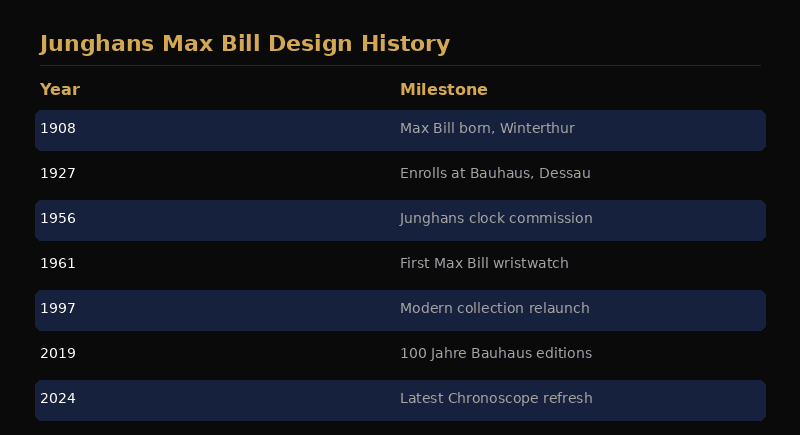
From the Bauhaus in 1925 to the wristwatch in 1961 — Max Bill’s design journey with Junghans
The Complete Max Bill Lineup
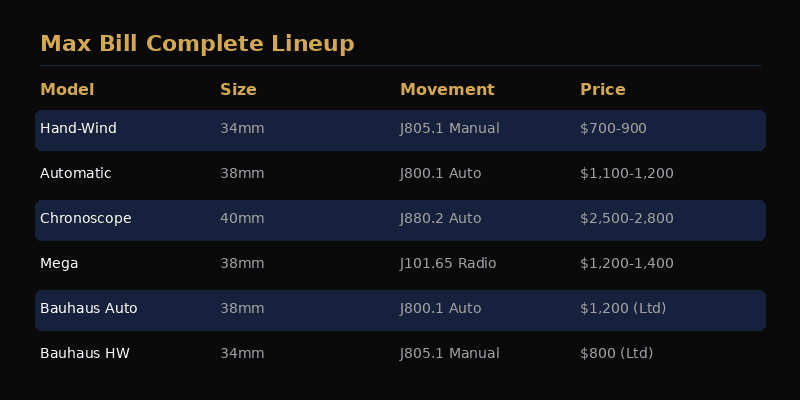
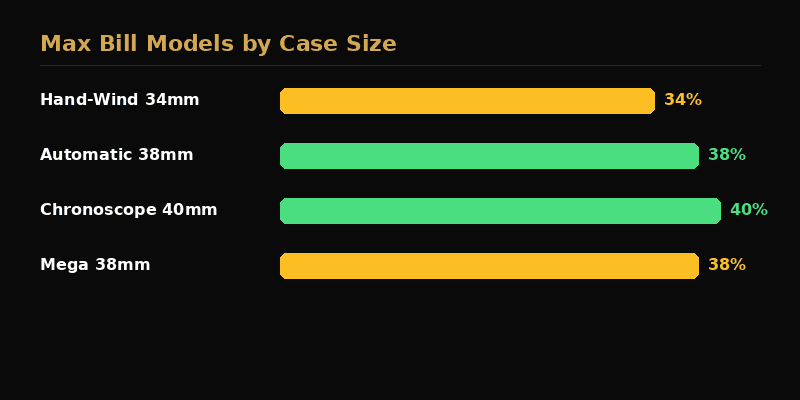
Junghans currently sells the Max Bill in four sub-collections. Each shares the same Bauhaus design DNA — the domed crystal, the printed numerals, the slim profile — but differs in size, movement type and price. Here is how they compare at a glance.
| Collection | Case Size | Movement | Power Reserve | Retail (approx.) |
|---|---|---|---|---|
| Hand-Wind | 34mm | J805.1 (manual) | 42h | $800 |
| Automatic | 38mm | J800.1 (ETA 2824-2) | 38h | $1,100–$1,200 |
| Chronoscope | 40mm | J880.2 (auto chrono) | 42h | $2,500–$2,800 |
| Mega | 38mm | J101.65 (radio quartz) | N/A | $1,200 |
Every model shares the same 30-metre water resistance (3 ATM), the same calfskin leather strap, and the same ultra-slim case profile that makes the Max Bill feel like it disappears on the wrist. The differences are size, complication level, and movement type.
Max Bill Hand-Wind (34mm)
The hand-wind is the purest expression of Bill’s original vision. At 34mm with a case height of just 9mm, it wears the way watches wore in 1961 — subtle, understated, and close to the wrist. The Calibre J805.1 is a manual-winding movement with a 42-hour power reserve, meaning you wind it once a day and forget about it.
The dial is available in silver, white, black, and grey variants. The lug width is 18mm, which limits strap options compared to the 20mm automatic, but the trade-off is a watch that truly looks like the 1961 original. If you have a wrist circumference under 17cm or simply appreciate vintage proportions, this is the model that stays truest to Bill’s intent.
At around $800, the hand-wind is also the most affordable mechanical Max Bill. It competes directly with the best value watches in its price bracket, and few of its competitors carry a design pedigree that stretches back to the Bauhaus.
Max Bill Automatic (38mm)
The automatic is the volume seller and the model most people mean when they say “Max Bill.” It bumps the case to 38mm and the height to 10mm, adds a date window at 3 o’clock (on most references), and uses the Calibre J800.1 — a self-winding movement based on the ETA 2824-2, one of the most proven and easily serviced calibres in the Swiss industry.
The 38-hour power reserve means the watch will run through a weekend on your nightstand if you take it off Friday evening and put it on Monday morning — just. In practice, most owners will want to give it a few winds when they pick it up after two idle days.
Lug width is 20mm, which opens up the aftermarket strap world. The signature domed plexiglass crystal is standard on most references, though Junghans has introduced sapphire-crystal variants on some newer models for buyers who prioritise scratch resistance over the original look.
At $1,100 to $1,200, the automatic sits in the same price territory as the best affordable watches from Orient, Tissot and Seiko’s Presage line — but none of those carries six decades of unbroken Bauhaus design history.
Check Any Watch Price in Seconds
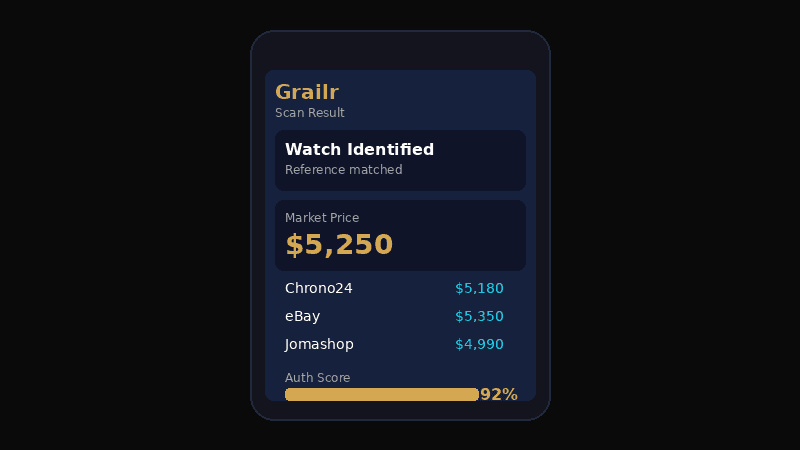
Grailr scans your watch photo and pulls live pricing from Chrono24, eBay, and Jomashop.
- AI identifies brand, model & reference number
- Live market prices from 3+ sources
- Authentication confidence score
Max Bill Chronoscope (40mm)
The Chronoscope is where the Max Bill grows up. At 40mm with an automatic chronograph movement (Calibre J880.2), it adds two sub-dials — a 30-minute counter at 12 o’clock and a running-seconds counter at 6 o’clock — while keeping the same Bauhaus proportions and domed plexiglass crystal that define the family.
References include the 27/4500.48 (silver dial), the 27/4601 (dark dial), and the 27/4003.46 (black dial with date). The Chronoscope is noticeably thicker than the time-only models — roughly 14mm including the crystal dome — which is the unavoidable cost of housing a chronograph movement inside a design language built around thinness.
At $2,500 to $2,800, the Chronoscope is not cheap by Junghans standards, but it remains significantly less expensive than the entry-level chronograph watches from Swiss maisons like TAG Heuer or Longines. On the used market, Chronoscopes trade between $875 and $2,250, making a pre-owned example an exceptional value for a mechanical chronograph from a brand with this heritage.
Max Bill Mega: Radio-Controlled Precision
The Mega is the oddball of the family — and for a certain kind of buyer, the most interesting. It uses a radio-controlled quartz movement (Calibre J101.65) that syncs nightly to the DCF77 atomic time signal broadcast from Mainflingen, Germany. If you live in central Europe, the Mega is effectively zero-drift accurate. If you live in North America or Asia, the radio signal won’t reach you and the watch runs as a standard quartz.
The Mega shares the 38mm case of the automatic, the same domed crystal, and the same calfskin strap. From three feet away, you cannot tell it apart from the mechanical automatic. The only visible difference is a tiny radio-wave icon on the dial.
At around $1,200, the Mega is priced between the hand-wind and the Chronoscope. It appeals to buyers who want the Bauhaus look with zero-maintenance accuracy — and who don’t mind that a quartz movement is heresy to some watch enthusiasts. If atomic-grade accuracy matters and you live in DCF77 range, this is the most technically capable Max Bill you can buy.
How the Max Bill Holds Its Value
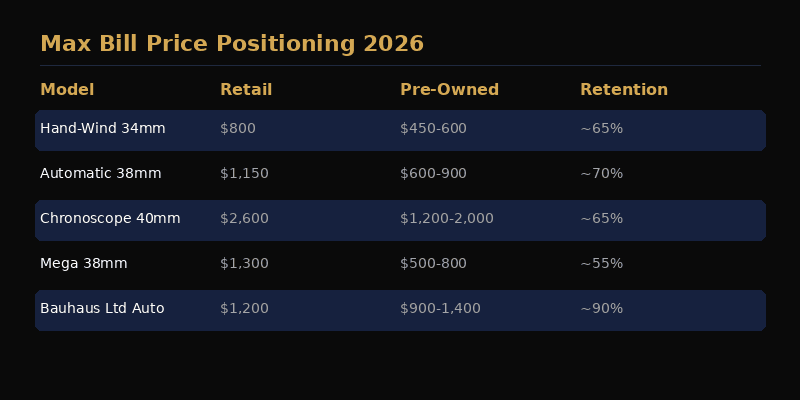
The Max Bill is not a watch you buy to flip. It is a watch you buy to wear for a decade. That said, it holds its value respectably for a sub-$3,000 dress watch. The secondary market is well established, and the Bauhaus name gives it cultural credibility that transcends the watch community.
| Model | Retail (approx.) | Used Range | Retention |
|---|---|---|---|
| Hand-Wind 34mm | $800 | $400–$600 | ~60% |
| Automatic 38mm | $1,100 | $600–$1,000 | ~65% |
| Chronoscope 40mm | $2,500 | $875–$2,250 | ~55% |
| 100 Jahre Bauhaus LE | $1,500 (orig.) | $1,000–$1,800 | ~80% |
The 100 Jahre Bauhaus limited editions — capped at 1,000 pieces each and released in 2019 to mark the centenary of the Bauhaus founding — command a noticeable premium over standard models. If you can find one with papers, it is the most collectible Max Bill on the market.
Used market pricing for the Max Bill Automatic (38mm) over the past three years
Where and How to Buy a Max Bill
1. Authorised Dealers vs Grey Market
Junghans sells through authorised dealers including Jura Watches (UK), WatchMaxx (US), and its own official webshop. Grey-market sellers typically discount 10–20%, but you lose the two-year manufacturer warranty. For a $1,100 watch, that trade-off is worth thinking about — a single service can cost $200 to $300.
2. Plexiglass vs Sapphire
If you’re buying new, check whether the reference uses plexiglass or sapphire. The original plexiglass dome is the authentic look, but it scratches easily. A tube of Polywatch paste ($10) will buff out light scratches in minutes. If you know you’ll baby the watch, choose plexiglass for the character. If you wear it daily around desks and doorframes, sapphire may save you frustration.
3. Check Pre-Owned Carefully
The Max Bill is popular on the used market, but its slim case means the movement sits close to the caseback and is more sensitive to impacts than a bulkier sports watch. Ask for a timegrapher reading before buying, and check the crystal for deep gouges that go past the surface — those cannot be polished out. Use Grailr’s scanner to verify the reference and check market pricing before committing.
4. Know the Water Resistance Limits
Every Max Bill is rated to 30 metres (3 ATM). That covers splashes and rain but not handwashing with the crown submerged, not swimming, and definitely not showering. This is a dress watch. Treat it like one. If you need a water-resistant everyday watch, look at the best dive watches instead.
5. Size Matters More Than Usual
The Max Bill wears larger than its listed diameter because of the slim bezel and the way the domed crystal extends nearly to the case edge. A 38mm Max Bill has the dial presence of a 40mm conventional watch. Try one on before ordering — the hand-wind at 34mm will feel small on a large wrist, and the Chronoscope at 40mm may overwhelm a slim one.
Frequently Asked Questions
Is the Junghans Max Bill a good first dress watch?
Yes. The hand-wind starts around $800 and the automatic around $1,100, both offering genuine Bauhaus heritage, a Swiss or German movement, and a design that has barely changed since 1961. Few watches at this price carry that kind of provenance.
What movement does the Junghans Max Bill use?
It depends on the model. The hand-wind uses the J805.1 (manual winding). The automatic uses the J800.1, based on the ETA 2824-2, with a 38-hour power reserve. The Chronoscope uses the J880.2 automatic chronograph. The Mega uses a radio-controlled quartz movement synced to the DCF77 signal.
Why does the Max Bill use plexiglass instead of sapphire?
The domed plexiglass crystal is a deliberate design choice from Max Bill's original 1961 specification. It creates the signature light-bending distortion at the edges that defines the watch's character. It scratches more easily than sapphire but can be polished out with Polywatch paste. Junghans offers sapphire on some newer references.
What is the difference between the Automatic and the Chronoscope?
The Automatic is a three-hand time-and-date watch in a 38mm case at $1,100 to $1,200. The Chronoscope adds a chronograph complication with two sub-dials in a 40mm case at $2,500 to $2,800. Both share the same Bauhaus design language, domed crystal and calfskin strap.
Does the Max Bill hold its value on the used market?
The Max Bill retains roughly 55 to 70 percent of retail on the secondary market. Used automatics trade between $600 and $1,000, and Chronoscopes between $875 and $2,250. Limited editions like the 100 Jahre Bauhaus models hold value better.
Is the Junghans Max Bill water resistant?
All Max Bill models are rated to 30 metres (3 ATM), which covers splashes and rain but not swimming or showering. This is a dress watch designed to stay dry.
Related Articles
The Bottom Line
The Junghans Max Bill is one of the rare watches that transcends the watch world. It is collected by architects, designers and Bauhaus enthusiasts as much as by horological fans. The 38mm automatic at around $1,100 is the sweet spot for most buyers — the right size for modern wrists, a proven movement, and a price that makes it accessible without cheapening the heritage. If you want something smaller and more historically faithful, the 34mm hand-wind delivers. If you want the chronograph complication, the Chronoscope is one of the best-designed chronographs under $3,000. Whatever you choose, you are wearing a piece of design history that has barely changed in over sixty years.
Found a Max Bill You Like?
Grailr uses a photo to suggest a watch identity and an indicative price estimate, with active eBay listings where available. Check the exact reference and condition independently; a photo scan cannot authenticate a watch.
Scan a Watch NowSources and price context
- Junghans Max Bill collection page — Official current models, specifications and recommended retail prices.
- Bauhaus Dessau Foundation — Historical context on the Bauhaus school where Max Bill studied.
These primary sources support the specific history, specification or policy points noted above. Prices and resale percentages elsewhere in this guide are indicative editorial figures, not a verified transaction dataset or guaranteed returns. Confirm the exact reference, region, condition and current quote before buying; asking prices are not completed-sale prices.