METAS Certified Watches: What It Tests and Why It Matters
The eight tests behind Master Chronometer certification, how it compares to COSC, and which brands carry it — explained without the marketing spin.
Price context: this guide includes indicative prices from its original publication period. They have not all been refreshed to current quotes. Use the linked primary sources for specifications and policies, and verify prices independently.
- METAS certification is administered by the Swiss Federal Institute of Metrology — a government body, not a watch brand
- Eight tests over 10 days evaluate the fully assembled watch, not just the bare movement
- Magnetic resistance is tested at 15,000 gauss — far beyond the fields produced by phones, laptops, and bag clasps
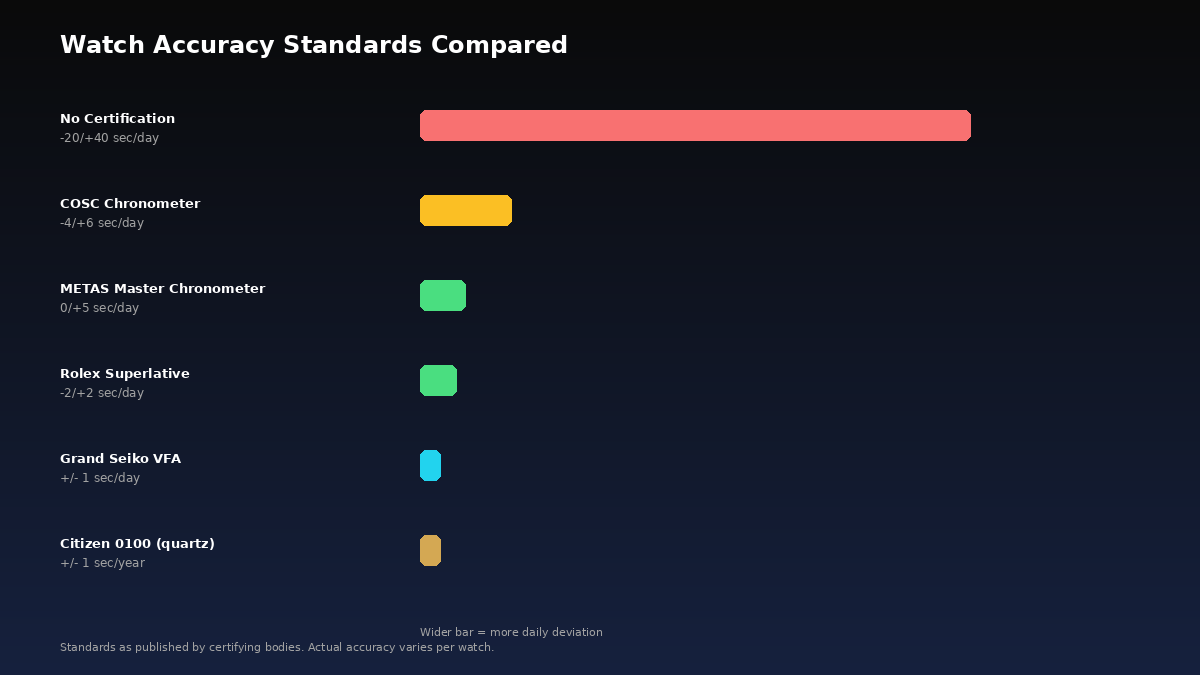
- Accuracy is held to 0/+5 seconds per day on the cased watch, tighter than COSC’s –4/+6 on a bare movement
- Omega, Tudor, TAG Heuer, and Chopard all carry the certification on selected or full-lineup references in 2026
What Is METAS Certification?
METAS stands for the Swiss Federal Institute of Metrology (Eidgenössisches Institut für Metrologie in German). It is a Swiss government body responsible for measurement standards across a range of industries, not a watch brand and not a trade association funded by the brands it certifies. That distinction matters because the testing facility and its standards sit outside the commercial interests of any single manufacturer.
The Master Chronometer certification program was developed in partnership with Omega and launched around 2015. It was created to address a gap that buyers and watchmakers had discussed for years: COSC, the traditional Swiss chronometer standard, tests bare movements before they are cased. That means a movement can earn its chronometer certificate and then behave differently once it is installed inside a watch case, exposed to the magnetic fields of its own rotor and caseback, and subjected to the physical stresses of daily wear. A movement-only test tells you how the engine performs on a bench; it does not tell you how the finished product performs on your wrist.
METAS solved this by testing the fully assembled, cased watch. The movement must first pass COSC certification as a prerequisite — so a Master Chronometer watch carries both certifications — and then the complete watch undergoes eight additional tests at the METAS facility over 10 days. These tests cover accuracy, magnetic resistance, power reserve, and water resistance, all on the watch as it will actually be sold to a buyer. Each watch receives an individual certificate with its specific test results, not a batch approval applied to a production run.
The 8 METAS Tests Explained
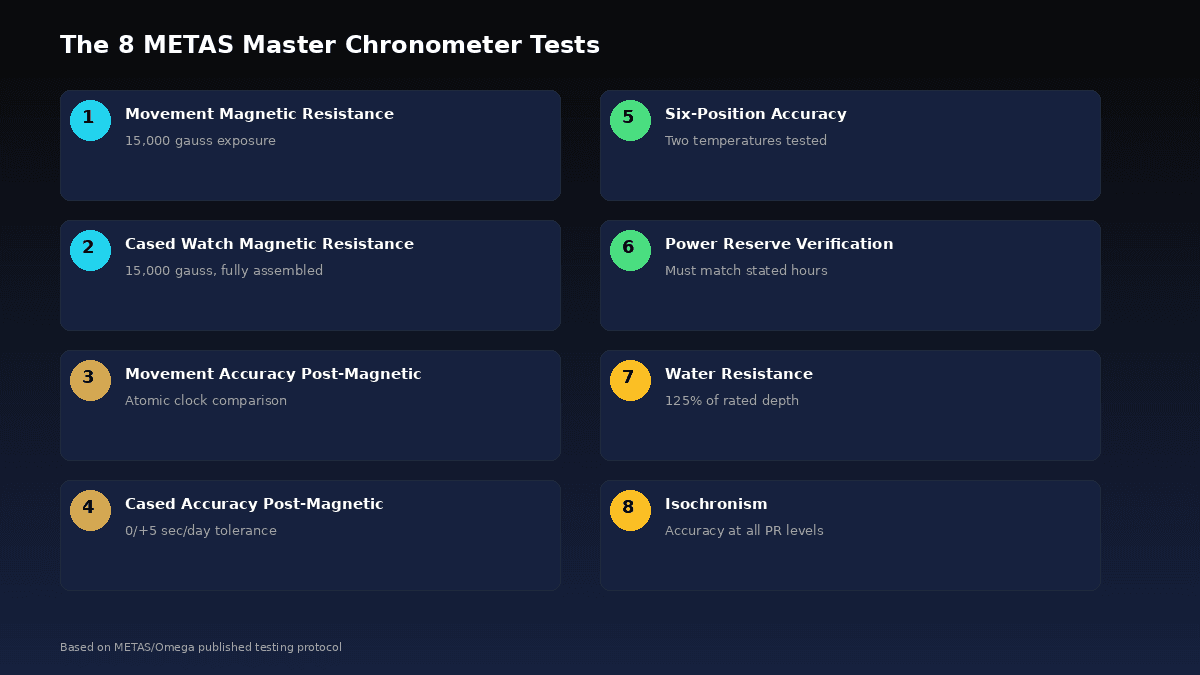
The full testing protocol runs over approximately 10 days and evaluates the watch through eight distinct stages. Each stage targets a specific performance attribute, and a failure at any point means the watch does not receive the Master Chronometer label. Here is what each test involves.
Test 1 — Movement Magnetic Resistance
The bare movement, before casing, is exposed to a 15,000-gauss magnetic field. This is not a brief pass — it is sustained exposure designed to confirm the movement’s components, particularly the balance spring, do not magnetize in a way that disrupts timekeeping. Most movements use silicon or similar non-ferromagnetic balance springs to pass this stage.
Test 2 — Cased Watch Magnetic Resistance
The same 15,000-gauss exposure is repeated on the fully assembled watch. This catches any magnetic sensitivity introduced by the case, caseback, bracelet, or other components that the movement-only test cannot reveal. It simulates a worst-case daily scenario far beyond what phones, laptops, or bag clasps produce.
Test 3 — Movement Accuracy After Magnetic Exposure
After the magnetic field is removed from the bare movement, its rate is measured again to confirm it has returned to within specification. This ensures the anti-magnetic properties are genuine — the movement did not merely survive the field but continued to keep time correctly once the field was gone.
Test 4 — Cased Watch Accuracy After Magnetic Exposure
The cased watch must maintain accuracy within 0 to +5 seconds per day after the 15,000-gauss exposure. This is the headline number most buyers encounter — it means a certified watch will not lose time and will gain no more than five seconds per day under conditions far more extreme than real-world use.
Test 5 — Daily Accuracy Across Positions and Temperatures
The watch is tested in six positions (dial up, dial down, crown left, crown right, crown up, crown down) and at two temperatures. This checks for positional variance — a common issue where gravity affects the balance wheel differently depending on the watch’s orientation — and for thermal sensitivity that could cause the rate to drift in hot or cold environments.
Test 6 — Power Reserve Verification
METAS verifies that the watch’s actual power reserve meets or exceeds the manufacturer’s stated figure. If the brand claims 60 hours, the watch must deliver at least 60 hours. This prevents brands from overstating power reserve in their marketing materials without consequence.
Test 7 — Water Resistance Verification
The watch is tested at 125% of its rated water resistance. A watch rated to 300 meters is tested at 375 meters of equivalent pressure. This margin confirms the case, crystal, crown, and gaskets exceed their stated specification rather than merely meeting it at the edge of their tolerance.
Test 8 — Accuracy Over Full Power Reserve (Isochronism)
The final test measures whether the watch keeps consistent time as the mainspring unwinds from fully wound to nearly depleted. Many movements slow down or speed up as the driving force diminishes; METAS requires the rate to remain stable across the full reserve. This is arguably the test that matters most to owners who do not wind their watch every morning — it ensures the last 10 hours of power reserve are as accurate as the first 10.
COSC vs METAS: How They Compare
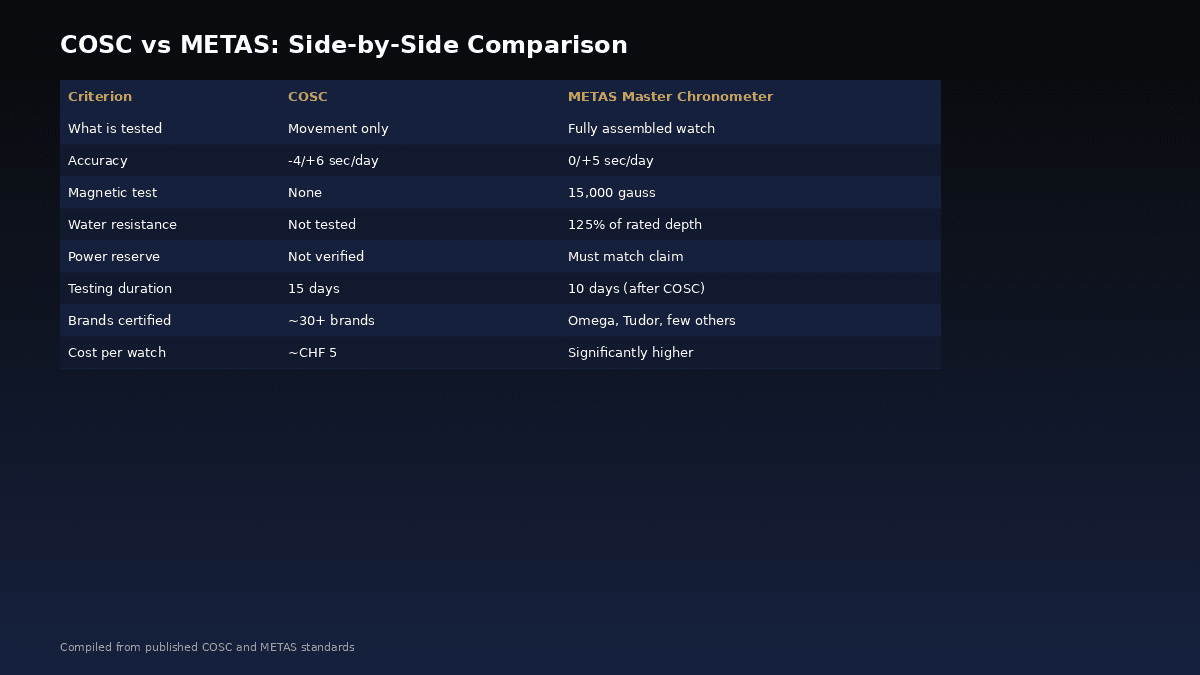
COSC and METAS are not competitors — METAS requires COSC as a prerequisite. But they test different things in different ways, and understanding those differences clarifies why some brands pursue both and others stop at COSC. The table below puts the two standards side by side on the criteria that matter most to buyers.
| Criterion | COSC | METAS |
|---|---|---|
| What is tested | Bare movement only | Fully cased watch |
| Accuracy standard | –4/+6 sec/day | 0/+5 sec/day |
| Testing duration | 15 days | ~10 days |
| Magnetic resistance | Not tested | 15,000 gauss |
| Power reserve check | Not tested | Must match claimed spec |
| Water resistance check | Not tested | Tested at 125% of rating |
| Isochronism (full PR accuracy) | Not tested | Tested across full reserve |
| Annual volume | ~1.5 million movements | Far fewer (mainly Omega, Tudor) |
| Individual certificate | Yes, per movement | Yes, per cased watch (viewable online) |
The practical difference comes down to what the certificate actually guarantees. A COSC certificate tells you the movement was accurate on a test bench before it was cased. A METAS certificate tells you the finished watch you are buying was accurate, anti-magnetic, water-resistant, and consistent across its power reserve — all tested on that specific watch, not a sample from the batch. For buyers, the METAS certificate is closer to a quality inspection report for the actual product they receive.
That said, COSC remains the far more widely used standard, with roughly 1.5 million certifications per year spread across dozens of brands. METAS is deliberately more selective — the testing infrastructure is more complex, the per-unit cost is higher, and the brands that pursue it are using it as an active differentiator rather than a baseline qualifier. Both certifications have value; METAS simply answers more questions about the finished product. Our guide to the most accurate watches covers how these standards play out across the market.
Which Brands Hold METAS Certification?
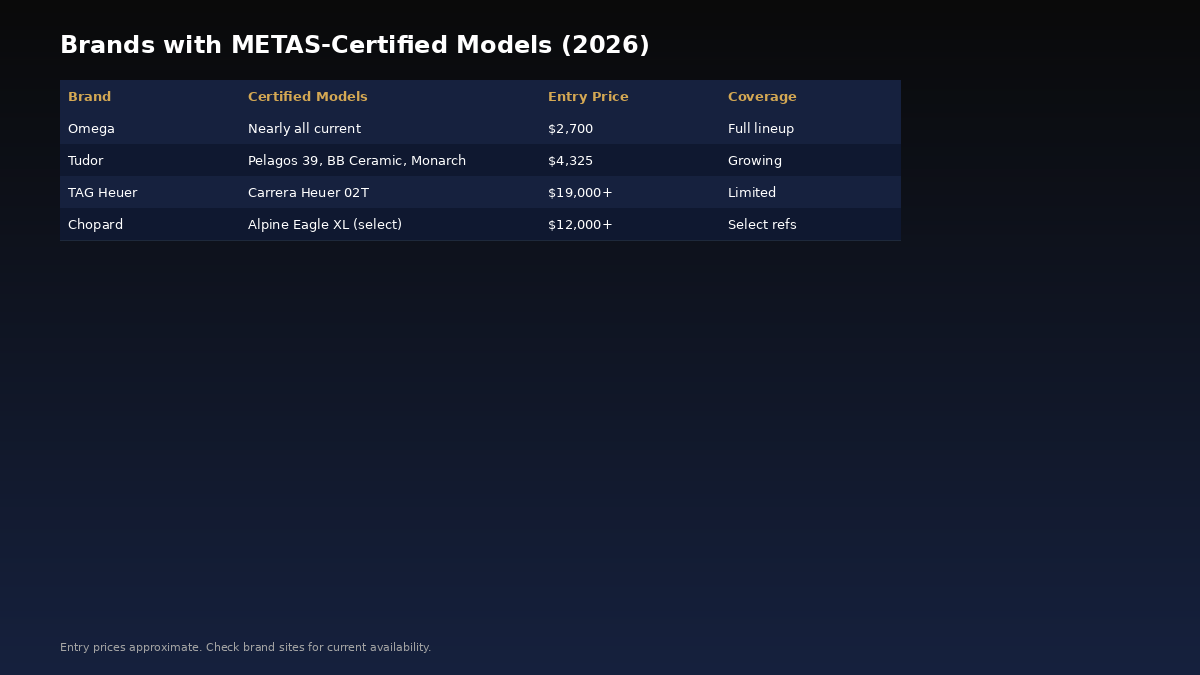
As of 2026, four brands have submitted watches to METAS for Master Chronometer certification. The depth of their commitment varies widely — Omega has certified nearly its entire catalog, while others apply the label to selected references only.
| Brand | Certified Models | Scope | Since |
|---|---|---|---|
| Omega | Seamaster, Speedmaster, Constellation, De Ville, Aqua Terra | Nearly all current models | 2015 |
| Tudor | Pelagos 39, Black Bay Ceramic, Monarch, Black Bay 58 GMT | Growing lineup | 2022 |
| TAG Heuer | Carrera Calibre Heuer 02T | Limited references | 2023 |
| Chopard | Alpine Eagle XL (selected references) | Limited references | 2023 |
Omega — The Full-Catalog Commitment
Omega partnered with METAS to develop the certification standard and has been the program’s anchor brand from the outset. By 2026, the Master Chronometer designation covers virtually every current Omega model: the Seamaster 300M, Planet Ocean, and Aqua Terra lines; every Speedmaster including the Silver Snoopy Award edition; the Constellation; and the De Ville family. This makes Omega the only major brand where a buyer can assume METAS certification by default rather than checking reference by reference.
For a detailed look at how the certification shows up across Omega’s dive watch range, see our Omega Seamaster buying guide and Aqua Terra buying guide.
Tudor — Selective but Expanding
Tudor’s first METAS-certified watch was the Pelagos 39 in 2022, and the brand has since expanded certification to the Black Bay Ceramic, the 2026 Monarch, and the Black Bay 58 GMT. Unlike Omega, Tudor applies METAS only to selected references rather than the entire catalog — most Black Bay steel models and the Ranger line still use COSC-certified movements without the additional METAS testing. Buyers should check the specific reference number rather than assuming any Tudor watch carries it.
TAG Heuer and Chopard — Limited Application
TAG Heuer has applied METAS certification to the Carrera Calibre Heuer 02T, a tourbillon reference positioned at the upper end of its catalog. Chopard has certified selected Alpine Eagle XL references. In both cases, the certification is a statement of technical ambition on specific high-end pieces rather than a brand-wide standard. It remains to be seen whether either manufacturer will expand the program to a broader range of models.
Check Any Watch Price in Seconds
Grailr scans your watch photo and pulls live pricing from Chrono24, eBay, and Jomashop.
- AI identifies brand, model & reference number
- Live market prices from 3+ sources
- Authentication confidence score
What METAS Means for Everyday Wear
Numbers like “15,000 gauss” and “0/+5 seconds per day” are easy to cite and harder to put into daily context. Here is what they actually mean for someone wearing the watch to work, traveling, or leaving it on the nightstand over a weekend.
Magnetic resistance in practice: A smartphone’s speaker magnet generates roughly 50 to 200 gauss at direct contact. A laptop speaker or iPad Smart Cover magnet might produce 200 to 600 gauss at the surface. A magnetic bag clasp can reach 300 to 1,000 gauss. METAS certifies at 15,000 gauss — roughly 15 to 300 times the strength of common everyday magnetic sources. This does not mean a certified watch is “immune to all magnets” in a physics sense, but it means daily exposure to personal electronics, security gates, and handbag hardware is not a practical concern for timekeeping accuracy.
Accuracy in practice: At 0/+5 seconds per day, a METAS-certified watch accumulates no more than about 35 seconds of gain per week in a worst case. Over a month, that is roughly two and a half minutes. For most wearers, this means the watch stays accurate enough that you never need to adjust it between services. By comparison, a standard COSC movement at its outer tolerance of +6 seconds per day gains about 42 seconds per week and just over three minutes per month — still good, but measurably less precise, and with the possibility of losing time rather than only gaining it.
Quick Reference
A METAS-certified watch at 0/+5 s/day gains ≤ 35 s/week and ≤ 2.5 min/month. A COSC-only watch at −4/+6 s/day can swing ± 42 s/week, with possible loss as well as gain.
Power reserve and isochronism: METAS’s isochronism test matters most for people who rotate between watches. If you set your watch on Friday evening and pick it up Monday morning, the last hours of the power reserve determine whether it has kept accurate time while you were away. A watch that gains three seconds per day when fully wound but loses two seconds per day at the tail end of its reserve creates a rate swing that makes the average accuracy figure misleading. METAS catches this by testing across the entire power reserve rather than only at full wind.
Water resistance margin: Testing at 125% of the rated depth provides a safety margin that accounts for the dynamic pressures of real-world use. Jumping into a pool or hitting water during a surface dive creates momentary pressure spikes above the static depth, and the 25% margin ensures the case is built to handle that rather than passing at exactly its rated limit with no room to spare.
Does METAS Affect Resale Value?
This is the question most buyers eventually ask, and the honest answer is: not directly and not yet. Secondary-market watch prices are driven overwhelmingly by brand, model, and condition rather than by which accuracy certification the watch carries. A Rolex Submariner without any external accuracy certification retains more of its value than a METAS-certified Omega Seamaster 300M, because the Rolex name and its supply dynamics dominate the pricing equation in a way that no test certificate overrides.
Where METAS certification does have an indirect effect is in buyer confidence on the pre-owned market. A buyer considering a used Omega or Tudor knows that the specific watch was individually tested to an exacting standard when new, and that its accuracy results are still viewable online through the brand’s certificate lookup. This is not the same thing as knowing the watch is currently accurate — it has been worn, potentially bumped around, and may be due for service — but it does establish a documented baseline that a non-certified watch cannot offer. For an Omega, that certificate is accessible through the individual card included with the watch; for Tudor, it is viewable through the brand’s own certificate portal.
Practically, this means METAS certification is best understood as a quality signal rather than a value driver. It tells you the manufacturer invested in individual testing at a government-run facility, which says something about their confidence in the product and their commitment to transparency. It does not, by itself, make the watch worth more on the secondary market. If resale value is a primary concern, brand selection and model choice matter far more than the certification label. Use Grailr’s watch identifier to check live market pricing on any specific reference and understand where it sits in the market today.
How to Verify a METAS Certificate
Every METAS-certified watch ships with a certificate card that carries a unique identification code. For Omega, this code can be entered on the brand’s website to view the individual test results for that specific watch — the exact accuracy figures it recorded across positions, temperatures, and power reserve states during its 10-day evaluation. Tudor provides a similar lookup through its own certificate verification portal, though the level of detail displayed varies between brands.
When buying pre-owned, the certificate card should be part of the box-and-papers set. If it is missing, you can still look up the watch by its serial number through the brand’s own certificate database, though you will need the brand to confirm the serial-to-certificate mapping. The existence of these records is one of the practical advantages of METAS certification for secondary-market buyers: it creates a documented performance history that begins before the first owner received the watch.
Keep in mind that a certificate verifies the watch’s performance at the time of testing, not its current accuracy. A five-year-old watch that has not been serviced may well run outside its original METAS tolerances, and no certificate can substitute for a fresh timing check. If you are evaluating a pre-owned purchase, treat the certificate as a positive indicator of build quality and the brand’s care during manufacture — then verify current performance with a timegrapher reading or a service inspection. Use Grailr’s authentication tool alongside the certificate for a broader picture of the watch’s identity and provenance.
Frequently Asked Questions
What does METAS Master Chronometer certification mean?
It means a fully assembled watch has passed eight tests administered by the Swiss Federal Institute of Metrology. These tests cover accuracy, magnetic resistance, power reserve, and water resistance on the complete, cased watch rather than the bare movement alone.
How is METAS different from COSC certification?
COSC tests bare movements over 15 days and allows -4 to +6 seconds per day. METAS tests the fully cased watch over 10 days and requires 0 to +5 seconds per day. METAS also adds magnetic resistance testing at 15,000 gauss, power reserve verification, and water resistance testing, none of which COSC covers.
Which watch brands have METAS certification?
Omega certifies nearly its entire current lineup. Tudor carries it on the Pelagos 39, Black Bay Ceramic, Monarch, and Black Bay 58 GMT. TAG Heuer and Chopard apply it to selected high-end references such as the Carrera Calibre Heuer 02T and Alpine Eagle XL.
Does METAS certification make a watch more accurate?
Yes, measurably so. METAS requires 0 to +5 seconds per day on the cased watch after magnetic exposure, tighter than COSC's -4/+6 on a bare movement. It also tests accuracy across the full power reserve, so the watch must keep time consistently as the mainspring unwinds.
Can METAS-certified watches resist magnets from phones and laptops?
Yes. METAS tests magnetic resistance at 15,000 gauss, which far exceeds the fields produced by smartphones (50-200 gauss), laptop speakers (200-600 gauss), and magnetic bag clasps (up to 1,000 gauss).
Does METAS certification increase a watch's resale value?
Not directly. Secondary-market prices are driven primarily by brand, model, and condition rather than the certification label. METAS does signal build quality and can support buyer confidence in a pre-owned purchase, but it has not created a measurable premium over otherwise identical non-METAS watches.
Related Articles
The Bottom Line
METAS Master Chronometer certification is the most comprehensive standard available for finished wristwatches. It answers questions that COSC certification — a worthy standard in its own right — does not ask: how does the watch perform after magnetic exposure, across its full power reserve, and at pressures beyond its rated water resistance? The fact that it tests the individual watch rather than a batch representative gives buyers something no other certification offers: documented evidence of that specific product’s performance.
Whether that matters to you depends on what you value in a watch. If guaranteed out-of-the-box accuracy, magnetic resistance for modern daily life, and individual accountability are priorities, METAS certification is a genuine differentiator worth seeking out. If you buy watches primarily for brand prestige, design, or resale potential, the certification is a welcome bonus but unlikely to be the deciding factor. Either way, understanding what it actually tests — and what it does not — puts you in a better position to evaluate any watch purchase.
Curious About a Specific Watch?
Grailr uses a photo to suggest a watch identity and an indicative price estimate, with active listings where available. Check the exact reference and condition independently; a photo scan cannot authenticate a watch.
Scan a Watch FreeSources and price context
- Omega Master Chronometer — Official overview of the Master Chronometer certification program, including test descriptions and individual certificate lookup.
- Tudor Pelagos 39 specification page — Tudor’s official specification page for its first METAS-certified model, the Pelagos 39 with the MT5400 movement.
These primary sources support the specifications and certification details noted above. Magnetic field strength ranges for consumer electronics are approximate figures drawn from published measurements and vary by device model. Confirm the exact reference and its certification status with the manufacturer before buying.