Most Accurate Watches: Mechanical and Quartz
From Swiss chronometer certifications to atomic-synced quartz, here is every standard, every movement, and every number that separates an adequate timekeeper from a genuinely accurate one.
Price context: this guide includes indicative prices from its original publication period. They have not all been refreshed to current quotes. Use the linked primary sources for specifications and policies, and verify prices independently.

- Mechanical ceiling: Rolex Superlative Chronometer (±2 sec/day) and Omega Super Racing (0/+2 sec/day) are the tightest widely available standards
- Quartz ceiling: the Citizen Caliber 0100 achieves ±1 second per year — around 31× more accurate than a COSC-certified quartz movement
- Spring Drive bridges both worlds: Grand Seiko’s hybrid delivers ±1 sec/day with a sweeping seconds hand no quartz can match
- Certification matters but varies: COSC, METAS, Rolex Superlative, Patek Seal, and Grand Seiko each test differently — we break down what each one actually proves
- Real-world accuracy differs from lab accuracy: magnetism, temperature, and position on your wrist all widen the gap
What “Accurate” Means for Watches
Two words get used interchangeably in watch marketing — and they shouldn’t. Accuracy is how close a watch runs to perfect time: zero gain, zero loss. Precision is how consistently it deviates. A watch that gains exactly five seconds every single day is extremely precise but not accurate. A watch that gains two seconds one day and loses two the next averages out to accurate but isn’t precise. The ideal is both: a movement that neither gains nor loses and does so consistently.
For mechanical watches, accuracy is rated in seconds per day. A COSC-certified chronometer allows -4 to +6 seconds per day, which translates to roughly one to two minutes per month. For quartz watches, accuracy is rated in seconds per year (or sometimes per month). A standard quartz crystal oscillates at 32,768 Hz and drifts about ±15 seconds per month. A thermocompensated quartz (HAQ) movement corrects for temperature fluctuations and can hold ±10 seconds per year or better.
Chronometer certification tests both qualities. The Swiss COSC tests a movement for 15 days across five positions and three temperatures, measuring daily rate, mean variation, and the largest variation. But certification is only a baseline. Several manufacturers — Rolex, Omega, Patek Philippe, Grand Seiko — go further with their own in-house standards that test the fully assembled watch, not just the bare movement.
That distinction matters. A movement can pass COSC beautifully on a test rig and then run differently once it’s cased, fitted with hands, and strapped to a warm, moving human wrist. The brands with the tightest real-world accuracy test the finished product because they know the movement is only half the story.
Certification Standards Compared
Not every “certified chronometer” label means the same thing. The table below breaks down the six major accuracy certifications you’ll encounter, from the industry-wide COSC baseline to brand-specific programmes that go considerably further. Pay particular attention to the “Tests What” column — a standard that certifies the assembled watch on the wrist is telling you more than one that certifies a bare movement on a bench.
| Standard | Accuracy Requirement | Who Uses It | Tests What | Magnetic Resistance | Price Impact |
|---|---|---|---|---|---|
| COSC Chronometer | -4/+6 sec/day (mech.); ±0.07 sec/day (quartz) | Rolex, Omega, Breitling, Tudor, many others | Movement only | Not tested | +$200–$500 vs non-certified |
| METAS Master Chronometer | 0/+5 sec/day | Omega (all current models) | Fully assembled watch | 15,000 gauss | Included in Omega pricing |
| Rolex Superlative Chronometer | -2/+2 sec/day | Rolex (all models) | Fully assembled watch (after COSC) | 1,000 gauss (Milgauss-level in all models) | Included in Rolex pricing |
| Patek Philippe Seal | -3/+2 sec/day | Patek Philippe (all models) | Fully assembled watch | Not specified | Included in Patek pricing |
| Grand Seiko Special Standard | -3/+5 sec/day (mechanical) | Grand Seiko (mechanical Hi-Beat) | Fully assembled watch | Not specified | Included in GS pricing |
| Hallmark of Geneva (Poinçon de Genève) | Varies; focus on finishing | Vacheron Constantin, Roger Dubuis, Chopard | Movement finishing + accuracy | Not tested | Significant; implies hand-finishing |
COSC figures represent the maximum allowable deviation across 15 days of testing. Brand-specific certifications layer additional criteria — Omega’s METAS programme, for example, first requires the movement to pass COSC and then retests the cased watch on its own, tighter scale including magnetic-resistance exposure.
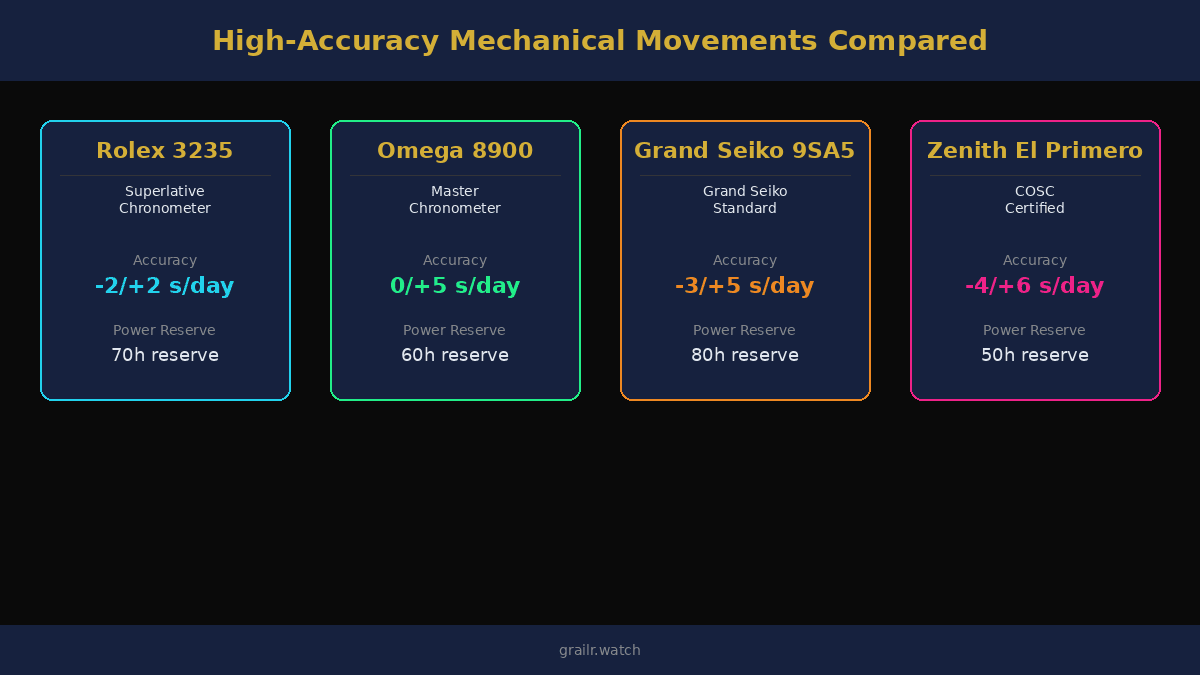
Illustration: high-accuracy mechanical movements from leading Swiss and Japanese manufacturers
Most Accurate Mechanical Watches
For centuries the balance wheel and hairspring set the ceiling on mechanical accuracy. Silicon escapements and novel oscillators have pushed that ceiling dramatically in the last decade. Here are the mechanical watches with the tightest rated accuracy in production today, along with what makes each one notable.
Zenith Defy Lab — 0.3 sec/day (~$30,000)
The Defy Lab replaces the entire balance wheel and hairspring with a single-piece silicon oscillator that vibrates at 15 Hz. The result is a rated accuracy of 0.3 seconds per day — roughly ten times better than COSC. It is immune to gravity-related positional errors and nearly impervious to magnetic fields. The catch: it was a limited run of 10 pieces per dial colour, so availability on the secondary market is thin and prices reflect that scarcity. Even so, the technology has filtered down into the more accessible Zenith Defy Inventor.
Omega Speedmaster Super Racing — 0/+2 sec/day ($13,100)
Omega’s Spirate system adds a secondary spiral to the silicon balance spring that allows in-situ rate adjustment during final assembly. The result is a rated accuracy of 0 to +2 seconds per day, making it the most accurate series-produced chronograph movement in the world. It is also METAS Master Chronometer certified, meaning it handles 15,000 gauss without flinching. For anyone who wants an everyday Speedmaster that also happens to be a technical tour de force, this is the one.
Rolex (Any Current Model) — -2/+2 sec/day ($5,800–$82,700)
Every Rolex leaves the factory with Superlative Chronometer certification: ±2 seconds per day, tested on the fully assembled watch after the movement has already passed COSC. That makes even the entry-level Oyster Perpetual at $5,800 one of the most accurate mechanical watches you can buy at any price. Rolex achieves this through a Parachrom or Syloxi hairspring (both non-magnetic), the Chronergy escapement, and what is essentially an obsessive final-regulation process. The brand doesn’t single out one “most accurate” model because they all hit the same mark.
Patek Philippe (Any Model Under Patek Seal) — -3/+2 sec/day ($20,000+)
The Patek Philippe Seal replaced the Geneva Seal in 2009 and sets its own standard: -3 to +2 seconds per day for the cased watch, along with strict finishing, function, and after-sales criteria. Given that Patek movements already pass Swiss standards, the Seal is both a quality guarantee and an accuracy floor. The asymmetric tolerance (tighter on the fast side) reflects Patek’s philosophy that a watch slightly slow is preferable to one slightly fast — you can always hurry, but you can’t undo being late.
Grand Seiko Hi-Beat 36000 (9SA5) — -3/+5 sec/day ($6,000–$12,000)
Grand Seiko’s 9SA5 calibre beats at 36,000 vph (5 Hz), and is tested to the brand’s Special Standard of -3/+5 seconds per day on the assembled watch. In practice, owners consistently report tighter numbers — often within ±2 seconds. The movement also offers a 80-hour power reserve, a dual-impulse escapement, and a level of hand-finishing that rivals anything from Switzerland. If you want mechanical accuracy without a five-figure Swiss price tag, Grand Seiko is the strongest contender.
Omega Master Chronometer Models — 0/+5 sec/day ($5,000–$15,000)
Beyond the Super Racing, every current Omega carries METAS Master Chronometer certification: 0 to +5 seconds per day, tested on the complete watch after exposure to a 15,000-gauss magnetic field. The Seamaster Aqua Terra, Speedmaster Professional, and Planet Ocean are all held to the same spec. METAS is notable because it tests after magnetisation — a condition that would throw many competing movements off by minutes. For a deeper dive on how Omega stacks up against its chief rival, see our automatic vs quartz comparison.
Most Accurate Quartz Watches
If pure accuracy is the goal, quartz wins and it isn’t close. A standard $10 quartz movement beats the best mechanical chronometer by an order of magnitude. But “quartz” covers a surprisingly wide performance range — from a Casio F-91W drifting 15 seconds a month to the Citizen Caliber 0100 holding one second per year. The difference is engineering, and it has a direct relationship with price.
Citizen Caliber 0100 — ±1 sec/year ($7,500)
The single most accurate wristwatch in production, full stop. The Caliber 0100 uses an AT-cut crystal oscillating at 8.4 MHz (256 times the standard quartz frequency) with autonomous temperature compensation that adjusts every second. The rated accuracy is ±1 second per year. Real-world tests by independent reviewers have confirmed the claim. It ships in a titanium case with a deliberately understated design — you buy this for what’s inside, not what’s on the dial.
Grand Seiko 9F Quartz — ±10 sec/year ($2,400–$3,000)
Grand Seiko treats quartz the way most Swiss brands treat mechanical: as something worth over-engineering. The 9F calibre uses aged quartz crystals, sealed in a vacuum, and individually thermocompensated. It also has an instant-change date and a backlash auto-adjust mechanism for the hands. The result is ±10 seconds per year in a watch that feels, on the wrist, nothing like the cheap quartz it technically shares a category with.
Breitling SuperQuartz — ±10 sec/year ($3,000–$5,000)
Breitling’s thermocompensated SuperQuartz movements power models like the Aerospace Evo and the Endurance Pro. At ±10 seconds per year, they match Grand Seiko’s 9F and add the benefit of Breitling’s COSC quartz certification (±0.07 sec/day, which is roughly ±25 sec/year — the SuperQuartz beats its own certification by a wide margin in practice).
Longines VHP — ±5 sec/year ($1,200)
VHP stands for Very High Precision, and Longines delivers. A perpetual calendar with flash-resetting after impacts or magnetic exposure, the VHP holds ±5 seconds per year at a fraction of the Citizen 0100’s price. It is arguably the best accuracy-per-dollar proposition in the watch industry and a legitimate competitor to the Grand Seiko 9F at less than half the price.
Bulova Precisionist 262 kHz — ~10 sec/year ($300–$900)
Bulova’s Precisionist uses a proprietary 262,144 Hz crystal — eight times the standard quartz frequency — paired with a three-prong design that averages out thermal drift. The result is roughly 10 seconds per year in a watch that starts at $300. The signature tell is a continuously sweeping seconds hand (16 steps per second) that mimics a mechanical movement at a fraction of the cost.
Casio G-Shock Multiband 6 (Radio-Controlled) — ~0 sec drift ($100–$300)
Technically, a radio-controlled watch doesn’t stay accurate — it resets itself. The G-Shock Multiband 6 receives time signals from atomic clocks in six locations worldwide and corrects itself every night. Between syncs, the base quartz module drifts like any other quartz, but since it resets daily, the practical accuracy is essentially zero. Pair it with Bluetooth sync via a smartphone app and drift becomes moot entirely. At $100–$300, it is the cheapest route to functionally perfect timekeeping.
Check Any Watch Price in Seconds
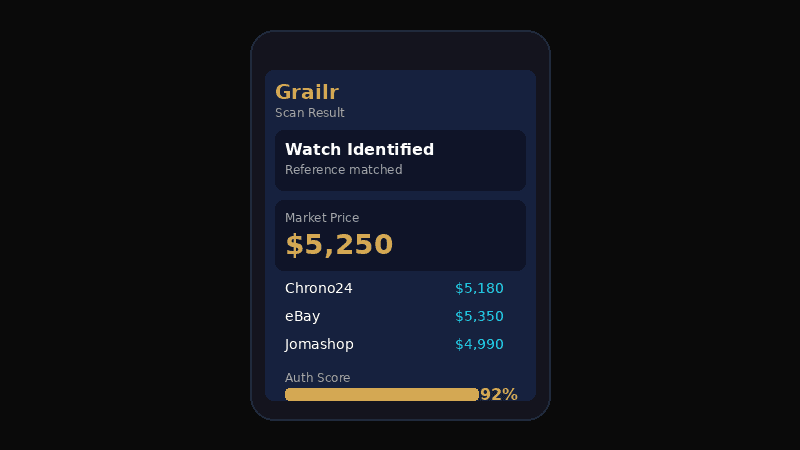
Grailr scans your watch photo and pulls live pricing from Chrono24, eBay, and Jomashop.
- AI identifies brand, model & reference number
- Live market prices from 3+ sources
- Authentication confidence score
Spring Drive — the Hybrid
Grand Seiko’s Spring Drive doesn’t fit neatly into either column. A conventional mainspring stores and delivers power through a traditional gear train, but instead of a balance wheel regulating the speed, a Tri-synchro Regulator uses an electromagnetic brake governed by a quartz crystal to control the glide wheel. The result is a movement that is mechanically powered but quartz-regulated.
The standard Spring Drive is rated to ±1 second per day (±15 seconds per month). The newer 9RA2 calibre, marketed as “Ultra Fine Accuracy,” tightens that to ±10 seconds per month. Both figures put it far ahead of any purely mechanical watch and close to dedicated quartz movements.
What makes Spring Drive unique in the context of accuracy is not the numbers alone — it is the combination. This is the only movement in production that offers a perfectly smooth, sweeping seconds hand (no tick, no micro-step) and quartz-level accuracy and a fully mechanical power source. Prices range from roughly $5,000 for the Elegance collection to well over $50,000 for high-complication Grand Seiko models.
For the collector who finds pure quartz too sterile and pure mechanical too inaccurate, Spring Drive is the only answer the industry has produced. It has been in continuous production since 1999, and no other manufacturer has successfully replicated or licensed the technology.
Accuracy vs Real-World Wearing
Every accuracy rating discussed above is a laboratory figure. On your wrist, things change. Three factors do the most damage to real-world accuracy, and understanding them will help you set realistic expectations.
Positional Variance
A mechanical watch runs at different rates depending on whether it is dial-up, crown-down, crown-up, or in any other position. COSC tests five positions; your wrist cycles through them all day. The aggregate effect is that a watch rated to ±4 seconds on the bench might show ±6 or ±7 in daily wear. High-beat movements (28,800 vph and above) generally show less positional variance because the faster oscillation averages out gravitational error more effectively.
Temperature Effects
Metal hairsprings expand and contract with temperature, changing the rate. COSC tests at 8°C, 23°C, and 38°C. Silicon hairsprings (used by Rolex, Omega, Patek, and others) are effectively immune to thermal variation within any range a human wrist encounters, which is one reason silicon-equipped watches consistently beat their own rated accuracy in practice.
Magnetism
The modern enemy of accuracy. A smartphone, a laptop lid, a handbag clasp — everyday objects produce magnetic fields strong enough to magnetise a traditional steel hairspring and throw a watch off by minutes per day. Non-magnetic hairspring materials solve the problem almost entirely. Rolex’s Parachrom and Omega’s silicon springs resist fields up to 15,000 gauss. Brands still using Nivarox (a conventional alloy) typically recommend keeping the watch away from electronics, which in 2026 is roughly as practical as recommending you avoid breathing.
Omega’s METAS certification is worth highlighting here because it is the only major standard that tests accuracy after magnetic exposure. A Master Chronometer watch must still run within 0/+5 seconds per day after being exposed to 15,000 gauss. That is a much more meaningful test for modern life than a bench test in an electromagnetically quiet room.
Most Accurate Watches Ranked
The table below consolidates everything above into a single ranking by rated accuracy, spanning both mechanical and quartz. Keep in mind: a radio-controlled watch resyncs to an atomic clock nightly and doesn’t “hold” accuracy the way the others do — it simply corrects. Spring Drive sits between the two camps. Use the table to find your personal intersection of accuracy and price.
| Watch | Movement Type | Accuracy | Certification | Price | Notes |
|---|---|---|---|---|---|
| Casio G-Shock Multiband 6 | Quartz (radio-synced) | ~0 (daily reset) | — | $100–$300 | Resets to atomic clock nightly; drift between syncs |
| Citizen Caliber 0100 | Quartz (HAQ) | ±1 sec/year | — | $7,500 | 8.4 MHz AT-cut crystal; most accurate standalone wristwatch |
| Longines VHP | Quartz (HAQ) | ±5 sec/year | — | $1,200 | Best accuracy-per-dollar; flash resetting |
| Grand Seiko 9F | Quartz (HAQ) | ±10 sec/year | GS Standard | $2,400–$3,000 | Vacuum-sealed aged crystal; instant-change date |
| Breitling SuperQuartz | Quartz (COSC HAQ) | ±10 sec/year | COSC Quartz | $3,000–$5,000 | Thermocompensated; beats own COSC rating |
| Bulova Precisionist | Quartz (262 kHz) | ~10 sec/year | — | $300–$900 | Sweeping seconds hand; three-prong crystal |
| Zenith Defy Lab | Mechanical (silicon oscillator) | 0.3 sec/day | — | ~$30,000 | Limited production; silicon oscillator replaces balance wheel |
| GS Spring Drive 9RA2 | Spring Drive (hybrid) | ±10 sec/month | GS Standard | $8,000–$12,000 | Ultra Fine Accuracy; sweeping seconds |
| GS Spring Drive (standard) | Spring Drive (hybrid) | ±1 sec/day | GS Standard | $5,000–$50,000+ | Mechanical power, quartz regulation |
| Omega Super Racing | Mechanical | 0/+2 sec/day | METAS + COSC | $13,100 | Spirate system; most accurate series chronograph |
| Rolex (all current) | Mechanical | -2/+2 sec/day | Superlative + COSC | $5,800–$82,700 | Tested on cased watch; Parachrom/Syloxi springs |
| Patek Philippe (all current) | Mechanical | -3/+2 sec/day | Patek Seal | $20,000+ | Asymmetric tolerance; finishing standard included |
| Grand Seiko Hi-Beat (9SA5) | Mechanical | -3/+5 sec/day | GS Special Standard | $6,000–$12,000 | 36,000 vph; dual-impulse escapement; 80h power reserve |
| Omega Master Chronometer | Mechanical | 0/+5 sec/day | METAS + COSC | $5,000–$15,000 | Tested after 15,000-gauss exposure |
Prices are indicative and based on current retail or typical secondary-market figures at publication. Confirm current pricing independently before purchasing. Accuracy ratings are manufacturer-stated; real-world performance may vary based on wearing habits and conditions.
Does Accuracy Actually Matter?
It depends on what you need — and how honest you are with yourself about what you need versus what you want.
For daily timekeeping: any COSC-certified mechanical watch is more than adequate. At -4/+6 seconds per day, you’re adjusting once a week at most. A Rolex at ±2 seconds per day means you’ll adjust once a month, maybe less. A quartz watch at ±10 seconds per year means you’ll adjust at the next daylight saving change and nothing else. For the vast majority of situations — catching a train, making a meeting, timing dinner — a $300 Bulova Precisionist is functionally identical to a $30,000 Zenith Defy Lab.
For timing-critical use: if you genuinely need precise timekeeping for navigation, racing, or scientific work, quartz is the only rational answer. A radio-controlled G-Shock at $150 gives you atomic-clock accuracy. No mechanical watch, regardless of price, can match it.
For the enthusiast: this is where it gets interesting. Accuracy in a mechanical watch is not about the seconds you save — it is a marker of engineering quality. Tight tolerances, superior materials, obsessive regulation — these are the same things that make a movement beautiful to look at through a caseback. The accuracy figure is a summary statistic for the overall quality of the watchmaking.
A Patek Philippe Seal watch at -3/+2 seconds per day is not more useful than a Tissot at -4/+6. But it is a more refined piece of engineering, and the accuracy figure is one of the simplest ways to demonstrate that. Accuracy, in high watchmaking, is less a functional specification and more a quality metric.
The real question to ask yourself: how much are you willing to pay for seconds you’ll never notice? If the answer is “nothing,” buy a Casio G-Shock and enjoy functionally perfect time for $150. If the answer is “a lot, because the engineering fascinates me,” then the Omega Spirate system, the Zenith silicon oscillator, and the Grand Seiko Spring Drive represent three genuinely different approaches to the same beautiful problem. And if you want to identify a watch you’ve spotted and find out which category it falls into, Grailr can help.
Frequently Asked Questions
What is the most accurate mechanical watch?
The Zenith Defy Lab, with a silicon oscillator rated to 0.3 seconds per day. Among widely available production models, the Omega Speedmaster Super Racing (0/+2 sec/day) and every current Rolex (±2 sec/day) set the standard.
What is the most accurate quartz watch?
The Citizen Caliber 0100, rated to ±1 second per year. It uses an 8.4 MHz AT-cut crystal with per-second temperature compensation — roughly 31 times more accurate than a COSC-certified quartz movement.
Is COSC certification worth it?
Yes, as a baseline. COSC guarantees -4/+6 sec/day across 15 days of testing. But brands like Rolex (±2), Omega (0/+5 after magnetic exposure), and Patek Philippe (-3/+2) layer their own tighter standards on top. COSC alone is the floor, not the ceiling.
What is the difference between accuracy and precision?
Accuracy is how close to perfect time. Precision is how consistent the deviation is. A watch gaining exactly 5 seconds daily is precise but not accurate. Chronometer testing evaluates both — the mean daily rate (accuracy) and the mean variation between days (precision).
Is Grand Seiko Spring Drive more accurate than mechanical?
Significantly. Standard Spring Drive holds ±1 sec/day (±15 sec/month) and the 9RA2 achieves ±10 sec/month. The best mechanical watches manage ±2 sec/day. Spring Drive bridges the gap between mechanical feel and quartz-level accuracy.
Does magnetism affect watch accuracy?
Yes — it is the single biggest real-world threat. A magnetised steel hairspring can throw a watch off by minutes per day. Modern silicon and Nivachron hairsprings are essentially immune. Omega’s METAS test is notable because it measures accuracy after exposure to 15,000 gauss.
Related Articles
The Bottom Line
If you want the single most accurate wristwatch money can buy, it is the Citizen Caliber 0100 at ±1 second per year. If you want the most accurate mechanical watch in regular production, it is a toss-up between Rolex (±2 sec/day across every model) and the Omega Speedmaster Super Racing (0/+2 sec/day with the Spirate system). And if you want something that feels mechanical but times like quartz, Grand Seiko Spring Drive stands alone.
But accuracy is a means, not an end. The best watch is the one you wear, and the one you wear is the one you enjoy looking at, not the one with the tightest tolerance on a spec sheet. Pick the movement philosophy that resonates with you — traditional mechanical, high-accuracy quartz, or the Spring Drive middle path — and let the numbers reassure you rather than decide for you.
Curious About a Watch You’ve Spotted?
Upload a photo and Grailr technology will suggest the brand, model, reference, and an indicative market price — in seconds. Check the result against the seller documentation and an independent inspection.
Identify a Watch NowSources and price context
- COSC official site — Certification criteria, testing protocol, and annual statistics for chronometer certification.
- Omega Master Chronometer (METAS) — Explains the eight METAS tests including magnetic resistance and accuracy on the wrist.
- Rolex Superlative Chronometer — Describes the in-house testing programme applied to every cased watch.
These primary sources support the specific certification, specification, or policy points noted above. Prices elsewhere in this guide are indicative editorial figures, not a verified transaction dataset or guaranteed returns. Confirm the exact reference, region, condition, and current quote before buying; asking prices are not completed-sale prices.