Minimalist Watches: The Best Clean Designs in 2026
From an $80 Timex to a $3,000 Nomos — the watches that prove less is more, compared with real specs, prices and resale data.
Price context: this guide includes indicative prices from its original publication period. They have not all been refreshed to current quotes. Use the linked primary sources for specifications and policies, and verify prices independently.

- True minimalist design starts with the Bauhaus movement of the 1920s — not with marketing labels
- The Junghans Max Bill (~$1,100) and Nomos Tangente (~$1,780) set the standard for clean watchmaking
- Budget picks like the Timex Marlin and Casio A168WA deliver clean dials for under $100
- Fashion-brand minimalists (MVMT, Daniel Wellington) rarely retain more than 30% of their retail price
What Makes a Watch Minimalist
A minimalist watch strips away everything that does not serve the act of telling time. No chronograph subdials, no rotating bezels, no busy date windows. The dial shows hours and minutes — sometimes seconds, sometimes nothing else at all. The goal is legibility through restraint, not simplicity through laziness.
The roots trace to the Bauhaus school in Weimar Germany, founded in 1919 by Walter Gropius. Its core principle — that form follows function — shaped everything from architecture to typography. When Max Bill, a Bauhaus student, designed a wall clock for Junghans in 1956 and then a wristwatch in 1961, he set the template that every minimalist watch still follows: a thin case, a clean dial with printed (not applied) indices, and typography as the only decoration.
Today the term gets stretched. Fashion brands label any watch with a plain dial “minimalist.” But genuine minimalist design has specific features: a case thickness under 10mm, a dial-to-bezel ratio that maximises the face, lugs that sit flush rather than protruding, and a crown small enough to disappear. The best minimalist watches achieve a visual lightness that makes the watch feel like it is barely there — on the wrist and in the room.
That discipline costs money to execute well. Thinner cases demand tighter tolerances. Printed dials without applied indices must be perfectly flat. Crystal doming requires careful curvature. This is why the best minimalist watches — Nomos, Junghans, early Cartier Tank designs — are not the cheapest ones on the shelf.
The Best Minimalist Watches by Price Tier
Under $200: Budget Minimalism
The Timex Marlin 34mm (~$90) is the standout. Its hand-wound movement, domed acrylic crystal and small case produce a genuinely clean aesthetic that belies the price. For digital minimalism, the Casio A168WA (~$25) strips the digital watch to its essentials. The Casio MTP-E180D (~$55) adds an analogue three-hand dial in a 39mm steel case.
Avoid spending $150–$200 on fashion brands that spend more on Instagram marketing than on case finishing. At this price, Timex, Casio and Citizen Eco-Drive models deliver better movements and build quality for less.
$200 – $1,000: The Sweet Spot
The Nordgreen Philosopher (~$230) was designed by Danish architect Jakob Wagner. At 36mm or 40mm with a domed sapphire crystal, it punches above its price in finishing. The Tissot Everytime (~$225) adds Swiss quartz credibility. The Orient Bambino Version 5S (~$280) introduces an automatic movement and a classic cream dial that belongs in a higher bracket.
Higher in this range, the Tissot PRX 35mm (~$375 quartz, ~$695 Powermatic 80) is not purely minimalist — the integrated bracelet adds visual weight — but its clean dial and thin profile earn it a place here. The Seiko Presage Cocktail Time (~$450) offers textured dials with a Japanese automatic movement. For a detailed look at Seiko’s options, see our best watches for value guide.
$1,000 – $3,000: Premium Minimalism
The Junghans Max Bill Automatic (~$1,100–$1,250) is the original. Designed by Max Bill in 1961, it has not changed because it does not need to. The 38mm case, domed Plexiglas crystal and printed Bauhaus numerals remain the reference point for every minimalist watch made since. The movement is a J800.1 based on an ETA 2824-2, with a 38-hour power reserve.
The Nomos Tangente 38 (~$1,780) justifies its premium with a fully in-house Alpha hand-wound movement. The Tangente’s 37.5mm case is 6.6mm thin, putting it on par with watches costing five times as much. The finishing is a step above the Max Bill: hand-engraved balance cock, blued screws, and Glashuette stripe decoration visible through the sapphire caseback.
Other strong picks in this range include the Stowa Antea (~$1,050), another genuine Bauhaus design from a brand that supplied the original Flieger watches in the 1940s, and the Nomos Club Campus (~$1,540), which adds a splash of colour to the Nomos formula.
$3,000+: Luxury Minimalism
At the top, the Nomos Lambda (~$4,200) offers a hand-finished in-house movement with a 42-hour power reserve in a 39mm gold or steel case. The A. Lange & Söhne Saxonia Thin (from ~$8,500 pre-owned) is the ultimate minimalist statement: a 5.9mm-thin case with the kind of movement finishing that justifies the price to anyone who flips it over. See our luxury watch brands guide for more at this level.
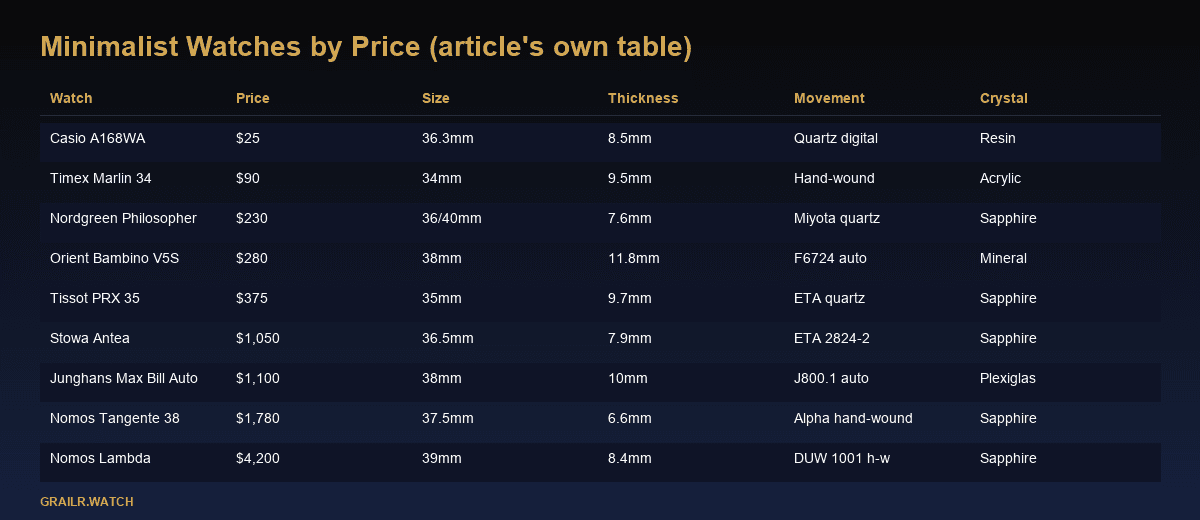
Minimalist Watch Comparison
| Watch | Price | Size | Thickness | Movement | Crystal |
|---|---|---|---|---|---|
| Casio A168WA | $25 | 36.3mm | 8.5mm | Quartz digital | Resin |
| Timex Marlin 34 | $90 | 34mm | 9.5mm | Hand-wound | Acrylic |
| Nordgreen Philosopher | $230 | 36/40mm | 7.6mm | Miyota quartz | Sapphire |
| Orient Bambino V5S | $280 | 38mm | 11.8mm | F6724 auto | Mineral |
| Tissot PRX 35 | $375 | 35mm | 9.7mm | ETA quartz | Sapphire |
| Stowa Antea | $1,050 | 36.5mm | 7.9mm | ETA 2824-2 | Sapphire |
| Junghans Max Bill Auto | $1,100 | 38mm | 10mm | J800.1 auto | Plexiglas |
| Nomos Tangente 38 | $1,780 | 37.5mm | 6.6mm | Alpha hand-wound | Sapphire |
| Nomos Lambda | $4,200 | 39mm | 8.4mm | DUW 1001 h-w | Sapphire |
Movement Matters: Quartz vs Automatic
Minimalism and thinness go together. A quartz movement is typically 2–3mm thick, while an automatic movement needs 4–6mm for the rotor alone. That is why the thinnest watches in every category — like the Nomos Tangente at 6.6mm total — use hand-wound calibres that eliminate the rotor entirely.
Under $500, quartz is the practical choice for minimalist design. The Nordgreen Philosopher achieves 7.6mm thickness precisely because it uses a slim Miyota quartz movement. An automatic like the Orient Bambino balloons to 11.8mm — thicker than many dive watches.
Above $1,000, automatic and hand-wound movements add value that quartz cannot match. The Junghans Max Bill Automatic uses a J800.1 (based on the ETA 2824-2) with 38 hours of power reserve. It is thicker than the hand-wound version at 10mm versus 7.9mm, but the sweeping seconds hand and self-winding convenience are worth the trade-off for most buyers.
The Nomos Alpha movement in the Tangente is the gold standard here: hand-wound, in-house, 6.6mm total case thickness, 43-hour power reserve. It proves that an affordable in-house movement can beat an ETA-based automatic on every metric that matters for minimalist design. Use Grailr’s identification tool to verify a movement claim on any pre-owned listing.
Sizing and Fit for Minimalist Watches
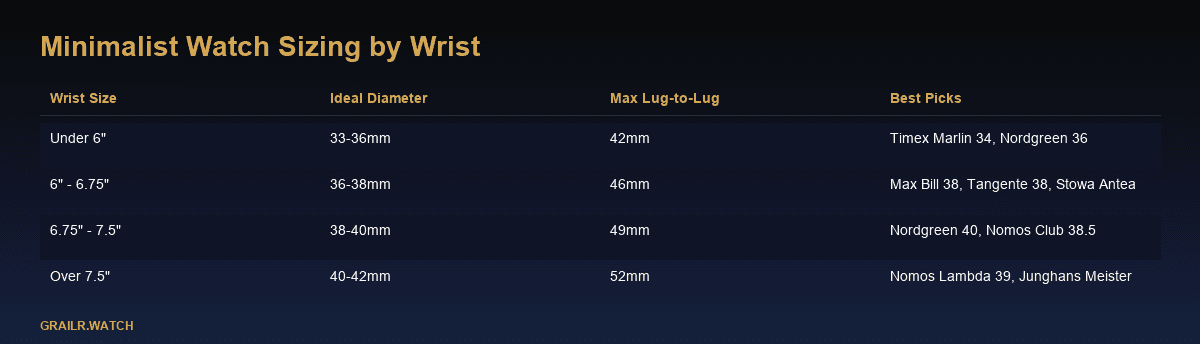
Minimalist watches tend to wear larger than their listed diameter because the bezel is narrow and the dial takes up more of the case face. A 38mm Junghans Max Bill shows as much dial as a 40mm diver with a chunky bezel. That means you can comfortably size down from what you might choose in a sport watch.
Lug-to-lug distance matters more than diameter for clean wrist fit. Lugs that overhang the wrist destroy the whole point of a minimalist watch. Measure your wrist, check the lug-to-lug figure, and scan any listing with Grailr before committing.
| Wrist Size | Ideal Diameter | Max Lug-to-Lug | Best Picks |
|---|---|---|---|
| Under 6” | 33–36mm | 42mm | Timex Marlin 34, Nordgreen 36 |
| 6” – 6.75” | 36–38mm | 46mm | Max Bill 38, Tangente 38, Stowa Antea |
| 6.75” – 7.5” | 38–40mm | 49mm | Nordgreen 40, Nomos Club 38.5 |
| Over 7.5” | 40–42mm | 52mm | Nomos Lambda 39, Junghans Meister |
The Resale Reality for Minimalist Watches
Minimalist watches are not investment pieces. The category attracts buyers who value design over brand prestige, which means less secondary-market demand than a Rolex or Omega. But the spread between brands is enormous, and knowing it saves you from paying a premium you will never recover.
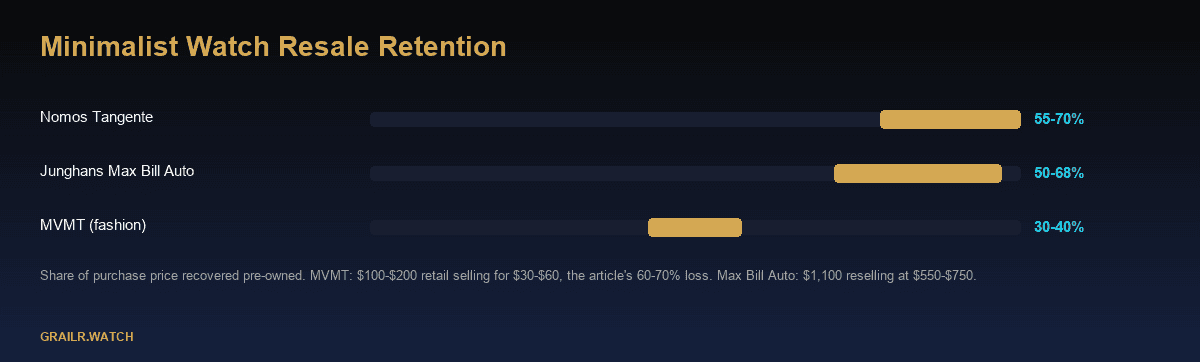
Fashion brands lose the most. MVMT watches retail for $100–$200 and sell pre-owned for $30–$60 — a 60–70% loss. Daniel Wellington follows a similar pattern. The watches are competent, but the brand premium has zero resale value because the next season’s marketing pushes a new model.
Horological brands retain more. A Junghans Max Bill Automatic purchased at $1,100 typically resells for $550–$750 (50–68% retention). The Nomos Tangente holds slightly better at 55–70%, supported by its in-house movement and collector appeal. The best-performing minimalist watches on the secondary market are limited editions and discontinued references.
Before buying pre-owned, use Grailr’s value estimator to check whether a seller’s asking price aligns with current market data. A pre-owned affordable watch in good condition can deliver the same design at a significant discount.
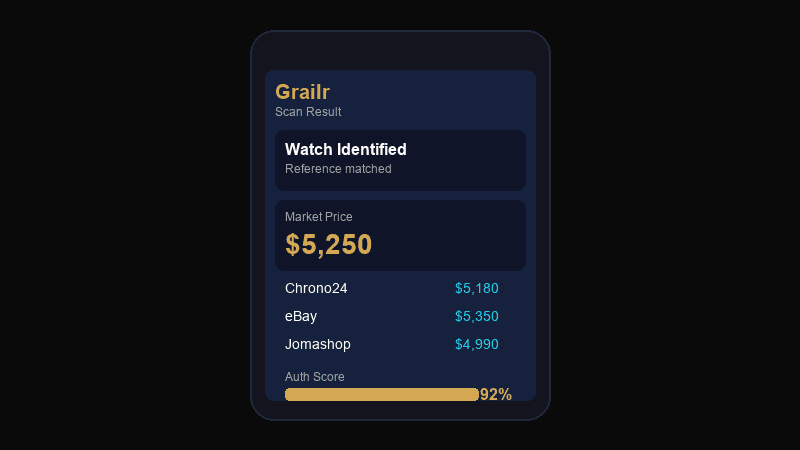
Check Any Watch Price in Seconds
Grailr scans your watch photo and pulls live pricing from Chrono24, eBay, and Jomashop.
- AI identifies brand, model & reference number
- Live market prices from 3+ sources
- Authentication confidence score
How to Spot a Quality Minimalist Watch vs a Fashion Brand
The minimalist aesthetic is easy to copy on the surface. A plain white dial, thin hands, a leather strap — any factory can produce that for $15. The difference between a $100 fashion watch and a $1,000 horological minimalist lies in details you can check before buying.
1. Check the Crystal
Sapphire crystal is the minimum standard above $200. Mineral crystal scratches within months of daily wear. If a $150+ watch uses mineral glass, the savings went to marketing, not materials.
2. Examine the Movement
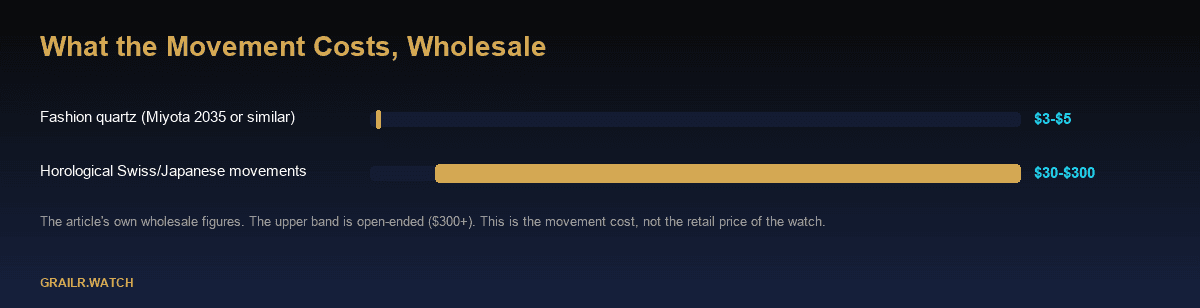
Fashion brands use Miyota 2035 or similar quartz movements that cost $3–$5 wholesale. Horological brands use Swiss or Japanese movements that cost $30–$300+. The movement is the watch — everything else is packaging.
3. Look at the Case Finishing
Run a fingernail along the case edge. A quality minimalist watch has crisp, consistent transitions between brushed and polished surfaces. Fashion watches often have soft, rounded edges from loose tolerances.
4. Research the Brand History
Junghans has been making watches since 1861. Nomos since 1990 in Glashuette, Germany. Stowa since 1927. MVMT was founded in 2013 as a Kickstarter campaign. Brand age is not everything, but decades of watchmaking experience correlate with consistent quality. Use Grailr’s authentication tools to verify any pre-owned listing before you send money.
As Gear Patrol notes in its minimalist watch guide, the best minimalist watches are the ones where the restraint is a design decision rather than a cost-saving measure. If the watch looks clean because the brand could not afford to add detail, that is not minimalism — it is just cheap.
Frequently Asked Questions
What is the best minimalist watch under $200?
The Timex Marlin 34mm at around $90 and the Casio A168WA at $25 are strong picks for clean design on a budget. If you can stretch to $230, the Nordgreen Philosopher adds sapphire crystal and a slimmer case.
Is a Junghans Max Bill worth the money?
Yes. The Max Bill Automatic at around $1,100 is the benchmark Bauhaus watch, designed in 1961 and still in production. Its domed Plexiglas crystal, printed dial and thin case are hard to replicate at any price.
Do minimalist watches hold their value?
Most minimalist watches under $500 lose 50-70% of their retail value on the secondary market. Premium brands like Nomos and Junghans retain 50-65%, while luxury minimalist watches from Cartier or A. Lange & Soehne can retain 70-85%.
What is the difference between a minimalist watch and a dress watch?
A dress watch is designed to fit under a shirt cuff and pairs with formal wear. A minimalist watch prioritises design simplicity regardless of context. The two categories overlap significantly, but a minimalist watch can be casual while a dress watch is always formal.
Are MVMT and Daniel Wellington watches good quality?
They use standard Miyota quartz movements in fashion-branded cases. Build quality is acceptable for the $100-$200 price range, but you can get a Timex or Casio with equal or better movements for less. Neither brand holds meaningful resale value.
Should I choose quartz or automatic for a minimalist watch?
Quartz is thinner, more accurate and cheaper. Automatic adds mechanical character and avoids battery changes. For pure minimalism under $500, quartz keeps cases slim. Above $1,000, automatic movements from ETA, Miyota 9 series or in-house calibres add lasting value.
Related Articles
The Bottom Line
A good minimalist watch does one thing perfectly: it tells the time without competing for attention. The Junghans Max Bill Automatic at ~$1,100 is our top recommendation for most buyers — it is the design that defined the category, and six decades later nothing has surpassed it. If you want an in-house movement, step up to the Nomos Tangente at ~$1,780. If you want clean design for less than $100, the Timex Marlin proves that restraint has no price floor. Whatever you choose, buy the design, not the brand name on the dial.
Sources and price context
- Nomos Tangente 38 specifications — Official reference for the Alpha movement, case dimensions and water resistance.
- Gear Patrol — Best Minimalist Watches — Editorial comparison of minimalist watches across price tiers.
These primary sources support the specific specification and editorial points noted above. Prices and resale percentages elsewhere in this guide are indicative editorial figures, not a verified transaction dataset or guaranteed returns. Confirm the exact reference, region, condition and current quote before buying; asking prices are not completed-sale prices.