Movado Watches: Every Collection and Price in 2026
Museum Classic, Bold, SE and Heritage Series 800 compared — with real pricing, movement specs and honest resale expectations.
Price context: this guide includes indicative retail and resale prices from its original publication period. They have not all been refreshed to current quotes. Use the linked primary sources for specifications and policies, and verify prices independently.

- Movado watches range from $395 (Bold Evolution 2.0) to roughly $995 (Museum Classic with sapphire crystal and automatic movement)
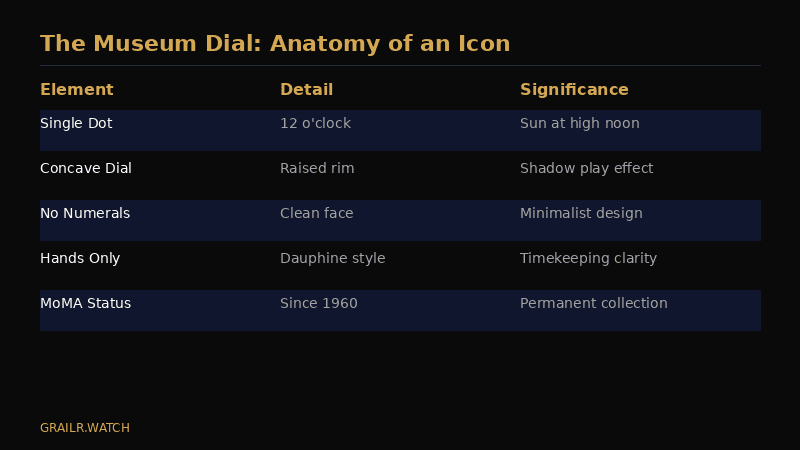
- The Museum dial — a single dot at 12 o’clock on a clean face — is one of the most recognizable designs in watchmaking
- Most models run Swiss quartz (ETA or Ronda); select automatics use the Sellita SW200 with 38-hour power reserve
- Resale retention is 20–40% — buy for the design, not as an investment
The Museum Dial: A Brief History
Movado was founded in La Chaux-de-Fonds, Switzerland, in 1881 by a nineteen-year-old watchmaker named Achille Ditesheim. The name itself — Esperanto for “always in motion” — was adopted in 1905, and the brand built a reputation for slim, elegant timepieces throughout the first half of the twentieth century. But the single design decision that defines Movado today came from outside the company entirely.
In 1947, American industrial designer Nathan George Horwitt created a watch dial with no numerals, no indices and no brand name — just a single gold dot at 12 o’clock representing the sun at high noon, set against a black field. The concept was radical: tell time by the position of the hands alone, with one reference point to orient the eye. Horwitt envisioned it as a piece of functional art, and in 1960 the Museum of Modern Art in New York added the dial to its permanent design collection — making it one of the first watch faces ever exhibited as fine art.
Movado adopted the design commercially, and the “Museum dial” became the brand’s signature. Every major Movado collection since has carried a variation of that single-dot motif, from the austere Museum Classic to the sportier SE. It is, without exaggeration, one of the most recognizable watch designs in the world — as instantly identifiable as the Rolex Cyclops or the Audemars Piguet octagonal bezel.
Today Movado is part of Movado Group Inc., a publicly traded company (NYSE: MOV) that also owns MVMT, Olivia Burton, and holds licenses for Coach, Hugo Boss and Lacoste watches. The group reported net revenue of approximately $740 million in fiscal 2025. Movado watches are assembled in Switzerland using Swiss-sourced movements, and the brand sits in what the industry calls the “accessible luxury” tier — priced above pure fashion brands like Michael Kors but below traditional Swiss watchmakers like Tissot and Longines.
Every Movado Collection Compared
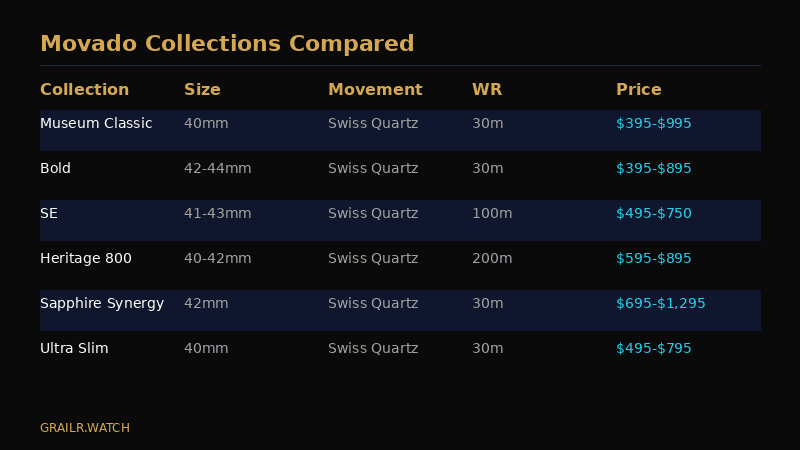
Movado’s current lineup spans six main collections, each pitched at a slightly different buyer. Here’s what separates them.
Museum Classic ($495–$995)
The flagship. The Museum Classic is Movado at its purest: the original single-dot dial on a slim stainless steel case with a leather strap or link bracelet. Men’s models come in 40mm, women’s in 28mm and 33mm. Most use Swiss quartz movements, though select references offer a Sellita SW200 automatic. Sapphire crystals are standard across the range. Cases are polished stainless steel, with PVD black and gold-tone options available. Water resistance is a modest 30 metres — enough for hand-washing, not for swimming.
Bold ($395–$895)
The modern, fashion-forward line. Bold watches run larger — 42mm to 44mm for men, 34mm to 36mm for women — and play with materials: ceramic, TR90 composite and stainless steel. The Bold Evolution 2.0, at $395, is the cheapest way into the Movado universe. Dials range from high-gloss lacquer to textured patterns, all carrying the signature single dot. Movements are Swiss quartz throughout. Mineral crystals are common at the lower end; sapphire appears on higher-priced models.
SE ($495–$750)
Movado’s sporty option. The SE adds a unidirectional rotating bezel, applied hour markers and 100-metre water resistance — making it the only Movado you could reasonably wear in a pool. Cases are 41mm in steel, and the bracelet is an integrated three-link design. The Museum dot sits on the bezel rather than the dial, giving the SE a distinctly different look from the rest of the range. Swiss quartz power.
Heritage Series 800 ($595–$895)
A dive-inspired collection that nods to Movado’s 1980s sport watches. The Series 800 has a 42mm case, a rotating bezel and 200-metre water resistance — the highest in the lineup. Luminous hands and indices make it genuinely legible in low light, and the bracelet has a diver’s extension clasp. This is the Movado for buyers who want the single-dot aesthetic with real sport-watch utility.
Sapphire Synergy ($650–$895)
The minimalist’s choice within an already minimalist brand. The Sapphire Synergy strips the dial to its barest essentials — sometimes removing even the single dot — and pairs it with a full sapphire crystal that extends to the edges of the case. Cases are slim (under 8mm) and polished to a mirror finish. Available in 42mm for men and 28mm for women. Swiss quartz throughout.
Ultra Slim ($595–$795)
Movado’s thinnest watches at approximately 6.6mm case thickness. The Ultra Slim is a dress-watch specialist: 40mm for men, 35mm for women, with sunray dials and mesh or leather straps. The ultra-thin profile makes it disappear under a shirt cuff. If the Museum Classic is the brand’s everyday face, the Ultra Slim is its formal one.
| Collection | Men’s Size | Movement | WR | Price Range |
|---|---|---|---|---|
| Museum Classic | 40mm | Quartz / SW200 | 30m | $495–$995 |
| Bold | 42–44mm | Swiss Quartz | 30m | $395–$895 |
| SE | 41mm | Swiss Quartz | 100m | $495–$750 |
| Heritage Series 800 | 42mm | Swiss Quartz | 200m | $595–$895 |
| Sapphire Synergy | 42mm | Swiss Quartz | 30m | $650–$895 |
| Ultra Slim | 40mm | Swiss Quartz | 30m | $595–$795 |
Movements and Build Quality
The vast majority of Movado watches run on Swiss quartz movements, typically sourced from ETA (a Swatch Group subsidiary) or Ronda. These are the same movement families used by Tissot, Hamilton and dozens of other Swiss brands at similar price points. Quartz means no winding, no power-reserve anxiety and accuracy within ±15 seconds per month — roughly ten times more accurate than a mechanical watch.
Select Museum Classic and Heritage references use the Sellita SW200 automatic caliber — a Swiss-made clone of the venerable ETA 2824-2. The SW200 beats at 28,800 vibrations per hour and offers approximately 38 hours of power reserve. It’s a workhorse movement found in watches costing up to $2,000 from brands like Oris, Mido and Christopher Ward, so finding it in a Movado at the $795–$995 price point represents fair mechanical value.
Build quality across the range is consistent. Cases are 316L stainless steel (the same alloy Omega and Tudor use), and PVD coatings on black and gold-tone models are durable enough for daily wear. Sapphire crystals appear on Museum Classic, Sapphire Synergy and higher-end Bold models; entry-level Bold watches use hardened mineral glass. Bracelets feature butterfly-clasp deployants on the higher collections and push-button clasps on the sportier SE and Series 800.
Where Movado falls short compared to traditional Swiss watchmakers is in the details enthusiasts notice: the movement is not decorated or visible through a display caseback, lume is limited or absent on most collections (the Heritage Series 800 is the exception), and the brand does not pursue chronometer certification. These are reasonable trade-offs for a design-led brand at this price, but they explain why watch collectors often point buyers toward Tissot, Seiko or Citizen as alternatives.
Check Any Watch Price in Seconds
Grailr scans your watch photo and pulls live pricing from Chrono24, eBay, and Jomashop.
- AI identifies brand, model & reference number
- Live market prices from 3+ sources
- Authentication confidence score

Pricing Across the Lineup
Movado’s pricing is tighter than most Swiss brands. The entire men’s lineup fits between $395 and $995, which means the most expensive Movado costs less than the cheapest Longines. This consistency is intentional: the brand targets a specific buyer — someone who wants a recognizable Swiss design at a predictable price — rather than stretching across price tiers the way some fashion brands attempt.
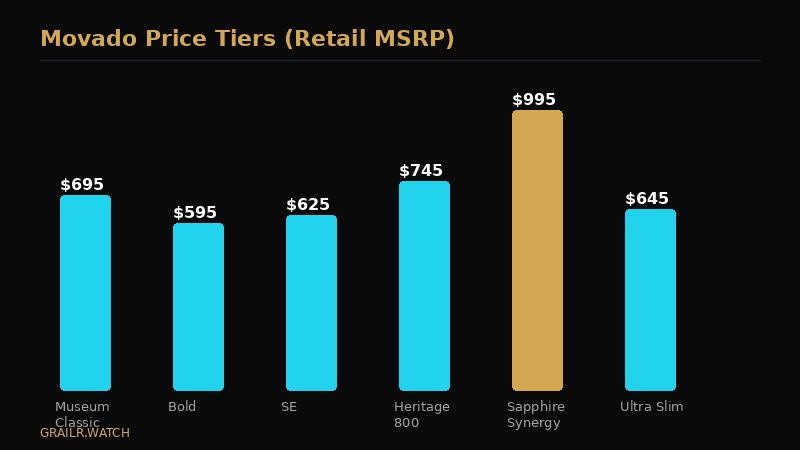
Here’s how each collection breaks down by price tier. The ranges below reflect 2026 retail at authorized dealers and Movado’s own US site; grey-market and pre-owned prices can be 30–50% lower.
Under $500: The Entry Point
Bold Evolution 2.0 ($395), SE entry models ($495), Museum Classic entry quartz ($495). At this tier you get the Museum dot aesthetic, Swiss quartz reliability and stainless steel construction. Trade-offs include mineral crystal on some Bold models and 30m water resistance.
$500–$750: The Sweet Spot
Heritage Series 800 ($595–$750), Ultra Slim ($595–$795), SE bracelet models ($650). This range adds sapphire crystals, better water resistance and diver’s clasps. The Heritage Series 800 at $595 is arguably the best value in the entire lineup: 200m water resistance, a rotating bezel and luminous hands for under $600.
$750–$995: Top of Range
Museum Classic automatic ($795–$995), Sapphire Synergy ($895), Bold with diamonds or special editions. The automatic Museum Classic with the Sellita SW200 is the horological highlight of the brand — the only Movado that watch enthusiasts tend to respect on its mechanical merits.
Men’s vs Women’s: Size and Price Differences
Movado prices women’s models identically to men’s within the same collection and material tier. The difference is sizing: women’s Museum Classic models come in 28mm and 33mm versus the men’s 40mm, women’s Bold models in 34mm and 36mm versus 42–44mm. For a detailed look at the women’s side of the range, see our dedicated Movado women’s guide.
Resale Value Reality Check
This is where honesty matters. Movado watches do not hold their value well on the secondary market. Typical resale retention falls between 20% and 40% of the original retail price, depending on the model, condition and whether box and papers are included. A $695 Museum Classic in excellent condition might fetch $200–$280 on the pre-owned market. A $395 Bold model might sell for $100–$150.
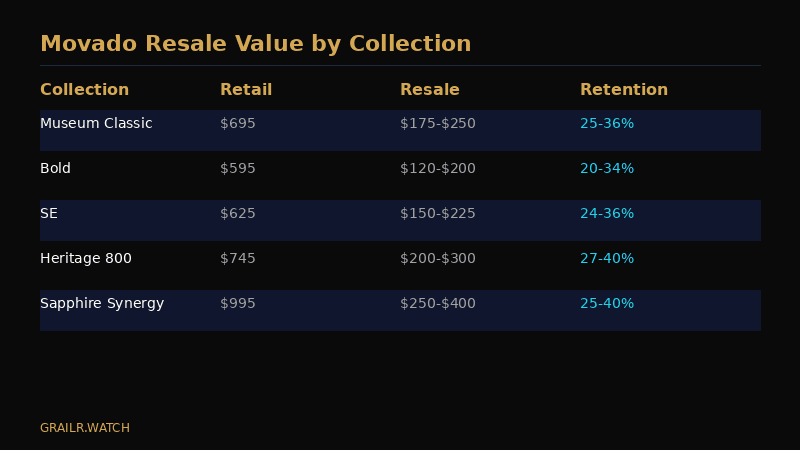
This is normal for fashion-adjacent watch brands. For comparison, Tissot retains roughly 35–50%, Seiko 30–60% (depending on the line) and Citizen 25–40%. Only true luxury brands like Rolex (85–110%) and Omega (50–75%) retain the majority of their purchase price. The resale story does not make Movado a bad purchase — it means you should buy one because you love the design and intend to wear it, not because you expect to recover your money.
| Brand | Typical Retail | Resale Retention | Category |
|---|---|---|---|
| Movado | $395–$995 | 20–40% | Accessible luxury |
| Tissot | $250–$2,500 | 35–50% | Swiss mid-range |
| Seiko | $120–$3,500 | 30–60% | Japanese mid-range |
| Citizen | $150–$1,500 | 25–40% | Japanese mid-range |
| Omega | $3,200–$10,900 | 50–75% | Swiss luxury |
| Rolex | $5,800–$82,700 | 85–110% | Swiss luxury |
Movado vs the Competition
At the $400–$1,000 price range, Movado competes with brands that offer substantially more horological substance for similar money. The question is whether that substance matters to you.
Tissot PRX Powermatic 80 ($650)
For less than a Museum Classic automatic, the Tissot PRX gives you a Swiss automatic movement with 80 hours of power reserve (double the Sellita SW200’s 38 hours), a sapphire crystal, 100m water resistance and a display caseback. The PRX has its own iconic integrated-bracelet design. The trade-off: no Museum dial.
Seiko Presage ($300–$750)
Seiko’s dress-watch line offers automatic movements with display casebacks, textured enamel and porcelain dials, and sapphire crystals — all starting at $300. The Presage Cocktail Time line has become a collector favourite. What you give up: the Seiko aesthetic is Japanese subtlety, not the Movado’s modernist minimalism.
Citizen Eco-Drive ($250–$600)
Citizen’s solar-powered Eco-Drive models never need a battery change, offer titanium cases on some models and include 200m-rated divers under $500. For buyers who prioritize function over fashion, a Citizen Eco-Drive gives you more watch for the money. But it doesn’t turn heads across a dinner table the way a Museum dial does.
The pattern is clear: at this price, competing brands deliver more horological value — longer power reserves, better water resistance, display casebacks, more complex movements. Movado’s advantage is purely aesthetic. The Museum dial is a design icon that none of these competitors can replicate, and for many buyers that is worth the premium.
Who Should Buy a Movado
Buy a Movado If…
- You love the Museum dial and want a recognizable design
- You prefer minimalist aesthetics over complications
- You want Swiss-made quality without a luxury-brand price tag
- You’re buying a gift that looks expensive without costing a fortune
Skip Movado If…
- You care about resale value or investment potential
- You want a mechanical watch with a display caseback
- You need serious water resistance (100m+ on most models)
- You prioritize horological value per dollar over design
The honest summary: Movado is a design brand that happens to make watches, not a watch brand that happens to have good design. That’s not an insult — it’s a description of where the brand invests its effort. The Museum dial is one of the most successful pieces of industrial design ever applied to a wristwatch, and it justifies a premium over purely horological competitors. Just go in knowing what you’re paying for. Use Grailr’s scanner to check current market pricing on any Movado model before you buy, especially on the pre-owned market where discounts can be steep.
Frequently Asked Questions
Are Movado watches good quality?
Movado watches use Swiss-made quartz movements (typically ETA or Ronda calibers) with sapphire crystals on most models and stainless steel cases. Build quality is solid for the $395–$995 price range, but you pay a design premium compared to brands like Seiko or Tissot that offer more horological substance at similar prices.
Do Movado watches hold their value?
Movado watches typically retain 20–40% of their retail price on the secondary market. As a fashion-adjacent brand, resale tracks closer to Michael Kors or Gucci than to Omega or Rolex. Buy a Movado because you love the design, not as a financial investment.
What is the famous dot on a Movado dial?
The single dot at 12 o’clock represents the sun at high noon. Industrial designer Nathan George Horwitt created the Museum dial in 1947, and the Museum of Modern Art in New York added it to its permanent collection in 1960. It remains Movado’s defining design element.
What movement does Movado use?
Most Movado watches use Swiss quartz movements sourced from ETA or Ronda. Select automatic models use the Sellita SW200 caliber with approximately 38 hours of power reserve. The SW200 is a respected Swiss automatic movement also found in watches from Oris, Mido and Christopher Ward.
Is Movado a luxury watch brand?
Movado sits in the accessible-luxury or premium-fashion tier. Prices range from $395 to $995 for most models, placing it below traditional Swiss luxury brands like Longines ($1,200+) or TAG Heuer ($1,500+) but above pure fashion brands. Its parent company, Movado Group, also owns MVMT and Olivia Burton.
What is the cheapest Movado watch?
The entry point is the Movado Bold Evolution 2.0 at approximately $395 for the 40mm quartz model. The Museum Classic starts around $495 for men’s models. On the pre-owned market, prices can drop 50–60% below retail for recent models in good condition.
Related Articles
The Bottom Line
Movado makes one bet: the Museum dial is worth paying for. If you agree — if a single gold dot on a clean black face makes you feel something that a Tissot PRX or Seiko Presage does not — then a Movado is a perfectly good watch at a reasonable price. The Heritage Series 800 at $595 is the strongest all-round pick, the Museum Classic automatic at $795–$995 is the enthusiast’s choice, and the Bold Evolution 2.0 at $395 is the cheapest way in. Just don’t expect to sell it for what you paid.
Considering a Movado?
Use Grailr to identify the exact reference, check current market pricing and get a suggested valuation — free, from a photo.
Scan a Watch NowSources and price context
- Movado official US watch catalogue — Current collections, specifications and retail pricing.
- ETA quartz movement specifications — Technical details on the Swiss quartz calibers used in Movado watches.
These primary sources support the specific specification and policy points noted above. Prices and resale percentages elsewhere in this guide are indicative editorial figures, not a verified transaction dataset or guaranteed returns. Confirm the exact reference, region, condition and current quote before buying; asking prices are not completed-sale prices.