Rado Watches: Every Collection and Price
Captain Cook, Centrix, True Square and DiaStar compared — with real pricing, movement specs and honest buying advice.
Price context: this guide includes indicative prices from its original publication period. They have not all been refreshed to current quotes. Use the linked primary sources for specifications and policies, and verify prices independently.

- Rado prices range from $1,300 (Centrix quartz) to $6,750 (Captain Cook High-Tech Ceramic Chronograph)
- Every automatic model uses the Caliber R763 with an 80-hour power reserve and Nivachron hairspring
- High-tech ceramic cases are roughly four times harder than steel, making Rado one of the most scratch-resistant brands at any price
- The Captain Cook 42mm diver is our top pick for most buyers — 200m water resistance, ceramic bezel and Swiss automatic under $2,500
Why Rado Deserves a Closer Look
Rado is the watchmaker most people walk past on the way to Omega or TAG Heuer — and that is exactly why it deserves your attention. A member of the Swatch Group since 1983, Rado has spent six decades perfecting high-tech ceramic cases at a time when most Swiss brands were still working in steel. The result is a lineup of watches priced between $1,300 and $6,750 that feel, wear, and resist scratches like pieces costing two or three times as much.
The story starts in 1962 with the DiaStar Original, the first scratch-resistant watch ever made. Rado fused a tungsten-carbide case with a hardmetal bezel that could shrug off daily wear, and the design has been in continuous production for over sixty years. That obsession with materials — ceramic, plasma, Ceramos, and diamond-like coatings — still defines the brand today.
Within the Swatch Group hierarchy, Rado sits in the upper tier alongside Longines, above Hamilton and Tissot. It shares access to ETA movements — the same supplier that powers much of the Swiss mid-range — but wraps them in cases that no one else at this price point can match for hardness and finish. If you want a Swiss automatic with a ceramic case and 80-hour power reserve under $3,000, Rado is essentially your only option.
Captain Cook Collection
Named after a 1962 original released the same year as the DiaStar, the modern Captain Cook is Rado’s dive watch and the collection that draws the most attention from enthusiasts. The standard model is a 42mm steel diver with a ceramic bezel insert, sapphire crystal, and 200 metres of water resistance. It runs the Caliber R763, based on the proven ETA C07.611, with a Nivachron hairspring and an 80-hour power reserve.
What sets the Captain Cook apart from every other sub-$3,000 diver is the High-Tech Ceramic variant. Rado fires the entire case, bezel, and bracelet from ceramic, producing a watch that weighs noticeably less than steel and shrugs off scratches that would ruin a Seiko or Orient in weeks. The ceramic chronograph version tops the range at around $6,750 and adds a 60-minute counter with a column-wheel movement.
Every Captain Cook, whether steel or ceramic, shares the same dial language: applied indices, a date window at three o’clock, and luminous hands with Super-LumiNova. The steel models come on a three-link bracelet or NATO strap; the ceramic versions pair with a ceramic bracelet that sits flush with the case.
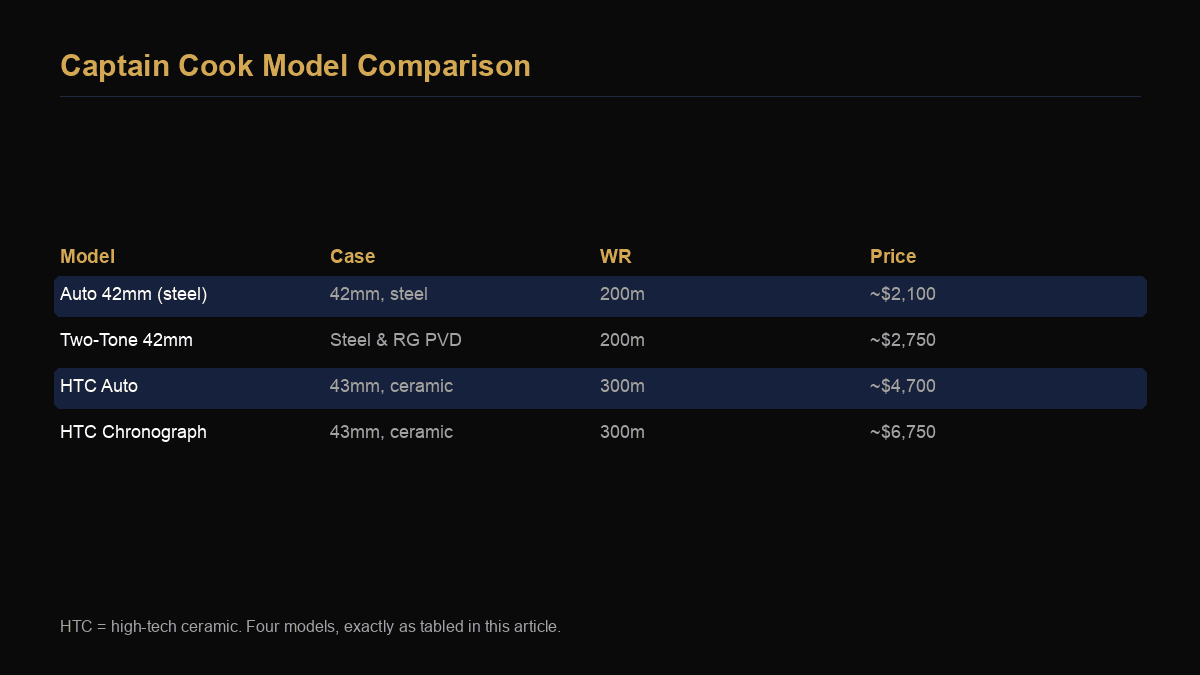
| Model | Case | WR | Price |
|---|---|---|---|
| Captain Cook Auto 42mm (steel) | 42mm, steel | 200m | ~$2,100 |
| Captain Cook Two-Tone 42mm | 42mm, steel & rose-gold PVD | 200m | ~$2,750 |
| Captain Cook HTC Auto | 43mm, high-tech ceramic | 300m | ~$4,700 |
| Captain Cook HTC Chronograph | 43mm, high-tech ceramic | 300m | ~$6,750 |
Centrix Collection
If the Captain Cook is the watch you wear diving, the Centrix is the one you wear to dinner. It is Rado’s dress line: slim, polished, and built around the brand’s signature ceramic-and-steel construction. The integrated bracelet tapers smoothly from case to clasp, and the ceramic centre links give the watch a two-tone look without any precious metal.
Entry into the Centrix starts at roughly $1,300 for a quartz model, making it the most affordable door into the Rado brand. Step up to the automatic and you get the same Caliber R763 with 80-hour power reserve found across the range. The “Open Heart” variant adds a dial cutout at 12 o’clock that reveals the balance wheel — a feature normally reserved for watches above $5,000.
At the top of the Centrix line sit the Diamonds versions, which set factory stones around the bezel or on the dial indices. These reach up to $5,360 for the 35mm diamond-set automatic. The stones are modest — no one will mistake a Centrix for a Cartier — but they add a dressy sparkle that photographs well and holds up under daily wear thanks to the ceramic case surround.
True Square and True Thinline
The True collection is where Rado showcases what ceramic can do when freed from round cases. The True Square uses a cushion-shaped monobloc ceramic case that is milled from a single block of material — no separate bezel, no gasket between case and crystal. The open-heart and skeleton dials let you see the Caliber R808 automatic movement turning inside what is effectively a ceramic sculpture.
Prices for the True Square automatic start at around $1,800 and climb to roughly $3,800 for the skeleton versions with exhibition casebacks. The True Thinline takes the same material philosophy but flattens it: cases as thin as 5mm on the wrist, making them some of the slimmest ceramic watches available anywhere.
Both lines are available in standard high-tech ceramic (black or white) and Rado’s proprietary Plasma Ceramic, which gives the watch a metallic, gunmetal-grey finish without any metal content. The plasma treatment changes only the surface colour, not the scratch resistance — the case is still rated at roughly 1,250 Vickers.
DiaStar Original
The DiaStar is where it all started. Launched in 1962 as the world’s first scratch-resistant watch, the original used a tungsten-carbide case with a hardmetal bezel — a radically different approach from the steel-and-gold norm of the era. The modern DiaStar Original retains the same oval case shape and faceted crystal but updates the materials: a Ceramos bezel (a ceramic-metal composite unique to Rado) and a high-tech ceramic caseback.
Inside, the DiaStar runs an automatic movement with an 80-hour power reserve. Pricing sits between $1,550 and $2,200 depending on the dial and bracelet configuration. The gold-tone dial on a Ceramos bracelet is the most popular variant and the one closest to the 1962 original’s look.
The DiaStar is a polarising design — its retro-futurist shape and metallic finish are not for everyone. But for collectors who appreciate watchmaking firsts, it is a genuine piece of horological history at a price that would barely cover a mid-tier Seiko Presage. It is also one of the few modern watches that can claim a continuous production lineage of more than sixty years.
Check Any Watch Price in Seconds
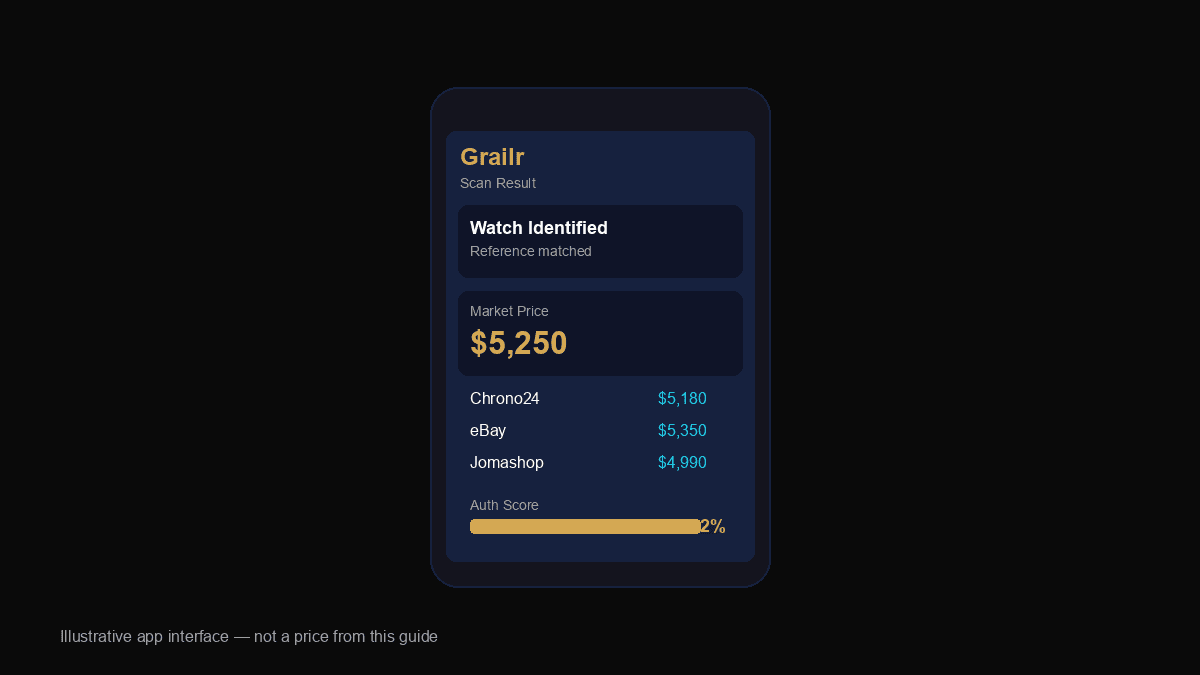
Grailr scans your watch photo and pulls live pricing from Chrono24, eBay, and Jomashop.
- AI identifies brand, model & reference number
- Live market prices from 3+ sources
- Authentication confidence score
Rado Materials Explained
Rado calls itself the “Master of Materials,” and the claim is not empty marketing. The brand works with five distinct case materials, each with different properties. Understanding them is the key to choosing the right Rado for your wrist and your lifestyle.
High-Tech Ceramic
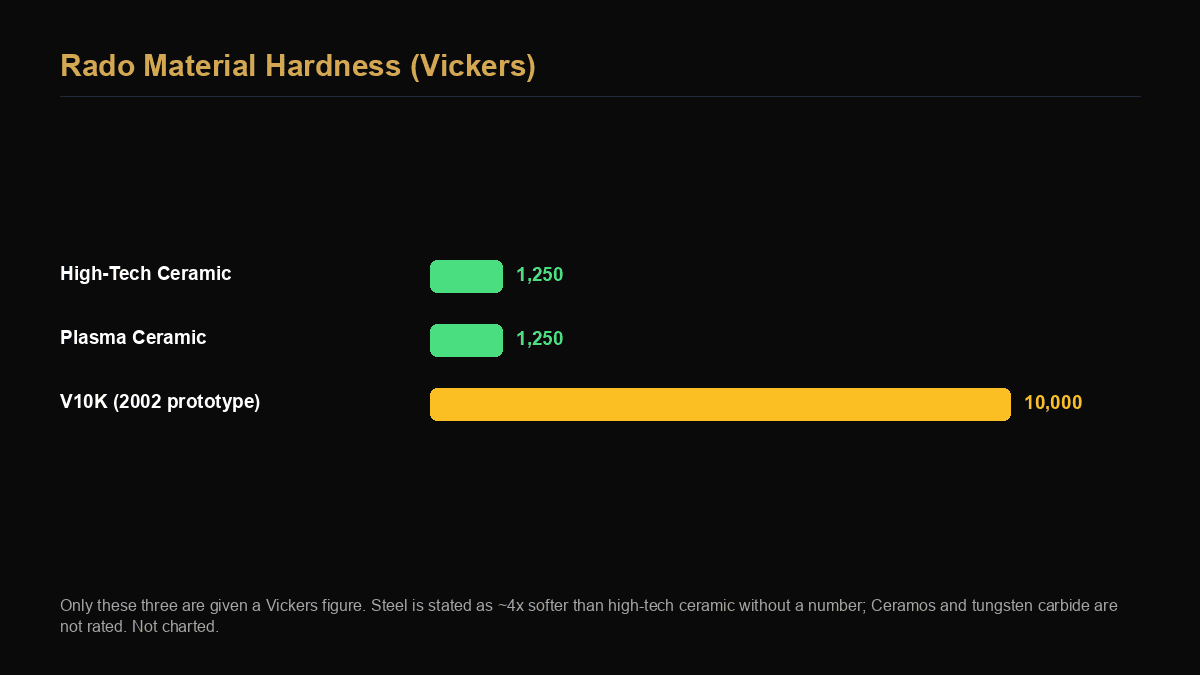
Sintered zirconium oxide, rated at roughly 1,250 Vickers. That is about four times harder than 316L stainless steel and nearly as hard as sapphire. It is the material used across the Captain Cook HTC, True Square, and Centrix ceramic models. Available in black, white, and green.
Plasma Ceramic
Standard high-tech ceramic treated in a gas furnace to produce a metallic grey finish. The process alters only the surface colour — hardness and scratch resistance remain identical to standard ceramic. Found on select True and True Thinline models.
Ceramos
A ceramic-metal composite unique to Rado, used primarily for bezels and bracelet links on the DiaStar Original. It blends the lightness of ceramic with a metallic lustre that ages more gracefully than plain ceramic.
Tungsten Carbide (Hardmetal)
The original 1962 DiaStar material. Extremely hard and heavy, with a density close to gold. Still used on the DiaStar Original case body. It gives the watch a satisfying heft that ceramic cannot replicate.
One material Rado does not use at this price is sapphire for cases. In 2002 the brand demonstrated a prototype called the V10K with a case rated at 10,000 Vickers on the hardness scale — effectively diamond-hard — but the cost of production has kept it out of the regular catalogue. Every current Rado does, however, use sapphire crystal for the glass.
How Rado Holds Value
Let’s be direct: Rado is not a brand you buy for resale value. Like most Swatch Group watches below the Omega tier, a new Rado typically loses 40–50% of its retail price the moment you walk out of the store. A Captain Cook purchased for $2,100 might sell for $1,000–$1,200 on the secondary market after a year of wear. A Centrix quartz fares worse, often trading below $700.
But context matters. The absolute dollar loss on a $2,100 Rado is smaller than the percentage loss on a $5,000 TAG Heuer or a $9,000 Rolex Oyster Perpetual. If you wear the watch daily for five years, the cost of ownership is a few hundred dollars per year — roughly the same as a pair of decent sneakers. And unlike sneakers, the Rado will look the same on day 1,825 as it did on day one, because the ceramic case does not scratch.
The exception to the depreciation rule is the DiaStar Original. Vintage examples from the 1960s and 1970s with intact hardmetal cases now sell for $500–$1,500 on eBay, which is remarkable for a brand that was never positioned as a collector’s piece. If you scan a vintage DiaStar with Grailr, you may be surprised by the current market asking prices.
How to Buy a Rado
Rado does not have a waitlist problem. Every model in the current catalogue is available to walk-in customers at authorised dealers, and there is no allocation game to navigate. Here is where to shop:
Authorized Dealers and Swatch Group Boutiques
Full international warranty (typically two years, extendable to three with registration), access to the latest references, and the ability to try the watch on before buying. No discount, but no risk. Use the Grailr identifier to confirm the reference before you leave the store.
Grey-Market and Online Retailers
Sites like Jomashop and WatchMaxx routinely discount Rado by 20–30%. The trade-off is a store warranty instead of the factory one. For a $2,100 Captain Cook, that 20% saving is roughly $420 — meaningful at this price point. Just verify the reference number and condition with a quick Grailr scan.
Pre-Owned Market
Because ceramic does not scratch, a three-year-old Rado can look brand new. Secondary-market platforms like Chrono24 and eBay list Captain Cook divers in the $1,000–$1,500 range. Confirm the model and current market value through Grailr before committing.
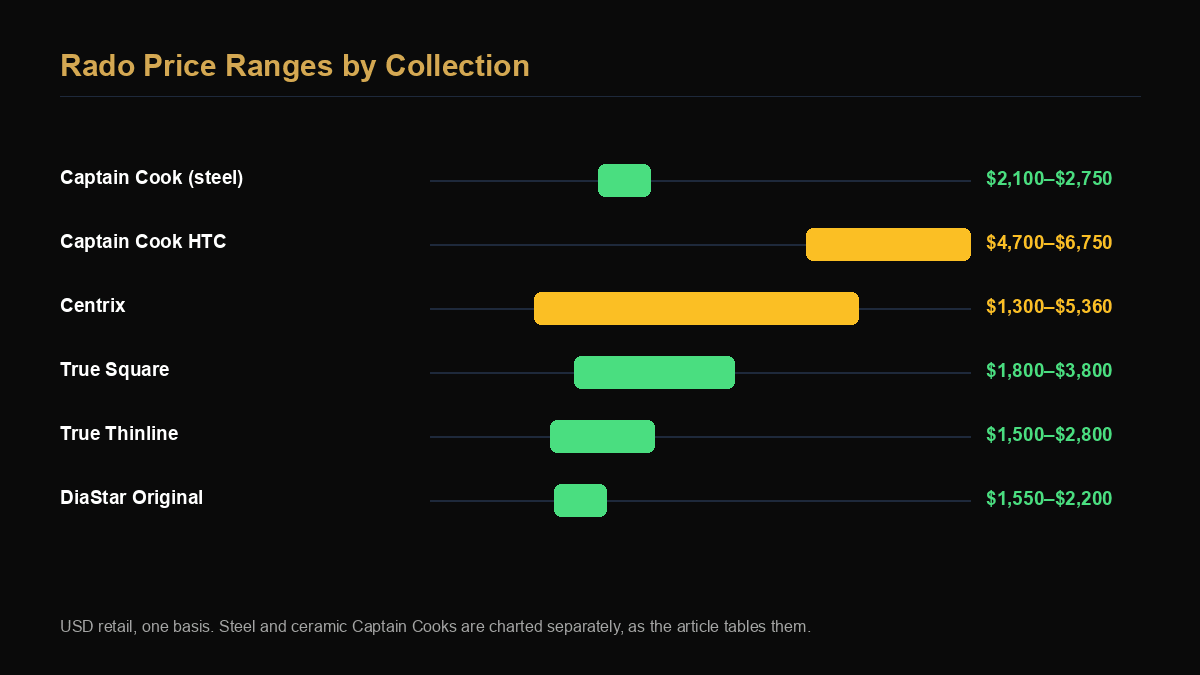
Full Collection Comparison
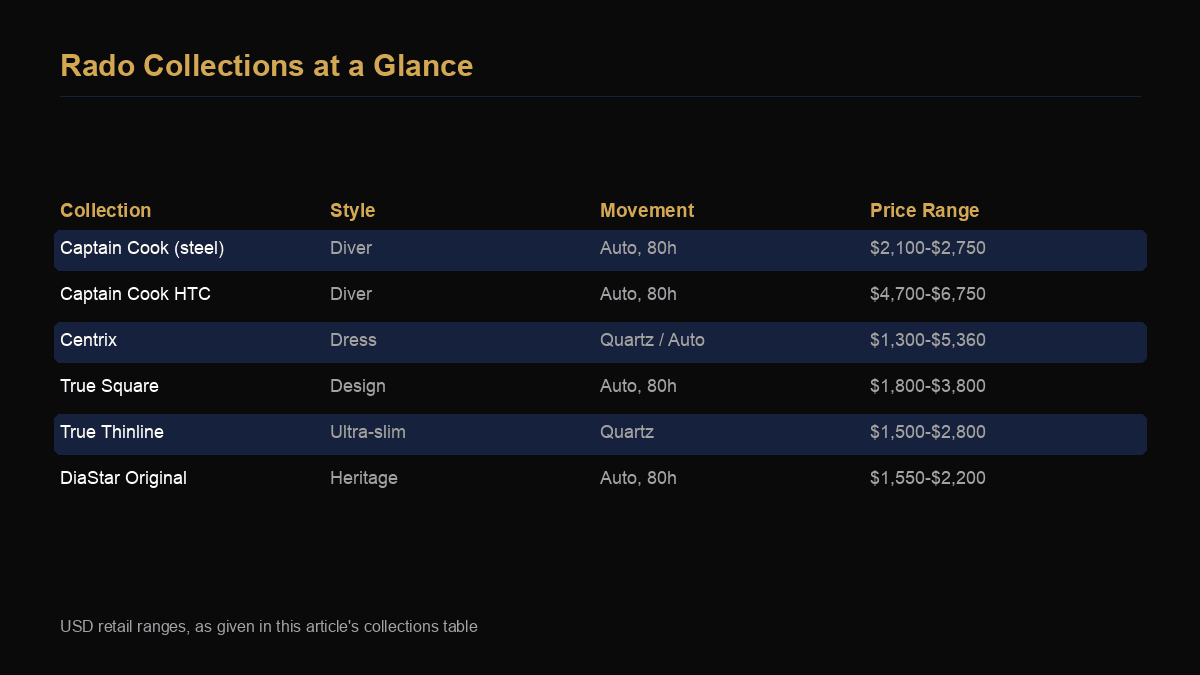
| Collection | Type | Case Material | Movement | Price Range |
|---|---|---|---|---|
| Captain Cook (steel) | Diver | Steel + ceramic bezel | Auto, 80h | $2,100–$2,750 |
| Captain Cook HTC | Diver | High-tech ceramic | Auto, 80h | $4,700–$6,750 |
| Centrix | Dress | Ceramic & steel | Quartz / Auto | $1,300–$5,360 |
| True Square | Design | Monobloc ceramic | Auto, 80h | $1,800–$3,800 |
| True Thinline | Ultra-slim | High-tech ceramic | Quartz | $1,500–$2,800 |
| DiaStar Original | Heritage | Tungsten carbide + Ceramos | Auto, 80h | $1,550–$2,200 |
Frequently Asked Questions
Is Rado a luxury watch brand?
Rado sits in the upper tier of the Swatch Group portfolio alongside Longines. It is classified as luxury by the Federation of the Swiss Watch Industry, but its prices ($1,300–$6,750) place it below Omega and well below Rolex.
What makes Rado ceramic watches scratch-resistant?
Rado’s high-tech ceramic is sintered zirconium oxide, rated at roughly 1,250 Vickers on the hardness scale. That is about four times harder than stainless steel, so the case resists everyday scratches that would mark a steel watch within weeks.
What is the cheapest Rado watch?
The most affordable current Rado is the Centrix quartz at around $1,300. If you want an automatic, the DiaStar Original starts at approximately $1,550 and the Captain Cook steel diver begins at roughly $2,100.
Do Rado watches hold their value?
Rado watches typically lose 40–50% on the secondary market, similar to most Swatch Group brands below Omega. The upside is that the entry price is modest, so the absolute loss in dollars is smaller than with higher-priced Swiss brands.
Which Rado collection is best for diving?
The Captain Cook is Rado’s dive line. The standard 42mm steel model is rated to 200 metres, while the High-Tech Ceramic versions are rated to 300 metres. Both use a unidirectional rotating bezel and the Caliber R763 with 80-hour power reserve.
Where should I buy a Rado watch?
Authorized dealers and Swatch Group boutiques offer the full warranty. Grey-market retailers like Jomashop often discount Rado by 20–30% but provide a store warranty instead of the factory one. Pre-owned ceramic models can look brand new because the cases do not scratch.
Related Articles
The Bottom Line
Rado is the brand that proves you do not need to spend $5,000 to get a genuinely innovative Swiss watch. The Captain Cook diver gives you an 80-hour automatic in a scratch-proof ceramic case for the price of a fashion watch, and the DiaStar Original connects you to one of the most important material breakthroughs in watchmaking history. Do not buy a Rado expecting to flip it for a profit — buy one because you want a watch that will look new in ten years, and enjoy the savings compared to the brands chasing the same materials at higher price points.
Thinking About a Rado?
Grailr uses a photo to suggest a watch identity and an indicative price estimate, with active eBay listings where available. Check the exact reference and condition independently; a photo scan cannot authenticate a watch.
Scan a Watch NowSources and price context
- Rado Captain Cook collection page — Official specifications, movement details and current-reference gallery for the Captain Cook line.
- Swatch Group brand portfolio — Confirms Rado’s positioning within the Swatch Group hierarchy alongside Longines and Hamilton.
These primary sources support the specific specification and positioning points noted above. Prices elsewhere in this guide are indicative editorial figures gathered from authorized retailers and secondary-market listings, not a verified transaction dataset. Confirm the exact reference, region, condition and current quote before buying; asking prices are not completed-sale prices.